Tag: Word of God

  • A Fragrant Aroma: Monday of Holy Week

    John 12:1-8

    Awhile after my father died, my mother asked if I would help her sort out his things. As I took some clothes out of his dresser it struck me; they still smelled like him. It was as if my father was right there. It took me several minutes to regain my composure.

    Scientists have known for years that the sense of smell is intimately tied to memory and emotion. In fact, smell is the only sense that works directly with the area of the brain that controls emotions. We’ve all experienced it; no matter how far away or far removed we are from a certain time, the aroma of something – perhaps a certain food, a perfume – can bring it all back again. It is if we are there.

    In the gospel we see how one of the sisters of Lazarus gave to their home a sense memory of our Lord: Mary took a liter of costly perfumed oil made from genuine aromatic nard and anointed the feet of Jesus and dried them with her hair; the house was filled with the fragrance of the oil (John 12:3).

    This is significant on many levels. First, it is the perfect counterbalance to the family’s recent experience at the tomb of Lazarus; the foul air of death is literally blown away by the fragrance of new life found in Christ. But second, this perfume is costly; the price of victory is high. As if she senses that his enemies are as near as Judas and plotting his demise, Mary anoints not the head of Christ the King but the feet of Christ the Servant which shall soon be pierced with nails and placed in a tomb. Finally, it may seem odd that Mary wipes away some of the perfume with her hair but I see in it a sign of her devotion; a way to identify herself with Christ and his sacrifice, personifying St. Paul’s meaning in 2 Corinthians when he said, we are a fragrance of Christ to God among those who are being saved and among those who are perishing (2 Corinthians 2:15).

    glass-4108085_640There is an ancient rabbinic saying that “the fragrance of a good perfume spreads from the bedroom to the dining room; so does a good name spread from one end of the world to the other.”1 As Mary filled her house and her hair with the fragrance of Christ, so may we fill the world and ourselves with his holy and glorious Name. And may be as untiring and devoted as she, willing to sacrifice whatever is costly to ourselves to do it. There is no greater identification with Christ than this, as St. Paul knew when he prayed that we may be imitators of God, as beloved children; and walk in love, just as Christ also loved you and gave Himself up for us, an offering and a sacrifice to God as a fragrant aroma (Ephesians 5:1-2).

    1Based on Ecclesiastes 7:1 and cited in Brown, R.E. (1966) The Anchor Bible: The Gospel According to John I-XII. New York: Doubleday & Company, Inc., p. 453.

  • The True Cornerstone: Memorial of St. Patrick, Bishop

    August 15th, the Feast of the Assumption, fell on a Sunday in the year 1858; that afternoon, a 22 year-old Irish immigrant named Cormack McCall1 may well have watched as a stone that he had cut with his own hands was blessed as the cornerstone of the new St. Patrick’s Cathedral by New York City’s Archbishop John Hughes. Around Hughes stood seven bishops, 130 priests, and 100 choirboys. The crowd was estimated at 100,000 people or more; New York’s entire fleet of streetcars had been diverted to the area just to accommodate them.

    It is an oddity in keeping with St. Patrick that to this day no one knows exactly where the cathedral’s cornerstone is or when it went missing.2 It has sunk into obscurity like the details of the life of the great saint himself. Nevertheless, St. Patrick’s impact on the faith is every bit as real and foundational as the cathedral’s mysterious cornerstone.

    Patrick was similar in a few ways to Israel’s son Joseph, whose life story closes the book of Genesis. Both became slaves in their youth, both were bright and resourceful men of dreams, and both used their gifts not just to endure their captivity but to be victorious over it.

    Of course, there were differences. Unlike Joseph, Patrick was not raised by parents with a strong and vibrant faith; nevertheless, during his captivity he found that his faith was strengthened. Moreover, although both were men of dreams, Patrick focused on one particular vision from his youth and was determined to see it come to fruition. While a slave he had a vision of Irish children reaching out for him and resolved that should he escape he would return and convert the pagan Irish to Christianity. In fact, he did escape and reunite with his family in Britain for awhile; however, Patrick never lost sight of that vision from his youth. Around the year 431, after being ordained in France, Patrick was sent to Ireland as its bishop by Pope Celestine I.

    At first, Bishop Patrick began by supporting the small band of Christians already on the island but was soon evangelizing far and wide, preaching, writing and baptizing countless people. It is ironic that Patrick was so self-conscious of his lack of formal education for as an evangelizer he was brilliant. He understood that the truth of Christ transcends culture, that certain symbols or practices of the pagan people could be imbued with Christian meaning. For example, an ancient pagan image of two crossed lines and a circle was reinterpreted by Patrick as the Cross of Christ with the circle symbolizing the eternity of God. We know it as the Celtic Cross to this day.

    Over the course his years a missionary bishop to Ireland, Patrick truly was a cornerstone of the Irish Church. He installed and supported church officials, created councils, founded monasteries and organized Ireland into dioceses. He died around the year 461 and was buried in the land that he first came to as a slave and to which he returned, faithful to his promise to the end.

    ireland-2184916_640The psalmist must have had Joseph in mind as he sang, they had weighed him down with fetters, and he was bound with chains till his prediction came to pass and the word of the LORD proved him true (Psalm 105:18-19) but it applies to St. Patrick as well. In a larger sense it applies to all of us, for to one degree or another we are all weighed down with the fetters of sin. Many are bound with the additional chains of addiction or illness, either our own or someone we love. Perhaps we have not been given visions or dreams like Joseph or Patrick, but we have been given the vision of Christ, the Eternal Word who proved himself true to the greatest promise ever given mankind: That every fetter would be lifted, every chain broken, every tear wiped away for all those who cling to him as their salvation. As much as they did, as faithful as they were, both Joseph and Patrick humbly bend their knee and fade into the background like an old cathedral cornerstone before the Stone rejected by the builders, the one true Cornerstone who is Christ.

    St. Patrick, pray for us.

  • The Outsiders: Tuesday of the Sixth Week in Ordinary Time

    James 1:12-18; Mark 8:14-21

    We may as well answer the question Jesus asked the disciples at the end of the gospel passage: Do you still not understand (Mark 8:21)? No, they do not understand at all. The question is, why? So far in Mark’s gospel they have heard him teach, seen him heal, witness him expelling demons, raising a girl from the dead, and feeding thousands with a few loaves. Who or what kept them from seeing him as the Christ? And more to the point, who or what does the same thing to us?

    It certainly isn’t God. As the first reading reminds us, God tempts no one (James 1:15). Here, James echoes the ancient truth revealed through the prophet Habakkuk that God cannot even look upon evil (Habakkuk 1:13). Rather, the reading goes on to say, evil comes from within each person who is lured and enticed by his desire (James 1:14). Let us briefly consider three different kinds of enticement.

    First, we entice ourselves to sin by failing to guard against temptation. Just as a person struggling with alcoholism would be foolish to hang around liquor stores so anyone who struggles with a certain sin is foolish to put themselves in situations where they are tempted to it. This is called the near occasion of evil and is what we promise to avoid every time we say the Act of Contrition.

    Second, we entice others to sin by becoming an occasion of evil ourselves. Some do this by dressing immodestly, others by gossiping. We rationalize such behavior in true Adam-and-Eve fashion by blaming the victims – “They shouldn’t look at me that way,” or “I only told the truth” – but deep down we know that we are far from innocent.

    Finally, we are enticed to sin by the dark angels whose master goes by many names: the father of lies (John 8:44), the tempter (Matthew 4:3), the devil (Matthew 4:1). By whatever name he sows confusion, preys on our weakness, encourages selfishness. The wise listen to Christ who urges us to fear the demons for they can destroy us body and soul (Matthew 10:28); the prudent avoid them, and the persevering cling to God with the assurance of St. Paul that no one and nothing can ever separate us from the love of God that is in Christ Jesus (Romans 8:38-39).

    Earlier in Mark, Jesus defined two kinds of people. The “insiders,” or those to whom the mysteries of the Kingdom had been revealed; and the “outsiders,” who did not. Of the outsiders he said, they may look and see but not perceive, and hear and listen but not understand, in order that they may not be converted and be forgiven (Mark 4:12). The irony is that the disciples, who should be the definitive insiders, act more like outsiders than the real outsiders! For example in today’s gospel the disciples, who just witnessed Jesus feeding four thousand people now have the chance to share a quiet boat ride with him. What a shame that this perfect opportunity to unpack all they have seen is wasted on worrying about how little bread they brought along!

    fishing boat and feetStill, Mark’s purpose is not to make us wonder at their behavior but to evaluate our own. Are we insiders or outsiders? Some of us witness Christ feeding a multitude every day, and every day share time with him in the Church, the barque of Peter. Are we focused on our own loaf of bread – be it the next place we have to go, the people we have to see, or things we have to do – or on the Living Bread that is Christ? We see the many wonderful people he gives us – our families, friends, each other; do perceive Christ living within them? We hear his word in the Scriptures; do we understand his voice speaking through all those crying for help? At the Mass he gives us himself Body, Blood, Soul, and Divinity in the Holy Eucharist; are our hearts hardened or are they being converted through the forgiveness of sins in Confession, that we may partake most fully in the infinite grace he offers?
    We conclude where we began, in the letter of James. Consider how the passage begins: Blessed is he who perseveres in temptation, for when he has been proven he will receive the crown of life that he promised to those who love him (James 1:12). Let us pray for perseverance, that gift of the Holy Spirit that empowers us to remain in the state of grace until the end of our lives; may we like the Saints see and perceive, hear and understand, that our hearts be converted, our many sins forgiven, and our focus on the things above.

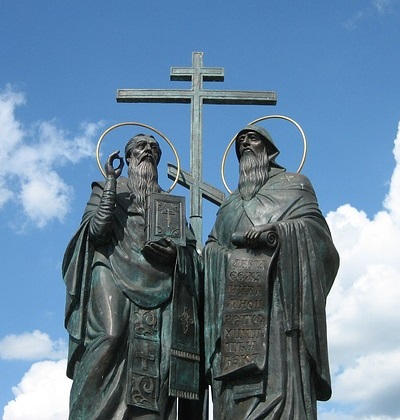
  • Heart Speaks to Heart: Sts. Basil the Great and Gregory Nazianzen

    1 John 2:22-28; John 1:19-28

    The first reading begins, Beloved: Who is the liar? Whoever denies that Jesus is the Christ. John seems to be thinking of someone in particular who had strayed from the truth about Christ. This was not uncommon; the early Church was plagued with heretics whose theories about Jesus ran the gamut, from the Ebionites who believed that Jesus was not divine at all, to the Docetists who believed that Jesus was only divine and merely pretended to be human for our sake.

    In the 4th century, one particular heresy took center stage. It was popularized by a priest named Arius, who used Scripture to teach that Jesus, although as close to divine as a human being could be, wasn’t actually divine; he was a creature and therefore less than God. The heresy was appealing; it made sense to people who couldn’t understand how God could die on a cross. Throughout the Christian world, Arianism spread like wildfire.

    At the same time, God was raising up a river to put that fire out. It came in the form of the two men we remember today, Basil and Gregory. Basil was born in what is now central Turkey in the year 330 AD; Gregory was born in the same area nine years later. Both left their native land to go to Athens where, as Gregory would later write,

    We had come, like streams of a river, from the same source in our native land… and were now united… as if by plan, for God so arranged it.

    Indeed, God arranged not just friendship; Basil and Gregory became soulmates. Blessed John Henry Newman used the phrase, cor ad cor loquitur – heart speaks to heart – and that describes these two men. Gregory further wrote

    When, in the course of time, we acknowledged our friendship and recognized that our ambition was a life of true wisdom, we became everything to each other: we shared the same lodging, the same table, the same desires, the same goal. Our love for each other grew daily warmer and deeper… We seemed to be two bodies with a single spirit.

    What united them was their common love of Christ. In the gospel the priests, Levites, and Pharisees also had ambitions; ironically, although Wisdom Himself had dawned upon the world and was so near them, they lived in the darkness of self-absorption and wished only to see that He satisfied their requirements. Unlike them, Basil and Gregory took to heart John’s words when he said, let what you heard from the beginning remain in you. From childhood they were taught the truth about Christ and sought to ensure that they satisfied His requirements. They asked questions of the faith only to see where their own understanding was darkened and prayed that Christ would shed His light upon them.

    United in this purpose, both men poured themselves into their studies and infused their knowledge with the grace of ordination. Gifted by God as powerful writers, orators, theologians, and shepherds, they fearlessly and eloquently defended the Church against Arius and all who opposed the truth that Father, Son, and Holy Spirit are a perfect Unity. As Patriarch of Constantinople, Gregory presided over the Council of Constantinople in 381, which completed the Nicene creed that we recite every Sunday. Not only that, both men wrote masterpieces of theology that are studied and used to this day.

    statue-2171097_640Saints Basil and Gregory can teach us many things, but today we focus on two. First, they teach us that faith in God requires true humility. Heresies are born from the pride that sees ourselves as the measure of all things; that interprets our failure to understand the truths of the faith to mean that the truths are wrong. True humility is as John admonished us, to remain in him; to see that God is the measure of all things and that our inability to understand means that we still have work to do. Second, in these days when the word “love” is so easily limited to physical expressions of self-gratification, the love of Basil and Gregory is a shining example of the most uplifting, life-giving love possible between people. This is the love that is modeled on God; that seeks only the good of the other; that finds its union with others in the heart and soul because that is where God dwells, and God is love. This is the love where heart speaks to heart and says, “I want for you what God wants for you.” My prayer is that all of us come to have that love for one another. What a world this would be.

    Saints Basil and Gregory, pray for us.

  • Living Stones: The Feast of the Holy Family

    Sirach 3:2-6, 12-14; Colossians 3:12-17; Matthew 2:13-15,19-23

    Recently on Catholic radio I heard of a church called the basilica of the Holy Family. It stands in downtown Barcelona and, from the images I’ve seen, is as breathtaking as it is hard to describe. I urge you to look up the pictures and videos online and see this majestic, cavernous, awe-inspiring structure for yourself.

    There isn’t time to talk about the brilliant architects, artists, and builders who have contributed their time and energy to the project but a couple of events deserve mention. In 2010, Pope Benedict XVI consecrated the basilica and in 2015 it was proclaimed nearly complete. What makes these events noteworthy? Three things: First, the planned completion date is 2026; second, the permit to begin construction wasn’t granted until 2019; and third, the building permit was applied for in 1885.

    That’s right, 1885. Actually, ground was broken on the feast of St. Joseph, March 19 1882 and construction has continued – off and on – since then. No one planned for Holy Family to take that long. Various things have gotten in the way – like the Spanish Civil War. Needless to say, the basilica is a work in progress.

    This is important to remember because it says a few things that touch on the idea of family and its holiness.

    First, good things can be a long time in the making. Holy Family basilica has taken over 130 years already and its scheduled completion date may come and go. Clearly, hitting the date is not the priority; the priority is that things are done well. The same is true for the holiness of the family. Parents are charged with the responsibility of seeing that their children grow in holiness; to do that well they must be holy themselves. Pope St. John Paul II called his childhood home his first seminary. His father was not afraid to pray in front of his children or to live a life in service of God and his neighbor; he did so every day. Obviously this is a long, slow process, but like Holy Family basilica a holy family is built bit by bit, stone by stone, day after day.

    Second, things don’t always go according to plan. As the history of Holy Family basilica shows, we make plans but life happens. Few knew this better than St. Joseph. He had plans: Wed Mary of Nazareth, have a family, and work to provide for them. As he came to learn, God had another plan: Be father of the Holy Family. Think of the tremendous responsibility this laid on his shoulders: The very life of the Savior, the Son of the Most High, was in his hands. God was depending on him to keep that child safe from people like Herod. Although fathers and mothers of our own holy families do not have exactly this same responsibility, theirs is still an awesome task. God lays on their shoulders the task of properly raising their children, of keeping them safe from whatever life throws at them and teaching them as Joseph and Mary taught our Lord in his human nature how to get along in the world, what is important and what isn’t, what it means to be married, what happiness is and how and where it is found. As every parent knows, this makes building a basilica seem easy by comparison! But the blueprint for such holiness exists; St. Paul gives it when he urges us to put on heartfelt compassion, kindness, humility, gentleness, and patience, bearing with one another and forgiving one another (Colossians 3:12-13).

    gaudi-2419961_640Finally, the basilica of the Holy Family teaches us that joy is not necessarily the destination but the journey. Every year, millions of people take the time to tour the basilica of the Holy Family in Barcelona. Whether they are watching as the builders add to its structure, marveling as artisans craft the artwork that adorns it, or attending the Masses offered there, the faithful are uplifted and sanctified even though the basilica is a work in progress. The same is true for our families, for they too are works in progress. Every day brings the happiness and sorrow, the cataclysms and quiet moments through which families progress either closer to God or further away from him. Let us pray that our families take every moment of life and find the joy in it; for each moment, whatever it holds, is an opportunity given to us by Almighty God to build up our own domestic Church in virtue, crafting ourselves more and more into what we are called to be – living stones built upon the cornerstone that is Christ.
  • Our Mother, Clothed With the Sun: Feast of Our Lady of Guadalupe

    Revelation 11:19a; 12:1-6a, 10ab; Luke 1:39-47

    The book of Revelation is apocalyptic literature. This was a genre used in and around the time of Christ. It is overloaded with rich and mystical symbolism; a single image may represent multiple things. Further, the imagery can be violent and warlike, even though its ultimate message is one of hope and peace.

    In the passage of Revelation chosen for today’s feast lurks a huge red dragon. The Hebrew word translated as dragon can also mean “serpent” or “sea monster” and is thought to represent the devil and the forces of evil, ready to make war against the Christ and his Church.

    In late 15th century Mexico, the Spanish conquistador Cortez saw echoes of that dragon in the violent, warlike Aztec religion. Every year, thousands of people were sacrificed to appease its bloodthirsty gods. In 1487, the dedication of a new pagan temple saw 80,000 people sacrificed in just a few days. As if that weren’t bad enough, the dragon’s shadow also appeared in some of the immigrants to the new world, who spoke of peace but practiced avarice, treating the Mexicans and their land as things to be exploited for personal gain. Even some within the Church hindered the spread of the gospel by refusing vocations from the local community; Catholic Mexicans were not allowed to minister to their own people. It’s not hard to understand why many resisted converting to Catholicism.

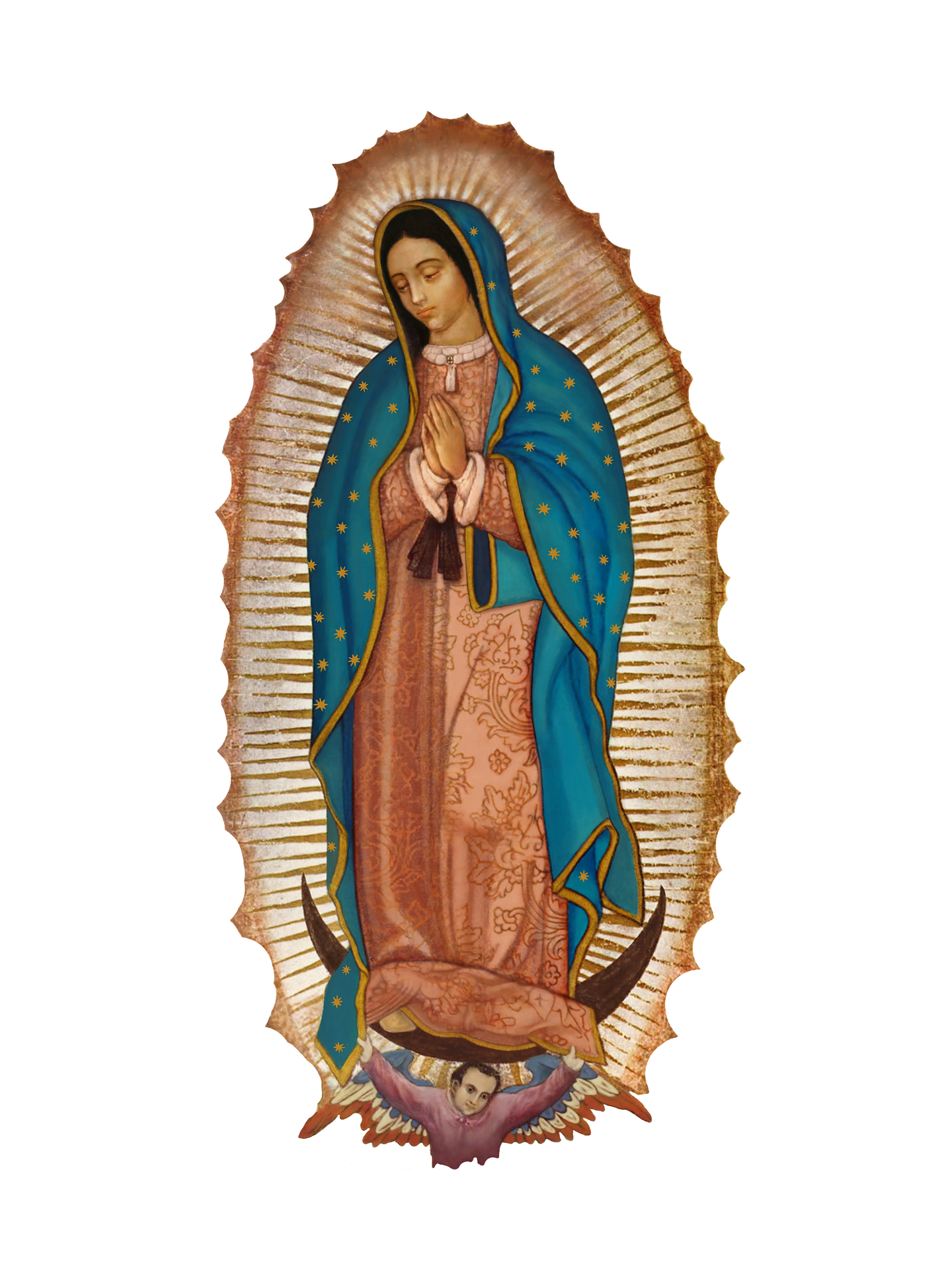
    If a reflection of the dragon could be found in the new world, so could a reflection of the woman. In 1531, a mystical apparition identified herself as “the ever Virgin, Holy Mary, the Mother of God” to a middle-aged Mexican man named Juan Diego. In Revelation, the woman was clothed with the sun, the moon under her feet, and wore a crown of stars. The apparition at Tepeyac is also rich in symbolism, but it is all Aztec. The woman stands in front of the sun, eclipsing the Aztec sun god; her foot rests on the moon, dominating their chief god, Quetzalcoatl; her mantle holds the stars, which they worshiped. Yet, the woman is not divine; her hands are in a posture of prayer and she looks down, which Aztec gods never do. She is a queen, for she wears the Aztec royal color of turquoise; a Christian, for there is a cross on her brooch, is pregnant, for she wears an Aztec maternity belt; yet she is a divine mother, for over her womb appears a four-petal flower, the Aztec symbol of a deity.

    As important as her image was, her words were far more so; for what she said, how she said it, and who she said it to. She spoke in the language of the Aztecs, not in Spanish; she spoke to a simple peasant, and through him to all people; her message was one of comfort and hope: She was there; she was their mother; she held them in her arms, heard their weeping, and knew of their hardships and sorrows. Above all, she wanted them to rest assured that through her intercession they would be healed.

    our-lady-of-guadalupe-4542831_1920She became known as Our Lady of Guadalupe, and as word of the miraculous appearance and image spread, she became the most effective tool of evangelization that Mexico or the world had ever known. In the gospel, Mary carried the Eternal Word into the Judean countryside where the babe within Elizabeth’s womb leaped for joy; 15 centuries later, Mary’s maternal word went out into the Mexican countryside where millions leaped for joy. Conversions increased so dramatically that for a couple of years the missionaries could almost not keep up with them. More than that, the peoples’ faith was strong; to this day, the faith of the Mexican people remains vibrant, with deep devotion to Our Lady of Guadalupe.

    In our own time the dragon still lurks. We do not have thousands dying in pagan temples, but we do have millions dying in abortion mills here and throughout the world. Still, the image of Our Lady of Guadalupe reminds us that the woman of Revelation is still present, still giving birth to the Church, still giving her ever victorious Son to the world. As she comforted the Mexican people, so she consoles us. She is our mother; she holds us in her arms; knows of our hardships and sorrows, and assures us that through her intercession, we too will be healed by Christ, her son.

    Our Lady of Guadalupe, pray for us.

  • How Not to Lean: Thursday of the First Week of Advent

    Isaiah 26:1-6; 55:6; Matthew 7:21, 24-27

    In the 12th century the people of Pisa, Italy could say like Judah in the first reading, A strong city have we (Isaiah 26:1). A military, political, and economic force, they had recently triumphed over Palermo in Sicily and returned home with the fortunes of war – millions in booty and a shipload of soil from Golgotha in the Holy Land. Eager to show off their wealth, the people set aside a large plot of land called the Field of Miracles and in it filled a new cemetery with the sacred soil, built a majestic cathedral and baptistery, and set to work on what was to be the largest bell tower in the world – 200 feet high.

    Unfortunately, Pisa could also say that the Lord humbles those in high places (Isaiah 26:5). Before it had risen 3 floors it was obvious the tower was leaning. Perhaps they forgot that the word Pisa is Greek for marshy land, its ground too soft to support such a structure. Construction stopped and started for centuries as different architects tried different things, all with the same result: Fixed on one side, the tower would lean the other. By 1990 it leaned so badly that it had to be closed to the public. Finally, after millions in repairs it reopened, still leaning. As one expert said, “Sandy and soggy ground is definitely not ideal for tall, heavy towers unless they have rock solid foundations.”

    As we begin a new Church year in these early days of Advent let us consider our own spiritual foundation. Like ancient Pisa we have been given so much. We are a strong city – the City of God. Strong walls and ramparts protect us – the four walls of the one, holy, catholic, and apostolic Church. We have neither the marshland of Pisa nor the dirt of Golgotha but something infinitely better: The Father, the eternal Rock (Isaiah 26:4), his Only Son who died on Golgotha giving birth to the Church, and the Holy Spirit sent by them to guide her into all truth. And we have every tool needed to build our faith: Sacred Scripture, Tradition, and the teaching authority vested by Christ in his Church.

    But all of that goes for nothing if we build our faith on the sand of ourselves and not on the rock foundation of God. How do we do that? By reading Scripture with our own mind rather than the mind of the Church; failing to give the assent of faith to Church teachings we find difficult; following whatever preaching tickles our ear; taking for granted or ignoring the Sacraments as the means of receiving sanctifying grace; and failing to see all people, especially those we don’t like, as made in the image and likeness of God and loved infinitely by him as we are.

    italy-3577677_1280These and many more are like the soft, marshy soil below the tower of Pisa. Like that tower, a faith built on human weakness will lean and no amount of stopping and starting, tinkering and refining will fix it. It must be torn to the ground and rebuilt on the foundation of Christ and his Church, for we must take the faith as it is, not as we would like it to be.

    This is painful but growth often is; to be fertile and capable of bearing fruit, soil must be dug into, plowed, upturned and weeded. It’s no different in the spiritual life; we must go deep into our minds and hearts, tear them open if need be, do all that we can to prepare them for the foundation of Christ. This will require that we come to him by repenting, admitting our weaknesses and failings, and resolving to amend our lives; trusting in God and all that he has revealed, whether we fully understand it or not.

    These first two weeks of Advent are a time set aside by the Church for exactly this. Now is the time! As the gospel acclamation says, call to him while he is still near (Isaiah 55:6). In the end each of us will stand before him from one of two places: A tower of faith built solidly on the rock of Christ or one built on sand. The Master Builder has already given us his advice; we find it in Proverbs: Trust in the Lord with all your heart and lean not on your own understanding (Proverbs 3:5).

    In other words, remember the tower of Pisa: When we lean on our own understanding, we simply lean.

  • An Attitude of Gratitude: Thanksgiving Day

    Sirach 50:22-24; 1 Corinthians 1:3-9; Luke 17:11-19

    I recently came across an article written by a psychologist who believes that developing an “attitude of gratitude” is important for our mental health. In her words, “Being able to appreciate what is important to us is a truly valuable way of stepping back from the stresses we are experiencing and re-framing our thoughts and attention, our feelings and behavior.”1

    With all due respect, she should have checked Scripture first. If she had gone even as far as today’s readings she would have found much more insight.

    The author of Sirach goes right to the heart of the matter when he reminds us to be grateful for the gift of life itself from conception onward. The grim realities of abortion and euthanasia are evidence of a culture where people do not understand the value of their own life let alone anyone else’s. The kind of social sickness that breeds such an attitude will be hard to heal but we have on call the Divine Physician who knows how to treat it. As we continue to pray for his intervention let us not forget our part; that is, showing thankfulness to God for the gift of all human life by doing whatever we can to support it, whether that means women in crisis pregnancies, people suffering from abuse or neglect, or those who are encouraged to end their lives. The world must come to see through Christ and his Church that every human life is infinitely valuable because it is made in God’s image and fashioned according to his will (Sirach 50:22).

    God’s will, that we have life and have it abundantly now and in eternity, comes to the fore as St. Paul reminds us of the grace bestowed on us in Christ Jesus (1 Corinthians 1:4). While human life is certainly enough to be thankful for in and of itself, God has given us the opportunity to share in so much more: Eternal life through the gift of his only Son, our Lord Jesus Christ, with whom we have fellowship and of whom we partake at every Eucharist just for this purpose.

    eucharist-1591663_640Still, a common problem is that we tend to take this fellowship for granted and forget gratitude. We fall into a routine of receiving Communion with little or no thought as to what – or rather Who – we are receiving. Like the nine lepers in today’s gospel passage, we are given what we ask for but then go back on our way with little regard either for the gift or what it cost the Giver. St. Paul goes on to warn about the grave danger of such ingratitude: That is why many among you are ill and infirm, and a considerable number are dying (1 Corinthians 11:30). The healthier, more grateful response is to first discern whether we are in the state of grace to receive Christ and, if not, to make ourselves a more worthy vessel. Like the leper who, once cleansed, remembered to be thankful, we thank God for what he has given us through the Church – the gifts of faith and the Sacraments through which he touches, heals, and sanctifies us.

    Today is Thanksgiving Day here in the United States, a day set aside to show our gratitude. Wherever you are, I urge you to stop and think about all that God has given you. No matter who you are or how many problems you struggle with, there is reason to be grateful. First and foremost, be grateful for life; each breath is a gift from God given that we may live life to the full. Secondly let us be grateful for each other; each person is a gift from God, sent to make us holy. Finally, let us thank God for the gift of the Church, through which Christ comes to us in Word and Sacrament to be one with us and above all to make us one with him, now and in Eternity.

    A very blessed and happy Thanksgiving.

  • Viva, Cristo Rey: Blessed Miguel Pro

    Daniel 1:1-6, 8-20; Luke 21:1-4

    In biblical studies, as in life, things aren’t always what they seem. For example, some books of the bible seem like history; they mention real historical people and places and the situations they describe seem real enough. However, clues such as language and historical inaccuracies show that the author had another purpose in mind; he is speaking symbolically.

    Thus it is with the book of Daniel. Scholars tell us that the symbolism running through its stories points to two particularly strong themes: The ability of the Jews to thrive in a Gentile world and the importance of remaining true to the traditions of the faith.

    Both themes appear in Daniel and the gospel according to Luke. By successfully bargaining with the Gentile authorities about their diet, four young Hebrew men were able to remain true to their religious identity. Not only that, when the king discovered that their wisdom and understanding far surpassed that of his own people, these men, who it seemed were the conquered, were in fact conquerors.

    These themes also run through the ministry of Blessed Miguel Pro. Born in Mexico, Pro was sent abroad as a seminarian and ordained a Jesuit priest in Belgium in 1925. Finding that he could not thrive abroad due to stomach ailments that nearly killed him, Father was returned to Mexico, despite the great persecution of Catholics currently underway.

    This might seem like the worst thing for an ailing priest, but things aren’t always what they seem. In fact, his ministry to the people of Mexico restored Father’s health. Like Christ and the saints, his food was to do the will of the One who sent him, and he greatly delighted in doing God’s will right under the authorities’ noses. A master of disguise, Father was never what he seemed. He ministered in prisons posing as a policeman; in posh neighborhoods dressed as a rich man; in slums dressed as a beggar. Hiding in plain sight, he taught, gave Communion, said Mass, absolved sins, confirmed the faithful, and prayed over the dead. Father Miguel Pro, like the widow in the gospel, seemed to have almost nothing, but in reality had everything, and freely gave it. He who seemed to be conquered was the conqueror.

    miguel proEventually, Father was caught, imprisoned on a false charge and on the morning of November 23rd 1927 faced a firing squad. Even here, he was a conqueror. Before the cameras and all assembled, he forgave and blessed his persecutors, held out his arms in the shape of the cross and shouted “Viva, Cristo Rey (Long live Christ, the King)!” With that, Father Miguel Pro died.

    The government published a photograph of his execution, believing that it would frighten Catholics into submission. Once again, things were not what they seemed. Father Pro, arms outstretched like a cross, displayed such Christ-like strength, such fearlessness in the face of unjust persecution, that the photograph and Father’s last words became the symbols around which Catholics rallied to resist the repression even more strongly. This was not a photograph of the conquered but of the conqueror. Ironically, the government quickly banned their own photograph.

    Like the young men in the first chapter of Daniel, Blessed Miguel Pro thrived in a hostile environment because he remained faithful to his calling and his religious heritage. While our culture and our authorities are not as openly hostile as was Mexico in the early 20th century, there is constant and perhaps growing pressure to minimize the voice of Christ and his Church in the public arena. While the times may seem bleak, remember: Things are not always what they seem. Let us imitate Blessed Miguel Pro by being in the culture but not of it; by ministering in whatever way we can to preserve and build on the good that has come before. Finally, let us remember that, in the end, we bow to only one authority – that of the Triune God.

    Viva Cristo Rey. Long live Christ the King.

    Blessed Miguel Pro, pray for us.

  • Mother and Disciple: The Feast of the Presentation of the Blessed Virgin Mary

    Zechariah 2:14-17; Matthew 12:46-50

    We may hear today’s gospel and wonder how any son could treat his mother like that, let alone the Son of God. Hearing that his mother is outside he doesn’t stop speaking and invite her in; rather, he uses her appearance to make the point that everyone who does the will of God is his mother. Shouldn’t Mary be insulted?

    No. She is doubly honored.

    First, remember that this is not just any son; this is Jesus, the only-begotten Son of God. Engaged in the mission for which he was sent, the salvation of souls, he was speaking about radical fidelity to the will of God. Faith binds us to Christ and to each other with a love born not in the blood of kinship but in his own precious blood. If his teaching shocked people, so be it. His point was not about Mary’s faithfulness, it was about ours.

    Indeed, faithfulness is her first honor. As St. Augustine said, Mary conceived her Son in faith before she conceived him in her womb. We think of her as his mother and rightly so for it was by her fiat that he came into the world, but we must also remember that she was his first and best disciple. Mary is the only person to appear in the gospels from before his conception until the coming of the Holy Spirit at Pentecost.

    It may seem ironic that from the faithful dwelling of her motherhood Mary invited him in yet he, her Son, refused to return the favor. But again Mary loved him as both mother and disciple. As mother she might feel the sting of his words as he broadened “family” from the ties of blood to those of faith, but as disciple she knew and lived their truth. Despite whatever personal pain the truth may cause it is always the source of joy, for joy is happiness in pursuit of the good and Mary lived her life in hope of attaining the greatest good: Eternal union in heaven with God who is love.

    Love is the second honor of Mary. Only through love do we live life to the full and this necessarily includes all the joys and sorrows that go with it. We might think that in his mercy Christ would spare his own mother the pain of suffering but actually the opposite is true: He loved her too much to deprive her of it. What kind of love knows no sorrow, feels no pain, and never suffers? Rightly is Mary the Mother of Sorrows for in her great love she suffered many times over, from the mystical sword that pierced her heart to her Son’s burial in the tomb. Yet as Scripture reminds us, love bears all things, believes all things, hopes all things, endures all things (1 Corinthians 13:7) and is as deep as death (Song of Songs 8:6); Mary’s love for Jesus could not be broken by any boundary of space or time, but did reach perfection in his love for her: her own glorious Assumption.

    stained-glass-4506616_640The two themes of fidelity and love are interwoven in the feast of the Presentation of the Blessed Virgin Mary. The presentation of oneself to God is an act of great faith and deep love. Whether Mary demonstrated her faith and love in a formal consecration to God in the Temple as described in the ancient non-biblical documents is irrelevant. Every day of Mary’s life was a presentation, a self-offering, an abandonment to the divine will made possible by the movement of grace within her. Long before he dwelled within her womb, indeed from the moment of her immaculate conception, our Lord dwelled within her soul and bestowed upon it the fullness of grace, his very life. By her response to that grace, Mary most truly defines what it means to be a Temple of the Holy Spirit.

    What does all this mean for us? It means that as Mary has done so we are invited to do. St. Paul said, “Do you not know that you are the temple of God, and that the Spirit of God dwells in you? … Therefore, glorify God in your body” (1 Corinthians 3:16, 6:20). May we never forget that every time we receive Holy Communion we present ourselves to God in an act of faith and love like Mary his handmaid, that we too may glorify God in our bodies.

    Blessed Mother intercede for us, that like you we may be among those to whom Christ says, “whoever does the will of my heavenly Father is my brother, and sister, and mother” (Matthew 12:50).