• Sowers and Seeds

    Sowers and Seeds

    2 Samuel 7:4–17; Mark 4:1–20

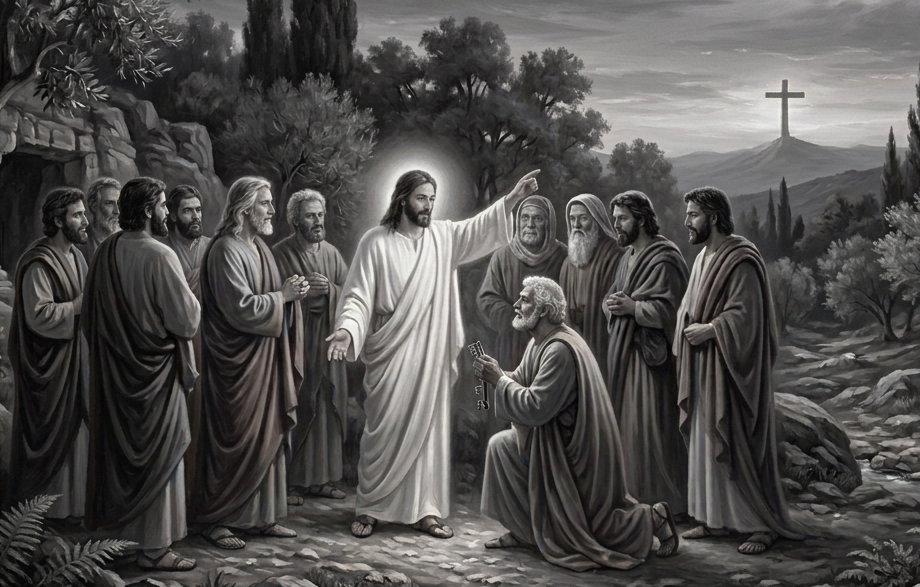
    When I’ve reflected on the Parable of the Sower, I’ve stuck with the explanation Jesus Himself gives: He is the sower, the seed is his word, and we are the soil. I’ve seen the truth of it in my own life, and I suspect you have, too. There have been times when my heart was like the hard-packed path, other times rocky or choked with thorns—and, by God’s grace, moments when it was good soil that bore fruit.

    Recently, I learned that Vincent van Gogh also spent a lot of time thinking about this parable. He painted and sketched it repeatedly. But van Gogh saw it a little differently. For him, his art was the seed, and he was the sower.

    We see something of both perspectives in the reading from 2Samuel. David has clearly been good soil: chosen, formed, and blessed by God. From that abundance, he now sees himself as a kind of sower, offering to do what he believes a faithful king should do: build a house for the Lord.

    But God gently reminds him through the prophet Nathan exactly who has built whom. It was God who first chose David, God who established his kingdom, and God who built David’s “house” — not of stone, but a lineage that would lead to the Messiah.

    The lesson is unmistakable. No one, no matter how great, gifted, or faithful, is the architect of God’s plan. We are its recipients. God first plants the seed. Only then does He invite us to share in the sowing. David becomes a sower of the Kingdom not by his own initiative, but because of what God has already done in him.

    The same is true for us. Discipleship is never our initiative; it is always God’s. We are chosen first, claimed in baptism, and only then entrusted with a share in His work.

    That’s how van Gogh understood his own vocation. Painting was his seed, his “holy task.” He cast it broadly, often into rocky, unreceptive soil, painting not with certainty of success, but with hope. In much the same way, our words, choices, and acts of love or mercy are the seeds we sow. We do not control where they land, what takes root, or how long they take to grow.

    No, God has assigned us a task that is simpler — and harder — than that: to sow generously, love without counting the cost, give without guarantees, and trust that God always controls the growth.

    In the end, the Kingdom of God grows not because we manage it well, but because God, who first planted His word in us, is faithful and always brings it to harvest.


  • Take the Underdog

    Take the Underdog

    Memorial of St. Agnes, Virgin and Martyr

    1 Samuel 17:32-33, 37, 40-51

    I’m not a gambler, and in my case, I shouldn’t be. Why? Because I love to root for the underdog. I can’t help it. That little one out there with virtually no chance—I’ll take them every time.

    That puts me in good stead not only for David against Goliath but also St. Agnes against the power of Rome. I mean, what chance does either one really have? Here is David – young, untrained, no armor, no sword – up against a mighty, giant Philistine warrior. And there is Agnes – young, no power, no status, no protection – up against a brutal Roman world. By any human measure, neither one stands a chance.

    But we’re not dealing with human measures, and we’re not dealing with chance; we’re dealing with God, who empowers those who place their trust in Him. Yes, David is brave, and that goes a long way, but true strength is a lot more than that; it’s knowing whose battle this really is. As David says, “The battle is the LORD’s.” And yes, Agnes is also brave, but her true strength is knowing that she belongs to Christ, that He is her only refuge.

    Both could have chosen a kind of protection the world offered, but neither one did. David refused Saul’s armor because it wasn’t his strength. Agnes refused the false armor of social status, safety, or compromise, because those would cost her fidelity to Christ. For David, Agnes, and all who trust in Him, God is their champion, their hope, and their protection.

    Trust in God remains a challenge to this day. We may not face the warriors or empires these two did, but our battles are no less deadly. We try to pass on the faith to our children and grandchildren in a culture that finds Christianity irrelevant; we face illnesses, or the loneliness or fatigue of age; we are tempted to believe that anything we do for God is too small to matter.

    Let the examples of David and Agnes remind us today of three things:

    1. God never waits for us to be strong or confident enough. He reveals His strength precisely where we are weak.

    2. The holiness He has called us to is not about having power. It’s about refusing to give our heart to anything or anyone other than God.

    3. God doesn’t ask us to be fearless in our struggles. What He asks is that we push beyond our fear to faith, for that alone is the assurance that, no matter what the world thinks of our chances, with Him and in Him, we are never defeated.
  • I Cannot See What I’m Looking At

    I Cannot See What I’m Looking At

    The 2nd Sunday in Ordinary Time, B

    Isaiah 49:3, 5-6; Psalm 40:2, 4, 7-8, 8-9, 10; 1 Corinthians 1:1-3; John 1:29-34

    As we look across the Bible, certain themes tend to keep showing up. One example shows itself today; it’s something I call, “I cannot see what I am looking at.” What is that? Well, in story after story, book after book, we find that a person’s significance or calling is completely unrecognized until someone discerns and names it. Think of King David. No one – not his family, his friends, not even the great Samuel himself – realized that this unassuming little shepherd had been chosen by God to lead Israel.

    There are many others – Gideon, Samuel himself, Queen Esther, Moses – showing this same pattern. God’s work is right there, people are looking right at it, but nobody sees it until someone points it out. And that someone is usually God Himself.

    What got me thinking about that was the mysterious line in the gospel spoken by John the Baptist: “I did not know him.” He says it twice! But weren’t they cousins? Did the two kids never hang out? Didn’t John leap in his mother’s womb when Jesus’s pregnant mother walked in? What’s going on?

    It’s that theme. John couldn’t see what he was looking at. Yes, he saw Jesus, perhaps many times, but not until the Spirit revealed it to him did he come to recognize who Jesus was. That’s why, after the Spirit descends, John says, “Now I have seen and testified…” In other words, “Now God has shown me.”

    It isn’t that we’re spiritually blind or refusing to see. Rather, as St. Paul said, we see, but through a glass, darkly. Samuel saw David, God saw a king. Gideon looked at himself and saw a weak man, God saw a warrior. Esther saw a crown, God saw a champion. In every case, human eyes were open, but understanding was closed. Recognition of God’s work requires revelation, not mere human insight.

    The lesson for us is simple, and very fitting for these weeks we call “Ordinary Time.” We hear the word ‘ordinary’ and think ‘plain, unremarkable.’ But ‘ordinary’ in Church time means ‘counted’ – the first week of Ordinary Time, the second, etc. In fact, Ordinary Time is far from plain or unremarkable; it’s the challenge of learning to see, with God’s help, what is already right in front of us.

    What’s the challenge? Familiarity. We actually see too well. We hear the start of a familiar reading or Eucharistic prayer and are tempted to think, “Oh, I know this one,” and tune out. Or we get so used to looking at one another that we don’t see the treasure each of us really is. Perhaps worst or all, we’re so used to seeing ourselves that we look in the mirror and think, “What’s the big deal? There’s nothing extraordinary about me.”

    That certainly isn’t what God thinks. Each time Scripture is read is a new time; we are different than last time, the situation is different, God is speaking to us right now, where we are. Each Eucharistic prayer brings us spiritually to the eternal moment of the crucifixion of Christ; he is dying that we might have life. Each person, ourselves and those around us are, in his eyes, infinitely precious; well worth dying for. And he loves each of us so much that he wouldn’t make the world without us.

    So, we fall victim to the same trap that many do in the Bible: we cannot see what we’re looking at. And we won’t see it unless the Spirit reveals it and we are attuned to it.

    Attuning to it means starting with some hard questions. What am I looking at every day but not recognizing? Where is God present around me but unnamed? Whose dignity or vocation am I overlooking — including my own?

    Just as John needed the Spirit to recognize Jesus, we need the Spirit to recognize grace in even the most “ordinary” places. But we also need humility. As John said, “I did not know him,” so we might say, “Lord, I don’t always know you. Please, help me see.” That says the plain truth: Faith isn’t about figuring God out or discovering something new, but realizing how God is already here. What’s missing isn’t information, but recognition.

    Perhaps the Baptist helps us out here, too. In a little while, we’ll hear words so familiar that they almost pass right through us: “Behold the Lamb of God.” John said that because he recognized (at last!) who was standing in front of him. Every time we hear them at Mass, the Church helps us do what John did — name what we would otherwise miss. What Father is holding is no longer bread, and this is no mere ritual. This is the Lamb who takes away the sins of the world. He is here, right in our midst.

    Finally, we are meant to take that revelation with us as we go, and make it make a difference in the world. Where is Christ? He’s in the people next to us, the people at the store, on the street, at school, at work, or wherever we are. We look at them, but do we see them? And as for ourselves, when you look in the mirror, see Christ, who desires to work in you and through you.

    John said, “I did not know him.” Let us say, “Lord, I don’t always recognize you, especially when you come quietly, in those deceptive, ordinary ways. Please send me the Holy Spirit again. Help me see what I’m looking at.”

  • To Bloom Once Again

    To Bloom Once Again

    1 Samuel 3:1-10, 19-20

    Some of the most beautiful flowers in the world grow in the most inhospitable places — deserts, rocky ground, even near ice. They don’t bloom there because conditions are easy, but because they’ve learned how to live with very little.

    That is the world Samuel was born into.

    Scripture tells us that “revelation of the LORD was uncommon and vision infrequent.” Israel had become spiritually barren. The priesthood was weary, and faith had become routine. God hadn’t stopped speaking, but Israel had largely stopped listening.

    And into that thin soil, God planted a child.

    Samuel grew up in the quiet and dark of a sanctuary where the lamp of God still burned, but the vision was dim. It’s not surprising that he didn’t recognize God calling him; no one had taught him to recognize God’s voice.

    Eli had his problems, and our Lord would soon be dealing with him, but his advice to Samuel was good: ‘Speak, LORD, for your servant is listening.’ And because Samuel took that advice, God’s word began to flower once again in Israel.

    That’s good news for us. Maybe we feel spiritually dry sometimes, or think God isn’t answering, which makes prayers hard to do. Maybe many things are going on in our lives and we feel stressed or overwhelmed. Maybe we’re tired and think we can’t give any more. Whatever place we’re in, no matter how inhospitable, the story of Samuel’s calling is there to reassure us that God never waits for ideal conditions. He speaks into every heart no matter how weary, to even the thinnest faith, and is at work in every life, no matter how dry. And He is persistent; no matter what, He keeps calling, keeps inviting us into a deeper relationship.

    So today, don’t force an answer or a feeling. Just make room. Repeat Samuel’s prayer — slowly, honestly: “Speak, Lord, your servant is listening.” That simple openness is all God needs to make something beautiful bloom once again.

  • No Trumpets

    No Trumpets

    Monday of the 1st Week in Ordinary Time

    1 Samuel 1:1-8; Mark 1:14-20

    Dancer and author Agnes de Mille once said, “No trumpets sound when the important decisions of our life are made. Destiny is made known silently.”

    That line captures the quiet power of today’s Scriptures.

    In the first reading, there are no trumpets for Hannah—nothing dramatic at all. No angels, no voices from heaven, no sudden change in her circumstances. She must have wished there were! We can sense her anguish, her misunderstood suffering, and the frustration of a pain that returns year after year. The real question is whether she will remain faithful in her suffering, despite the seeming silence of God.

    The Gospel is just as understated. Jesus simply walks along the shore and says to four fishermen, “Come after me.” No fanfare. No crowds. No explanation of where this will lead or what it will cost. Like Hannah, their decision rests on whether they will trust God and act without understanding what lies ahead.

    Of course, we know how these stories unfold. Because of Hannah’s faithfulness, God blesses her with a son—Samuel—who becomes prophet, judge, and king-maker. The Apostles, despite their repeated confusion and fear, ultimately remain faithful to Christ and become the first pillars of the Church.

    But that’s hindsight. What about now? What about us?

    For most of us, God’s call sounds far more ordinary. It may be when someone asks us to serve in the parish in a way we don’t feel qualified for, when a neighbor needs help at an inconvenient time, or when prayer begins to feel dry but we know we should keep going anyway. Nothing dramatic happens. No one applauds. And we may wonder whether any of it makes a difference.

    The point of the readings is that the so-called “ordinariness” of life is precisely where faith is lived. And it’s actually far from ordinary.

    Like Hannah and the Apostles, there are no trumpets or clear signs. Even when we do sense God’s call, we can’t see clearly down the road. All we know is that God comes quietly into our lives, asking us to follow Him without recognition, without certainty, and without any guarantee that our suffering will be quickly resolved. But Scripture also teaches us that God is always with us, and if we remain faithful, He will work through us in extraordinary ways.

    Some years ago, Thomas Merton summarized this in a beautiful prayer which I ask you to pray with me:

    “My Lord God, I have no idea where I am going. I do not see the road ahead of me. I cannot know for certain where it will end. Nor do I really know myself, And the fact that I think I am following your will does not mean that I am actually doing so. But I believe that the desire to please you does in fact please you. And I hope I have that desire in all that I am doing. I hope that I will never do anything apart from that desire. And I know that if I do this, you will lead me by the right road though I may know nothing about it. Therefore I will trust you always though I may seem to be lost and in the shadow of death. I will not fear, for you are ever with me, And you will never leave me to face my perils alone.” 1

    1From Thoughts In Solitude by Thomas Merton, first published in 1956.

  • Immersion

    Immersion

    The Baptism of the Lord (A)

    Matthew 3:13-17

    A German immigrant living in Italy asked how best to learn Italian. The advice he got was simple: Go down to the marketplace and spend time there. Listen. Speak. Make mistakes. Do this enough times and the language will become yours.

    That was it: No textbook, no computer program. Immersion, pure and simple. And it worked. In time, he spoke Italian fluently.

    Immersion is really what we celebrate as we remember the Baptism of the Lord. In ancient times, it wasn’t the custom to stand at a baptismal font and be sprinkled with a few drops of water. No, people were plunged into it, going under as the old, sinful self, and coming back up as the new, redeemed self.

    That practice was done in imitation of Christ’s own baptism in the Jordan by John. Of course, Jesus didn’t need repentance. Still, he chose to plunge fully into the waters – with sinners. With us. Knowing our weakness, our confusion, our need for mercy, God didn’t just stand and watch from a distance. He entered the water. And not only entered, but completely immersed himself in the human condition.

    Thus he teaches us that belonging – that taking up our mission – is revealed in immersion, not observation. For the baptized Christian, life isn’t a spectator sport, something to merely observe, but something to totally immerse ourselves in. Just as that man didn’t master Italian by reading a book or using a computer program, we don’t learn to live like Christ by occasional exposure to him or his Church.

    That brings up the difficult questions Christ wants us to ask ourselves: Do I live a “Christmas and Easter” type faith, or do I live it every day? Do I look at others in need and hope someone will help them, or do I “take the plunge” and do it myself?

    No matter how we answer such questions, let us remember that we learn the language of Christ by immersion: Prayer, reception of the sacraments, being an active part of the community, and by practicing mercy, especially to those who we may think least deserve it.

    If we aren’t where we know we need to be in these things, that’s OK. God has given us time. To learn the language of love, forgiveness, and self-gift, we must go down to the marketplace and spend time where those things are spoken. Where is that? Not the clean, clear water of a baptismal font or an easy chair, but the muddy and unclear water of humanity – of the cross. But as Jesus showed, that’s the place to do as he did, to immerse ourselves fully.

    That is what our Lord, Jesus Christ showed us, not just at his baptism, but by his life, death, and resurrection. And that’s what the Father showed when He said,”This is my beloved Son, with whom I am well pleased.”

    In the same way, we don’t learn how to live “fluently” as God’s beloved sons and daughters by watching from the shore. We learn it by immersion.

  • Love and Fear

    Love and Fear

    Wednesday after Epiphany

    1 John 4:11-18; Mark 6:45-52

    Many things John says get my attention, but today, one thing in particular stands out: perfect love drives out fear (1 John 4:18). He doesn’t say that love reduces or manages fear; it drives it out. When love becomes primary, it takes over. There is no room for fear.

    It sounds wonderful, but how does that happen? Let me give you an example.

    Laying by a pool one day, I noticed a commotion in the water. It was my son. Not only was he in trouble, he was drowning! Immediately, I jumped in. I saved him, but in doing so almost drowned myself. While I was then and still am terrified of drowning, in that moment love completely dominated. There was no time, no room, for fear. All that mattered was love.

    That’s what John means. Perfect love doesn’t wait for fear to calm down or try to reason or compromise with it. No, it totally overrides it.

    But then Mark adds an important dimension. Sometimes, fear becomes crippling or disabling. For example, the disciples in the boat were terrified, not just because of the storm, but also because of the “ghost” on the water. Fear blinded them; looking right at Jesus, they do not recognize him. And it’s not only them. Recently, while suffering with cancer, I was afraid many times. Despite my own prayers, the fear was so bad that I was tempted to give up.

    But that’s where St. Mark’s story proves so helpful. It reminds us that love isn’t only what we give, it’s what we receive when we can no longer carry ourselves. For the disciples in the boat, it was the presence and the voice of Jesus saying, Take courage, it is I; do not be afraid. At that moment, fear lost hold; Christ, Love Himself, had arrived. For me, it was Christ working in ways known only to him and in one way he allowed me to feel: The prayers, the concern, the quiet fidelity of others. Their love was like a “shared” courage that cast out my fear. Together, the love of Christ and the love shared by others in imitation of him are more than enough to stand watch when our own strength falters.

    Whether it’s the barque of the Church or the small, fragile boats of our own lives, there will always be dark nights and sudden storms, times when fear threatens to take over. At those moments — at every moment — we must remember that Christ is always here, always personally present to us in Word and Sacrament. He speaks into the storms of every human life, “Take courage, it is I; do not be afraid.” And he empowers us to stand watch for one another, to lend strength when strength is failing, and to share the courage that only the grace of God can give.

    Fear is real. But as Christ has shown so perfectly, love — his love — is sovereign.

  • Holy Families, Not Perfect Ones

    Holy Families, Not Perfect Ones

    Sirach 3:2-6, 12-14; Colossians 3:12-21; Matthew 2:13-15, 19-23

    The Scriptures for the Feast of the Holy Family speak honestly about family life; not as perfect, but as a place where faith is tested and love is learned.

    Sirach tells us, “Take care of your father when he is old… even if his mind fails, be considerate of him.” He does not limit this call to ideal relationships. It is a summons to faithful love, even when family bonds are complicated or strained.

    That passage reminds me of a time when, as a teenager, I traveled with my father to New York to be with his own father, who was alone and dying of cancer. I didn’t know the details, but I knew there had been difficulties between them. Yet during those few days, I didn’t see that. All I saw was a patient, gentle, attentive son. No speeches, no attempts to fix the past… just the silence of Dad’s presence, care, and compassion.

    Those images have never left me. More importantly, they helped me see Dad in a new and illuminating light. Just like he had struggles with his father, I had struggles with him. Despite all that, watching him live out that kind of reverent love went a long way toward healing our relationship. That mattered, because Dad died young. Had I waited, that healing might never have come.

    St. Paul urges us to “put on compassion, kindness, humility, gentleness, and patience.” In the Gospel, Joseph does just that: he silently rises, protects those entrusted to him, and trusts God with his family’s future. Watching Dad live that way has challenged me to do the same.

    And it’s about challenge, after all. While the Feast of the Holy Family rightly draws our eyes to Jesus, Mary, and Joseph, it’s not about comparing the Holy Family’s perfection to ours. Rather, the Feast invites us to challenge ourselves; that the love in our family be stronger than our resentment, our presence stronger than our history, and our faith strong enough to act — quietly, faithfully, and one day at a time— so that God’s love and peace may work through us to bring healing and wholeness.

  • Open the Door

    Open the Door

    Isaiah 7:10-14; Psalm 24:7c, 10b; Matthew 1:18-24

    You’ve probably seen the famous painting of Jesus standing on a porch, holding a lantern, and knocking on the door. The painting is called “The Light of the World,” and its artist, William Holman Hunt, embedded a few symbols into it, two of which are very appropriate for Advent.

    First is the door itself; it has no handle on the outside. Second is the bottom of the door; weeds are growing everywhere. What did Hunt intend with these symbols?

    The answer lies in the Psalm response chosen by the Church today: Let the Lord enter; he is the king of glory. The door opening only from the inside means that we have to let Jesus enter. He will not force his way in. The weeds symbolize a life where prayer has been crowded out. Again, if we don’t take the time to speak to Jesus, to ask him in, he will not enter.

    So, is there anything keeping me from opening the door and letting God more fully into my life? There are probably many things, but I can think of two.

    First, fear. Despite his outward appearance of piety (“I will not tempt God!”), King Ahaz was afraid. What did this arrogant young man have to fear? Loss of control. He couldn’t allow anyone, even God, to take control from him. But notice in the gospel how Joseph is just the opposite: He allowed God full control, to the point of listening to Him in dreams.

    Second, distraction. That was another problem with Ahaz. He was too occupied with himself and his kingdom to make time for God. Again, Joseph was the opposite; even in his dreams, he discerned and listened to God’s voice. In return, God made him the guardian of Jesus and his Most Blessed Mother.

    That brings us to ourselves. We might ask who we’re more like – Ahaz or Joseph – but perhaps we’re a little of both. Our “inner Ahaz” may fear giving God control. He might ask a lot of us, or lead us where we don’t want to go. Or we too may be distracted, our hearts so cluttered with other things that we aren’t really listening for God or speaking much with Him.

    Let us use these last days of Advent, when things can get so busy, to remind ourselves that God doesn’t need to take control. As Emmanuel, “God With Us,” He is already in control. Fear is useless; what is needed is faith. We need only be still, ask Him for the faith we need, then “open the door”: Pray, listen, and trust that He who is already near may truly be “with us” – in our homes and hearts, now and for all the days to come.

  • The Shoot and the Fruit

    The Shoot and the Fruit

    The 2ndSunday of Advent, Cycle A

    Isaiah 11:1-10; Matthew 3:1-12

    It may not seem like it, but today Isaiah presents one of the most striking images in all of Scripture: A shoot shall sprout from the stump of Jesse. To us it sounds poetic, and is, but for the prophet’s audience, it was also practical, and its symbolism powerful. Why? Because the Hebrews knew that a shoot growing from the stump of an old olive tree, when properly cared for, grows into a new olive tree. Then and now, the olive tree was a symbol of resurrection: What looked dried up and dead is alive again; a whole new tree, fresh and full of fruit.

    To this, the prophet adds two things: First, he gives the stump a family name – Jesse, King David’s father – in effect prophesying a son from that family endowed with spiritual gifts. Second, this son would usher into the world a kingdom of peace beyond our imagination. On this side of the resurrection, it’s easy to see this son of David as our Lord, Jesus Christ, and creation at the end state God planned from all eternity: healed and restored, with its people living in justice and peace. What a perfect picture.

    But, as we all know from times we’ve pictured ourselves having reached some new personal milestone, there has to be a path to get us there. We don’t just become a new self; real effort is involved. Sometimes, I think I need a drill sergeant to push me where I want to go. Once I find out how hard the path to a better me is, the less I’m motivated to get there on my own.

    Enter John the Baptist, the first century’s spiritual drill sergeant.

    His words – Repent… prepare the way… make straight the paths… produce good fruit as evidence of your repentance – may sound harsh, but they’re true. They remind us that the kingdom Isaiah pictured takes a lot more than good intentions or warm feelings. It takes real effort; a deliberate, disciplined turning back to God.

    As John none-too-gently reminded his audience when he said, the ax lies at the root of the tree, some pain may be involved. We know the discomfort, the humility of Confession. But we also know that God meets us there, and gives us the grace to cut away the behaviors and attitudes that lead us away from Him.

    It may feel as though all that remains of our old life is a stump, but remember the olive tree – from the stump that remains, new shoots can grow. What are those? Imagine the possibilities: A moment of honesty; a bad habit given up; a virtue practiced on purpose; a relationship tended with patience; less screen time replaced by more and deeper prayer; reconciliation with someone we have avoided. And many more.

    The best news of all? Any of these small shoots will become, if tended, a new tree — a new self — rooted in Christ. And from that tree, the good fruit will begin to appear: gentleness rather than impatience, mercy rather than judgment, courage rather than fear.

    So, this Advent – right now – let’s choose just one concrete act of repentance, one “spiritual muscle” to train, or one place where we invite the Lord to straighten the path. God is eager to do it; He, who raised a shoot from Jesse’s stump will raise a new heart in us as well. And, through that heart, we will bear the fruit that shows we are really doing what God wants most – turning back to Him.