Hebrews 10:32-39; Mark 4:26-34
Jonathan Swift once said that vision is the art of seeing what is invisible to others. Saint Angela Merici exemplified that art.
As a child, Angela might well have foreseen a bright future. Born into a middle class family during the Italian Renaissance, Angela and her sister were raised by devoutly Catholic parents who made sure their daughters were well-educated in the faith.
Listening to their father as he read them stories from the lives of the saints, the girls learned that the road to sanctity was no different for them than it was for anyone else, even the earliest Christians who first heard those consoling words in the letter to the Hebrews. The lesson transcends time and space: Those who choose to love Christ and follow Him wherever He leads learn that the road to sanctity always includes the cross.
Angela learned this lesson very well. By the time she was 10, both of her parents had died; by 15, her sister was also gone. Some people might have despaired over these great losses, seeing the absence of God, but Angela did not. The seeds of the faith planted by her parents in those early years and watered by the grace of God had taken root within her as surely as the mustard seed which our Lord spoke of in the gospel. Rather than turn away from Christ or the cross, Angela consecrated herself to him as a Third Order Franciscan.
Just 20 years old, Angela did not wait to find a way to serve. Looking at the society around her, she saw the disorder in it and traced it to disorder in the family. One thing was especially problematic. In Italian society of the time, only the wealthiest girls received any kind of education; the vast majority received little or none. Angela wondered how these girls, the wives and mothers of the future, could ever grow up to be the first teachers of their children in the ways of the faith if the seeds of their own faith withered and died.
Inspired to action, Angela immediately converted her family home into a school and devoted herself to providing religious education to the young girls of the area. She was gentle, focused on the dignity of each girl as a unique person, and used persuasion over force. This was so effective that she was invited to the larger nearby town of Brescia so that she might more broadly and formally institute the same program throughout the area. Ultimately, Angela would go on to found the Ursulines, an order of consecrated virgins devoted to St. Ursula, whose mission it became to bring religious education to young girls. Her order was so successful that the Pope himself asked Angela to relocate to Rome. She declined, saying that she was devoted to the children of the rural country she called home and wished to remain there. This she did until her death in 1540.
 Angela Merici was a visionary; she saw what was invisible to everyone else. Where others saw the Italian countryside she saw the Kingdom of God; where they saw poor and middle class girls, Angela saw fertile ground waiting for seed. Christ asked her to sow and she obeyed. He asks no less of us. The Kingdom of God is here and now; the ground is fertile and plentiful. All our actions, for good and bad, fall like seeds into that ground. May we always remember what Saint Angela already knew, as given by the spiritual writer James Allen: “The law of the harvest is to reap more than you sow. Sow an act, and you reap a habit. Sow a habit and you reap a character. Sow a character and you reap a destiny.”
Saint Angela Merici, pray for us.
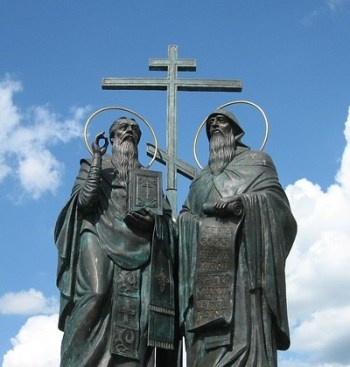 Saints Basil and Gregory can teach us many things, but today we focus on two. First, they teach us that faith in God requires true humility. Heresies are born from the pride that sees ourselves as the measure of all things; that interprets our failure to understand the truths of the faith to mean that the truths are wrong. True humility is as John admonished us, to remain in him; to see that God is the measure of all things and that our inability to understand means that we still have work to do. Second, in these days when the word “love” is so easily limited to physical expressions of self-gratification, the love of Basil and Gregory is a shining example of the most uplifting, life-giving love possible between people. This is the love that is modeled on God; that seeks only the good of the other; that finds its union with others in the heart and soul because that is where God dwells, and God is love. This is the love where heart speaks to heart and says, “I want for you what God wants for you.” My prayer is that all of us come to have that love for one another. What a world this would be.
 Eventually, Father was caught, imprisoned on a false charge and on the morning of November 23
 Persistence in prayer does not test God’s patience or change his mind; rather, it tests our faith and changes our attitude. Through his life and the Scriptures he has given the world, Jesus has told us that God loves each of us with a love beyond our understanding and knows our needs before we ask. That being so, God wants our prayer to consistently express the trust we have in him and his providence; that is the faith that Christ wants to find upon his return.
 No wonder. Internet scans, scrolls, and searches cannot bring the wisdom we need. As the first reading tells us, Wisdom is a spirit… Firm, secure, tranquil, all-powerful, all-seeing… the spotless mirror of the power of God, the image of his goodness (Wisdom 7:22, 23, 26). Wisdom is Christ, and his gift to us is wisdom as the fruit of the Spirit. A fruit born of the love of God, wisdom desires not only to be one with God but to see things as God sees them. Like any fruit, wisdom takes time to mature; its development a function of our life experience as seen through the lens of long-suffering that strengthens us to finish what we start, docility to listen as God speaks, and humility to remember that we are servants of God and each other.
 We who have inherited this faith must never forget these two lessons from the readings: First, the worth of the human body was not, is not, and never will be ours to decide. God has given us freedom, so we can define and re-define who is and who is not worthy to live, but in the end these are just words; our laws
 Finally, the parables teach us that the love of God works mysteriously through the process of conversion so that no matter how hard we search for Christ, it isn’t we who find him but he who finds us. Our life stories are a testament to the truth of the parables and Isaiah’s words that we have
  To win this combat and know the peace of Christ we need the armor of the virtues; prudence, to discern where our good lies; temperance, to know when we should move on; justice, to understand that the love we give our neighbor and God is the love we owe them; and fortitude, to constantly yield our will to that of Christ, for only his is the love that casts out all fear, not only restoring us to right relationship with the Father, but reconciling us with each other.
 There is much more we could say on this, the day we remember him, but it would only belabor the point, which is that none of his work would have been possible unless this man had given himself completely over to the will of the Father, in devotion to our Lord Jesus Christ, through the power and inspiration of the Holy Spirit. But he did, and this masterpiece was the result.
 We asked for other things; why should we be happy to receive the Holy Spirit instead? Consider everything he brings: Wisdom, the ability to see what is most important; understanding, to get to the heart of the matter; counsel, to submit to the providence of God; fortitude, the strength to pursue the good; knowledge, the ability to judge rightly; piety, reverence for God; and fear of the Lord, a love of God so deep that we would do nothing to hurt him. Poured lavishly upon us, these gifts bring us closer and closer to the mind and heart of Christ, who prayed as he lived – perfectly – that the Father’s will be done, who lived his prayer to the death, and who showed us that death is not the end but the pathway to resurrection and perfect unity with the Father.
 Mark 10:45