Leviticus 19:1-2, 17-18; 1 Corinthians 3:16-23; Matthew 5:38-48
As a young married woman, Edith Eger emigrated to the United States just after World War II and settled in Texas with her husband and first child. If she didn’t carry much material baggage, she carried a lot inside. A Jew, she and her family had been taken by rail along with hundreds of others to Auschwitz. Her parents were immediately put to death. A gymnast and dancer, she got the attention of a camp physician and was forced to dance for him; this was the notorious war criminal Jozef Mengele. Months later she was forced to march to another death camp and was one of the very few who survived. Her way of dealing with the trauma was to dedicate her life to helping others so in the 1970’s, her children grown, she went to college and became a psychologist. Now Dr. Eger, she began treating soldiers suffering from post-traumatic stress syndrome.
One day Dr. Eger met with two patients, both Viet Nam veterans. They suffered identical injuries; the war left them paraplegics. The first man was angry, bitter, and resentful; all he saw was the world’s evil and his own limitations. His attitude was, “Why me?” The second man was just the opposite. Grateful to have survived, he was determined to focus on the good things in life and on its possibilities. His attitude was, “What next?”
Both patients deeply affected her. Through the first man she realized two things. First, her wartime experiences had left her like him: Angry, bitter, and resentful inside. More importantly she realized those feelings not only remained unresolved but had taken over, made things worse. Like that patient, she too was defined more by hatred than by love. But the second man showed her that she had a choice. She could choose life over death, to be a victor and not a victim, to celebrate the good and stop mourning the evil; to ask “What next?” and not “Why me?” That is the path she chose and, to coin a phrase, it has made all the difference.
In her book “The Choice,” Dr. Eger writes, “Maybe to heal isn’t to erase the scar… to heal is to cherish the wound.” May be; we know from the book of Leviticus that we are to cherish no grudge (Leviticus 19:18), for that is the opposite of healing. No wonder the same verse advises us to take no revenge. Although it may seem satisfying for a time, especially when someone has really hurt us, Dr. Eger also said that revenge keeps us revolving, not evolving. Our goal is to get past the pain, not pay it forward, to make a positive change in our lives.
But when someone has hurt you badly, how do you get past that kind of anger? By acknowledging it and giving it to God. Hiding it or pretending it doesn’t exist aren’t realistic solutions. You must be honest and admit that the anger you feel is the normal response to being badly hurt, but you must also resolve that anger will not win, will not define you, is not who you are. St. Paul told you who you are; you are the temple of God (1 Corinthians 3:16); don’t let anger defile that temple. Then give it to God in prayer. Be completely honest; tell God that the hurt and anger are too big for you, that you cannot do it alone. Ask him to help you forgive those who hurt you.
Finally, have a realistic understanding of love in the context of forgiveness. When our Lord says love your enemies he isn’t asking us to forget what happened and be friends; rather he is challenging us to see other people, including our enemies, as God sees them. Therefore, forgiveness doesn’t mean complete reconciliation of all differences with all people; it means freeing ourselves to love as God loves. Edith Eger didn’t reconcile with the Nazis but she did forgive them because she came to see them as they were: People who, although created good by God, learned as children to fear and hate what they could not understand. We come to forgiveness the same way; not by total reconciliation of our differences but by accepting first and foremost that all people, even those who have hurt us, are created and loved by God just as we are and in need of the same salvation we need.
 It’s tempting to dismiss all this as foolishness but remember what St. Paul says: If any one among you considers himself wise in this age, let him become a fool so as to become wise (1 Corinthians 3:18). It may be wisdom in the eyes of the world to hate those who have hurt us and foolishness to forgive them but in Christ’s world it’s just the opposite; his is the world where hatred keeps us bound and love frees us, where judgment takes a back seat to mercy, and where God alone sees the heart, knows the pain, calms the fear, heals the wounds, and breaks the chains.
As Lent approaches I invite you to find that one person in your life most in need of your forgiveness. Make forgiving that person your Lenten project. It may not take you all of Lent or you may not have succeeded come Christmas; regardless, keep working at it. Pray for them; your prayers are the greatest gift you can give and are truly sacrificial. Forgiving others from the heart may be the one thing we do that God loves the most, for it shows how much we want to be like him. After all, God has forgiven us.
 Still, Mark’s purpose is not to make us wonder at their behavior but to evaluate our own. Are we insiders or outsiders? Some of us witness Christ feeding a multitude every day, and every day share time with him in the Church, the barque of Peter. Are we focused on our own loaf of bread – be it the next place we have to go, the people we have to see, or things we have to do – or on the Living Bread that is Christ? We see the many wonderful people he gives us – our families, friends, each other; do perceive Christ living within them? We hear his word in the Scriptures; do we understand his voice speaking through all those crying for help? At the Mass he gives us himself Body, Blood, Soul, and Divinity in the Holy Eucharist; are our hearts hardened or are they being converted through the forgiveness of sins in Confession, that we may partake most fully in the infinite grace he offers?
 The pattern of disagreement, debate, and decision is how things get most productively settled in the Church provided it is done in the right spirit; that is, the Holy Spirit. Since the Council of Jerusalem was called to settle the dispute between the Gentile and Jewish Christians this has been the model, its justification found in the letter issued from that Council, specifically the sentence that begins, It seems good to the Holy Spirit and to us (Acts 15:28). The Holy Spirit promised by Christ continually works within us, finding ways to maintain unity despite our differences. In all our human affairs but especially between the members of the Church what matters is not that we disagree but that we dialog, not the heat of our words but the light of the Holy Spirit, not the distance we keep but the fellowship we extend, and not the hostility throughout the debate but the peace of Christ we give in the resolution. As with Cyril and Methodius, some will not accept us or the decisions reached but we cannot help that. All we can do is what Methodius did: Continue to act in union with Christ and his Church, remembering always that it is not about us but about the Holy Spirit and us.
 Angela Merici was a visionary; she saw what was invisible to everyone else. Where others saw the Italian countryside she saw the Kingdom of God; where they saw poor and middle class girls, Angela saw fertile ground waiting for seed. Christ asked her to sow and she obeyed. He asks no less of us. The Kingdom of God is here and now; the ground is fertile and plentiful. All our actions, for good and bad, fall like seeds into that ground. May we always remember what Saint Angela already knew, as given by the spiritual writer James Allen: “The law of the harvest is to reap more than you sow. Sow an act, and you reap a habit. Sow a habit and you reap a character. Sow a character and you reap a destiny.”
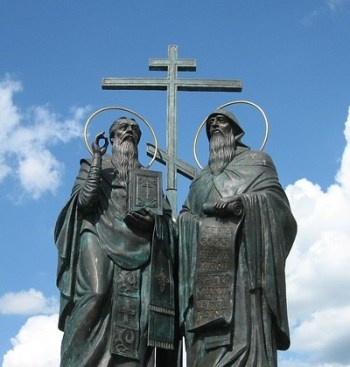 Saints Basil and Gregory can teach us many things, but today we focus on two. First, they teach us that faith in God requires true humility. Heresies are born from the pride that sees ourselves as the measure of all things; that interprets our failure to understand the truths of the faith to mean that the truths are wrong. True humility is as John admonished us, to remain in him; to see that God is the measure of all things and that our inability to understand means that we still have work to do. Second, in these days when the word “love” is so easily limited to physical expressions of self-gratification, the love of Basil and Gregory is a shining example of the most uplifting, life-giving love possible between people. This is the love that is modeled on God; that seeks only the good of the other; that finds its union with others in the heart and soul because that is where God dwells, and God is love. This is the love where heart speaks to heart and says, “I want for you what God wants for you.” My prayer is that all of us come to have that love for one another. What a world this would be.
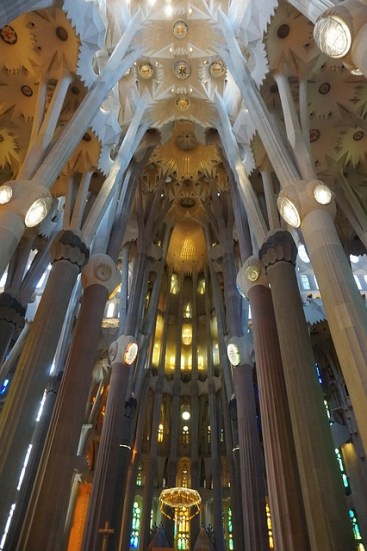 Finally, the basilica of the Holy Family teaches us that joy is not necessarily the destination but the journey. Every year, millions of people take the time to tour the basilica of the Holy Family in Barcelona. Whether they are watching as the builders add to its structure, marveling as artisans craft the artwork that adorns it, or attending the Masses offered there, the faithful are uplifted and sanctified even though the basilica is a work in progress. The same is true for our families, for they too are works in progress. Every day brings the happiness and sorrow, the cataclysms and quiet moments through which families progress either closer to God or further away from him. Let us pray that our families take every moment of life and find the joy in it; for each moment, whatever it holds, is an opportunity given to us by Almighty God to build up our own domestic Church in virtue, crafting ourselves more and more into what we are called to be – living stones built upon the cornerstone that is Christ.
 Like the mysterious sacrifice of the wren, this may leave us curious. Why does the Church take the first day after Christmas to remember the first martyr? The answer lies precisely in the similarity of Stephen’s passion and death to Christ’s. Christmas is the celebration of the birth of Jesus; the same Jesus who came not to be served
 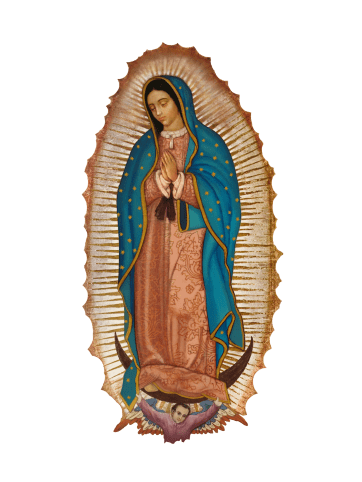 She became known as Our Lady of Guadalupe, and as word of the miraculous appearance and image spread, she became the most effective tool of evangelization that Mexico or the world had ever known. In the gospel, Mary carried the Eternal Word into the Judean countryside where the babe within Elizabeth’s womb leaped for joy; 15 centuries later, Mary’s maternal word went out into the Mexican countryside where millions leaped for joy. Conversions increased so dramatically that for a couple of years the missionaries could almost not keep up with them. More than that, the peoples’ faith was strong; to this day, the faith of the Mexican people remains vibrant, with deep devotion to Our Lady of Guadalupe.
 These and many more are like the soft, marshy soil below the tower of Pisa. Like that tower, a faith built on human weakness will lean and no amount of stopping and starting, tinkering and refining will fix it. It must be torn to the ground and rebuilt on the foundation of Christ and his Church, for we must take the faith as it is, not as we would like it to be.
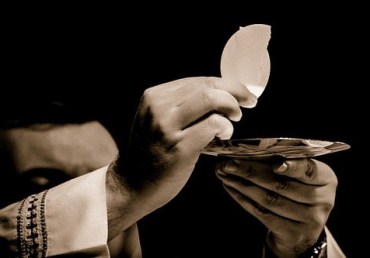 Still, a common problem is that we tend to take this fellowship for granted and forget gratitude. We fall into a routine of receiving Communion with little or no thought as to what – or rather Who – we are receiving. Like the nine lepers in today’s gospel passage, we are given what we ask for but then go back on our way with little regard either for the gift or what it cost the Giver. St. Paul goes on to warn about the grave danger of such ingratitude: That is why many among you are ill and infirm, and a considerable number are dying (1 Corinthians 11:30). The healthier, more grateful response is to first discern whether we are in the state of grace to receive Christ and, if not, to make ourselves a more worthy vessel. Like the leper who, once cleansed, remembered to be thankful, we thank God for what he has given us through the Church – the gifts of faith and the Sacraments through which he touches, heals, and sanctifies us.
 Mark 10:45