Tag: Word of God

  • I Will Make You Great: Friday of the 14th Week in Ordinary Time

    Genesis 46:1-7, 28-30

    An important part of getting to know someone is finding out about their background – their childhood, family, whatever details they’d like to share. It gives us a fuller, richer picture of the person, puts what they say and do in context, and helps us come to a better understanding and appreciation of them.

    Of course, we’re much more limited when it comes to getting to know people in the bible, but that doesn’t mean there is nothing to learn. Sometimes, important details lie hidden between the lines, and knowing them helps us not only to learn more about that person but also more about us and God. This is true for one of the most important, indeed foundational, biblical characters we have heard about this week – Jacob, the son of Isaac and grandson of Abraham.

    As we study the chapters of Genesis that tell us about his life, one thing is clear: Jacob came from a dysfunctional family. It began from the twin brothers’ birth. The name Jacob means “to supplant” or “replace,” and that is what he did, first duping Esau out of his inheritance, then tricking his father into giving him the blessing intended for his slightly older brother. But their parents, Isaac and Rebecca, are the real problem; they play favorites, Rebecca going so far as to help her favorite (Jacob) steal from his brother and get away, while Isaac sat idly by as his favorite (Esau) plotted murder against Jacob. Not what anyone would call a healthy family dynamic.

    Sadly the problem followed Jacob into adulthood, for he too played favorites. We heard this week how his favoritism of Joseph led to such envy in Jacob’s other sons that like their uncle Esau they too plotted to kill their brother – and nearly succeeded.

    Yet we also saw that things don’t always work out the way we think they will. Where in Jacob’s family revenge would be expected, by the grace of God Joseph took a different tack; just yesterday we heard him say to his brothers, It was really for the sake of saving lives that God sent me here ahead of you (Genesis 45:5).

    And therein lies the lesson: With God’s help, the unchangeable can change. Like Jacob, we are born with problems, born into problems, problems plague us all our lives. They may be dysfunctional relationships, addictions, abuse, the list is endless. Whatever they are we feel powerless to change them, and on our own we probably are. But the story of Jacob teaches us that we are not alone, that no matter what the problems are God has ways of dealing with them that we do not, and that as St. Paul once said, all things work for good for those who love God, who are called according to his purpose (Romans 8:28).

    Although Jacob may have taken too much pride in himself and his own schemes over the years, he never forgot God’s purpose and to humble himself before it. In today’s reading we find him doing exactly that at Beersheba. He’s been there before; recall on Monday Scripture told of him fleeing from Esau as a frightened young man. Then, God spoke to him in a dream and, although the words are slightly different, the main points are exactly the same today: I am God… do not be afraid… I will make you great… I will be with you… I will bring you home. Through all that had happened to him from that first moment on – the joys, the sorrows, the love, the loss, the bliss, and the agony – Jacob was never alone. God was right there with him, doing what he said he would do.

    So let us resolve to respond as Jacob did. Scripture tells us that he took everything he owned and everyone in his family with him to Egypt (Genesis 46:6-7). That is, he was totally committed to whatever God wanted him to do. This takes great faith but that is ours for the asking. Jacob asked for it at Beersheba; we have the present moment, here in His presence. And let us remember too that God is never outdone in generosity. For his act of faith, Jacob was rewarded not only with the joy of holding his long-lost son in his arms once again but also, through the great prosperity and growth that Israel, the nation named after him, would come to enjoy, he could rest secure in the knowledge that God’s plan is far above any of human schemes and His merciful love infinitely bigger than any of our problems.

    The best news of all is that to those who commit themselves to Him as Jacob did hear the same words that Jacob heard. Keep them with you today and everyday. Here they are again: I am God… do not be afraid… I will make you great… I will be with you… I will bring you home.

  • All Things to One Man: The Solemnity of the Sacred Heart of Jesus

    All Things to One Man: The Solemnity of the Sacred Heart of Jesus

    Hosea 11:1, 3-4, 8c-9; Ephesians 3:8-12, 14-19; John 19:31-37

    In high school we once did an exercise on self-perception. Sister began by asking us to take out a sheet of paper and write down 3 negative things about ourselves. After a couple of minutes she said, “Alright, now write down 3 positive things about yourself.” I can’t remember what I wrote but I know I didn’t list three; I’m not sure I even wrote two. That was Sister’s point; self-conscious teen-agers aside, people in general tend to be very good when it comes to focusing on their negative qualities but not so good when it comes to the positive.

    The same goes for our relationship with God. If you’re anything like me, it’s probably much easier to come up with reasons why He shouldn’t think very highly of you than reasons why He should. Today, on the Solemnity of the Most Sacred Heart of Jesus, our Lord gives us at least three reasons to focus on the positive.

    First, listen again to his words in the 11th chapter of Hosea: When Israel was a child I loved him… I taught Ephraim to walk… took them in my arms… fostered them like one who raises an infant to his cheeks… stooped to feed my child… I will not let the flames consume you (Hosea 11:1, 3-4, 8-9). This isn’t the imagery of a God who loves from a distance, impersonally, or until we leave or hurt him; no, this is a God who loves intimately, with a deeply personal, boundless, and most of all, healing and merciful love.

    Second, as St. Paul makes clear, this is a love that goes beyond all words except the one, Eternal Word – Jesus. We can hear Paul struggling to express the inexpressible as he prays that we may have the strength to comprehend with all the holy ones what is the breadth and length and height and depth, and to know the love of Christ which surpasses knowledge (Ephesians 3:18-19). This is the key; divine love surpasses human knowledge and can be known only by faith (Ephesians 3:17), the gift of the Father possible only by the strength that comes from the Holy Spirit (CCC §683). To those who have faith, all the riches of grace are available.

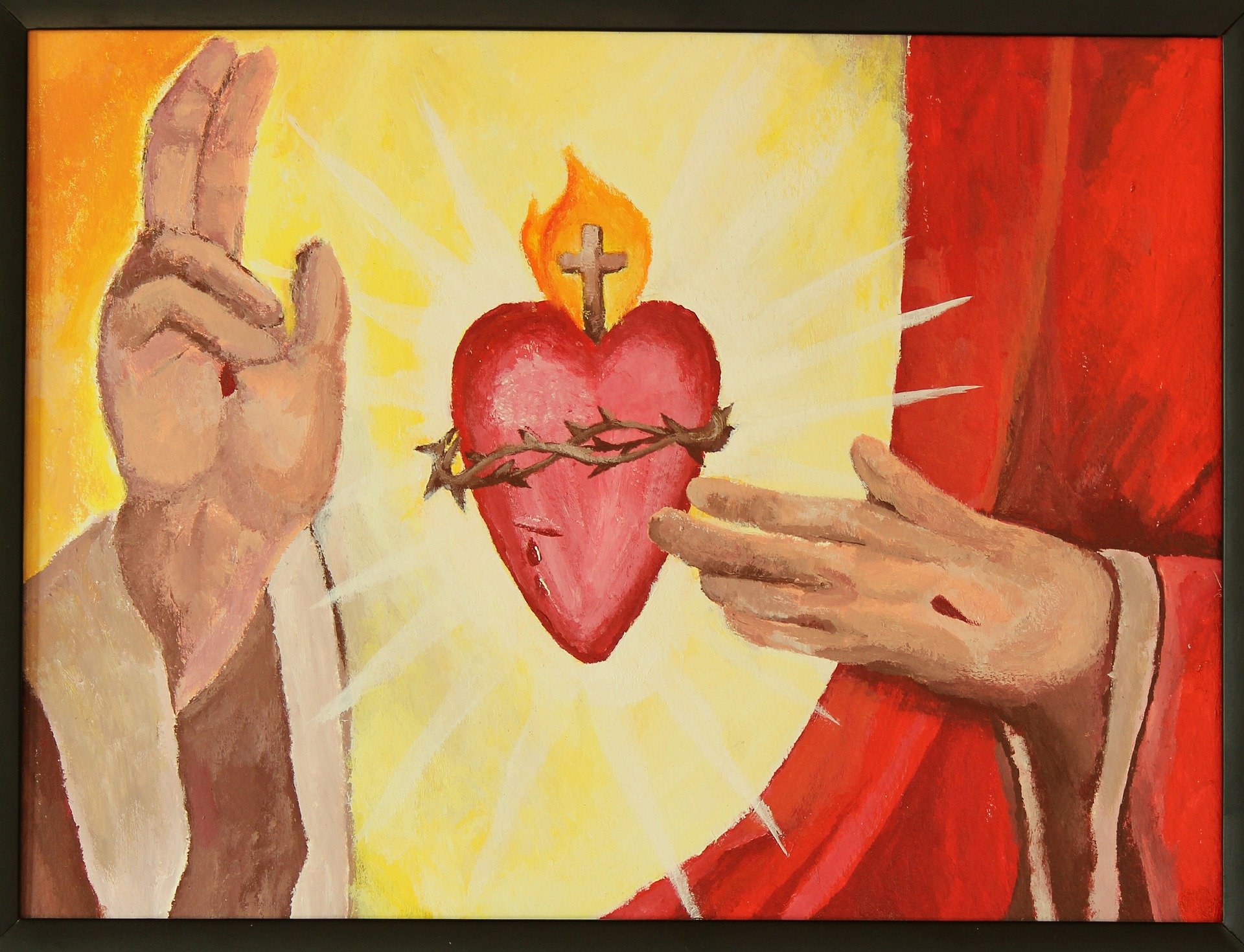
    Finally, every image of the Sacred Heart reminds us with its crown of thorns of the cost of this love. We hear in the gospel of the soldier who thrust his lance into his side, and immediately blood and water flowed out (John 19:34). There is no love worthy of the name that is not asked to endure insult, temptation, and suffering. From the dawn of humankind it is written into our nature; it’s in our blood. But it isn’t in the blood of Christ, either from his Heavenly Father or his holy Mother, the Immaculate Conception. He willingly took it on. This is perhaps the greatest and most positive of all – that God, purely out of his infinite and merciful love for us, gave his only Son that we would be raised to life eternal. As Christ himself said, there is no greater love than this.

    St. Pio of Pietrelcina, Padre Pio, understood that very well. While passing through a crowd of people all clamoring to get near him, someone shouted, “Padre, you are all things to all men!” He replied, “No, I am all things to one Man.”

    May we all come to that kind of understanding! May we all see the Solemnity of the Sacred Heart of Jesus as a day to set aside the negatives and focus on the overwhelming positive – that we too are all things to one Man. We are loved infinitely, personally, and mercifully; we are given the gift of faith which alone can make this love known to us beyond any human understanding; and finally, that as the ultimate expression of this love the Second Person of the Blessed Trinity took human form and allowed his own heart to be pierced that we may not only look upon him in mourning for the sinfulness that put him there but with rejoicing that divine love can take even the passion and death of Christ, the greatest insult of all time, and transform it into the greatest victory the world will ever know – the resurrection to eternal life for all who believe and return to God with their whole heart (Joel 2:12).

    Sacred Heart of Jesus, have mercy on us.

  • Alive Inside: Monday of the 34th Week in Ordinary Time

    Alive Inside: Monday of the 34th Week in Ordinary Time

    Revelation 14:1-3, 4b-5; Psalm 24:1bc-2, 3-4ab, 5-6; Matthew 24:42a, 44; Luke 24:1-5

    Recently I saw a documentary called “Alive Inside.” It briefly follows the career of a social worker who dedicated himself to bringing music to people who suffer from brain disorders such as dementia and Alzheimer’s disease. The effects of the music are startling; people who spent months or years living an almost catatonic existence, isolated from the rest of the world and from their own memories, transform when they hear the music. Some weep, some laugh, some sing, some dance; all to one degree or another and at least for awhile have awakened within a sense of their own identity, reconnecting with long-forgotten memories and the emotions that go with them. As one doctor in the film says, when they listen to certain music, people who appear virtually dead to the world show that they are very much alive inside.

    Of course, no one is more alive than those who dwell in perfect union with God, and as Revelation reminds us, they hear the music of Heaven. They aren’t alone; John says he heard it, too. The reality is that the divine music is and has been all around us. The question is, do we hear it?

    We do if we detect a note of urgency in the Scriptures today, as we should in all the Scriptures given to us by the Church as the year closes. We certainly hear it in the Gospel Acclamation, for Christ says to us, Stay awake! For you do not know when the Son of Man will come (Matthew 24:42,44). He knows that it’s easy for us to “fall asleep” in the spiritual life. Our natural tendency is to allow ourselves to get comfortable; to be willing to go only so far but not farther; to pray this much but not more; to be satisfied with where we are and avoid whatever seems uncomfortably challenging.

    And we hear counterpoint to that comfort when our Lord speaks of the gift offered by the poor widow. Notice that what mattered to him was not the amount she gave but that she held nothing back; for love of God, she allowed the cost to herself to be the highest possible – to give from her own need. This is the kind of person of whom the psalmist sings, the one who truly longs to see the face of God, who wants for themselves and others what God wants for them, and who are willing to show that to Christ and the world by living like those in Revelation: Following the Lamb wherever he goes (Revelation 14:4b).

    If we listen to the Scriptures there is no doubt that we too will hear their music. The question is not if we hear it but whether we will allow it to transform us; to move us out of our self-imposed spiritual isolation; to remind of us our identity as Christians; to re-awaken the perhaps long-forgotten memory of who we were created to be and the love we were given to share; and to show our Lord that we, like all his saints, are not dead to the world but very much alive inside.

  • The Slave of the Slaves: Memorial of St. Peter Claver

    Although I am free in regard to all, I have made myself a slave to all so as to win over as many as possible.

    1 Corinthians 9:19

    Imagine being dragged aboard a ship, naked and chained in the darkness below deck, lying helpless for several weeks, through rough seas and stifling heat. There are over 500 of you; males here, females there. You are fed just enough to keep you alive. Starvation, disease, and death are rampant. No one knows where you’re going or what awaits you when the hatch finally opens. Over the centuries of the slave trade, millions of people saw that hatch open only to a lifetime of slavery in a strange New World.

    Yet, like a drop of mercy from heaven, hundreds of thousands of these same people saw that hatch open to reveal the caring, concerned face of a gentle Spanish Jesuit. He would come below and find the newborns who were still alive, pour water over them, make the sign of the Cross and pray. He then ministered to the dying, and the dead he had respectfully removed. To the sick he brought medicine and bandaged their wounds. Those too sick to leave the ship on their own he helped carry above. When he got to you, he would clean you, give you food, clothing, and fresh water. He would speak warmly and gently through an interpreter, although no translation was needed for his touch. This was a man fluent in the language of love and by the time he had finished, he had restored a measure of the dignity so shamefully taken away. Every moment, this man acted as if he was your slave and happy to be nothing more.

    That’s because he was.

    The man was Peter Claver, a 17th century priest and Jesuit who devoted his life to ministering however he could to every slave shackled in the darkness aboard the hundreds of ships landing in the port city of Cartagena. Fr. Claver took to heart the words of St. Paul, who said, Although I am free in regard to all, I have made myself a slave to all so as to win over as many as possible (1 Corinthians 9:19).

    Father’s devotion to the service of slaves sprang from his desire to imitate the service of his model, the Blessed Mother, to whom he was devoted. As a young novice he was so moved by a pilgrimage to one her shrines that he wrote, “I must dedicate myself to the service of God until death, on the understanding that I am like a slave, wholly occupied in the service of his master.” He traveled to the New World after hearing that millions of enslaved people died there knowing nothing of Christ. After his first few years serving them, Father signed the document of his final profession to the Society of Jesus with the words, “Peter Claver, slave of the slaves, forever.”

    Before the slaves were sent on, Father took whatever time was given him to teach them about Christ. He used pictures, rosaries, crucifixes, anything he could find. He concluded every session by teaching them to say, “Lord Jesus Christ, Son of God, You are my Father. I am sorry for having offended You. I love You very much. I love You very much.” It is said that he personally baptized over 300,000 slaves.

    Fr. Claver continued his ministry for 40 years. Finally, sick, frail and exhausted, he knelt and kissed the feet of his young Jesuit successor and on the day he predicted – the Feast of the Nativity of the Blessed Virgin Mary, September 8th, 1654 – he died at the age of 73.

    portsoy-1244572_640Although the slave trade of that era is thankfully no more, slavery still abounds. Who are the people in our own lives, chained in the darkness of sin, feeling helpless, uncertain and fearful of their destiny? Who are those with wounded or even dying spirits, on the brink of losing hope? Who are those starving for affection, for shelter, for safety, for dignity? Will you be the one to open the hatch to descend into their suffering and restore what dignity you can?

    Let us pray that we, like St. Peter Claver, may be the slave of the slaves, forever.

    St. Peter Claver, pray for us.

  • Fed to the Dogs: Wednesday of the 18th Week in Ordinary Time

    Fed to the Dogs: Wednesday of the 18th Week in Ordinary Time

    Matthew 15:21-28

    There are times in the gospel when Jesus says something that makes us ask, “Did he really just say that?” For example, his mother came to see him and what does he do but turn to his disciples and say, Who is my mother? (Matthew 12:48). Then there is the time he said, If your right eye causes you to sin, tear it out and throw it away (Matthew 5:29). Today is yet another, as he says to a woman pleading for help, It is not right to take the food of the children and throw it to the dogs (Matthew 15:26).

    Did he really just say that?

    Well, yes. The question is, what did he mean? To answer that, we have to know more about the context.

    To begin with, Jesus withdrew to the region of Tyre and Sidon (Matthew 15:21), pagan lands. We might wonder why he went there but I think it was for two reasons: First, as the Catechism tells us, Christ comes to meet every human being (CCC 2560); he wants none lost but all brought to knowledge of him. Second, he has just sparred with the Pharisees about what truly defiles a person, teaching them that it is not what goes into the mouth that matters but what comes out of it (Matthew 15:1-20); that is, vice or virtue. Where better to demonstrate that than pagan territory for, by implication, the Gentiles are not defiled (as the Hebrews assumed) because of who they are; to the contrary, there may be great virtue among them. He has come to see.

    The Canaanite woman does not disappoint. She too has come to see – to see Him – and on finding him shows the faith to call him Lord and the love to pray on behalf of her child: Have pity on me, Lord, Son of David! My daughter is tormented by a demon (Matthew 15:22). She doesn’t know it but the Holy Spirit is moving within her, making her as St. Augustine once said, “a beggar before God” (CCC 2559).

    And a persistent beggar! Three times she is rebuffed. First when Jesus does not answer her (Matthew 15:23), again when he says, I was sent only to the lost sheep of the house of Israel (Matthew 15:24). Anyone less persevering might have gone away but the Holy Spirit prompts her to move closer, now to the piety of doing him homage and pleading, Lord, help me.(Matthew 15:25). If it is help that comes it is of a mysterious sort, coming in the third rebuff, the now brief but infamous parable, It is not right to take the food of the children and throw it to the dogs (Matthew 15:26).

    Before we get to the term “dogs,” consider the word “food.” Its literal translation is “bread.” In reality, Jesus is the Living Bread; in the parable, he is referring to himself. As for “dogs,” it is true that Hebrews compared people to dogs or called them dogs to imply they were either of very low status (e.g., 2 Kings 8:13; Exodus 22:31; Deuteronomy 23:18; 2 Samuel 3:8; Proverbs 26:11; Ecclesiastes 9:4; 2 Samuel 9:8; 1 Samuel 24:14) or evil (Philemon 3:2; Revelation 22:15). And although Christ softened the term by changing it to puppy or house dog, it was still in no way complimentary. However, taken as a whole, Christ is challenging her by way of parable to ask herself, “Jesus is the bread, Israel are the children; where do I belong? How am I fed?”

    Her answer is inspired: Please, Lord, for even the dogs eat the scraps that fall from the table of their masters (Matthew 15:27). Not only does she say nothing about the term ‘puppies,’ she humbly puts herself in the dog’s place yet proposes an ending to his parable that allows everyone to partake in Christ, Jew or Gentile, each in their own place. The Holy Spirit has enlightened her mind with the gift of understanding; she has begun to see that the answer to her prayer, to all prayer, means uniting her will with the will of Christ, which as we said above is that none be lost but all come to knowledge of God, who is love.

    Thus, through this faithful woman’s inspired reply to his challenge, Christ has vindicated his argument to the Pharisees that the things that come out of the mouth come from the heart (Matthew 15:18), in her case humility, perseverance, love, and understanding. These are as he said the key to “great faith” (Matthew 15:28) and they only happen when we allow the Holy Spirit to work within us, slowly but surely uniting our will to the perfect will of God.

  • The Standard of Love: Tuesday of Holy Week

    So he dipped the morsel and took it and handed it to Judas (John 13:26).

    Judas was chosen by Christ; he accompanied Him throughout his ministry. Like every disciple, he was fed spiritually and physically. Empowered by our Lord, Judas healed, expelled demons, preached the coming of the kingdom, and shook the dust of unbelieving towns off of his feet. On top of that, he witnessed countless signs and miracles.

    Yet still Judas betrayed Jesus.

    Nevertheless, even to the end Jesus fed him; He never shook the dust of his betrayer off of his own feet. To the contrary, Jesus extended hospitality toward him; He put him first.

    last-supper-1921277_640Let us keep this in mind as we prepare to receive the Sacred Morsel of our Lord in the most Holy Eucharist. For we are all like Judas; we have all betrayed our Lord’s innocent blood with every sin, no matter how small. And as He did with Judas, so does our Lord do to us; He continues to feed us, to respect our dignity, to love us unconditionally.

    This is the standard of a love that is bigger than any sin; this is the love that we are called every day to imitate. This is the love of Christ.

  • A Fragrant Aroma: Monday of Holy Week

    John 12:1-8

    Awhile after my father died, my mother asked if I would help her sort out his things. As I took some clothes out of his dresser it struck me; they still smelled like him. It was as if my father was right there. It took me several minutes to regain my composure.

    Scientists have known for years that the sense of smell is intimately tied to memory and emotion. In fact, smell is the only sense that works directly with the area of the brain that controls emotions. We’ve all experienced it; no matter how far away or far removed we are from a certain time, the aroma of something – perhaps a certain food, a perfume – can bring it all back again. It is if we are there.

    In the gospel we see how one of the sisters of Lazarus gave to their home a sense memory of our Lord: Mary took a liter of costly perfumed oil made from genuine aromatic nard and anointed the feet of Jesus and dried them with her hair; the house was filled with the fragrance of the oil (John 12:3).

    This is significant on many levels. First, it is the perfect counterbalance to the family’s recent experience at the tomb of Lazarus; the foul air of death is literally blown away by the fragrance of new life found in Christ. But second, this perfume is costly; the price of victory is high. As if she senses that his enemies are as near as Judas and plotting his demise, Mary anoints not the head of Christ the King but the feet of Christ the Servant which shall soon be pierced with nails and placed in a tomb. Finally, it may seem odd that Mary wipes away some of the perfume with her hair but I see in it a sign of her devotion; a way to identify herself with Christ and his sacrifice, personifying St. Paul’s meaning in 2 Corinthians when he said, we are a fragrance of Christ to God among those who are being saved and among those who are perishing (2 Corinthians 2:15).

    glass-4108085_640There is an ancient rabbinic saying that “the fragrance of a good perfume spreads from the bedroom to the dining room; so does a good name spread from one end of the world to the other.”1 As Mary filled her house and her hair with the fragrance of Christ, so may we fill the world and ourselves with his holy and glorious Name. And may be as untiring and devoted as she, willing to sacrifice whatever is costly to ourselves to do it. There is no greater identification with Christ than this, as St. Paul knew when he prayed that we may be imitators of God, as beloved children; and walk in love, just as Christ also loved you and gave Himself up for us, an offering and a sacrifice to God as a fragrant aroma (Ephesians 5:1-2).

    1Based on Ecclesiastes 7:1 and cited in Brown, R.E. (1966) The Anchor Bible: The Gospel According to John I-XII. New York: Doubleday & Company, Inc., p. 453.

  • The True Cornerstone: Memorial of St. Patrick, Bishop

    August 15th, the Feast of the Assumption, fell on a Sunday in the year 1858; that afternoon, a 22 year-old Irish immigrant named Cormack McCall1 may well have watched as a stone that he had cut with his own hands was blessed as the cornerstone of the new St. Patrick’s Cathedral by New York City’s Archbishop John Hughes. Around Hughes stood seven bishops, 130 priests, and 100 choirboys. The crowd was estimated at 100,000 people or more; New York’s entire fleet of streetcars had been diverted to the area just to accommodate them.

    It is an oddity in keeping with St. Patrick that to this day no one knows exactly where the cathedral’s cornerstone is or when it went missing.2 It has sunk into obscurity like the details of the life of the great saint himself. Nevertheless, St. Patrick’s impact on the faith is every bit as real and foundational as the cathedral’s mysterious cornerstone.

    Patrick was similar in a few ways to Israel’s son Joseph, whose life story closes the book of Genesis. Both became slaves in their youth, both were bright and resourceful men of dreams, and both used their gifts not just to endure their captivity but to be victorious over it.

    Of course, there were differences. Unlike Joseph, Patrick was not raised by parents with a strong and vibrant faith; nevertheless, during his captivity he found that his faith was strengthened. Moreover, although both were men of dreams, Patrick focused on one particular vision from his youth and was determined to see it come to fruition. While a slave he had a vision of Irish children reaching out for him and resolved that should he escape he would return and convert the pagan Irish to Christianity. In fact, he did escape and reunite with his family in Britain for awhile; however, Patrick never lost sight of that vision from his youth. Around the year 431, after being ordained in France, Patrick was sent to Ireland as its bishop by Pope Celestine I.

    At first, Bishop Patrick began by supporting the small band of Christians already on the island but was soon evangelizing far and wide, preaching, writing and baptizing countless people. It is ironic that Patrick was so self-conscious of his lack of formal education for as an evangelizer he was brilliant. He understood that the truth of Christ transcends culture, that certain symbols or practices of the pagan people could be imbued with Christian meaning. For example, an ancient pagan image of two crossed lines and a circle was reinterpreted by Patrick as the Cross of Christ with the circle symbolizing the eternity of God. We know it as the Celtic Cross to this day.

    Over the course his years a missionary bishop to Ireland, Patrick truly was a cornerstone of the Irish Church. He installed and supported church officials, created councils, founded monasteries and organized Ireland into dioceses. He died around the year 461 and was buried in the land that he first came to as a slave and to which he returned, faithful to his promise to the end.

    ireland-2184916_640The psalmist must have had Joseph in mind as he sang, they had weighed him down with fetters, and he was bound with chains till his prediction came to pass and the word of the LORD proved him true (Psalm 105:18-19) but it applies to St. Patrick as well. In a larger sense it applies to all of us, for to one degree or another we are all weighed down with the fetters of sin. Many are bound with the additional chains of addiction or illness, either our own or someone we love. Perhaps we have not been given visions or dreams like Joseph or Patrick, but we have been given the vision of Christ, the Eternal Word who proved himself true to the greatest promise ever given mankind: That every fetter would be lifted, every chain broken, every tear wiped away for all those who cling to him as their salvation. As much as they did, as faithful as they were, both Joseph and Patrick humbly bend their knee and fade into the background like an old cathedral cornerstone before the Stone rejected by the builders, the one true Cornerstone who is Christ.

    St. Patrick, pray for us.

  • The Outsiders: Tuesday of the Sixth Week in Ordinary Time

    James 1:12-18; Mark 8:14-21

    We may as well answer the question Jesus asked the disciples at the end of the gospel passage: Do you still not understand (Mark 8:21)? No, they do not understand at all. The question is, why? So far in Mark’s gospel they have heard him teach, seen him heal, witness him expelling demons, raising a girl from the dead, and feeding thousands with a few loaves. Who or what kept them from seeing him as the Christ? And more to the point, who or what does the same thing to us?

    It certainly isn’t God. As the first reading reminds us, God tempts no one (James 1:15). Here, James echoes the ancient truth revealed through the prophet Habakkuk that God cannot even look upon evil (Habakkuk 1:13). Rather, the reading goes on to say, evil comes from within each person who is lured and enticed by his desire (James 1:14). Let us briefly consider three different kinds of enticement.

    First, we entice ourselves to sin by failing to guard against temptation. Just as a person struggling with alcoholism would be foolish to hang around liquor stores so anyone who struggles with a certain sin is foolish to put themselves in situations where they are tempted to it. This is called the near occasion of evil and is what we promise to avoid every time we say the Act of Contrition.

    Second, we entice others to sin by becoming an occasion of evil ourselves. Some do this by dressing immodestly, others by gossiping. We rationalize such behavior in true Adam-and-Eve fashion by blaming the victims – “They shouldn’t look at me that way,” or “I only told the truth” – but deep down we know that we are far from innocent.

    Finally, we are enticed to sin by the dark angels whose master goes by many names: the father of lies (John 8:44), the tempter (Matthew 4:3), the devil (Matthew 4:1). By whatever name he sows confusion, preys on our weakness, encourages selfishness. The wise listen to Christ who urges us to fear the demons for they can destroy us body and soul (Matthew 10:28); the prudent avoid them, and the persevering cling to God with the assurance of St. Paul that no one and nothing can ever separate us from the love of God that is in Christ Jesus (Romans 8:38-39).

    Earlier in Mark, Jesus defined two kinds of people. The “insiders,” or those to whom the mysteries of the Kingdom had been revealed; and the “outsiders,” who did not. Of the outsiders he said, they may look and see but not perceive, and hear and listen but not understand, in order that they may not be converted and be forgiven (Mark 4:12). The irony is that the disciples, who should be the definitive insiders, act more like outsiders than the real outsiders! For example in today’s gospel the disciples, who just witnessed Jesus feeding four thousand people now have the chance to share a quiet boat ride with him. What a shame that this perfect opportunity to unpack all they have seen is wasted on worrying about how little bread they brought along!

    fishing boat and feetStill, Mark’s purpose is not to make us wonder at their behavior but to evaluate our own. Are we insiders or outsiders? Some of us witness Christ feeding a multitude every day, and every day share time with him in the Church, the barque of Peter. Are we focused on our own loaf of bread – be it the next place we have to go, the people we have to see, or things we have to do – or on the Living Bread that is Christ? We see the many wonderful people he gives us – our families, friends, each other; do perceive Christ living within them? We hear his word in the Scriptures; do we understand his voice speaking through all those crying for help? At the Mass he gives us himself Body, Blood, Soul, and Divinity in the Holy Eucharist; are our hearts hardened or are they being converted through the forgiveness of sins in Confession, that we may partake most fully in the infinite grace he offers?

    We conclude where we began, in the letter of James. Consider how the passage begins: Blessed is he who perseveres in temptation, for when he has been proven he will receive the crown of life that he promised to those who love him (James 1:12). Let us pray for perseverance, that gift of the Holy Spirit that empowers us to remain in the state of grace until the end of our lives; may we like the Saints see and perceive, hear and understand, that our hearts be converted, our many sins forgiven, and our focus on the things above.

  • Heart Speaks to Heart: Sts. Basil the Great and Gregory Nazianzen

    1 John 2:22-28; John 1:19-28

    The first reading begins, Beloved: Who is the liar? Whoever denies that Jesus is the Christ. John seems to be thinking of someone in particular who had strayed from the truth about Christ. This was not uncommon; the early Church was plagued with heretics whose theories about Jesus ran the gamut, from the Ebionites who believed that Jesus was not divine at all, to the Docetists who believed that Jesus was only divine and merely pretended to be human for our sake.

    In the 4th century, one particular heresy took center stage. It was popularized by a priest named Arius, who used Scripture to teach that Jesus, although as close to divine as a human being could be, wasn’t actually divine; he was a creature and therefore less than God. The heresy was appealing; it made sense to people who couldn’t understand how God could die on a cross. Throughout the Christian world, Arianism spread like wildfire.

    At the same time, God was raising up a river to put that fire out. It came in the form of the two men we remember today, Basil and Gregory. Basil was born in what is now central Turkey in the year 330 AD; Gregory was born in the same area nine years later. Both left their native land to go to Athens where, as Gregory would later write,

    We had come, like streams of a river, from the same source in our native land… and were now united… as if by plan, for God so arranged it.

    Indeed, God arranged not just friendship; Basil and Gregory became soulmates. Blessed John Henry Newman used the phrase, cor ad cor loquitur – heart speaks to heart – and that describes these two men. Gregory further wrote

    When, in the course of time, we acknowledged our friendship and recognized that our ambition was a life of true wisdom, we became everything to each other: we shared the same lodging, the same table, the same desires, the same goal. Our love for each other grew daily warmer and deeper… We seemed to be two bodies with a single spirit.

    What united them was their common love of Christ. In the gospel the priests, Levites, and Pharisees also had ambitions; ironically, although Wisdom Himself had dawned upon the world and was so near them, they lived in the darkness of self-absorption and wished only to see that He satisfied their requirements. Unlike them, Basil and Gregory took to heart John’s words when he said, let what you heard from the beginning remain in you. From childhood they were taught the truth about Christ and sought to ensure that they satisfied His requirements. They asked questions of the faith only to see where their own understanding was darkened and prayed that Christ would shed His light upon them.

    United in this purpose, both men poured themselves into their studies and infused their knowledge with the grace of ordination. Gifted by God as powerful writers, orators, theologians, and shepherds, they fearlessly and eloquently defended the Church against Arius and all who opposed the truth that Father, Son, and Holy Spirit are a perfect Unity. As Patriarch of Constantinople, Gregory presided over the Council of Constantinople in 381, which completed the Nicene creed that we recite every Sunday. Not only that, both men wrote masterpieces of theology that are studied and used to this day.

    statue-2171097_640Saints Basil and Gregory can teach us many things, but today we focus on two. First, they teach us that faith in God requires true humility. Heresies are born from the pride that sees ourselves as the measure of all things; that interprets our failure to understand the truths of the faith to mean that the truths are wrong. True humility is as John admonished us, to remain in him; to see that God is the measure of all things and that our inability to understand means that we still have work to do. Second, in these days when the word “love” is so easily limited to physical expressions of self-gratification, the love of Basil and Gregory is a shining example of the most uplifting, life-giving love possible between people. This is the love that is modeled on God; that seeks only the good of the other; that finds its union with others in the heart and soul because that is where God dwells, and God is love. This is the love where heart speaks to heart and says, “I want for you what God wants for you.” My prayer is that all of us come to have that love for one another. What a world this would be.

    Saints Basil and Gregory, pray for us.