The next time you are tempted to think that one person cannot make much of a difference, consider:
One man singlehandedly wrote a quarter of the New Testament. His is a two-volume work; the first a detailed gospel and the second the only account we have of how the Church developed in her earliest years.
His gospel is packed with rich, unique characters: Zechariah and Elizabeth, parents of John the Baptist, Simeon and Anna in the Temple, the penitent woman who washes the feet of Jesus with her hair, the widow of Nain, the ten lepers, the good thief, and the travelers on the road to Emmaus. Women are accorded an unheard-of place of honor. First and foremost is his mother; told by the angel that she is to be mother of the Son of God, Mary is the only person to appear at his birth, his death, and the coming of the Spirit at Pentecost. Other prominent women featured include Mary Magdalene, Martha and Mary, and those who supported his ministry out of their own resources.
He also uniquely portrays our Lord. Son of God and son of Adam, Jesus has a special compassion for the poor, the outcast, and the sick, and an equally special dislike of Herod. His Jesus is also kinder and more compassionate to his family and the Apostles than either Mark or Matthew; the family are those who hear the word of God and do it and the Apostles have his prayers, even at the Last Supper for Peter, who he knows will deny him. In his passion Jesus agonizes to the point of blood yet still has the presence of mind to heal a servant’s ear. Most movingly, on the cross he forgives his persecutors and promises the good thief Paradise. Finally, after his resurrection he appears on the road to Emmaus and stuns back to life the faithfulness of those two downhearted disciples who failed to recognize him until the breaking of the bread.
Apart from these unique characters and perspective, the evangelist has a wonderful sense of story. He made sure to include some of our Lord’s most memorable parables: The lowly guest, the great banquet of the king, the lost sheep, the lost coin, the unjust steward, Lazarus and the rich man, the Good Samaritan, and of course the Prodigal Son. More than that, he crafted in beautiful prose the vignettes that form many mysteries of the holy Rosary (including much of the Hail Mary prayer itself): the Annunciation, the Visitation, the Presentation, the finding of Jesus in the Temple, and the descent of the Holy Spirit at Pentecost. His mastery of Greek, unparalleled in the Scriptures, is on full display in such prayers as the Benedictus of Zechariah, the Magnificat of Mary, and the Nunc Dimittis of Simeon. Every day around the world, millions of people recite these – probably from memory – as part of the Divine Office of the Church.
As if all this weren’t enough, this same man then goes on to give us yet more of what no one else has: the story of the early Church. From Pentecost on he tells the amazing story of the spread of the gospel throughout Judea, Samaria, and to the ends of the earth – including Rome. In sometimes intimate detail he gives us both the beginning of St. Peter’s ministry and virtually all of St. Paul’s, writing the story at times as a fellow traveler, from Paul’s mystical encounter with Christ on the road to Damascus, through his victories and failures in ministry, all the way to his ultimate destination, the seat of the Empire – Rome.
Overall, the span of his work is breathtaking; it is a complete narrative that stretches from before Christ’s birth, through his ministry, passion, death, resurrection, and ascension all the way into the development and growth of the early Church.
 There is much more we could say on this, the day we remember him, but it would only belabor the point, which is that none of his work would have been possible unless this man had given himself completely over to the will of the Father, in devotion to our Lord Jesus Christ, through the power and inspiration of the Holy Spirit. But he did, and this masterpiece was the result.
Remember the power of one; not one person alone but one who has conformed himself to being in union with the will of God. There is a plan and we all have a part to play in it. So let us each take the time to meditate on how God is calling us, then submit to his will and do it. This is what changes the world.
St. Luke, pray for us.
 St. Ignatius of Antioch understood this. The depths of divine love moved him
  This is what the saints and the blessed have discovered. The greatest good in life is to see and serve Christ; that is what gives our life its ultimate meaning. However, we will never be able to do that until we see Christ in each other and become Christ for each other. St. Paul knew this; that is how he could write that the grace of apostleship is found in the obedience of faith. By faith we believe that God loves everyone and that we are to love as God loves, but it also teaches that the people who we think are least deserving of our love are the ones most worthy of it. Thus, obedience to the faith means that as apostles we are sent to be Christ and to find Christ in everyone, even those we find hardest to serve. Only grace can provide the humility and openness to vulnerability that can empower us to do the work for which we have been sent.
 As the Catechism teaches, hope is “the theological virtue by which we desire the kingdom of heaven and eternal life as our happiness, placing our trust in Christ’s promises and relying not on our own strength” (CCC 1817). Joel pointed toward Christ our hope when he spoke of the spring that
  We asked for other things; why should we be happy to receive the Holy Spirit instead? Consider everything he brings: Wisdom, the ability to see what is most important; understanding, to get to the heart of the matter; counsel, to submit to the providence of God; fortitude, the strength to pursue the good; knowledge, the ability to judge rightly; piety, reverence for God; and fear of the Lord, a love of God so deep that we would do nothing to hurt him. Poured lavishly upon us, these gifts bring us closer and closer to the mind and heart of Christ, who prayed as he lived – perfectly – that the Father’s will be done, who lived his prayer to the death, and who showed us that death is not the end but the pathway to resurrection and perfect unity with the Father.
 This is the strength that has inspired the saints throughout the centuries. Every saint knows what it means to wonder as Habakkuk wondered how and when God will fulfill his promises, but they also know what it means to offer themselves as the instruments through which that promise is fulfilled. Every saint knows what it means to face hardship or to be with others as they face them, but like Timothy and Paul they also know what it means to possess the grace to endure and to support others who need to endure. Finally, every saint knows what it means to feel as if their own faith is inadequate to uproot their mulberry tree full of weaknesses. But they also know what it means to surrender themselves totally to the power of the One who nailed those weaknesses to his own tree and cast them once and for all into the ocean of his infinite mercy.
 Of all the things he might have chosen to begin with, Francis wanted to teach that the best and most mystical encounter we can have with Christ comes not from a voice on a sickbed or even a leper on the road but from the encounter with our own sinfulness. Only when we allow the Lord to lead us from the pain of penance through the conquest of our fears can we too rise and leave the world; not to abandon it, but that we may be Christ to it.
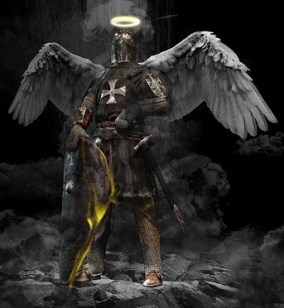 The Archangel Michael, whose name means Who is like unto God?, is the prince of angels. We read in Revelation why Holy Father Leo sought his intercession; it is Michael who leads the heavenly angels in the ultimate battle against Satan and his demons and teaches them why there are none like unto God. Apart from reciting the Pope’s prayer following Mass, let us also ask St. Michael’s intercession for all those who so often find themselves in harm’s way such as soldiers, first responders, and emergency workers. Let us also ask his intercession for ourselves during times of temptation as well as those who have fallen or are in danger of falling away from practice of the faith.
 As Christ commissioned San Lorenzo and his companions, so he commissions us. We are the light of the world; not the light of the rising sun but the light of the risen Son.
 St. Vincent de Paul didn’t begin any better than we, but he ended as well as we can ever hope to. What led him to a healthy, happy life? His relationships to God, his peers, and his flock. How does that help us? At least three ways. First, our relationship with God is at its best when we remember that He dwells not only above but also within each one of us; second, that when we reach out in love to others God is reaching them through us; and third, that we are both sheep and shepherd; the call to holiness is not only a call to take up our cross and follow Christ but to take up our staff and bring others to Him by the example of our lives.
 Mark 10:45