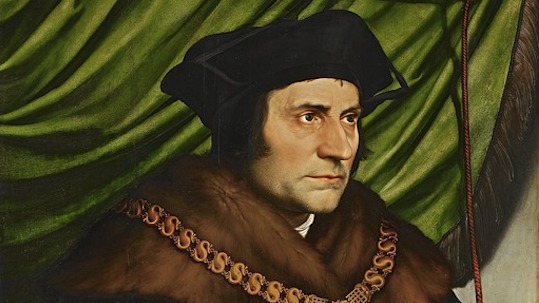
Genesis 12:1-9; Matthew 7:1-5
In the story The Emperor’s New Clothes, author Hans Christian Anderson cleverly lays bare not only the emperor but also the human tendency to go along with the crowd. This becomes most obvious near the end of the story, when a child proclaims the truth that all can see but none are willing to admit: “He hasn’t got anything on!”
In the England of the 16th century, King Henry VIII was emperor and his new clothes were the pretension that he alone held supreme authority over the Church in England. For reasons related to his marriage annulment from Catherine of Aragon it was convenient for him to believe this, and history is clear that those who surrounded the king were like the crowd in Anderson’s story; they knew it was fantasy but called it reality anyway.
Jesus had a word for them, and he used it in the reading from Matthew: hypocrites. The meaning of the word hypocrite has changed over the centuries. Nowadays we think of a hypocrite as someone who says one thing and does another, but in those days a hypocrite was someone who pretended, like an actor; a person who got along by going along.
In the reading from Genesis, Abraham went along with God, but there was no pretense. Although to the naked eye he held a promise as invisible as the emperor’s new clothes or King Henry’s pretensions, Abraham was in reality clothed by God in a seven-fold blessing that made him the father of one nation and a blessing for every other nation on earth. Abraham would never live in the Promised Land but he would build an altar there to worship the one, true, and living God.
This is the vision of true faith; it is the eyes to see the truth and the courage to live out the destiny that beckons, come what may.
Born of the same faith, this was the same vision given to St. John Fisher and St. Thomas More. When King Henry VIII demanded not a denial of the faith but a redefinition of it, they looked past their earthly king to their heavenly one. Christ was their help and their shield, and it was love for him and his Church that emboldened them to expose the naked ambition of a king who would arrogate to himself the keys of the Kingdom of God. Of course, that kind of courage comes at a cost, but the same courage that compelled them to remain with Christ did not abandon them when their own journey led them up the platform at Tower Hill in London to be executed.

While we must remember the courage and faith with which these men died, we must never forget that this was same courage and the same faith by which they lived; it is the same faith and courage by which we too must live. In our own time we have heard politicians warn, “Religious beliefs must change.” Henry VIII might have said that. How little things have really changed.
Like Bishop John Fisher, Sir Thomas More and all holy martyrs, our conscience must choose. Will we be the hypocrite who marvels at the emperor’s new clothes or the child who sees the truth and calls it what it is? The witness of the saints testifies now and for all time that there is only one Emperor; he who shed his vestments at the foot of the cross yet was clothed in the glory to which we all aspire and who comes to us cloaked in a host. Ask him and he will remove the wooden beam from your eye that you may better behold the wooden beam that saved the world.
St. John Fisher and St. Thomas More, pray for us.

 Of course t
 When we think of the dragon we think of the Devil and it is right to do so, for Scripture does refer to him that way (Revelation 12, for example). There is no doubt that the dragon is the Enemy but there is also no doubt that too often the dragon looks back from our own mirror. Worse yet, the victim does too; we allow sinfulness such a hold over us that in effect we devour ourselves, relent to the darker angels of our nature.
 The psalmist must have had Joseph in mind as he sang,
  At every apparition Mary is highly honored and rightly so for she is as she said, the Immaculate Conception. But the honor we give her goes far beyond her identity to the two-fold reality behind it. First, Mary points us to Christ. Through the grace bestowed on her by the will of God and her total abandonment to it, Mary has perfectly heeded her own advice:
  Angela Merici was a visionary; she saw what was invisible to everyone else. Where others saw the Italian countryside she saw the Kingdom of God; where they saw poor and middle class girls, Angela saw fertile ground waiting for seed. Christ asked her to sow and she obeyed. He asks no less of us. The Kingdom of God is here and now; the ground is fertile and plentiful. All our actions, for good and bad, fall like seeds into that ground. May we always remember what Saint Angela already knew, as given by the spiritual writer James Allen: “The law of the harvest is to reap more than you sow. Sow an act, and you reap a habit. Sow a habit and you reap a character. Sow a character and you reap a destiny.”
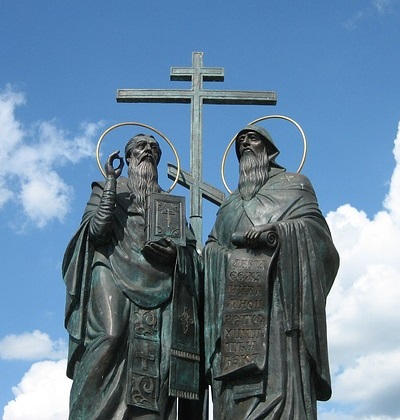 Saints Basil and Gregory can teach us many things, but today we focus on two. First, they teach us that faith in God requires true humility. Heresies are born from the pride that sees ourselves as the measure of all things; that interprets our failure to understand the truths of the faith to mean that the truths are wrong. True humility is as John admonished us, to remain in him; to see that God is the measure of all things and that our inability to understand means that we still have work to do. Second, in these days when the word “love” is so easily limited to physical expressions of self-gratification, the love of Basil and Gregory is a shining example of the most uplifting, life-giving love possible between people. This is the love that is modeled on God; that seeks only the good of the other; that finds its union with others in the heart and soul because that is where God dwells, and God is love. This is the love where heart speaks to heart and says, “I want for you what God wants for you.” My prayer is that all of us come to have that love for one another. What a world this would be.
 Like the mysterious sacrifice of the wren, this may leave us curious. Why does the Church take the first day after Christmas to remember the first martyr? The answer lies precisely in the similarity of Stephen’s passion and death to Christ’s. Christmas is the celebration of the birth of Jesus; the same Jesus who came not to be served
  The great gift of fertility given to Samson’s mother and to Elizabeth are confirmation that perseverance is rewarded. God sees all of us who endure desolation and, in his own time and manner, provides from the storehouse of his infinite mercy the life-giving consolation of his Spirit. When we find ourselves in times of desolation remember to ask the intercession of St. Elizabeth; she understands very well not only the pain of endless waiting but also the indescribable joy of the Holy Spirit’s three priceless consolations: The new life of St. John within her womb; the love and help of Mary, the Mother of Hope; and most of all the fulfillment of Hope itself: Our Lord and Savior, Jesus Christ.
 Mark 10:45