Romans 1:1-7; Luke 11:29-32
One day at a high school for wealthy children in India, a teacher happened to wander outside the school’s gates. In the poverty and misery that surrounded her, this young nun saw and heard something greater than the wisdom of Solomon. Saint Teresa of Calcutta spent the rest of her life serving the poorest of the poor in the gutters and slums of India and the world.
In another part of the world, a young Frenchman rejected the faith of his family and indulged in a carefree life of luxury. After squandering a huge inheritance he entered the military, who threw him out. His second attempt at military service drew him into contact with the people of the Sahara; in their poverty and solitude, this man saw something greater than the Temple. He went home, rediscovered his faith, became a priest, and returned to Africa. Blessed Charles de Foucauld spent the rest of his life ministering to the Muslims of the desert.
It would be hard to find two people more different at the outset, yet how similar they became. One a hedonistic playboy looking out only for himself; the other a consecrated religious doing what she thought God wanted her to do. Both were called by Christ to a life they would have never imagined and in the end would never relinquish. Their responses transformed them and transformed the world.
Their destiny points to the choice that Jesus lays before us. Either we can be part of the “evil generation” that demands the certainty of miraculous signs and rejects the certitude of faith, or we can use our God-given faith given to discern the only sign that matters. Jesus called it the sign of Jonah, but in reality it is his own true presence, for he is the Temple not made with hands; he is Wisdom itself.
 This is what the saints and the blessed have discovered. The greatest good in life is to see and serve Christ; that is what gives our life its ultimate meaning. However, we will never be able to do that until we see Christ in each other and become Christ for each other. St. Paul knew this; that is how he could write that the grace of apostleship is found in the obedience of faith. By faith we believe that God loves everyone and that we are to love as God loves, but it also teaches that the people who we think are least deserving of our love are the ones most worthy of it. Thus, obedience to the faith means that as apostles we are sent to be Christ and to find Christ in everyone, even those we find hardest to serve. Only grace can provide the humility and openness to vulnerability that can empower us to do the work for which we have been sent.
That brings us to the final point. Where have we been sent and who are we to serve? Consider this thought from Blessed Charles de Foucauld:
It is not necessary to teach others, to cure them or to improve them; it is only necessary to live among them, sharing the human condition and being present to them in love.
Put that in the context of this thought from Saint Teresa:
It is easy to love the people far away. It is not always easy to love those close to us. It is easier to give a cup of rice to relieve hunger than to relieve the loneliness and pain of someone unloved in our home. Bring love into your home for this is where our love for each other must start.
So, you are the apostle to your home, to your parish, and to your community. See Christ in them; love Christ in them; serve Christ in them.
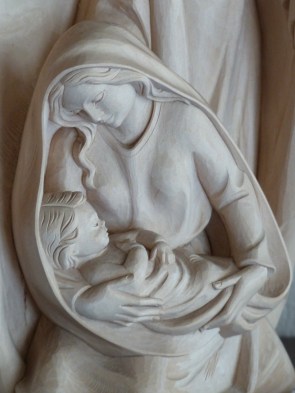 As the Catechism teaches, hope is “the theological virtue by which we desire the kingdom of heaven and eternal life as our happiness, placing our trust in Christ’s promises and relying not on our own strength” (CCC 1817). Joel pointed toward Christ our hope when he spoke of the spring that
 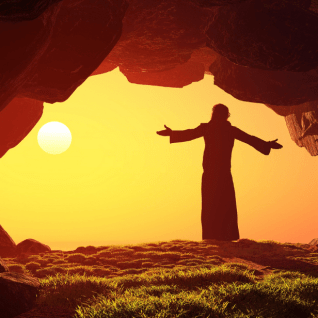 This is the strength that has inspired the saints throughout the centuries. Every saint knows what it means to wonder as Habakkuk wondered how and when God will fulfill his promises, but they also know what it means to offer themselves as the instruments through which that promise is fulfilled. Every saint knows what it means to face hardship or to be with others as they face them, but like Timothy and Paul they also know what it means to possess the grace to endure and to support others who need to endure. Finally, every saint knows what it means to feel as if their own faith is inadequate to uproot their mulberry tree full of weaknesses. But they also know what it means to surrender themselves totally to the power of the One who nailed those weaknesses to his own tree and cast them once and for all into the ocean of his infinite mercy.
 As Christ commissioned San Lorenzo and his companions, so he commissions us. We are the light of the world; not the light of the rising sun but the light of the risen Son.
 St. Paul reminds us of this when he says that grace is given to each according to the measure of Christ’s gift (Ephesians 4:11). His measure to Matthew was enough to transform him from a mere money-counter into an artist; indeed the artist who gave us the first portrait of Jesus in our New Testament. His medium wasn’t oil on canvas but words on paper, his subject not simply the man named Jesus but the Son of God and Son of Mary, the prophesied Emmanuel, “God is with us.” His palette held the many colors of Christ: teacher, healer, wonder-worker, Shepherd, Savior. He boldly painted all these images against a dark background for Jesus had come not into a roomful of Roman gamblers but into a land whose people were overshadowed by the darkness of sin and death. Where Caravaggio showed the light coming from behind Christ, Matthew knew that for all times and places Christ is the light – not the light who shines but the light who has arisen (Matthew 4:16). The long night of waiting, hoping, and wondering was over; the bright promise of salvation had dawned in Jesus, the Morning Star who never sets. This is why the great artist put the final brushstroke to his masterpiece in the words of our risen, ascending Master: And behold, I am with you always, until the end of the age (Matthew 28:20).
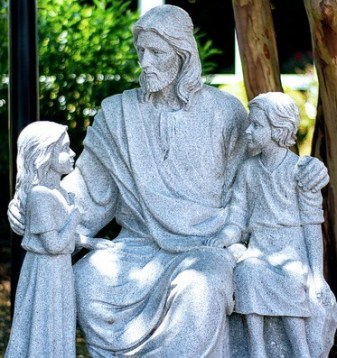 The example of the Korean Church and her martyrs teaches us that every heart open to God and acting on his word becomes a mother, sister, and brother to Christ. Even though we may not have the power of Orders, we do have Christ in the Scriptures and the power of the Holy Spirit through our baptism. We too can evangelize. If you don’t know where to begin, consider: Religious education programs can always use help teaching children the faith; there is a bible study nearby that would teach you more about Christ; there are many ministries that reach out to the hungry, the poor, and the mourning. Be docile to the promptings of the Holy Spirit; He will show you ways to bring Christ to someone in need.
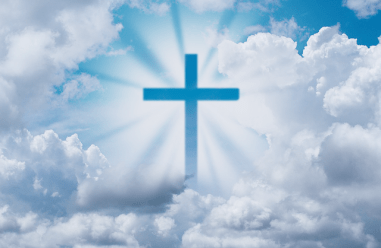 Finally, the cross is a sign of victory. It is the apparent irony seen throughout salvation history that God works for good by turning evil upon itself. It was Pharaoh who pronounced the curse by which his own people would most suffer: the death of every firstborn. In the desert it was the emblem of the serpent, reminiscent of the one whose envy brought death into the world, that would be lifted up on a tree as a sign of healing and life. It was Caiaphas, plotting to have Jesus executed, who unwittingly prophesied that it was better for one man to die than for the whole nation to perish. It was the Roman governor Pilate who first asked
  It was Simon’s willingness to put out into deep water and lower his nets despite his reservations that yielded him not only an abundant catch but more importantly the grace to see that the one who sent him was not to be called “Master,” but “Lord.” This is the same Lord before Whom we kneel as we say, “O Lord I am not worthy that you should enter under my roof, Speak but the word and my soul shall be healed.”
 The answer to all of this is given by Jesus in the gospel and can be boiled down to one word – vigilance. If you sense that you are distracted in prayer, then let that become your prayer. Say, “Lord, see how weak I am. I can’t even focus on you now when I need you the most!” In your weakness Christ will be your strength. If you feel like God is far away, remember: God doesn’t move, we do. Weak faith causes us to drift. We strengthen it with exercise, so pray more, not less; attend Mass more often; see him in Adoration. If you find yourself putting off prayer, remember Christ’s words: At an hour you do not expect, the Son of Man will come (Luke 12:40). Also, remember his reaction to finding people not doing what he asked; it did not go well for them. Finally, when you’re discouraged remember Abraham and everything he went through. In faith he left his native land, wandered homeless, and nearly lost his only son. As if that wasn’t enough, he was never allowed to actually live in the land he was promised. Those are pretty good reasons to be discouraged! Still, no matter where he was, he always built an altar and sacrificed to God. He could lose his home, his son, and the land of his inheritance, but he never lost heart; he remained faithful, prayerful, and vigilant to the end. So can we.
 Jesus could; Jesus did. He “took” the loaves and fish, “looked” to heaven, “said” the blessing, “broke” the loaves, and “gave” them to the disciples. If that sounds a lot like the actions of Jesus instituting the Eucharist, that’s because it is. In feeding the multitudes, Jesus showed that only God could carry the world; only God could unite a house divided. The Eucharist foreshadowed by Christ in the gospel is the sacrament of unity; it is the antidote to the enemy within that seeks to divide.
  Mark 10:45