Romans 8:31b-39; Luke 13:31-35
In the gospel we heard the Pharisees warn Jesus to leave town because Herod wanted to kill him. That was very nice of them! It leads us to believe that, even though they didn’t think Jesus was the Christ, he was still a fellow Jew; it was only right to see that he came to no harm. It was the brotherly thing to do.
Unless of course it wasn’t true.
Call me cynical but I think the Pharisees were fibbing. Why? I have three reasons. First, Luke has nothing good to say about them anywhere else; to them, Jesus was a nuisance to be disposed of. Second, Jesus had just publicly scolded them (Luke 11:37-54); they were very unlikely to be feeling all warm and brotherly toward him. Third, while it’s true that Luke doesn’t have anything good to say about Herod either, he does say that Herod wanted to meet Jesus for a long time, for he had heard about him and had been hoping to see him perform some sign (Luke 23:8).
But then why would the Pharisees deceive Jesus? Perhaps it was to test his resolve or try and break it. Knowing from their previous interactions that they were no match for him (Luke 6:1-11; 11:37-54), using Herod’s name was a way to threaten Jesus, to frighten him into going away and possibly even abandoning his mission.
We would naturally condemn the Pharisees for that but before we do, we should look inside ourselves. Ask yourself: Have I ever wanted to do something I knew Jesus would condemn yet made the deliberate choice to do it anyway? Have I ever promised him that I would never do it again only to repeatedly break my word? Do I pray “Thy will be done” but try my best to see that my will is done?
The truth is, we all have a Pharisee within. At one time or another, in one way or another, we are less than fully honest with our Lord. We say things we don’t mean, make promises we can’t keep, and twist the truth about ourselves, all in a vain attempt to hide what he already knows we are: sinners in dire need of his mercy and healing grace.
The true wonder is that our Lord knows all this and loves us anyway, even unto death. After all, the gospel concludes with Jesus naming his executioners and it wasn’t Herod, it wasn’t Pilate, it wasn’t any one person. It was Jerusalem. Specifically, it was people who prayed for him, waited for his coming, followed his ministry, and greeted him at the city gates with shouts of Hosanna. These were the same people who shouted, “Crucify him!” Not just people like us. It was us. We have all crucified our Lord with our sins.
So we are not only the Pharisee; we are Jerusalem.
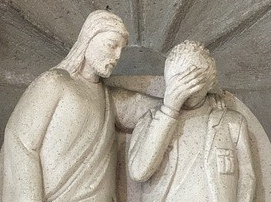 The psalmist today sings Save me O Lord in your mercy (Psalm 109:26). The readings are God’s answer to that prayer. In his infinite love and mercy he assures us that no matter how hypocritical we are, how much a Pharisee, or how much we deserve it, we are never alone. God is always true to his word and today his word is that there is nothing – neither death, nor life, nor angels, nor principalities, nor present things, nor future things, nor powers, nor height, nor depth, nor any other creature – that can separate us from the love of Jesus Christ our Lord (Romans 8:38-39).
Praise be to God!
 That is the image I think of now when I think of saints. Not images set in glass that glow with the sunlight, but people who now and forever glow with the radiance of the one true Light – Christ, the Morning Star who never sets.
 To win this combat and know the peace of Christ we need the armor of the virtues; prudence, to discern where our good lies; temperance, to know when we should move on; justice, to understand that the love we give our neighbor and God is the love we owe them; and fortitude, to constantly yield our will to that of Christ, for only his is the love that casts out all fear, not only restoring us to right relationship with the Father, but reconciling us with each other.
 In Luke’s gospel, Jesus said
  There is much more we could say on this, the day we remember him, but it would only belabor the point, which is that none of his work would have been possible unless this man had given himself completely over to the will of the Father, in devotion to our Lord Jesus Christ, through the power and inspiration of the Holy Spirit. But he did, and this masterpiece was the result.
 St. Ignatius of Antioch understood this. The depths of divine love moved him
  This is what the saints and the blessed have discovered. The greatest good in life is to see and serve Christ; that is what gives our life its ultimate meaning. However, we will never be able to do that until we see Christ in each other and become Christ for each other. St. Paul knew this; that is how he could write that the grace of apostleship is found in the obedience of faith. By faith we believe that God loves everyone and that we are to love as God loves, but it also teaches that the people who we think are least deserving of our love are the ones most worthy of it. Thus, obedience to the faith means that as apostles we are sent to be Christ and to find Christ in everyone, even those we find hardest to serve. Only grace can provide the humility and openness to vulnerability that can empower us to do the work for which we have been sent.
 As the Catechism teaches, hope is “the theological virtue by which we desire the kingdom of heaven and eternal life as our happiness, placing our trust in Christ’s promises and relying not on our own strength” (CCC 1817). Joel pointed toward Christ our hope when he spoke of the spring that
  We asked for other things; why should we be happy to receive the Holy Spirit instead? Consider everything he brings: Wisdom, the ability to see what is most important; understanding, to get to the heart of the matter; counsel, to submit to the providence of God; fortitude, the strength to pursue the good; knowledge, the ability to judge rightly; piety, reverence for God; and fear of the Lord, a love of God so deep that we would do nothing to hurt him. Poured lavishly upon us, these gifts bring us closer and closer to the mind and heart of Christ, who prayed as he lived – perfectly – that the Father’s will be done, who lived his prayer to the death, and who showed us that death is not the end but the pathway to resurrection and perfect unity with the Father.
 In the marvelous healing providence of God, it so happened that this same woman heard bishop Nonnus preach the homily the next day at Mass. Whatever he said moved her to repentance. She asked him to make her a Christian. Not long afterward, the same bishops who once looked away in disgust now watched in wonder as this woman threw herself upon the floor of the church, washed the bishop’s feet with her tears, and dried them with her hair. Once baptized, she traded her jewels for a robe and devoted the rest of her life to penance in the strict regimen of a cloistered monastery. The beautiful, bejeweled harlot once known in Antioch as Margarita (meaning “Pearl”) transformed herself into a beautiful model of penitence known to this day by her birth name, Pelagia.
 Mark 10:45