Isaiah 26:1-6; 55:6; Matthew 7:21, 24-27
In the 12th century the people of Pisa, Italy could say like Judah in the first reading, A strong city have we (Isaiah 26:1). A military, political, and economic force, they had recently triumphed over Palermo in Sicily and returned home with the fortunes of war – millions in booty and a shipload of soil from Golgotha in the Holy Land. Eager to show off their wealth, the people set aside a large plot of land called the Field of Miracles and in it filled a new cemetery with the sacred soil, built a majestic cathedral and baptistery, and set to work on what was to be the largest bell tower in the world – 200 feet high.
Unfortunately, Pisa could also say that the Lord humbles those in high places (Isaiah 26:5). Before it had risen 3 floors it was obvious the tower was leaning. Perhaps they forgot that the word Pisa is Greek for marshy land, its ground too soft to support such a structure. Construction stopped and started for centuries as different architects tried different things, all with the same result: Fixed on one side, the tower would lean the other. By 1990 it leaned so badly that it had to be closed to the public. Finally, after millions in repairs it reopened, still leaning. As one expert said, “Sandy and soggy ground is definitely not ideal for tall, heavy towers unless they have rock solid foundations.”
As we begin a new Church year in these early days of Advent let us consider our own spiritual foundation. Like ancient Pisa we have been given so much. We are a strong city – the City of God. Strong walls and ramparts protect us – the four walls of the one, holy, catholic, and apostolic Church. We have neither the marshland of Pisa nor the dirt of Golgotha but something infinitely better: The Father, the eternal Rock (Isaiah 26:4), his Only Son who died on Golgotha giving birth to the Church, and the Holy Spirit sent by them to guide her into all truth. And we have every tool needed to build our faith: Sacred Scripture, Tradition, and the teaching authority vested by Christ in his Church.
But all of that goes for nothing if we build our faith on the sand of ourselves and not on the rock foundation of God. How do we do that? By reading Scripture with our own mind rather than the mind of the Church; failing to give the assent of faith to Church teachings we find difficult; following whatever preaching tickles our ear; taking for granted or ignoring the Sacraments as the means of receiving sanctifying grace; and failing to see all people, especially those we don’t like, as made in the image and likeness of God and loved infinitely by him as we are.
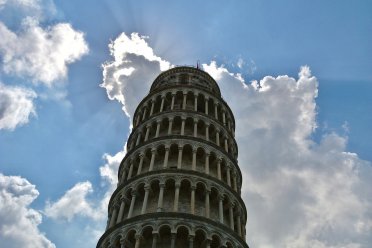 These and many more are like the soft, marshy soil below the tower of Pisa. Like that tower, a faith built on human weakness will lean and no amount of stopping and starting, tinkering and refining will fix it. It must be torn to the ground and rebuilt on the foundation of Christ and his Church, for we must take the faith as it is, not as we would like it to be.
This is painful but growth often is; to be fertile and capable of bearing fruit, soil must be dug into, plowed, upturned and weeded. It’s no different in the spiritual life; we must go deep into our minds and hearts, tear them open if need be, do all that we can to prepare them for the foundation of Christ. This will require that we come to him by repenting, admitting our weaknesses and failings, and resolving to amend our lives; trusting in God and all that he has revealed, whether we fully understand it or not.
These first two weeks of Advent are a time set aside by the Church for exactly this. Now is the time! As the gospel acclamation says, call to him while he is still near (Isaiah 55:6). In the end each of us will stand before him from one of two places: A tower of faith built solidly on the rock of Christ or one built on sand. The Master Builder has already given us his advice; we find it in Proverbs: Trust in the Lord with all your heart and lean not on your own understanding (Proverbs 3:5).
In other words, remember the tower of Pisa: When we lean on our own understanding, we simply lean.
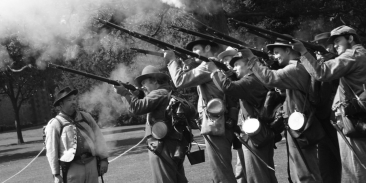 Eventually, Father was caught, imprisoned on a false charge and on the morning of November 23
 The two themes of fidelity and love are interwoven in the feast of the Presentation of the Blessed Virgin Mary. The presentation of oneself to God is an act of great faith and deep love. Whether Mary demonstrated her faith and love in a formal consecration to God in the Temple as described in the ancient non-biblical documents is irrelevant. Every day of Mary’s life was a presentation, a self-offering, an abandonment to the divine will made possible by the movement of grace within her. Long before he dwelled within her womb, indeed from the moment of her immaculate conception, our Lord dwelled within her soul and bestowed upon it the fullness of grace, his very life. By her response to that grace, Mary most truly defines what it means to be a Temple of the Holy Spirit.
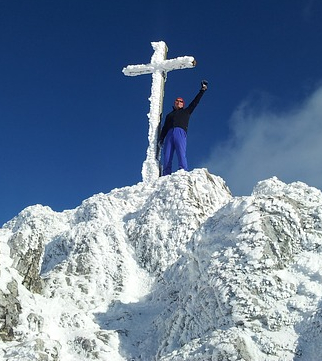 Persistence in prayer does not test God’s patience or change his mind; rather, it tests our faith and changes our attitude. Through his life and the Scriptures he has given the world, Jesus has told us that God loves each of us with a love beyond our understanding and knows our needs before we ask. That being so, God wants our prayer to consistently express the trust we have in him and his providence; that is the faith that Christ wants to find upon his return.
 No wonder. Internet scans, scrolls, and searches cannot bring the wisdom we need. As the first reading tells us, Wisdom is a spirit… Firm, secure, tranquil, all-powerful, all-seeing… the spotless mirror of the power of God, the image of his goodness (Wisdom 7:22, 23, 26). Wisdom is Christ, and his gift to us is wisdom as the fruit of the Spirit. A fruit born of the love of God, wisdom desires not only to be one with God but to see things as God sees them. Like any fruit, wisdom takes time to mature; its development a function of our life experience as seen through the lens of long-suffering that strengthens us to finish what we start, docility to listen as God speaks, and humility to remember that we are servants of God and each other.
 We who have inherited this faith must never forget these two lessons from the readings: First, the worth of the human body was not, is not, and never will be ours to decide. God has given us freedom, so we can define and re-define who is and who is not worthy to live, but in the end these are just words; our laws
 Finally, the parables teach us that the love of God works mysteriously through the process of conversion so that no matter how hard we search for Christ, it isn’t we who find him but he who finds us. Our life stories are a testament to the truth of the parables and Isaiah’s words that we have
 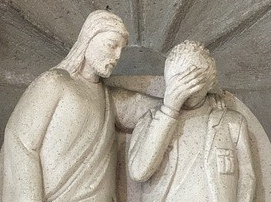 The psalmist today sings Save me O Lord in your mercy (Psalm 109:26). The readings are God’s answer to that prayer. In his infinite love and mercy he assures us that no matter how hypocritical we are, how much a Pharisee, or how much we deserve it, we are never alone. God is always true to his word and today his word is that there is nothing – neither death, nor life, nor angels, nor principalities, nor present things, nor future things, nor powers, nor height, nor depth, nor any other creature – that can separate us from the love of Jesus Christ our Lord (Romans 8:38-39).
 That is the image I think of now when I think of saints. Not images set in glass that glow with the sunlight, but people who now and forever glow with the radiance of the one true Light – Christ, the Morning Star who never sets.
 To win this combat and know the peace of Christ we need the armor of the virtues; prudence, to discern where our good lies; temperance, to know when we should move on; justice, to understand that the love we give our neighbor and God is the love we owe them; and fortitude, to constantly yield our will to that of Christ, for only his is the love that casts out all fear, not only restoring us to right relationship with the Father, but reconciling us with each other.
 Mark 10:45