Revelation 11:19a; 12:1-6a, 10ab; Luke 1:39-47
The book of Revelation is apocalyptic literature. This was a genre used in and around the time of Christ. It is overloaded with rich and mystical symbolism; a single image may represent multiple things. Further, the imagery can be violent and warlike, even though its ultimate message is one of hope and peace.
In the passage of Revelation chosen for today’s feast lurks a huge red dragon. The Hebrew word translated as dragon can also mean “serpent” or “sea monster” and is thought to represent the devil and the forces of evil, ready to make war against the Christ and his Church.
In late 15th century Mexico, the Spanish conquistador Cortez saw echoes of that dragon in the violent, warlike Aztec religion. Every year, thousands of people were sacrificed to appease its bloodthirsty gods. In 1487, the dedication of a new pagan temple saw 80,000 people sacrificed in just a few days. As if that weren’t bad enough, the dragon’s shadow also appeared in some of the immigrants to the new world, who spoke of peace but practiced avarice, treating the Mexicans and their land as things to be exploited for personal gain. Even some within the Church hindered the spread of the gospel by refusing vocations from the local community; Catholic Mexicans were not allowed to minister to their own people. It’s not hard to understand why many resisted converting to Catholicism.
If a reflection of the dragon could be found in the new world, so could a reflection of the woman. In 1531, a mystical apparition identified herself as “the ever Virgin, Holy Mary, the Mother of God” to a middle-aged Mexican man named Juan Diego. In Revelation, the woman was clothed with the sun, the moon under her feet, and wore a crown of stars. The apparition at Tepeyac is also rich in symbolism, but it is all Aztec. The woman stands in front of the sun, eclipsing the Aztec sun god; her foot rests on the moon, dominating their chief god, Quetzalcoatl; her mantle holds the stars, which they worshiped. Yet, the woman is not divine; her hands are in a posture of prayer and she looks down, which Aztec gods never do. She is a queen, for she wears the Aztec royal color of turquoise; a Christian, for there is a cross on her brooch, is pregnant, for she wears an Aztec maternity belt; yet she is a divine mother, for over her womb appears a four-petal flower, the Aztec symbol of a deity.
As important as her image was, her words were far more so; for what she said, how she said it, and who she said it to. She spoke in the language of the Aztecs, not in Spanish; she spoke to a simple peasant, and through him to all people; her message was one of comfort and hope: She was there; she was their mother; she held them in her arms, heard their weeping, and knew of their hardships and sorrows. Above all, she wanted them to rest assured that through her intercession they would be healed.
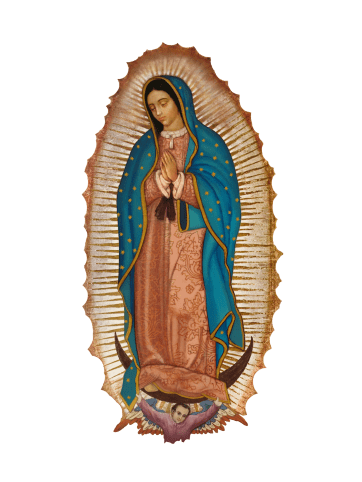 She became known as Our Lady of Guadalupe, and as word of the miraculous appearance and image spread, she became the most effective tool of evangelization that Mexico or the world had ever known. In the gospel, Mary carried the Eternal Word into the Judean countryside where the babe within Elizabeth’s womb leaped for joy; 15 centuries later, Mary’s maternal word went out into the Mexican countryside where millions leaped for joy. Conversions increased so dramatically that for a couple of years the missionaries could almost not keep up with them. More than that, the peoples’ faith was strong; to this day, the faith of the Mexican people remains vibrant, with deep devotion to Our Lady of Guadalupe.
In our own time the dragon still lurks. We do not have thousands dying in pagan temples, but we do have millions dying in abortion mills here and throughout the world. Still, the image of Our Lady of Guadalupe reminds us that the woman of Revelation is still present, still giving birth to the Church, still giving her ever victorious Son to the world. As she comforted the Mexican people, so she consoles us. She is our mother; she holds us in her arms; knows of our hardships and sorrows, and assures us that through her intercession, we too will be healed by Christ, her son.
Our Lady of Guadalupe, pray for us.
 Persistence in prayer does not test God’s patience or change his mind; rather, it tests our faith and changes our attitude. Through his life and the Scriptures he has given the world, Jesus has told us that God loves each of us with a love beyond our understanding and knows our needs before we ask. That being so, God wants our prayer to consistently express the trust we have in him and his providence; that is the faith that Christ wants to find upon his return.
 We who have inherited this faith must never forget these two lessons from the readings: First, the worth of the human body was not, is not, and never will be ours to decide. God has given us freedom, so we can define and re-define who is and who is not worthy to live, but in the end these are just words; our laws
 That is the image I think of now when I think of saints. Not images set in glass that glow with the sunlight, but people who now and forever glow with the radiance of the one true Light – Christ, the Morning Star who never sets.
 There is much more we could say on this, the day we remember him, but it would only belabor the point, which is that none of his work would have been possible unless this man had given himself completely over to the will of the Father, in devotion to our Lord Jesus Christ, through the power and inspiration of the Holy Spirit. But he did, and this masterpiece was the result.
 St. Ignatius of Antioch understood this. The depths of divine love moved him
  This is what the saints and the blessed have discovered. The greatest good in life is to see and serve Christ; that is what gives our life its ultimate meaning. However, we will never be able to do that until we see Christ in each other and become Christ for each other. St. Paul knew this; that is how he could write that the grace of apostleship is found in the obedience of faith. By faith we believe that God loves everyone and that we are to love as God loves, but it also teaches that the people who we think are least deserving of our love are the ones most worthy of it. Thus, obedience to the faith means that as apostles we are sent to be Christ and to find Christ in everyone, even those we find hardest to serve. Only grace can provide the humility and openness to vulnerability that can empower us to do the work for which we have been sent.
 As the Catechism teaches, hope is “the theological virtue by which we desire the kingdom of heaven and eternal life as our happiness, placing our trust in Christ’s promises and relying not on our own strength” (CCC 1817). Joel pointed toward Christ our hope when he spoke of the spring that
  In the marvelous healing providence of God, it so happened that this same woman heard bishop Nonnus preach the homily the next day at Mass. Whatever he said moved her to repentance. She asked him to make her a Christian. Not long afterward, the same bishops who once looked away in disgust now watched in wonder as this woman threw herself upon the floor of the church, washed the bishop’s feet with her tears, and dried them with her hair. Once baptized, she traded her jewels for a robe and devoted the rest of her life to penance in the strict regimen of a cloistered monastery. The beautiful, bejeweled harlot once known in Antioch as Margarita (meaning “Pearl”) transformed herself into a beautiful model of penitence known to this day by her birth name, Pelagia.
 This is the strength that has inspired the saints throughout the centuries. Every saint knows what it means to wonder as Habakkuk wondered how and when God will fulfill his promises, but they also know what it means to offer themselves as the instruments through which that promise is fulfilled. Every saint knows what it means to face hardship or to be with others as they face them, but like Timothy and Paul they also know what it means to possess the grace to endure and to support others who need to endure. Finally, every saint knows what it means to feel as if their own faith is inadequate to uproot their mulberry tree full of weaknesses. But they also know what it means to surrender themselves totally to the power of the One who nailed those weaknesses to his own tree and cast them once and for all into the ocean of his infinite mercy.
 Mark 10:45