
Thursday of the 6th Week of Easter
Acts 18:1–8
Not long ago, I was vacationing in Amish country – a place I’ve come to love for its quiet beauty and deep sense of tradition. One morning, I heard about a barn-raising that had happened nearby. Storms and the wear of years had left a farmer’s barn in ruins. While he might’ve been able to rebuild it himself, something else happened.
His neighbors came. Dozens of them – men, women, and children. Working together, down came the old, and up went the new. In a few days, that man had a brand new, beautiful barn.
What struck me most about it wasn’t the end result, as nice as I’m sure it was, or the amount of lumber, tools, or labor it took. Rather, it was the love and solidarity that clearly went into it. This wasn’t a one-off kind of thing; the Amish do this for their neighbors all the time. That’s the kind of stuff that builds a lot more than a sturdy barn – it builds a sturdy and life-giving community.
As if that isn’t enough, it’s also a powerful reminder that some things are just too big to do alone.
We see something similar in our reading from the Acts of the Apostles. Paul, newly arrived in Corinth, was just one man, like that Amish farmer. But as we also saw, it didn’t take long for God to surround him with help.
First, there were Aquila and Priscilla, fellow tent-makers, who helped in two ways: They took Paul in and joined him in spreading the Word. Next came Silas and Timothy. The presence and help of those four allowed Paul to focus entirely on what he did best – preaching the Gospel. What happened? The Church in Corinth began to grow. In time, it became an important center for Christianity. And while his beautiful and influential letters to the Corinthians turn our minds to him, St. Paul would be the first to say that building the Church wasn’t a one-person project; it took the effort of many people.
The Gospel was never meant to be a one-person job, and neither is the Christian life. We are saved as a people, not as isolated individuals. When our Lord ascended into heaven, he didn’t say, “Good luck, Peter, you’re on your own!” No, he promised to send the Holy Spirit to guide them (note, them) into all truth.
What does this have to do with us? Well, maybe today the Lord is asking us a couple of questions:
- Have we been trying to carry our burdens alone?
- Are we trying to “raise a barn” – be it our faith, our families, our vocation – by ourselves?
- Are we asking for the Holy Spirit to give us the grace to work together to build a parish, a community, and the Church?
Remember the barn-raising. Remember Corinth. Above all, remember this: The Holy Spirit doesn’t just build us as individuals. He builds us together and helps us raise the most magnificent barn of all – the Church, the Mystical Body of Christ.
—




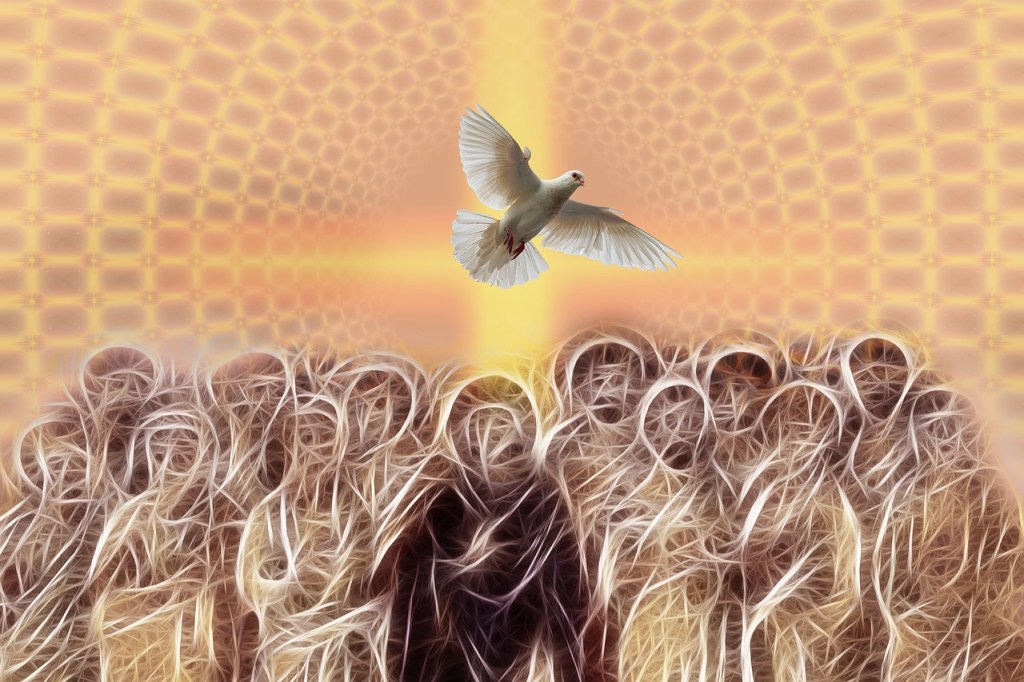


 The pattern of disagreement, debate, and decision is how things get most productively settled in the Church provided it is done in the right spirit; that is, the Holy Spirit. Since the Council of Jerusalem was called to settle the dispute between the Gentile and Jewish Christians this has been the model, its justification found in the letter issued from that Council, specifically the sentence that begins, It seems good to the Holy Spirit and to us (Acts 15:28). The Holy Spirit promised by Christ continually works within us, finding ways to maintain unity despite our differences. In all our human affairs but especially between the members of the Church what matters is not that we disagree but that we dialog, not the heat of our words but the light of the Holy Spirit, not the distance we keep but the fellowship we extend, and not the hostility throughout the debate but the peace of Christ we give in the resolution. As with Cyril and Methodius, some will not accept us or the decisions reached but we cannot help that. All we can do is what Methodius did: Continue to act in union with Christ and his Church, remembering always that it is not about us but about the Holy Spirit and us.
 Angela Merici was a visionary; she saw what was invisible to everyone else. Where others saw the Italian countryside she saw the Kingdom of God; where they saw poor and middle class girls, Angela saw fertile ground waiting for seed. Christ asked her to sow and she obeyed. He asks no less of us. The Kingdom of God is here and now; the ground is fertile and plentiful. All our actions, for good and bad, fall like seeds into that ground. May we always remember what Saint Angela already knew, as given by the spiritual writer James Allen: “The law of the harvest is to reap more than you sow. Sow an act, and you reap a habit. Sow a habit and you reap a character. Sow a character and you reap a destiny.”
 Mark 10:45