Tag: Discipleship

  • Happiness: Tuesday of the Seventh Week in Ordinary Time

    Readings: Sirach 2:1-11; Mark 9:30-37

    Are people who practice their faith happier than people who don’t? It would seem so, if the results of a recent survey on religious practice can be trusted. Data collected from people around the world showed that those who are actively religious tended to describe themselves as very happy more often than people who are not. Here in the United States the difference is remarkable; actively religious people were over 40% more likely to describe themselves as very happy.1

    We might wonder what the non-religious would make of this in light of today’s readings. First they hear Sirach say, “When you come to serve the LORD… prepare yourself for trials… in crushing misfortune be patient… For in fire gold and silver are tested, and worthy people in the crucible of humiliation” (Sirach 2:1-5). This is followed by Jesus predicting his passion and death and then telling his power-hungry disciples that those who wish to be first “shall be the last of all and the servant of all” (Mark 9:35). So, the non-religious person asks, happiness comes to those who endure trials, misfortune, and humiliation; who carry crosses, finish last, and act as everyone’s servant? Sounds like a recipe for making myself unhappier than I already am!

    If we define happiness as feelings of contentment, well-being, or pleasant experiences, then they have a point; trials, humiliation, crosses, and servitude are the furthest thing from pleasant. But this is a misunderstanding. Happiness is not a feeling, it is a state of being; specifically, it is the state of being in union with God.

    Look at it this way: Both religious and non-religious people have good times and bad; they undergo trials, are humiliated from time to time, suffer misfortunes, and know what it means to sacrifice. The difference is that religious people see these times not only as something to endure or to learn from but as opportunities to unite themselves to God and to others and in so doing come closer and closer to loving as God loves.

    hospice-1793998_640Divine love is the key to happiness. Again, although religious and non-religious people know what it means to love, there are at least two important differences. First, the religious person knows that we can only be happy to the degree that we love as God loves and that no one showed greater love than Christ. None endured more trials, suffered more humiliation, was crushed by more infirmity, carried a cross weighed down by more sin, or was more of a suffering servant than he who did it that we his beloved may be spared. With this depth of love as the standard, we are called to imitate Christ in the love we bear toward each other, even and perhaps especially those we think least worthy of it. We can never be happy without doing so.
    Yet even our best effort to show this kind of love is in vain without the second aspect – hope. As the Catechism reminds us, “hope is the theological virtue by which we desire the kingdom of heaven and eternal life as our happiness, placing our trust in Christ’s promises and relying not on our own strength, but on the help of the grace of the Holy Spirit” (CCC §1817). The non-religious may love and will find some contentment in it but without God, there is no happiness; with God, the hope of happiness springs eternal.

    We should not be surprised that those who have received the gift of faith are happy. Christ promised it to the mourning, the meek, and the merciful; to the peacemakers and the persecuted; the humble and hungry; to all those who would imitate the love he showed by offering himself for the life of the world: “Rejoice and be glad, for your reward will be great in heaven” (Matthew 5:12).

    1 Marshall, J. (2019). Are religious people happier, healthier? Our new global study explores this question. Available online as of 02/19/19 at https://pewrsr.ch/2MEWOYx.

  • Fragile Man

    Fragile Man

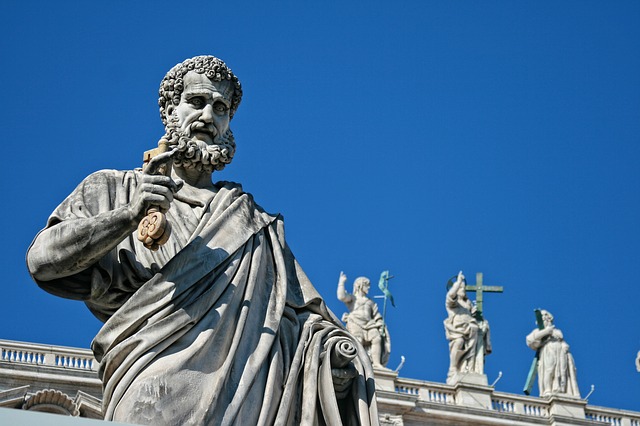
    Feast of the Chair of Saint Peter, Apostle

    1 Peter 5:1-4; Matthew 16:13-19

    • Pope St. Leo I, who singlehandedly faced down Attila the Hun, preventing him from sacking Rome, and who later spoke so eloquently about the person and nature of Christ that the bishops exclaimed, “Peter has spoken through Leo”;
    • Pope Nicholas II, who turned clerics into kingmakers;
    • Pope St. Gregory VII, who drove the German King Henry IV to his knees begging forgiveness after making him stand four days in the snow waiting for it;
    • Pope Julius II, the warrior pope known for his fierce temper or “terribilita,” yet whose great aesthetic sense drove him to commission Michelangelo, Raphael, and Bramante to create some of their greatest works; and
    • Pope Paul III, who excommunicated the King of England, Henry VIII, organized the Council of Trent against the Protestant Revolt, instituted seminaries to train priests, and founded the Roman Inquisition to enforce purity of doctrine.

    As we celebrate the Feast of the Chair of St. Peter, the Church gives us a selection from the first letter of Peter which tell us that those who tend the flock of Christ are to do so “willingly,” “eagerly,” and to “be examples.” As we look across the centuries, history shows that different popes have interpreted these words in very different ways. There have been forceful shepherds such as

    There have been more pastoral shepherds such as

    • Pope St. Gregory I, the first monk to be pope, such a deeply pastoral man that he saw himself as “the servant of the servants of God,” who took the care of his flock so seriously that he sold papal property to feed them;
    • Pope Innocent III, who approved the Franciscan and Dominican orders, greatly deepening the spiritual lives of the faithful for generations to come;
    • Pope Leo XIII, known as “the worker’s pope,” who laid the groundwork for Catholic social thought in the 20th and into the 21st century; and
    • Pope St. John XXIII, perhaps the most ecumenical pope in history, who called the Second Vatican Council, wrote an encyclical on world peace, and went out of his way to change the relationship of the Church to the world and to other religions.

    Of course, for every one of these shepherds we can name at least one whose pontificates were marred by scandals and abuses of every sort. And for every one of these, we can name perhaps a dozen more who passed through history almost completely unnoticed and who seem to have done nothing at all during their reign.

    Yet how like St. Peter they all are! Peter, who grudgingly re-cast his nets after catching nothing on his own, only to have Jesus fill them to the breaking point; who in one breath proclaimed Jesus as the Christ and in the next tried to talk him out of his destiny; who tested the reality of Christ’s presence on the water by walking on it himself and sank as the truth sank into him; who insisted that he would never deny Our Lord but did so three times; and who ran from the cross only to end his life on a cross of his own.

    And how well we know that St. Peter lies within each one of us. We let the Holy Spirit work within us, proclaiming Jesus as the Christ of God, yet at the same time allow the enemy to tempt us to lay down the cross Christ bids us carry. We challenge Christ to prove himself to us yet sink as he does so. We say that we would never deny him yet in fact deny him with every sin we commit.

    So as we look at every man who has ever sat on the Chair of Peter from the greatest to the least, we should see ourselves. Within each of us lies the strength and poetry of Leo I, the “terribilita” of Julius, the compassion of Gregory I, the resolve of Gregory VII, and the openness of John XXIII. The celebration of the Chair of St. Peter is at its heart a call to look within; to be as 1 Peter reminded us, shepherds in our own way, tending those around us with the care of the Shepherd who commissioned Peter himself, giving to fragile man the keys to the Kingdom of Heaven and best of all, who loved, forgave, and strengthened Peter as he loves, forgives, and strengthens us.

  • The True Tower to Heaven – The Seven Holy Founders of the Servite Order

    Genesis 11:1-9; Mark 8:34-9:1

    In the 12th century, Pope Innocent III looked upon a world that seemed to fit Christ’s description in the gospel: A faithless and sinful generation. Germany mired in civil war; the king of England plotting rebellion against Rome; Spain in the grip of the Moors; Jerusalem still under Muslim control. Closer to home things were no better; Italy’s city-states warring with each other and families within cities fighting each other for power and political control.

    As counterpoint to this, the Church tried to be a sanctuary of unity and peace. In Florence, a confraternity was formed known as the Society of Our Blessed Lady, composed of aristocrats, wealthy noblemen and merchants. By 1233, 50 years after its founding, the Society boasted 200 members.

    That same year on the Feast of the Assumption, seven members of the Society, aged 27 to 34, lingered in church after Mass. Separately yet simultaneously each received a vision of the Blessed Mother, who asked them to “Leave the world, retire together into solitude, that you may fight against yourselves, and live wholly for God. You will thus experience heavenly consolations. My protection and assistance will never fail you.”

    It couldn’t have been easy to just “leave the world.” These were businessmen with substantial fortunes and bright futures. Some had families; while three were celibate and two were widowed, two were still married. The call to leave everything might have seemed as difficult to them as it was to the disciples to hear Christ say that the only way to be raised to the glory of Heaven was to take up the cross on Earth.

    The human will naturally resists this. We want the glory but we want it our way. In the first reading, the people tried it their way; they disobeyed God’s command to populate the world, choosing instead to gather in one place to build a tower that would reach the heavens. But as our Lord implied in the gospel, heaven cannot be reached by human will; it can only be reached by the cross. The seven men kneeling in church on that August day knew this. Mary had shown them their cross, so they did as she asked. Renouncing their wealth, they left family and friends and lived outside the city walls in devotion to Christ.

    Finding solitude was no easier than leaving the world. As you might guess, such a radical change of life drew a lot of attention. The faithful, the doubters, and the merely curious all came to visit. Aware that this interfered with the Blessed Mother’s request, the men relocated to an isolated mountain north of Florence. There they took up the life of total devotion to God that Mary had requested. Thus energized to serve others, they began to teach against a popular heresy of the time and achieved great success. For this they were beloved by several popes and ultimately confirmed as the Order of the Servants of Mary, or the Servites.

    suffering-2668413_640In a sense, we are all Servites. Our mission is to witness the gospel, to be at the service of God and all people, inspired by Mary his Mother and most ideal Servant. We can only do this if we do as she did: Conform our wills to that of the Father and do whatever Christ tells us. Only He knows the cross that he has in mind for us. It may be to give up what we hold most dear, to separate from family or friends, and to devote ourselves totally to God. Whatever it is, let us pray for the grace to accept it, to bear it willingly, and to remember in the words of St. Rose of Lima that “apart from the cross there is no other ladder by which we may get to heaven.”

    Seven Founders of the Servite Order, pray for us.

  • The Language of Divine Love – Memorial of Sts Cyril, Monk, and Methodius, Bishop

    Genesis 6:5-8; Mark 8:14-21

    As I was just beginning my teaching career, a professor I once worked for gave me some very good advice. I asked her how I could tell if what I was trying to teach was actually sinking in. She replied, “Here’s my rule: If you see a student nodding her head up and down more than three times while you’re lecturing, she has absolutely no idea what you just said.”

    Mark does not depict the disciples nodding their heads but it’s pretty clear to their Teacher that they too had no idea at all what he had just said. After the disciples discovered that they had forgotten bread, Jesus made a spiritual point about leaven that went so far over their heads that, to paraphrase the ancient saying, he may as well have been speaking Greek.

    Greek would have posed no problem to the saints we remember today. These two brothers, Michael and Constantine, were born in northern Greece in the early 800’s and grew up bilingual, speaking Greek and Slavonic. Although both were well educated and could have attained great success in worldly terms, they were more interested in heavenly rewards. Michael left government service to profess vows, taking the name Methodius, while Constantine left academics, was ordained to the Diaconate, and became a renowned defender of the faith.

    At this time, a prince from what is now the Czech Republic asked the emperor to send missionaries who his people could understand. Constantine and Methodius were sent and they prospered. Not only did they translate the liturgy and the Bible into Slavonic, they invented a written alphabet to do it. Known as the Cyrillic alphabet, it is used in languages such as Russian to this day.

    Sadly, success in ministry sometimes breeds not praise but hostility; so it was for Constantine and Methodius. While the Slavic people took to the faith and loved their liturgy, missionaries from the West complained that they should be using Latin since that was the language of Rome. Pressured to conform, the brothers resisted and were forced to travel to Rome to explain themselves to the Holy Father, Adrian II. Impressed with their arguments and their success, the Pope granted an exemption, authorizing them to continue using Slavonic.

    While still in Rome, Constantine entered the monastery and took the name Cyril. He never returned to the East, dying in Rome just a few months later. His older brother did return, however, and trouble followed him. Without the Pope’s knowledge or consent, the local bishop continued to harass him for not using Latin. He was even horsewhipped and thrown in prison for his refusal. The pope discovered this and had him released, but the precedent had been sent; Methodius was systematically harassed for the rest of his life. His spirit undaunted but his body broken, he died April 6, 885.

    Of the many lessons that tstatue-2171097_640he lives and ministry of Cyril and Methodius teach us, perhaps the greatest is that the Holy Spirit transcends human barriers by speaking the language of Divine love; His is the tongue of fire that seeks nothing but to speak to every heart and kindle in it the fire of that same love. By using their God-given gifts to foster true understanding of the faith among people despite the cost to themselves, Cyril and Methodius showed that barriers such as human language are nothing to our God, in Whose eyes we are deeply and eternally loved, not for who or what we are, but that we are at all.

    Further, as the reading from Genesis implies, we grieve the heart of God not only when we ourselves remain cold to the Divine flame but when we try to extinguish that flame in others. Like the disciples in the boat, the missionaries who harassed Cyril and Methodius heard but did not understand. Perhaps it was envy or jealousy of the brothers’ ingenuity or success that hardened their hearts. Regardless, we are called to look inside ourselves and ask if we too are envious or jealous of the gifts God gave others. It is true that other people have gifts that we do not, but it is equally true that we possess gifts that they do not. To each has been given the same Spirit; from each is expected the fruits of that gift.

    Therefore, let us resolve to be fluent in the language of love: Pray and thank God for the gifts of the Holy Spirit given to ourselves and to all people of good will; work to develop those gifts that God’s will be done on Earth; rejoice in the success of these gifts and above all, remember that success in ministry means the salvation of souls, each infinitely loved by God, Who is Love itself.


    Saints Cyril and Methodius, pray for us.


  • More Powerful than a Thunderstorm – St. Scholastica, Virgin

    Mark 7:9

    Very little is known about St. Scholastica. Most of our information comes in the form of a single story, related most probably by Pope St. Gregory the Great in the 6th century.

    According to St. Gregory, St. Benedict had a sister, perhaps a twin, named Scholastica. Consecrated to the Lord as a child, she would visit her brother once a year at a place close to his monastery. On what would be their last visit in this life, brother and sister spent the whole day praising God and talking together. After they had dinner and it grew late, Scholastica asked him if he would remain and talk some more, to which Benedict replied, “What are you talking about, my sister? Under no circumstances can I stay outside my cell.” This may be because his own Benedictine rules required a monk traveling locally to return to the monastery the same day he left under pain of excommunication.

    Here we get a little insight into Scholastica’s personality and into the passage from Mark’s Gospel as well. After hearing his answer, she folded her hands on the table, leaned her head down on her hands, and prayed. As she raised her head, a thunderstorm broke clouds-3933106_640out with rain so intense that Benedict was forced to remain where he was. Seeing this, he became irritated and said, “May God have mercy on you, my sister. Why have you done this?” With tears in her eyes, she replied, “I asked you, and you would not listen to me. So I asked my Lord, and he has listened to me. Now then, go, if you can. Leave me, and go back to the monastery.” Of course, St. Benedict stayed and they talked through the night.

    Pope St. Gregory concluded, “It is no wonder that the woman who had desired to see her brother that day proved at the same time that she was more powerful than he was. For as John says: God is love, and according to that most just precept, she proved more powerful because she loved more.”

    From this we learn two things. First, even a saint as great as Benedict had to be reminded, as Christ reminds all of us in the Gospel, not to disregard the commandment of God by clinging to traditions of our own making. What is the commandment of God? To love Him above all things and our neighbor for love of Him. The rule of St. Benedict was and remains a masterpiece of spiritual discipline and tradition in the Benedictine community. Nevertheless, St. Scholastica’s great love demonstrated that it is not proper to cling to any tradition at the expense of the commandment to love as God loves.

    Second we learn that, although we may not live by the rule of St. Benedict, our personal rules and habits can get in the way of advancement in the spiritual life. Being human, we are subject to forming habits; however, a routine prayer life invites dryness. Even worse, interruptions in our routine become obstacles that cause us to lose perspective. I know it’s probably never happened to you, but we all know people who have gotten upset upon walking into Mass only to find someone sitting in “their” pew! Allowing such things to be a distraction is a sure sign that our prayer habits might have become more important than the One they are intended to honor.

    Let us allow St. Scholastica’s thunderstorm to remind us that whatever hinders our spiritual growth – whether dryness in prayer or irritation when our routines are interrupted – is waiting, with a little effort on our part, to be washed away in the love, grace, and mercy of God that constantly rain all around us.

    St. Scholastica, pray for us.


  • Come Away By Yourselves – Saturday of the Fourth Week in Ordinary Time

    Hebrews 13:15-17, 20-21; Psalm 23:1-6; Mark 6:30-34

    Some of the best advice I ever got about working in the Church came from a spiritual advisor who encouraged me to “look for ways to unwind” with other clergy and parishioners. He said that part of our job is to teach people by example that we’re not meant to spend all of our time together exclusively at Mass or in meetings; we should make time to talk, relax, laugh, get to know each other, and enjoy each other’s company.

    Jesus models this in today’s gospel. Recall that the Twelve had been sent out on a mission to preach, exorcise demons, and heal the sick. Now they have returned, reassembled, and just recounted to their Master all that happened to them on their journeys.

    I know from personal experience that there is joy both in the mission and the return. In the mission we use the gifts we have been given in the way best suited for the situation; this is the time to plant seeds as best we can and to pray for their growth. During the mission time we experience all that it has to offer – good and bad – and these affect us for the better and the worse. Our return is the opportunity to share these experiences with each other and in so doing relive the triumphs, laugh at the mistakes or foibles in ourselves, but also to relieve the stress of the problems and see that we are not alone; others along the way have seen many of the same things.

    By inviting the Twelve to “come away by yourselves to a deserted place and rest a while” (Mark 6:31), Christ modeled the virtue of temperance. Mission and return, as fulfilling as they are, aren’t enough. We also need leisure; not so much a time to play as a time to unwind, to share quiet, personal time with each other and most importantly with Him. There will be no advance in our spiritual life without such a retreat.

    Take a moment to picture in your mind what this time with Jesus might look like. Choose your own deserted place – just you, a small group of friends, and Christ. He wants nothing more than to be with you and spend the afternoon. He has no agenda other than you; to listen to you, laugh and/or cry with you, and to enjoy the peace of the moment together with you.

    We all know that on this side of eternity that kind of time won’t last forever. The mission must begin anew. In the gospel at that very moment the crowds were searching for them and did find them. In his infinitely merciful love, Christ fed them and will soon teach his Apostles how to do so by the thousand.

    But the lesson today is that the mission best begins anew once its ministers are renewed. Our bodies and spirits grow weary and need recharging. Without renewal we risk burning out instead of burning with the Spirit; the same fields that shine for the harvest come to resemble the dark valley of the psalm (Psalm 23:4).

    jesus-3499151_1280Nevertheless, the letter to the Hebrews assures us that the God of peace furnishes us with all that is good, that we may do his will and carry out what is pleasing to him through Jesus Christ (Hebrews 13:20-21). The greatest good is Christ, the Good Shepherd who remains at our side and invites us to come away by ourselves and rest awhile. Only there, beside the restful waters where he restores our soul, can we the sheep once again become the shepherds he has called us to be.

  • Seeds on the Divine Wind – St. Paul Miki and Companions, Martyrs

    1 Kings 3:4-13; Mark 6:30-34

    For many people, the word “kamikaze” conjures up images of Japanese pilots crashing their airplanes into Allied ships in a suicidal attempt to stop or slow the defeat of the emperor and invasion of Japan. However, few people know that in Japanese, kamikaze means “divine wind,” and dates back to the 13th century, when two Chinese invasion attempts were repelled by powerful storms, “divine winds,” believed by the Japanese to have been sent by the Shinto gods to protect them.

    A few centuries later, a different wind quietly blew onto Japanese shores. The great Jesuit missionary Francis Xavier swept through the island preaching Christ and baptizing thousands. About twenty years later, one of the seeds he sowed took root in a distinguished Samurai from Kyoto; in 1568, he was baptized along with his wife and their four year-old son, who we know as Paul Miki.

    As Miki grew, Christians were free to practice their faith despite the emperor’s reservations. He distrusted Christianity because the missionaries were Western, but he ignored it when converts were few. However, like the Jews in the reading from Mark, the Japanese people began coming to Christ in great numbers. By 1596, the emperor’s fear finally got the better of him; he banished foreign missionaries and commanded the native Japanese to renounce Christ or die.

    By then, Paul Miki was 33 years old. He had been a Jesuit brother for 11 years and was not far from ordination to the priesthood. Like Solomon in 1 Kings 3, the Spirit had been poured abundantly upon him; Miki was an eloquent teacher, a gifted homilist, and was graced with a large and forgiving heart.

    These gifts were soon on display. Convicted of practicing Christianity and sentenced to be crucified, Paul Miki and about two dozen others were forced to march about 400 miles, from Kyoto to Nagasaki. The journey took a month and contained its share of jeering from hostile Japanese who saw Miki as a disgrace. He saw these taunts as opportunities for conversion; he wanted everyone to share in his Master’s joy.

    As with Jesus and his Apostles in the reading from Mark, vast crowds awaited their arrival. Nagasaki was largely Christian; her people were genuinely moved at the sight of the prisoners. Looking at them, Paul Miki saw this as an opportunity not to be consoled but to console; to urge them to deeper faith and assure them that he was praying for them.

    The prisoners were strapped to their crosses, with iron rings holding them at the neck. Hoisted on this pulpit, Paul Miki saw the crowd perhaps as Jesus did in the gospel; like sheep without a shepherd. He, too, was moved with pity, and took these final moments to show how one lives for Christ and how one dies for him.

    He forgave the emperor and his executioners, and prayed that they too would become Christian. He confessed Christ as his Lord and Savior, and himself as a soldier, a samurai, honored to die for love of him. Finally, in imitation of Jesus, he commended himself to God, saying, “Father, into your hands I commend my spirit.” He was then executed by a thrust of the lance.

    If the emperor counted on this persecution to chase Christianity from Japan, he badly miscalculated. After the deaths of Paul Miki and his companions, conversions increased; Catholicism was in Japan to stay.

    dove-3951312_1920.jpgChristians are martyrs, not kamikazes. The word martyr means “witness,” for that’s what a martyr does; they witness the faith in whatever circumstances they find themselves. What St. Paul Miki knew, and what the emperor could not understand, is that there is only one true kamikaze, one Divine Wind. The Holy Spirit graces each martyr with the gifts they need to witness the gospel according to their inclinations; always for the building up of the kingdom.

    We must ask for the gifts to be witnesses, just as Solomon and St. Paul Miki did; not for our own sake, but for the good of all God’s people. God has shown that this prayer, and the work that goes with it, are amply rewarded. As Jesus said:

    Give and gifts will be given to you; a good measure, packed together, shaken down, and overflowing, will be poured into your lap. For the measure with which you measure will in return be measured out to you (Luke 6:38).

    St. Paul Miki and companions, pray for us.

  • The True Reward – Tuesday of the 4th Week in Ordinary Time

    Hebrews 12:1-4; Mark 5:21-43

    Today we are presented with two characters who are among the easiest in the entire gospel of Mark to sympathize with. The first is Jairus, the father of a dying twelve year-old girl; the second, an unnamed woman plagued with continuous menstrual bleeding. Who cannot sympathize with a man helplessly watching as life ebbs from the body of his daughter, or a woman left broke from futile medical treatments whose perpetual state of uncleanness condemns her to live out her life suffering and isolated from her family, friends, and society at large?

    Yet for all that the evangelist doesn’t want to evoke sympathy; rather, his intention is to draw us into the action, to see ourselves in the stories and characters. This is an effective technique not only for contemplating and better understanding the actions of Christ and those around him but ourselves as well.

    These characters make this easier because their stories resonate across time. We’ve all known people whose children have suffered life-threatening illnesses or who have gone from doctor to doctor with no relief of their suffering. We may be those people! What did we do? Being believers we prayed, asking God for relief. Certainly Jairus and the woman prayed; however, neither had gotten the answer they wanted. The question is, what would our reaction be to that?

    If we’re honest with ourselves we must admit that sometimes when our prayers are not answered as we want, we’re tempted to stop praying; to be angry at or resentful toward God. While this is perfectly normal the honesty works both ways; that is, if we’re going to question God’s motives then we must question our own by asking if our image of God is as a Father or as an instrument to be used (CCC §2734)? That is, are we praying “Thy will be done” or “My will be done”?

    Consider Jairus. Mark calls him a “synagogue official” and in his gospel they are no friends of Christ. Even if he was a disciple, the scandal of association might have kept him away. No matter; his love for his daughter eclipsed everything. Even if his prayer at the feet of our Lord was tinged with ambivalence or fear, Jesus rewarded him for overcoming it and trusting in God’s providence rather than his own understanding.

    Next, consider the woman by the side of the road. She was afraid to approach our Lord, perhaps because of her impurity. Nevertheless, her desperation and frustration drove her to find Jesus, if only to touch his garment. While her immediate healing implied faith on her part, Jesus wanted her faith expressed.church-753815_1920 Even so, he doesn’t demand, only asks, “Who touched me?” Now think about her response. She could have hidden or run away; instead, she approached him and confessed all. Only then did he say that her faith cured her.

    The letter to the Hebrews exhorts us to “rid ourselves of every burden and sin that clings to us and persevere in running the race that lies before us” (Hebrews 12:1-2). This is much easier said than done when we are suffering but the key lies in the next phrase of that verse: “while keeping our eyes fixed on Jesus, the leader and perfecter of faith” (Hebrews 12:2). The important thing is not that Jairus and the woman understood or were unafraid; they may have understood nothing and been completely afraid. The important thing is that they persevered, they kept their eyes fixed on Jesus. They allowed faith to be their guide and in so doing went beyond their understanding, beyond their fear.

    That is the boldness of faith, founded on divine love and rewarded with transformation of the heart (CCC §2739). It is true that both women in today’s gospel story were healed, and that is a reward in itself, but the true reward given to Jairus and the woman was transformation of the heart. This transformation causes us to seek only what pleases the Father, and it’s why St. Josemaria Escriva urged us to begin our prayers of petition with the words, If it pleases you, Lord…. He knew, as the Catechism teaches, that “If our prayer is resolutely united with that of Jesus, in trust and boldness as children, we obtain all that we ask in his name, even more than any particular thing: the Holy Spirit himself, who contains all gifts” (CCC §2741).


  • The Greatest Gift – The Purification

    Luke 2:22-35

    Although St. Luke writes in his gospel account that the time was fulfilled for “their” purification, he really was referring only to the Blessed Virgin Mary. We have always known and honored her as Immaculate Mary, sinless from the moment of her conception by the gracious act of her Son and Lord. Given that, how could she possibly be in need of purification?

    This isn’t the time or the place for a lecture on ritual impurity laws, but suffice it to say that it had nothing necessarily to do with sinfulness. For example, it wasn’t sinful to bury the dead; that was and still is an act of mercy. However, even standing in the shadow of a coffin was terribly defiling for an ancient Jew. Similarly, it wasn’t sinful to give birth; one was fulfilling the command of God to be fruitful and multiply. However, because it put a woman in danger of death – and many women did die in those days due to the complications of giving birth – it put her in a state of ritual impurity.

    The book of Leviticus chapter 12 says that 40 days after a woman has given birth to a son, she is to be purified. So, the first thing that Mary needed to do was to come to the Temple.

    Jewish historical tradition holds that the Temple was built on Mount Moriah, the mountain where, by the command of God, Abraham was to sacrifice his son, Isaac. Carrying up the mountain the wood for the burnt offering, Isaac asked his father where they would find the sheep for the sacrifice. Abraham’s answer was mysterious, yet prophetic: God would provide the sheep.

    With this in mind, consider that the second thing a woman seeking purification needed to do was to bring a lamb to the Temple for a burnt offering. Only after the lamb had been sacrificed was she made clean. If she could not afford a lamb, then two turtledoves or pigeons could be substituted, and St. Luke does note that these were what the Holy Family did bring.

    Yet for her purification the Blessed Virgin Mary has in reality brought the greatest gift that both the Temple and the world have ever known. God himself is the deliverance; He has fulfilled Abraham’s prophecy and answered Isaac’s question by sending his only Son as the lamb for the sacrifice.

    On the one hand, this is a moment of great rejoicing, and we hear how Simeon does rejoice. These people had waited centuries for deliverance and, by a singular grace of the Holy Spirit, Simeon had been allowed to see and hold in person the long-awaited deliverance and glory of his people, Israel.

    maria-100112_1280

    On the other hand and by the same grace, he sees the bitterness that lies ahead. As certainly the shadow of the cross stretches from the dawn of human history to the twilight of the Second Coming, so Simeon sees its shadow across the face of infant and mother. Just as this little baby would one day grow up to speak words that cut as sharply as a two-edged sword, even so would the God-man’s side feel the wound of a different blade on a different mount in Jerusalem. As for the mother, while Abraham was spared the grief of losing his son, the Blessed Mother would be asked to endure his loss twice: first from the family and then from earthly life itself.

    Thus in the purification of Mary we learn that God keeps his promises, not on our terms or in our time, but on his terms and in his time; not for our understanding, but for our benefit; not in the warm light of earthly glory, but in the cold shadow of a cross; and not to spare us the pains of separation in and from this life, but to lavish upon us the joy of eternal union with Him in the life to come.


  • From Little Seeds – Friday, the 3rd Week in Ordinary Time

    Psalm 37:5; Mark 4:26-34

    Tradition dating from the second century tells us that St. Mark was writing to a Christian community in Rome that had experienced its share of persecution and failure. This was a community where it seems that people were leaving the faith under the threat of torture or death, leaders were more interested in preserving their own well-being than in leading the community, and evangelization was met with indifference or at times hostile rejection. Under these conditions, it would be hard not to lose hope.

    Given that, it might be hard to understand how such a community would benefit from grasses-1939673_1280hearing parables about farmers and seeds. For that matter, it may be hard for us in the modern age to see the point. Jesus teaches us that seeds grow in the ground of their own accord and mustard seeds are small but grow into bushes large enough for birds to nest in. OK, but what is the point of this?

    Simply put, Jesus is giving both them and us very good reason to hope.

    Earlier this week, we heard him explain that the seed is the word of God. Once, those seeds were sowed within us. We heard them and over time they took root and grew. Now we are called to sow the same seeds in the hearts and minds of other people.

    Here though we must remember one important point. Jesus teaches that those who sow the word do not control the growth. Just as a farmer can cultivate the soil, plant at the right time, and rotate the crops, but cannot control the elements, so it is with us. We sow the word in whatever ways our talents lead us, but we cannot worry about how to control its growth. That must be left to God. We are asked only to have faith that God will bring forth abundance in his own time according to his own design.

    The second point concerns the seed itself. Namely, the seed is not only the word; it is also the person in whom the word has taken root. Jesus reminds us that from something as tiny and insignificant as a mustard seed comes a bush that can flower and grow several feet high. Imagine that one little seed as one seemingly insignificant person. Isn’t that how God has always worked? In the Old Testament, think of Joseph with the coat of many colors; Moses; David. In the New Testament, think of Mary, the mother of our Savior. It’s always the little people, the human mustard seeds, in whom the word of God flourishes and through whom mighty things are accomplished.

    Taken together, these parables told St. Mark’s community exactly what they needed to hear, and they do the same for us. First, the seed is the word of God. It has been sown in us and we are to sow it in others. It will flourish, but it will do so according to a design over which God alone has control. Second, no person, no community is too small or insignificant to serve as an instrument for God. There is great hope, for all that is needed is openness to hear the word of God and do it.

    As Psalm 37 reminds us: Commit to the LORD your way; trust in him, and he will act (Psalm 37:5).