Tag: Discipleship

  • I Saw You

    I Saw You

    Feast of St. Bartholomew (August 24)

    Revelation 21:9b-14; John 1:45-51

    There are many things to love about today’s Gospel, but let me mention three that caught my attention.

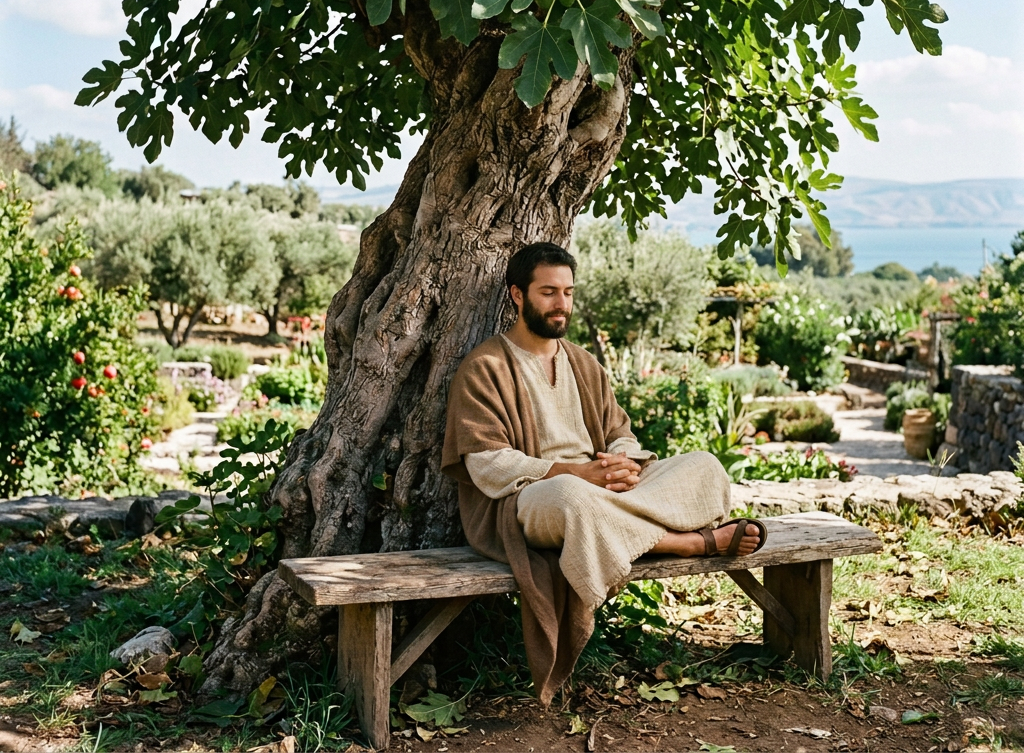
    First is the image of Nathanael under the fig tree. I can’t help but wonder what he was doing there. Guesses abound and we can’t know for sure, but as I see it, he was doing what I think we’ve all done and still do: sitting alone in a quiet place, thinking. And not just thinking, but asking questions, wrestling with God, and waiting for an answer – a clue, a light in the darkness, some revelation telling him that God is listening and will respond.

    Then come those great, consoling words of Jesus: “I saw you under the fig tree.” No wonder Nathanael was amazed! I wonder if we think about that enough. Even in our fig tree moments, we are never alone, never unseen. God is always there; watching, listening, and planning. We talk to Him, perhaps look at Him in the tabernacle or monstrance, but do we realize how close He is, and that as we are looking at Him, so He is looking at us? We may hear nothing, but silence doesn’t mean abandonment. “I saw you” is Christ’s great assurance that our waiting is never wasted if we remain grounded in faith.

    And that faith can be tested, for as the story shows, God’s answers can come in quite unexpected ways. I doubt that when Philip spoke of the one who Moses wrote about, Nathanael thought, “Ah, the answer to my prayers under the fig tree!” His reply shows it: “Can anything good come from Nazareth?”

    What makes this so intriguing is Nathanael’s response. When Philip said, “Come and see,” he could have easily replied, “No, thanks. I have other things to do.” He didn’t; instead, he opened himself to the possibility. He went and saw.

    This is a good time to stop and thank God for the “Philips” of the world. Ask yourself: Who has been Philip to me? Who ever invited me to “come and see” – maybe a parent, friend, priest, or teacher? And to whom am I Philip? Who do I invite? Do I live in such a way that people will want to know the source of my peace, joy, and hope?

    Finally, consider our Lord’s response to Nathanael’s amazement at being seen: “You will see greater things than these…”

    Of course, he did. And while he probably had many more “fig tree moments” in the days and years to come – times he wondered, was challenged, questioned, or suffered – these were nothing compared to what God had in store for him. Especially in the life to come, for as we heard in Revelation, “the holy city Jerusalem coming down out of heaven” has 12 foundation stones. One of them bears his name.

    St. Nathanael, or Bartholomew as today’s Feast calls him, is a wonderful model for us. He teaches us that our fig tree moments, and even our encounters with Jesus, aren’t the destination. They’re just the beginning of what God has ready for us, things far beyond our imagination. Like Nathanael, we may question, wonder, and not understand, but that’s not what ultimately matters. What matters is that we do what he did – keep asking, stay open to finding the answers, go where our Lord leads us, and keep faith that we, too, will see “greater things than these.”

    St. Bartholomew, pray for us.

  • Labors of Love

    Labors of Love

    Feast of St. Lawrence, Deacon and Martyr

    2 Corinthians 9:6-10; John 12:24-26

    Recently, I was looking back on all the things I did as a young man — raising three kids, working two jobs, studying, going to school — and I wondered where I found the energy. Sure I was young, and that matters, but what also matters is that these things were a labor of love. I wasn’t doing them for myself; I was doing them to provide for my family.

    They weren’t small things, and they required sacrifice. But love made them seem small, and if they were a sacrifice, they were joyfully done. Looking at what came from them— especially my kids, and seeing how they have grown and are making their way in life — I can say that those labors of love were very much worth it.

    I couldn’t help but think of that as I read today’s passage from St. Paul. If our self-giving becomes a labor of love for Christ, then his grace becomes our strength. And as St. Paul says, the fruits of our labor will be multiplied.

    And that multiplication isn’t simply a reward. It’s a participation in divine generosity. God doesn’t merely return to us what we give; He multiplies it.

    Think about a parent raising their children. We pour love into them, and then, if all goes well, they learn to love others in the same way. We benefit, they benefit, and everyone they love benefits. The harvest of love expands.

    That’s the mystery Jesus describes in the Gospel: “Unless a grain of wheat falls to the ground and dies, it remains just a grain of wheat. But if it dies, it produces much fruit.”

    Certainly, love requires dying to self. But when all is said and done, is that what we remember most? Probably not. Why? Because the love we imitate — the love of God — gives by its very nature without counting the cost. The grain of wheat doesn’t stop to calculate what it is giving up. It does what is in its nature to do: it falls, it dies, and eventually it bears fruit.

    Often, we don’t see the fruit in that moment; we don’t see what our sacrifices are accomplishing. We can’t “see” the child being formed, the marriage being made stronger, the family being held together, or the faith being passed on. It might be years until we see the fruit, but when we do we realize that God’s grace multiplied what our love made possible. And we rejoice.

    The example of St. Lawrence shows us that this is true even when the giving is literally unto death. Most of us know the famous tradition about his martyrdom: that as he was being burned on the gridiron, he joked about being done on that side. That image endures for a reason; Lawrence wasn’t just a man enduring suffering, he was a man facing death with joy.

    That’s not stoicism. That’s love.

    St. Lawrence had already poured himself out for Christ and for the poor. The fire was simply the final act of a life that had already become a gift.

    While none of us are facing Lawrence’s gridiron, we all know what it means to feel exhausted or overwhelmed, to wonder where we’re going to find the energy to keep giving.

    Christ gives us the answer today. It isn’t simply more discipline or willpower. It’s love; love oriented toward Christ, animated by his grace, and willing to trust him to bear fruit in ways we may not see for a long time.

    St. Lawrence didn’t count the cost before he walked into the fire. He simply loved. More importantly, he knew that long before he ever loved Christ, Christ loved him. Long before he gave himself to Christ, Christ gave himself for him. And he knew his own labors of love were a response to the love Christ had already poured into his life.

    So today, let’s remember that the same is true for us. Each of us is Christ’s unique and precious labor of love. In every moment of our own labors – in the sacrifice, in the exhaustion, in those moments we wonder if what we’re doing will bear any fruit – Jesus is there; loving, consoling, and rejoicing in the harvest. Just as he did with St. Lawrence.

    St. Lawrence, pray for us.

  • Am I Ready?

    Am I Ready?

    Monday of the 15th Week in Ordinary Time

    Isaiah 1:10-17; Matthew 10:34-11:1

    A few years ago, a young married couple out for a Sunday morning drive happened to pass our parish. On a whim, they decided to stop in. The Mass intrigued them, so they kept coming back. Eventually, they enrolled in RCIA and seemed to really enjoy it. It looked like the Holy Spirit was drawing them home.

    Then, in RCIA class, we got to the part where we talk about the Christian life; not as a list of rules, but as the natural consequence of belonging to Christ. They realized that becoming Catholic would require changes in the way they were living.

    They thanked me sincerely, said they had learned a great deal, but added, “We’re just not ready to make that kind of change.”

    With that, they walked away, and I’ve never seen them again. I pray they tried again at a parish closer to their home.

    I admit it – my first temptation was to get a little “judgy.” How could they just walk out like that? But as I gained some perspective over time, I think they were simply being honest with themselves and with me.

    They were intrigued by Jesus, and it’s easy to see why. There’s something about him, his teaching and his life that always has and always will draw people.

    But Jesus doesn’t want to intrigue us. He wants to be our Lord. And if he is Lord, then every other loyalty — even the best — is measured against our loyalty to him.

    That’s exactly what Isaiah is saying in the first reading. God isn’t impressed by worship that never reaches our hearts. He wants lives that have been changed by the One we worship.

    So that gives us the direction we need. Let us ask ourselves:

    If Jesus asked me today to change one part of my life — not someone else’s, but mine — which part would it be? And would I say yes? Or would I politely thank him for everything he’s taught me and say, ‘Lord… I’m just not ready to make that kind of change’?

    Allow that question to sit with you a while. It may cause a bit of discomfort, but if so, rejoice! That is, as our Lord said in the gospel, not peace but the sword, striking us right where we need it most — between the comfort we cling to and the faith Christ calls us to live.

  • What is it about Jesus?

    What is it about Jesus?

    Wednesday of the 3rd Week of Easter

    Acts 8:1b-8; John 6:35-40

    This may sound surprising or counter-intuitive, but it’s true: the places in the world where the Church is the most highly persecuted or suppressed right now – Iran, Nigeria, China – are also places where it is growing… fast.

    This has happened for as long as the Church has existed. We see it today in Acts 8; despite believers in Jerusalem being persecuted, the Church continues to grow.

    Why? I think it has something to do with the behavior of the persecuted disciples.

    First, we hear that “devout men buried Stephen and made a loud lament over him,” then that many Christians preferred prison over recanting their faith. The quiet witness of these disciples carries a dignity and strength that evangelizes. Seeing it, outsiders might ask, “What is it about Jesus that makes his followers so dedicated?”

    Second, “those who had been scattered went about preaching the word.” Like a fulfillment of our Lord’s parables, these seeds took root where the Word had not gone before, and there blossomed new church communities. Again, this is the witness that makes outsiders ask, “What is it about Jesus that attracts people in such numbers?”

    What is it about Jesus? He tells us in the gospel: “I am the bread of life; whoever comes to me will never hunger, and whoever believes in me will never thirst.” Because we are made in the image and likeness of God, each of us has a hunger that nothing and no one but Him can satisfy. Not only that, he says that “everyone who sees the Son and believes in him may have eternal life, and I shall raise him on the last day.”

    The Bread of Life Eternal. We don’t need to guess the effect; Acts tells us. Once the Samaritans see and experience Christ through the ministry of those disciples, they have a joy that no one and nothing can take from them.

    Given this witness, the Church doesn’t grow despite persecution; it grows because of it.

    Does that mean persecution is necessary? No. What is necessary is to find ways to do what persecution does – strip away the worldly distractions that lead us to hunger for what can never truly satisfy, and ask ourselves, “What are we really living for?”

    The Church has given us a good way to answer that: the works of mercy. When we feed the hungry, visit the sick, forgive someone who has hurt us, give our time to someone who can’t repay us, something happens: Distractions begin to fade, our hearts begin to change, and we see more clearly that Christ really is enough.

    And people notice. Not all at once, and not with a lot of fanfare, but quietly, as in Acts. They wonder, “What is it about this person? What drives them? They’re Christian… is it their faith?”

    Our witness becomes evangelizing.

    So, the question for us is simple, but challenging: Where is Christ inviting me to live more simply, more faithfully, more like those Jerusalem disciples? Where is he asking me to let go of what doesn’t satisfy, so I can more deeply experience the Bread of Life who does?

    When we do that, we don’t just hear His promise. We live it. And others will see it.

    And, most importantly, they will see Christ better by it.

  • All For the Sake of Love

    All For the Sake of Love

    Wednesday of the 2nd Week of Easter

    John 3:16

    The Taj Mahal. The Hope diamond. Romeo and Juliet. Each in its own way a priceless masterpiece – built, gifted, or written all for the sake of love.

    Imagine being given any one of these. How special we would feel! Unique in all the world. To be the subject of that force of emotion.

    Fortunately, we don’t have to imagine such a gift. We have one infinitely more precious. As Jesus says to Nicodemus:

    God so loved the world that he gave his only-begotten Son, so that everyone who believes in him might not perish but might have eternal life (John 3:16).

    This is the verse that stopped Church Fathers in their tracks. We too know its power, not least by its enormous popularity. That’s good, but it’s also a problem; we hear it so often, see it so many places – from bumper stickers to end-zone signs – that we risk looking right past it.

    Don’t let that happen.

    Today, take a good, long, hard look at a crucifix. For there is the love that built not a building, but the Church; that isn’t the gift of a stone, but the Cornerstone; that isn’t written with ink but with the Precious Blood of Christ.

    And remember: We know the price of that love story – the death of Jesus Christ. But we also know the ending – the tomb is empty.

    So, rejoice and be glad! You really are loved that much.

  • The “Talking Cure”

    The “Talking Cure”

    Friday of the Third Week of Lent

    Hosea 14:2-10; Mark 12:28-34

    I’ve noticed in my spiritual life that sometimes my problem isn’t finding the time or place to pray. It’s finding the words. I have things on my mind, feelings I want to express, but as I approach the tabernacle, words simply fail me. I sit there thinking, “Well?” and wonder if God is saying the same.

    Those are the times I’m likely to say, “Lord, I can’t find the words. I don’t know what to say.” But even going that far seems to break the spiritual ice. Even if slowly, words start flowing after that, and I feel better.

    At least for me, saying something – basically, anything – seems to help.

    It turns out that I’m not alone. Psychologists discovered over a century ago that peoples’ inner wounds began to heal when they found a way to put into words whatever they were carrying, be it guilt, regret, fear, or failure.

    They called it “the talking cure,” and you’ve probably seen it your own life. I think we all have. There’s something about speaking the truth out loud, rather than keeping it inside, that causes pain or anxiety to loosen its hold on us.

    Of course, long before either we or psychologists came across it, God already knew it. We hear it in the reading from Hosea when the prophet says, “Return to the Lord your God…Take with you words.”

    That’s it. “Take with you words.” Not “Bring sacrifices,” “Make sure everything inside you is fixed,” or “Prove that you’ve changed.” All He asks is that they “bring words” – that is, speak to Him.

    It worked then and works to this day. When we go to Confession, we do exactly what Hosea describes. We bring words. “I have sinned,” “I have failed,” “I could have done better.”

    And something remarkable happens. The burden we carried begins to lift; not just psychologically, but spiritually. Best of all, God answers our words with the most merciful and healing words of His own: “I absolve you.”

    Of course, it isn’t just about removing guilt. It’s also about love. Remember what Jesus said today in the gospel when asked about the greatest commandment. He said, “love the Lord your God with all your heart.”

    That’s the goal of Lent – to love God more and more deeply. That doesn’t begin with grand gestures or perfect prayers, but with the smallest step: finding the words and bringing them to God.

    As Hosea said, take with you words. Come back and speak to Him again.

  • The Point of the Law

    The Point of the Law

    Wednesday of the 3rd Week of Lent

    Deuteronomy 4:1, 5-9; John 6:63c, 68c; Matthew 5:17-19

    On a break during Canon Law class, the professor told me about a case he studied years before.

    On one side was a priest whose behavior showed a blatant disregard of Canon Law. He acted as if it simply didn’t apply to him. On the other side, the prosecuting priest was just as extreme in the opposite direction. He clung so tightly to the letter of the law that he almost made it an end in itself.

    The professor said that every clergyman must remember above all the last canon in the Church’s law. Its final line says this: ‘The salvation of souls must always be the supreme law of the Church.’ “So remember,” Father said, “when you deal with people, the law isn’t there to control them or to be ignored. The law exists to save souls.”

    That’s exactly what Christ teaches in today’s Gospel. When he says he has not come to abolish the law but to fulfill it, our minds might jump to the Pharisees or others, who treated the law as an end in itself. But I believe he was also thinking of people who lived as if God’s commandments were optional.

    Maybe, before my mind jumps to anyone else, I should take a look at myself. Are there times in my life – like when I do something wrong – that I look the other way, make excuses, or go easy on myself? And are there other times when I’m hard or unforgiving – say perhaps when someone offends me or someone I love? The truth is, I don’t have to look very far to find that I myself live on both sides of the continuum; I am both priests Father talked with me about.

    All the more reason for me to remember Father’s lesson – the law exists to save souls, to give life. The Gospel Acclamation said it so well – His words are Spirit and life (John 6:63, 68); medicine for the soul and meant to bring us all to everlasting life.

    So when Jesus says he has not come to abolish the law but fulfill it, he’s reminding us of something simple but very profound: God did not give us his commandments to control us or offer suggestions. He gave them to save us.

    With that in mind, here’s a way we can live out the gospel this week: Choose one commandment and bring it to life in a small, concrete way. For example, if it’s the Fifth Commandment, speak gently in a situation in which you might otherwise speak in anger. If it’s the Seventh Commandment, be honest yet gentle, even if that’s inconvenient. In all things, let the law guide you to life, not weigh you down.

    When we do such things, our actions show the world that the most important thing is that the law points the way to Jesus, who himself is the Way.

    And the Truth.

    And the Life.


  • Full of Emptiness

    Full of Emptiness

    Monday of the 2nd Week of Lent

    Daniel 9:4b-10; Luke 6:36-38

    Visiting a newly built Catholic church, I asked my host why it was so plain and unadorned. He replied that the planning committee chose a Buddhist-inspired design to help people “come to emptiness” in prayer.

    Later, a priest commented on that idea. He said, “The problem with that kind of design is that our goal as Catholics is not to come to emptiness. Just the opposite! We are to come to the fullness of life in Christ.”

    Of course, emptiness has value. We need to empty ourselves of sin. We see that in the reading from the Book of Daniel. He stands before God and confesses, “We have sinned.” Daniel doesn’t blame others. He humbles himself, empties himself of pride.

    That kind of emptiness is holy; it makes room for mercy.

    But emptiness is not the final goal, fullness is. And in today’s Gospel, Jesus tells us how fullness comes: Give, and gifts will be given to you… a good measure, packed together, shaken down, and overflowing (Luke 6:38). In the marketplace of his day, a merchant would press and shake the grain to make sure the measure was full, not skimpy. Then it would be poured into the fold of the buyer’s garment.

    Jesus is describing overflowing abundance.

    But notice the order: Give, and you will receive. Forgive, and you will be forgiven. Be merciful as your Father is merciful.

    We may think we’ll be full if we protect ourselves; measure carefully; give only what feels safe. But Jesus says the measure we use on others will be used on us.

    That isn’t a threat, it’s a promise. If we measure generously, forgive generously, and show mercy generously, God will do the same to us.

    So, today the question is simple: Where am I measuring tightly? Who needs my mercy? Who am I still judging instead of forgiving?

    We empty ourselves of sin, yes. But we fill ourselves with Christ by giving. And when we dare to give generously, we find that God’s generosity is infinitely greater: packed together, shaken down, and overflowing.


  • Three Reasons to Thank God

    Three Reasons to Thank God

    Wednesday of the 1st Week in Lent

    Jonah 3:1-10; Psalm 51:3-4, 12-13, 18-19; Luke 11:29-32

    Today we heard again from that beautiful penitential psalm, Psalm 51. David’s yearning for forgiveness is plain, but I think equally plain is his desire to feel the restoration of joy that follows it. We can hear it in lines like, “Let me hear joy and gladness; let the bones that you have crushed rejoice… Restore to me the joy of your salvation” (Psalm 51:9, 12). Contrition blossoms into the thanksgiving of a joyful heart.

    I’m sure the people of Nineveh felt that same joy after heeding Jonah’s warning and coming to repentance. I’m also sure that many of us, after leaving the Confessional, feel it too.

    In that spirit, my advice based on these readings is to take a moment today to thank God in three ways.

    First, thank God for the signs He has sent you. Nineveh had Jonah. The Queen of the South had Solomon. Who did you have? I can think of so many – my parents, the nuns, priests, and laypeople who taught me, the priests who formed me, the bishop who ordained me, parishioners who pray for and sustain me. Let us thank God for all those He put in our lives who brought us to faith, formed us in it, or have encouraged us to keep trying.

    Second, thank God for the times He has made you a sign to others. You might think, “Hey, I’m no sign. I’m just an ordinary person.” So was Jonah! Did you notice the first reading began by telling us this was the second time God sent him? The first time, Jonah ran away! Still, despite his failings, God used him. Jonah needed God’s strength (we call it fortitude) and so do we. It takes strength to stay married, to forgive, to keep praying despite setbacks. Those are all signs to others, and you’ve done them. And because you did, others have seen that faith is not just possible, it’s life giving. Thank God!

    Finally, thank God for the Sign that is greater than all others. In the gospel, Jesus said, “Something greater than Jonah is here.” Indeed! Here, at Mass, is something far, far greater than Jonah or Solomon. Of course, the sign isn’t a prophet pointing or warning; it is our Lord’s true, total, and abiding Presence. Yes, Nineveh had a preacher, but we have the Eucharist. They had a warning, we have Mercy Himself.

    No wonder the gospel acclamation urged us to return to God. There is no better place to thank Him – in His House, and before His Eucharistic Face.


  • Overcoming Familiarity

    Overcoming Familiarity

    Wednesday of the 4th Week in Ordinary Time

    Mark 6:1-6

    When Abraham Lincoln first met Frederick Douglass, he didn’t think much of him. He certainly didn’t regard him as an equal; to the contrary, he believed that Douglass had nothing to teach him. But over time and repeated meetings, Lincoln came to see that Douglass, while not educated the way he was, possessed a moral clarity and insight on the issue of slavery that he himself lacked. He came to depend on Douglass for advice. At Lincoln’s second inauguration, when policemen barred Douglass from coming near, Lincoln insisted that he stay. In fact, he took Douglass by the hand and said, “There is no man in the country whose opinion I value more than yours. What do you think of my speech?”

    Because Lincoln opened himself to listen to Frederick Douglass, a deeper truth was allowed to shape history. Sadly, this was not the case with the people of Nazareth, who allowed familiarity with Jesus to harden their hearts to the point that God was left with no room to work. As Mark tells us, he was not able to perform any mighty deed there (Mark 6:5).

    We all know the old adage that familiarity breeds contempt, but I think it can also breed dismissal. The people of Nazareth dismissed the idea that Jesus had anything to teach them; as far as they were concerned, they already knew everything worth knowing about him.

    I can’t really criticize them. I’ve seen a similar attitude at times in myself. Because I’ve studied theology a lot, read many books and articles, and taken many classes, I get tempted to think, “OK, now I think I know everything I need to know about God.” If you’ve ever had similar thoughts, I urge you to remember this gospel passage, for that’s exactly the kind of thinking that closes the door to God, giving Him no room to work in us or through us.

    Our faith thrives on openness, and the key to openness is humility. That’s what brought Lincoln around – the humility to recognize his own limits, and to start listening where he least expected wisdom to be found.

    Today’s gospel presents us with the same choice. It’s not whether Jesus has power, but whether we will allow him to teach us again; perhaps through Scripture passages we’ve heard many times before, a person we think we already understand well enough, or a moment that feels ordinary.

    The people of Nazareth could not move past asking, “Isn’t this the carpenter?” The question for us is simpler and more unsettling: Have we already decided who Jesus is, and stopped listening?