Category: Saints

  • Viva, Cristo Rey: Blessed Miguel Pro

    Daniel 1:1-6, 8-20; Luke 21:1-4

    In biblical studies, as in life, things aren’t always what they seem. For example, some books of the bible seem like history; they mention real historical people and places and the situations they describe seem real enough. However, clues such as language and historical inaccuracies show that the author had another purpose in mind; he is speaking symbolically.

    Thus it is with the book of Daniel. Scholars tell us that the symbolism running through its stories points to two particularly strong themes: The ability of the Jews to thrive in a Gentile world and the importance of remaining true to the traditions of the faith.

    Both themes appear in Daniel and the gospel according to Luke. By successfully bargaining with the Gentile authorities about their diet, four young Hebrew men were able to remain true to their religious identity. Not only that, when the king discovered that their wisdom and understanding far surpassed that of his own people, these men, who it seemed were the conquered, were in fact conquerors.

    These themes also run through the ministry of Blessed Miguel Pro. Born in Mexico, Pro was sent abroad as a seminarian and ordained a Jesuit priest in Belgium in 1925. Finding that he could not thrive abroad due to stomach ailments that nearly killed him, Father was returned to Mexico, despite the great persecution of Catholics currently underway.

    This might seem like the worst thing for an ailing priest, but things aren’t always what they seem. In fact, his ministry to the people of Mexico restored Father’s health. Like Christ and the saints, his food was to do the will of the One who sent him, and he greatly delighted in doing God’s will right under the authorities’ noses. A master of disguise, Father was never what he seemed. He ministered in prisons posing as a policeman; in posh neighborhoods dressed as a rich man; in slums dressed as a beggar. Hiding in plain sight, he taught, gave Communion, said Mass, absolved sins, confirmed the faithful, and prayed over the dead. Father Miguel Pro, like the widow in the gospel, seemed to have almost nothing, but in reality had everything, and freely gave it. He who seemed to be conquered was the conqueror.
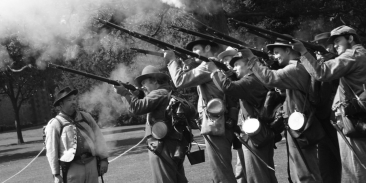
    miguel proEventually, Father was caught, imprisoned on a false charge and on the morning of November 23rd 1927 faced a firing squad. Even here, he was a conqueror. Before the cameras and all assembled, he forgave and blessed his persecutors, held out his arms in the shape of the cross and shouted “Viva, Cristo Rey (Long live Christ, the King)!” With that, Father Miguel Pro died.

    The government published a photograph of his execution, believing that it would frighten Catholics into submission. Once again, things were not what they seemed. Father Pro, arms outstretched like a cross, displayed such Christ-like strength, such fearlessness in the face of unjust persecution, that the photograph and Father’s last words became the symbols around which Catholics rallied to resist the repression even more strongly. This was not a photograph of the conquered but of the conqueror. Ironically, the government quickly banned their own photograph.

    Like the young men in the first chapter of Daniel, Blessed Miguel Pro thrived in a hostile environment because he remained faithful to his calling and his religious heritage. While our culture and our authorities are not as openly hostile as was Mexico in the early 20th century, there is constant and perhaps growing pressure to minimize the voice of Christ and his Church in the public arena. While the times may seem bleak, remember: Things are not always what they seem. Let us imitate Blessed Miguel Pro by being in the culture but not of it; by ministering in whatever way we can to preserve and build on the good that has come before. Finally, let us remember that, in the end, we bow to only one authority – that of the Triune God.

    Viva Cristo Rey. Long live Christ the King.

    Blessed Miguel Pro, pray for us.

  • Mother and Disciple: The Feast of the Presentation of the Blessed Virgin Mary

    Zechariah 2:14-17; Matthew 12:46-50

    We may hear today’s gospel and wonder how any son could treat his mother like that, let alone the Son of God. Hearing that his mother is outside he doesn’t stop speaking and invite her in; rather, he uses her appearance to make the point that everyone who does the will of God is his mother. Shouldn’t Mary be insulted?

    No. She is doubly honored.

    First, remember that this is not just any son; this is Jesus, the only-begotten Son of God. Engaged in the mission for which he was sent, the salvation of souls, he was speaking about radical fidelity to the will of God. Faith binds us to Christ and to each other with a love born not in the blood of kinship but in his own precious blood. If his teaching shocked people, so be it. His point was not about Mary’s faithfulness, it was about ours.

    Indeed, faithfulness is her first honor. As St. Augustine said, Mary conceived her Son in faith before she conceived him in her womb. We think of her as his mother and rightly so for it was by her fiat that he came into the world, but we must also remember that she was his first and best disciple. Mary is the only person to appear in the gospels from before his conception until the coming of the Holy Spirit at Pentecost.

    It may seem ironic that from the faithful dwelling of her motherhood Mary invited him in yet he, her Son, refused to return the favor. But again Mary loved him as both mother and disciple. As mother she might feel the sting of his words as he broadened “family” from the ties of blood to those of faith, but as disciple she knew and lived their truth. Despite whatever personal pain the truth may cause it is always the source of joy, for joy is happiness in pursuit of the good and Mary lived her life in hope of attaining the greatest good: Eternal union in heaven with God who is love.

    Love is the second honor of Mary. Only through love do we live life to the full and this necessarily includes all the joys and sorrows that go with it. We might think that in his mercy Christ would spare his own mother the pain of suffering but actually the opposite is true: He loved her too much to deprive her of it. What kind of love knows no sorrow, feels no pain, and never suffers? Rightly is Mary the Mother of Sorrows for in her great love she suffered many times over, from the mystical sword that pierced her heart to her Son’s burial in the tomb. Yet as Scripture reminds us, love bears all things, believes all things, hopes all things, endures all things (1 Corinthians 13:7) and is as deep as death (Song of Songs 8:6); Mary’s love for Jesus could not be broken by any boundary of space or time, but did reach perfection in his love for her: her own glorious Assumption.

    stained-glass-4506616_640The two themes of fidelity and love are interwoven in the feast of the Presentation of the Blessed Virgin Mary. The presentation of oneself to God is an act of great faith and deep love. Whether Mary demonstrated her faith and love in a formal consecration to God in the Temple as described in the ancient non-biblical documents is irrelevant. Every day of Mary’s life was a presentation, a self-offering, an abandonment to the divine will made possible by the movement of grace within her. Long before he dwelled within her womb, indeed from the moment of her immaculate conception, our Lord dwelled within her soul and bestowed upon it the fullness of grace, his very life. By her response to that grace, Mary most truly defines what it means to be a Temple of the Holy Spirit.

    What does all this mean for us? It means that as Mary has done so we are invited to do. St. Paul said, “Do you not know that you are the temple of God, and that the Spirit of God dwells in you? … Therefore, glorify God in your body” (1 Corinthians 3:16, 6:20). May we never forget that every time we receive Holy Communion we present ourselves to God in an act of faith and love like Mary his handmaid, that we too may glorify God in our bodies.

    Blessed Mother intercede for us, that like you we may be among those to whom Christ says, “whoever does the will of my heavenly Father is my brother, and sister, and mother” (Matthew 12:50).

  • True Wisdom: Thursday of the 32nd Week in Ordinary Time

    Wisdom 7:22b-8:1; Luke 17:20-25

    In college one of my classmates was a man who it seemed was always a step ahead of me. While I was still learning one computer technology he was onto whatever was replacing it. I couldn’t keep up with him.

    One semester we took the same class and it became clear to me that he wasn’t far ahead at all; he was actually much further behind. The problem was that he didn’t stick with anything long enough to finish it. He’d start a book, paper, or project but move on when something else caught his attention. When it came time for our final class presentations he was totally unprepared; he had nothing to say. He ended up dropping out of school. I felt very sorry for him.

    Had I been wiser I would have stopped and contemplated the many ways I am that man. For one thing, my shelves are lined with books that got my attention for awhile but which I put down as soon as I found something else. For another, I catch myself tuning out a Scripture passage because I’ve heard it before and think I understand it. As if that isn’t bad enough, I sometimes pay the least attention to the people closest to me, assuming that they know I care so I don’t need to say it or act much like it.

    Maybe this describes all of us to some degree. We begin a spiritual article on the internet and abandon it as soon as a flashy image catches our eye; scroll past bible verses and quotes from saints without contemplating them; spend hours searching for God online but miss finding him in our own families.

    These are the modern-day equivalent of the behavior discussed by Jesus in today’s gospel. Expectations about the flash and bombast of the Messiah and his Kingdom, scant attention paid to the meaning of our Lord’s words, and eagerness to scan the spiritual horizon for something new combined to give the Pharisees and even some of our Lord’s disciples a kind of spiritual farsightedness; they looked at but couldn’t see either the King or his Kingdom there among them.

    They did these things for the same reason we do: To gain the wisdom that will bring us closer to God and other people. The irony is that instead of bringing us closer they overwhelm us and keep us away. Discouraged by lack of results, some of us even abandon the attempt, drop out, or fall away.

    directory-229117_640No wonder. Internet scans, scrolls, and searches cannot bring the wisdom we need. As the first reading tells us, Wisdom is a spirit… Firm, secure, tranquil, all-powerful, all-seeing… the spotless mirror of the power of God, the image of his goodness (Wisdom 7:22, 23, 26). Wisdom is Christ, and his gift to us is wisdom as the fruit of the Spirit. A fruit born of the love of God, wisdom desires not only to be one with God but to see things as God sees them. Like any fruit, wisdom takes time to mature; its development a function of our life experience as seen through the lens of long-suffering that strengthens us to finish what we start, docility to listen as God speaks, and humility to remember that we are servants of God and each other.
    Spurred on by these, spiritual wisdom helps us find the proper balance between searching for the Kingdom yet to come and living in the Kingdom here and now. We must do both, for the Christ who tells us today that the Kingdom of God is among us is the same Christ who teaches us to pray “Thy Kingdom come.” The balance can only be found through prudence, the virtuous midpoint between the extreme of finding too many paths to take and the other extreme of looking for none at all.

    So let us pray for prudence, and that whatever path to God we find ourselves on we do what prudence dictates: Prepare for the coming of the Kingdom by tending to the Kingdom among us, and anticipate the glorious return of Christ the King by seeing and serving him in everyone we meet.

  • The Pharisee Within: Thursday of the 30th Week in Ordinary Time

    Romans 8:31b-39; Luke 13:31-35

    In the gospel we heard the Pharisees warn Jesus to leave town because Herod wanted to kill him. That was very nice of them! It leads us to believe that, even though they didn’t think Jesus was the Christ, he was still a fellow Jew; it was only right to see that he came to no harm. It was the brotherly thing to do.

    Unless of course it wasn’t true.

    Call me cynical but I think the Pharisees were fibbing. Why? I have three reasons. First, Luke has nothing good to say about them anywhere else; to them, Jesus was a nuisance to be disposed of. Second, Jesus had just publicly scolded them (Luke 11:37-54); they were very unlikely to be feeling all warm and brotherly toward him. Third, while it’s true that Luke doesn’t have anything good to say about Herod either, he does say that Herod wanted to meet Jesus for a long time, for he had heard about him and had been hoping to see him perform some sign (Luke 23:8).

    But then why would the Pharisees deceive Jesus? Perhaps it was to test his resolve or try and break it. Knowing from their previous interactions that they were no match for him (Luke 6:1-11; 11:37-54), using Herod’s name was a way to threaten Jesus, to frighten him into going away and possibly even abandoning his mission.

    We would naturally condemn the Pharisees for that but before we do, we should look inside ourselves. Ask yourself: Have I ever wanted to do something I knew Jesus would condemn yet made the deliberate choice to do it anyway? Have I ever promised him that I would never do it again only to repeatedly break my word? Do I pray “Thy will be done” but try my best to see that my will is done?

    The truth is, we all have a Pharisee within. At one time or another, in one way or another, we are less than fully honest with our Lord. We say things we don’t mean, make promises we can’t keep, and twist the truth about ourselves, all in a vain attempt to hide what he already knows we are: sinners in dire need of his mercy and healing grace.

    The true wonder is that our Lord knows all this and loves us anyway, even unto death. After all, the gospel concludes with Jesus naming his executioners and it wasn’t Herod, it wasn’t Pilate, it wasn’t any one person. It was Jerusalem. Specifically, it was people who prayed for him, waited for his coming, followed his ministry, and greeted him at the city gates with shouts of Hosanna. These were the same people who shouted, “Crucify him!” Not just people like us. It was us. We have all crucified our Lord with our sins.

    So we are not only the Pharisee; we are Jerusalem.

    prodigal-son-3388599_640The psalmist today sings Save me O Lord in your mercy (Psalm 109:26). The readings are God’s answer to that prayer. In his infinite love and mercy he assures us that no matter how hypocritical we are, how much a Pharisee, or how much we deserve it, we are never alone. God is always true to his word and today his word is that there is nothing – neither death, nor life, nor angels, nor principalities, nor present things, nor future things, nor powers, nor height, nor depth, nor any other creature – that can separate us from the love of Jesus Christ our Lord (Romans 8:38-39).

    Praise be to God!

  • Stained Glass Images of God: Friday of the 29th Week of Ordinary Time

    Romans 7:18-25a; Luke 12:54-59

    As a young man I spent several years attending a church that I thought had the most beautiful stained glass windows. I used to love sitting there early in the morning or late in the afternoon, watching how the sunlight made those images so warmly luminescent. I never liked going there at night when most of the lights were out. In the darkness the images appeared so lifeless, dull, and indistinct.

    Those memories came to mind as I thought about today’s readings. Every person conceived in original sin knows firsthand that struggle between light and darkness within ourselves. We have been given both knowledge of the light – what St. Paul calls “the law of God” – and the darkness of concupiscence, or the tendency to do evil – what he calls the “law of sin.” The saints are no different. Stained glass images may depict them as solemn, haloed people in pious postures, but they were flesh and blood just like we are. They felt all the same joys and sorrows and they knew the frustration of feeling trapped in a seemingly endless cycle of knowing the right yet so consistently doing the wrong. It was one of the greatest saints known to us, St. Paul himself, who wrote of this frustration, Miserable one that I am! (Romans 7:24)

    In today’s gospel, Jesus points out why we’re miserable. It is our failure to read the signs of the times and to settle with our opponent. The opponent may be the devil, and it is convenient to blame him, but many times we don’t need his help; we are our own worst enemy. And our enemy knows us very well. When we’re caught up in the darkness of sin and feel its misery, he fools us into thinking that all we need to feel better is more of what made us sick to begin with. This was portrayed perfectly by C.S Lewis in his novel The Lion, the Witch, and the Wardrobe. Remember how Edmund craved the Turkish Delight? He couldn’t eat enough of it yet the more he ate the worse he felt, the more addicted he became, and the easier he was for the witch to manipulate. Our Turkish Delight may be money, power, or control. We think, “If only I can get more, I will be satisfied,” only to find upon getting it that the emptiness we longed to fill is still there, maybe worse than before. Like those stained glass windows in the dead of night we become lifeless, dull, indistinct images of God. Who couldn’t sympathize with St. Paul as he asks, Who will deliver me from this mortal body? (Romans 7:24)

    Of course, he knew the answer for he says, Thanks be to God through Jesus Christ our Lord (Romans 7:25). St. Paul knew that even the darkest night gives way to dawn. What makes a saint a saint is not that they rid themselves of their concupiscence but that they did as Christ taught; they settled the matter on the way. Their repentance set the example for us in three ways. First, they made a firm resolution to turn from the darkness of sin and live in the light of Christ. This happens in Confession when we pray an Act of Contrition, telling God that we are sorry for what we have done not only because we fear his judgment but because our sins have offended him, who is all good and deserving of all our love. Second, the saints amended their lives, which again is obeying the voice of Christ who through St. John the Baptist urged us to show fruits of our repentance (Matthew 3:8). Third, because they knew that they would never in this life be free of concupiscence, the saints spent the rest of their lives cultivating the virtue of hope. They have come to realize once and for all that the redeeming light of Christ is the only sure hope against the ever-looming darkness of sin.

    king-1841529_640That is the image I think of now when I think of saints. Not images set in glass that glow with the sunlight, but people who now and forever glow with the radiance of the one true Light – Christ, the Morning Star who never sets.
    Thanks be to God through Jesus Christ our Lord.

  • Rich in What Matters to God: St. Isaac Jogues and Companions, Martyrs

    Luke 12:13-21

    In the 17th century, Fr. Isaac Jogues and his companions were among the French Jesuit missionaries who ministered to the Huron, Iroquois, and Mohawk tribes in Canada and New York. To the natives they were “the Black Robes” and were seen at first as curiosities and perhaps nuisances; however, over time their gentle, loving, and helpful demeanor won over many Hurons.

    The Hurons’ enemies, the Iroquois and Mohawks, were not as open-minded. Eventually, Fr. Jogues was taken captive by the Mohawks in upstate New York. Despite mutilating and breaking his body, his captors could not break his spirit. He was the prisoner who acted as though he was free; so implacably kind, so resolutely loving in the face of abuse that he became known as “the Indomitable One.” Slowly, he began to win them over. An elderly Mohawk even adopted him as her nephew.

    When afforded an opportunity to escape, Father regained his freedom but did not enjoy it. In France he seemed to have achieved celebrity status, which he found distasteful. He quickly requested and received permission to return to Canada and New York, where he was soon assigned as ambassador to the Mohawks.

    Although Father was anxious about this assignment, he left his fate in Christ’s hands. For a time the Mohawks were cordial and Father ministered to them. Sadly though, when the crops failed and illnesses set in among the tribe, he was blamed and again made a prisoner. While most of the Mohawks wanted him treated humanely, a small and hostile minority did not. Fr. Jogues suffered martyrdom at their hands at the age of 39 on October 18, 1646.

    antique-233285_640In Luke’s gospel, Jesus said this night your life will be demanded of you; and the things you have prepared, to whom will they belong? Thus will it be for the one who stores up treasure for himself but is not rich in what matters to God.

    Father’s life of missionary service stands as a great testament to these words. In terms of possessions, he died with nothing; in what matters to God, he was the richest of men. Slowly, kindly, patiently, and lovingly he had amassed a fortune by preparing the hearts of these native people, for he knew that they all belonged to God, even the one who would demand and take his life.

    Of this last point we have proof. Sometime after his death, a captured Mohawk warrior was identified by witnesses as Father’s killer. There was not enough hard evidence to convict him, so the missionaries had to set him free. However, the man told them that he had heard Father Jogues preach around the campfire and now wanted to be baptized. When asked what his Christian name would be, he said that he wanted to take the name of the “Indomitable One.” The warrior died not long after being baptized “Isaac Jogues.”

    We will have the mind of St. Isaac Jogues, so totally patterned after the mind of Christ, when we can picture the two men named Isaac Jogues meeting in heaven, and can imagine the joy.

    St. Isaac Jogues, pray for us.

  • The Power of One: Feast of St. Luke, Evangelist

    The next time you are tempted to think that one person cannot make much of a difference, consider:

    One man singlehandedly wrote a quarter of the New Testament. His is a two-volume work; the first a detailed gospel and the second the only account we have of how the Church developed in her earliest years.

    His gospel is packed with rich, unique characters: Zechariah and Elizabeth, parents of John the Baptist, Simeon and Anna in the Temple, the penitent woman who washes the feet of Jesus with her hair, the widow of Nain, the ten lepers, the good thief, and the travelers on the road to Emmaus. Women are accorded an unheard-of place of honor. First and foremost is his mother; told by the angel that she is to be mother of the Son of God, Mary is the only person to appear at his birth, his death, and the coming of the Spirit at Pentecost. Other prominent women featured include Mary Magdalene, Martha and Mary, and those who supported his ministry out of their own resources.

    He also uniquely portrays our Lord. Son of God and son of Adam, Jesus has a special compassion for the poor, the outcast, and the sick, and an equally special dislike of Herod. His Jesus is also kinder and more compassionate to his family and the Apostles than either Mark or Matthew; the family are those who hear the word of God and do it and the Apostles have his prayers, even at the Last Supper for Peter, who he knows will deny him. In his passion Jesus agonizes to the point of blood yet still has the presence of mind to heal a servant’s ear. Most movingly, on the cross he forgives his persecutors and promises the good thief Paradise. Finally, after his resurrection he appears on the road to Emmaus and stuns back to life the faithfulness of those two downhearted disciples who failed to recognize him until the breaking of the bread.

    Apart from these unique characters and perspective, the evangelist has a wonderful sense of story. He made sure to include some of our Lord’s most memorable parables: The lowly guest, the great banquet of the king, the lost sheep, the lost coin, the unjust steward, Lazarus and the rich man, the Good Samaritan, and of course the Prodigal Son. More than that, he crafted in beautiful prose the vignettes that form many mysteries of the holy Rosary (including much of the Hail Mary prayer itself): the Annunciation, the Visitation, the Presentation, the finding of Jesus in the Temple, and the descent of the Holy Spirit at Pentecost. His mastery of Greek, unparalleled in the Scriptures, is on full display in such prayers as the Benedictus of Zechariah, the Magnificat of Mary, and the Nunc Dimittis of Simeon. Every day around the world, millions of people recite these – probably from memory – as part of the Divine Office of the Church.

    As if all this weren’t enough, this same man then goes on to give us yet more of what no one else has: the story of the early Church. From Pentecost on he tells the amazing story of the spread of the gospel throughout Judea, Samaria, and to the ends of the earth – including Rome. In sometimes intimate detail he gives us both the beginning of St. Peter’s ministry and virtually all of St. Paul’s, writing the story at times as a fellow traveler, from Paul’s mystical encounter with Christ on the road to Damascus, through his victories and failures in ministry, all the way to his ultimate destination, the seat of the Empire – Rome.

    Overall, the span of his work is breathtaking; it is a complete narrative that stretches from before Christ’s birth, through his ministry, passion, death, resurrection, and ascension all the way into the development and growth of the early Church.

    italy-2472027_1920There is much more we could say on this, the day we remember him, but it would only belabor the point, which is that none of his work would have been possible unless this man had given himself completely over to the will of the Father, in devotion to our Lord Jesus Christ, through the power and inspiration of the Holy Spirit. But he did, and this masterpiece was the result.

    Remember the power of one; not one person alone but one who has conformed himself to being in union with the will of God. There is a plan and we all have a part to play in it. So let us each take the time to meditate on how God is calling us, then submit to his will and do it. This is what changes the world.

    St. Luke, pray for us.

  • What Faith Demands: Memorial of St. Ignatius of Antioch, Bishop and Martyr

    Romans 3:21-30; Luke 11:47-54

    Although the Hebrew bible and Christian Old Testament are very similar with regard to the books they contain, they are structured quite differently. In the Old Testament the prophets come at the end, just before the New Testament. Placing them there emphasizes the prophets’ role as looking forward to the coming of Christ. In the Hebrew bible, however, the prophetic books come much closer to the Torah, or the first 5 books of the bible. This placement emphasizes the prophets’ role of looking back, reflecting on the Law and urging people to live it out in their daily lives.

    This role of reflection and exhortation made the prophets very much the conscience of Jewish society. The voice of the voiceless, the champion of the downtrodden, they spoke the word of God in words of men. While this made the prophets popular to some, the feeling was not universal; others, like the powerful and influential who were threatened by the cries for justice, found them irritating and troublesome. This is why in the gospel today Jesus refers to the blood of the prophets (Luke 11:50); at least a few tyrants thought the best way to deaden the social conscience was to kill those speaking it.

    But God is not so easily dismissed; for every voice silenced, another made itself heard. This was most perfectly the case for Christ, whose voice not only echoed through the prophets but rang through the hills and valleys of Israel in his earthly ministry and continues to ring in the words of the Scriptures he gave the world.

    In the first reading, St. Paul reflects on the foundation of equality preached by the prophets, as regards both sin and righteousness. As he reminds us, sin is no one’s private property; it is the shared condition of all humanity. But the remedy for it also equally applies; slave and king alike share in the righteousness bestowed as the gift of the Father, given through the blood of his Son, in the love that is the Holy Spirit. This is the love Christ most wants us to have for it is the life of God himself (1 John 4:16), given that we may have life in abundance (John 10:10).

    Of course, the abundant life requires listening to the prophetic voice within that urges a selfless life of God first, others next, and ourselves as servants of all. Like the scribes and Pharisees in today’s gospel it is tempting to want to silence that voice in favor of the comfort and complacence of the status quo. But in his merciful love Jesus assumed the role of prophet to forcefully remind them – and us – that every time we fail to be the voice of the voiceless, champion of the downtrodden, or justice for the oppressed, every time we hear his law of love in our hearts but refuse to live it out in our lives, we keep ourselves from God and worse, keep others away as well.

    colosseum-1234144_640St. Ignatius of Antioch understood this. The depths of divine love moved him to be one of those of whom Christ said, I will send to them prophets and apostles… (Luke 11:49a). Sent to oversee the Christian faithful as bishop of Antioch, Ignatius tirelessly preached the truth of the real presence of Christ in the Eucharist as well as the necessity of accepting the faith as it was handed down by the Apostles. Ignatius had such deep faith in Christ that he chose to remain with him despite the conclusion of that same verse: some of them they will kill and persecute (Luke 11:49b). Preferring to die rather than betray Christ, Ignatius was brought to Rome and martyred around the year 115.

    We as disciples must be ready for the acceptance and rejection that our role as prophet brings. This is what faith demands, for it is not faith in ourselves or our ability to move hearts but in the One who has justified, commissioned, and sent us, and in whose name we do all that we do. Let us pray that like St. Ignatius of Antioch we never lose heart in the face of persecution or rejection, but rather redouble our efforts at living out the gospel, that through us many are called to the repentance and salvation that only Christ can offer.

    St. Ignatius of Antioch, pray for us.

  • Sent: Monday of the 28th Week in Ordinary Time

    Romans 1:1-7; Luke 11:29-32

    One day at a high school for wealthy children in India, a teacher happened to wander outside the school’s gates. In the poverty and misery that surrounded her, this young nun saw and heard something greater than the wisdom of Solomon. Saint Teresa of Calcutta spent the rest of her life serving the poorest of the poor in the gutters and slums of India and the world.

    In another part of the world, a young Frenchman rejected the faith of his family and indulged in a carefree life of luxury. After squandering a huge inheritance he entered the military, who threw him out. His second attempt at military service drew him into contact with the people of the Sahara; in their poverty and solitude, this man saw something greater than the Temple. He went home, rediscovered his faith, became a priest, and returned to Africa. Blessed Charles de Foucauld spent the rest of his life ministering to the Muslims of the desert.

    It would be hard to find two people more different at the outset, yet how similar they became. One a hedonistic playboy looking out only for himself; the other a consecrated religious doing what she thought God wanted her to do. Both were called by Christ to a life they would have never imagined and in the end would never relinquish. Their responses transformed them and transformed the world.

    Their destiny points to the choice that Jesus lays before us. Either we can be part of the “evil generation” that demands the certainty of miraculous signs and rejects the certitude of faith, or we can use our God-given faith given to discern the only sign that matters. Jesus called it the sign of Jonah, but in reality it is his own true presence, for he is the Temple not made with hands; he is Wisdom itself.

    passion-3807312_640This is what the saints and the blessed have discovered. The greatest good in life is to see and serve Christ; that is what gives our life its ultimate meaning. However, we will never be able to do that until we see Christ in each other and become Christ for each other. St. Paul knew this; that is how he could write that the grace of apostleship is found in the obedience of faith. By faith we believe that God loves everyone and that we are to love as God loves, but it also teaches that the people who we think are least deserving of our love are the ones most worthy of it. Thus, obedience to the faith means that as apostles we are sent to be Christ and to find Christ in everyone, even those we find hardest to serve. Only grace can provide the humility and openness to vulnerability that can empower us to do the work for which we have been sent.
    That brings us to the final point. Where have we been sent and who are we to serve? Consider this thought from Blessed Charles de Foucauld:

    It is not necessary to teach others, to cure them or to improve them; it is only necessary to live among them, sharing the human condition and being present to them in love.

    Put that in the context of this thought from Saint Teresa:

    It is easy to love the people far away. It is not always easy to love those close to us. It is easier to give a cup of rice to relieve hunger than to relieve the loneliness and pain of someone unloved in our home. Bring love into your home for this is where our love for each other must start.

    So, you are the apostle to your home, to your parish, and to your community. See Christ in them; love Christ in them; serve Christ in them.

  • The Hope of Happiness: Saturday of the 27th Week in Ordinary Time

    Joel 4:12-21; Luke 11:27-28

    In the reading from the prophet Joel, God vanquishes the enemies of Judah and the land produces in overflowing abundance. As the earlier chapters of this book make clear, a famine brought on by a plague of locusts had ravaged the land, both city and countryside. The images offered by Joel of a conquering, provident God were a hope-filled reflection of this suffering people’s desire to know that God was dwelling among them; in other words, this is how they wanted their prayers answered, in security and abundance.

    We are not so different from them. In our own prayers we ask God to do things like conquer our foes, provide abundant harvests, heal us or those we love. We speak of our prayers being answered and we give thanks to God when the enemy is gone, the harvest is good, and we or someone for whom we have prayed does in fact recover.

    On one level, there is nothing wrong with that. God does keep us secure; does provide for us; does heal. For this, we can and must give thanks.

    There is a deeper level though, and Jesus points us toward it in today’s gospel. When a woman blessed the womb that bore him and the breasts that nursed him, Jesus replied that Mary was blessed because, as his first disciple, she heard the word of God and did it. As St. Augustine said, Mary conceived in her heart before she conceived in her womb.

    This is the deeper level on which Jesus focuses our attention. Although we can pray that things go the way we want them to, the most fruitful prayer is that our will be aligned to the will of God. This was Mary’s prayer when she said, May it be done to me according to your word (Luke 1:38); it was Christ’s prayer when he said not my will but yours be done (Luke 22:42b). This doesn’t mean that we are happy if and when catastrophe strikes, but it does mean that we hear the word of God and do it, keeping in mind that he has also said, I know well the plans I have in mind for you … plans for your welfare and not for woe, so as to give you a future of hope (Jeremiah 29:11).

    maria-100112_1280As the Catechism teaches, hope is “the theological virtue by which we desire the kingdom of heaven and eternal life as our happiness, placing our trust in Christ’s promises and relying not on our own strength” (CCC 1817). Joel pointed toward Christ our hope when he spoke of the spring that will rise from the house of the LORD (Joel 4:18b). This is the hope of life that springs eternal; the happiness to which Mary was united at the end of her earthly life; the hope of happiness that we desire. May we unite our wills to the will of God as she did, and may it be done to us according to his Word.