Luke 12:13-21
In the 17th century, Fr. Isaac Jogues and his companions were among the French Jesuit missionaries who ministered to the Huron, Iroquois, and Mohawk tribes in Canada and New York. To the natives they were “the Black Robes” and were seen at first as curiosities and perhaps nuisances; however, over time their gentle, loving, and helpful demeanor won over many Hurons.
The Hurons’ enemies, the Iroquois and Mohawks, were not as open-minded. Eventually, Fr. Jogues was taken captive by the Mohawks in upstate New York. Despite mutilating and breaking his body, his captors could not break his spirit. He was the prisoner who acted as though he was free; so implacably kind, so resolutely loving in the face of abuse that he became known as “the Indomitable One.” Slowly, he began to win them over. An elderly Mohawk even adopted him as her nephew.
When afforded an opportunity to escape, Father regained his freedom but did not enjoy it. In France he seemed to have achieved celebrity status, which he found distasteful. He quickly requested and received permission to return to Canada and New York, where he was soon assigned as ambassador to the Mohawks.
Although Father was anxious about this assignment, he left his fate in Christ’s hands. For a time the Mohawks were cordial and Father ministered to them. Sadly though, when the crops failed and illnesses set in among the tribe, he was blamed and again made a prisoner. While most of the Mohawks wanted him treated humanely, a small and hostile minority did not. Fr. Jogues suffered martyrdom at their hands at the age of 39 on October 18, 1646.
 In Luke’s gospel, Jesus said this night your life will be demanded of you; and the things you have prepared, to whom will they belong? Thus will it be for the one who stores up treasure for himself but is not rich in what matters to God.
Father’s life of missionary service stands as a great testament to these words. In terms of possessions, he died with nothing; in what matters to God, he was the richest of men. Slowly, kindly, patiently, and lovingly he had amassed a fortune by preparing the hearts of these native people, for he knew that they all belonged to God, even the one who would demand and take his life.
Of this last point we have proof. Sometime after his death, a captured Mohawk warrior was identified by witnesses as Father’s killer. There was not enough hard evidence to convict him, so the missionaries had to set him free. However, the man told them that he had heard Father Jogues preach around the campfire and now wanted to be baptized. When asked what his Christian name would be, he said that he wanted to take the name of the “Indomitable One.” The warrior died not long after being baptized “Isaac Jogues.”
We will have the mind of St. Isaac Jogues, so totally patterned after the mind of Christ, when we can picture the two men named Isaac Jogues meeting in heaven, and can imagine the joy.
St. Isaac Jogues, pray for us.
 There is much more we could say on this, the day we remember him, but it would only belabor the point, which is that none of his work would have been possible unless this man had given himself completely over to the will of the Father, in devotion to our Lord Jesus Christ, through the power and inspiration of the Holy Spirit. But he did, and this masterpiece was the result.
 St. Ignatius of Antioch understood this. The depths of divine love moved him
  This is what the saints and the blessed have discovered. The greatest good in life is to see and serve Christ; that is what gives our life its ultimate meaning. However, we will never be able to do that until we see Christ in each other and become Christ for each other. St. Paul knew this; that is how he could write that the grace of apostleship is found in the obedience of faith. By faith we believe that God loves everyone and that we are to love as God loves, but it also teaches that the people who we think are least deserving of our love are the ones most worthy of it. Thus, obedience to the faith means that as apostles we are sent to be Christ and to find Christ in everyone, even those we find hardest to serve. Only grace can provide the humility and openness to vulnerability that can empower us to do the work for which we have been sent.
 As the Catechism teaches, hope is “the theological virtue by which we desire the kingdom of heaven and eternal life as our happiness, placing our trust in Christ’s promises and relying not on our own strength” (CCC 1817). Joel pointed toward Christ our hope when he spoke of the spring that
  We asked for other things; why should we be happy to receive the Holy Spirit instead? Consider everything he brings: Wisdom, the ability to see what is most important; understanding, to get to the heart of the matter; counsel, to submit to the providence of God; fortitude, the strength to pursue the good; knowledge, the ability to judge rightly; piety, reverence for God; and fear of the Lord, a love of God so deep that we would do nothing to hurt him. Poured lavishly upon us, these gifts bring us closer and closer to the mind and heart of Christ, who prayed as he lived – perfectly – that the Father’s will be done, who lived his prayer to the death, and who showed us that death is not the end but the pathway to resurrection and perfect unity with the Father.
 In the marvelous healing providence of God, it so happened that this same woman heard bishop Nonnus preach the homily the next day at Mass. Whatever he said moved her to repentance. She asked him to make her a Christian. Not long afterward, the same bishops who once looked away in disgust now watched in wonder as this woman threw herself upon the floor of the church, washed the bishop’s feet with her tears, and dried them with her hair. Once baptized, she traded her jewels for a robe and devoted the rest of her life to penance in the strict regimen of a cloistered monastery. The beautiful, bejeweled harlot once known in Antioch as Margarita (meaning “Pearl”) transformed herself into a beautiful model of penitence known to this day by her birth name, Pelagia.
 This is the strength that has inspired the saints throughout the centuries. Every saint knows what it means to wonder as Habakkuk wondered how and when God will fulfill his promises, but they also know what it means to offer themselves as the instruments through which that promise is fulfilled. Every saint knows what it means to face hardship or to be with others as they face them, but like Timothy and Paul they also know what it means to possess the grace to endure and to support others who need to endure. Finally, every saint knows what it means to feel as if their own faith is inadequate to uproot their mulberry tree full of weaknesses. But they also know what it means to surrender themselves totally to the power of the One who nailed those weaknesses to his own tree and cast them once and for all into the ocean of his infinite mercy.
 Of all the things he might have chosen to begin with, Francis wanted to teach that the best and most mystical encounter we can have with Christ comes not from a voice on a sickbed or even a leper on the road but from the encounter with our own sinfulness. Only when we allow the Lord to lead us from the pain of penance through the conquest of our fears can we too rise and leave the world; not to abandon it, but that we may be Christ to it.
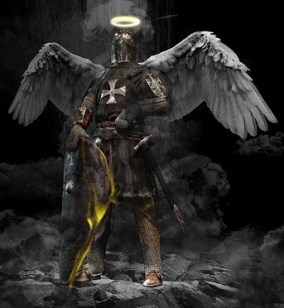 The Archangel Michael, whose name means Who is like unto God?, is the prince of angels. We read in Revelation why Holy Father Leo sought his intercession; it is Michael who leads the heavenly angels in the ultimate battle against Satan and his demons and teaches them why there are none like unto God. Apart from reciting the Pope’s prayer following Mass, let us also ask St. Michael’s intercession for all those who so often find themselves in harm’s way such as soldiers, first responders, and emergency workers. Let us also ask his intercession for ourselves during times of temptation as well as those who have fallen or are in danger of falling away from practice of the faith.
 Mark 10:45