The Commemoration of All the Faithful Departed
Wisdom 3:1-9; Romans 5:5-11; John 6:37-40
Many years ago, on a train trip to Chicago from rural Michigan, I sat behind a family who had never been to a big city before. I tried not to listen, but their conversation was too interesting. The kids had no idea what skyscrapers were, so Dad tried to explain. It didn’t work; when we stopped in a small town, one kid said, “A skyscraper!” No, son, that’s a grain elevator. As we got to the city limits, Mom got tense. “Kids, when we stop, stay with me. Don’t wander off. They probably carry guns here. It doesn’t look like a very friendly place to me.” I wanted to say, “Ma’am, we’re going to Union Station, not Al Capone’s headquarters,” but kept my mouth shut. By the time we got downtown and they saw Chicago, it was clear that the actual reality was nothing like they imagined.
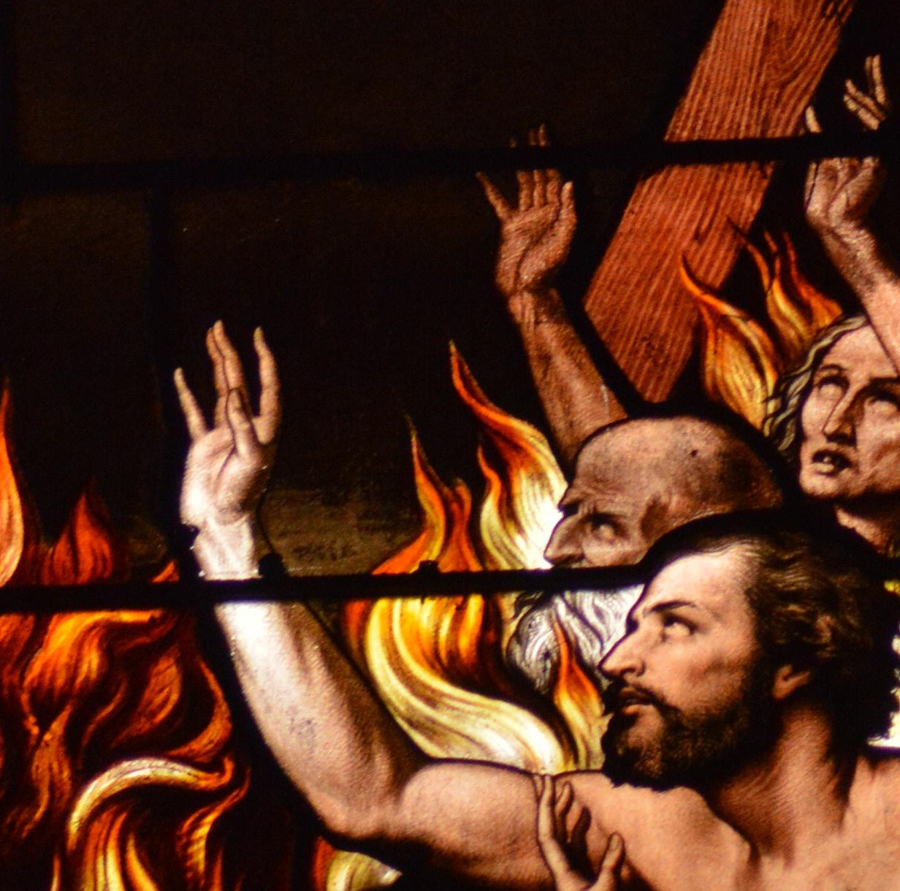
This kind of thing happens in the Church, too. All Souls’ Day is a good time to see it, because purgatory takes center stage. Just hearing the word “purgatory” conjures up in many minds some of the imagery of the first reading: souls punished, chastised, tried, put in a furnace, burnt offerings (Wisdom 3:4-6). Not hard to see why in the popular imagination, purgatory is a fiery place where souls go to be purified – somehow – and for some length of time. (That’s all fuzzy. What isn’t fuzzy is the fire.)
Let me do what my much younger self should have done for that young family on the way to Chicago: Clear up some misconceptions.
- Purgatory isn’t a place, it’s a process. For what? Well, although all of us would love to enter God’s presence immediately after we die, we have to deal with what John wrote in Revelation; namely, that nothing impure can enter heaven (21:27). So, if our soul has any venial sins or attachments to worldly things, all that must be eliminated first.
- There is, and there isn’t, a fire. There isn’t, in the sense that souls can’t “feel” the way bodies can, but there is, in the sense that souls can yearn (or burn, if you will) for a closer relationship with God, and know that growing closer to Him is only possible if we let go of our selfish desires.
- After we die, there is no time. The dead are beyond that. The better question is, how spiritually distant am I from God? Do I love God with an intense love that is willing to overcome any obstacle that keeps me from being with Him, or am I too attached to what I want? And how much do I really love others, especially those I’ve had the most difficulty with?
With these misconceptions cleared up, we can better appreciate the balance of the imagery we heard in the book of Wisdom. Souls are punished, but also full of hope; chastised, but greatly blessed; tried, but found worthy of God; proven in a furnace, but like gold; sacrificed, but taken by God to Himself. So yes, there is suffering, but the battle is won, and they are not alone. This is why St. Paul said that hope does not disappoint (Romans 5:5); God is with us every step of the way, and the outcome is both known and glorious. Every soul being purified will be united with Him when all is said and done.
What should we take away from this? Three things:
- The best way to deal with purgatory is by working to avoid it entirely! Our goal is sanctity; let us pray for the grace and strength to do what it takes to stay close to Christ, to remain in him, to do whatever he tells us.
- Pray for the souls in purgatory. This is a wonderful example of the love we are called to have – the love that seeks the good of others before the self. The witness of the saints testifies that souls undergoing purification are helped in the process by the prayers and sacrifices of others. Once in heaven, they can intercede for us.
- Remember that purgatory isn’t about who we were, or who we are, but who we are becoming, which is the most perfect version of ourselves. That is what Christ has called us from all eternity to be: perfect, as our heavenly Father is perfect (Matthew 5:48).
—
 Mark 10:45
Leave a comment