Category: Roman Catholic

  • Set Apart and Sent:

    Set Apart and Sent:

    Wednesday of the 4th Week of Easter

    Acts 12:24-13:5a; John 12:44-50

    The word St. Luke uses for “worshiping” or “ministering” is the word we know as liturgy. In the liturgy, we don’t just worship God; we are drawn into what God is doing. And what God is doing is always this: He speaks, He calls, and He sends.

    We saw that in the reading from Acts, when the Holy Spirit set Barnabas and Saul apart, and sent them.

    So, since the earliest times, our liturgies have given birth to mission.

    But mission for whom – certain people only? It might seem that way, especially when we think of Sacraments such as Baptism, Confirmation, and Holy Orders. But the fact is that every time we gather, as we do now for the Eucharist, the Holy Spirit says again, “Set apart for me those I have called.”

    Who’s that? All of us.

    And why does God send us? Because of what Jesus says in the Gospel: ‘Whoever sees me sees the one who sent me.’ Jesus Himself is sent, and everything Jesus does reveals the Father. So when we are sent, it is for the same reason: to make the Father visible in the world.

    St. Catherine of Siena lived exactly this way. Long before she was a woman of action, Catherine was a woman of the liturgy. She grew in her love for Christ from baptism through the Eucharist. So thoroughly did she consecrate herself with Christ to the Father in the Holy Eucharist that for the last several years of her life, her only food was the Eucharist. She drew her very life from the Blessed Sacrament, discovering in it a source of endless spiritual energy that united her to Christ in charity.

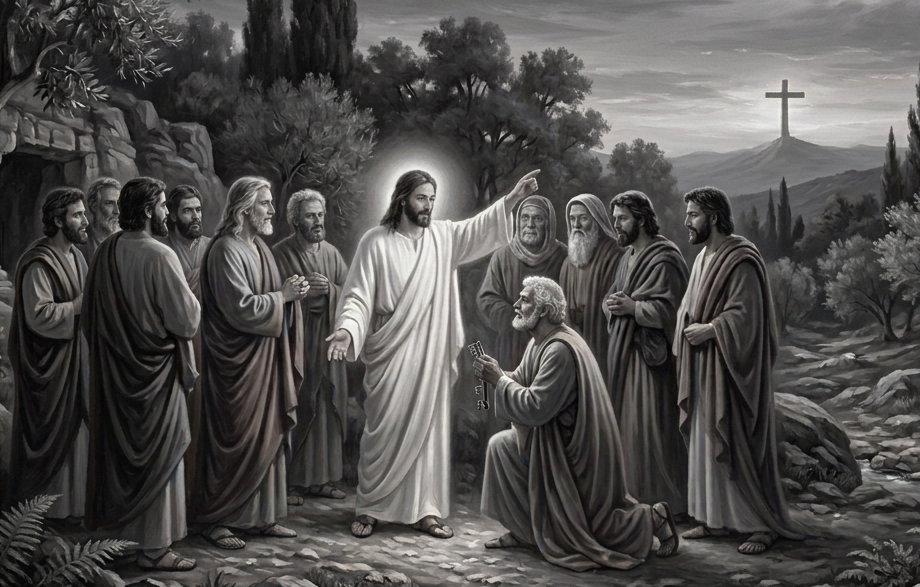
    In other words, Catherine’s extraordinary mission — reforming the Church, calling popes to return the papacy to Rome — did not come from her. It came from liturgy. It came from the altar.

    The fearlessness it took for her – a laywoman with no formal education – to write to popes and kings didn’t come from human confidence, but from the same Spirit who said to the Church at Antioch: “Set apart for me Barnabas and Saul.” Catherine heard the Spirit, and like Barnabas and Saul, poured out her life in obedience.

    I remember once asking my spiritual director about this. Hearing that people like St. Catherine lived only on the Eucharist made me wonder, “Is that to be a model for me? Should I hope, someday, to live on nothing but the Eucharist?” Father replied, “God gives us such saints, not that we imitate their level of piety or virtue, but that we push ourselves a little further in that direction. God is probably not asking you to live only on the Eucharist, but He may well be asking you to increase your desire to receive Him and be transformed by His grace.”

    I think that’s a good answer. It reminds us that the Holy Spirit is speaking to us personally – right here, right now. Each of us is set apart and sent. From this altar. Today. It is also a reminder to pray during the liturgy, especially Holy Mass, for the strength to answer the Spirit’s call. It’s easy and tempting to allow fear to take hold, which is why St. Catherine once said, “Don’t look at your weaknesses. Realize instead that in Christ crucified you can do everything.”

    St. Catherine of Siena, pray for us.

  • What is it about Jesus?

    What is it about Jesus?

    Wednesday of the 3rd Week of Easter

    Acts 8:1b-8; John 6:35-40

    This may sound surprising or counter-intuitive, but it’s true: the places in the world where the Church is the most highly persecuted or suppressed right now – Iran, Nigeria, China – are also places where it is growing… fast.

    This has happened for as long as the Church has existed. We see it today in Acts 8; despite believers in Jerusalem being persecuted, the Church continues to grow.

    Why? I think it has something to do with the behavior of the persecuted disciples.

    First, we hear that “devout men buried Stephen and made a loud lament over him,” then that many Christians preferred prison over recanting their faith. The quiet witness of these disciples carries a dignity and strength that evangelizes. Seeing it, outsiders might ask, “What is it about Jesus that makes his followers so dedicated?”

    Second, “those who had been scattered went about preaching the word.” Like a fulfillment of our Lord’s parables, these seeds took root where the Word had not gone before, and there blossomed new church communities. Again, this is the witness that makes outsiders ask, “What is it about Jesus that attracts people in such numbers?”

    What is it about Jesus? He tells us in the gospel: “I am the bread of life; whoever comes to me will never hunger, and whoever believes in me will never thirst.” Because we are made in the image and likeness of God, each of us has a hunger that nothing and no one but Him can satisfy. Not only that, he says that “everyone who sees the Son and believes in him may have eternal life, and I shall raise him on the last day.”

    The Bread of Life Eternal. We don’t need to guess the effect; Acts tells us. Once the Samaritans see and experience Christ through the ministry of those disciples, they have a joy that no one and nothing can take from them.

    Given this witness, the Church doesn’t grow despite persecution; it grows because of it.

    Does that mean persecution is necessary? No. What is necessary is to find ways to do what persecution does – strip away the worldly distractions that lead us to hunger for what can never truly satisfy, and ask ourselves, “What are we really living for?”

    The Church has given us a good way to answer that: the works of mercy. When we feed the hungry, visit the sick, forgive someone who has hurt us, give our time to someone who can’t repay us, something happens: Distractions begin to fade, our hearts begin to change, and we see more clearly that Christ really is enough.

    And people notice. Not all at once, and not with a lot of fanfare, but quietly, as in Acts. They wonder, “What is it about this person? What drives them? They’re Christian… is it their faith?”

    Our witness becomes evangelizing.

    So, the question for us is simple, but challenging: Where is Christ inviting me to live more simply, more faithfully, more like those Jerusalem disciples? Where is he asking me to let go of what doesn’t satisfy, so I can more deeply experience the Bread of Life who does?

    When we do that, we don’t just hear His promise. We live it. And others will see it.

    And, most importantly, they will see Christ better by it.

  • All For the Sake of Love

    All For the Sake of Love

    Wednesday of the 2nd Week of Easter

    John 3:16

    The Taj Mahal. The Hope diamond. Romeo and Juliet. Each in its own way a priceless masterpiece – built, gifted, or written all for the sake of love.

    Imagine being given any one of these. How special we would feel! Unique in all the world. To be the subject of that force of emotion.

    Fortunately, we don’t have to imagine such a gift. We have one infinitely more precious. As Jesus says to Nicodemus:

    God so loved the world that he gave his only-begotten Son, so that everyone who believes in him might not perish but might have eternal life (John 3:16).

    This is the verse that stopped Church Fathers in their tracks. We too know its power, not least by its enormous popularity. That’s good, but it’s also a problem; we hear it so often, see it so many places – from bumper stickers to end-zone signs – that we risk looking right past it.

    Don’t let that happen.

    Today, take a good, long, hard look at a crucifix. For there is the love that built not a building, but the Church; that isn’t the gift of a stone, but the Cornerstone; that isn’t written with ink but with the Precious Blood of Christ.

    And remember: We know the price of that love story – the death of Jesus Christ. But we also know the ending – the tomb is empty.

    So, rejoice and be glad! You really are loved that much.

  • Called, Faithful, and Sent

    Called, Faithful, and Sent

    The Easter Vigil

    Matthew 28:1-10

    I can think of moments in my life when everything changed, when what came before and what came after were forever different. Marriage. The births of our children. A diagnosis. A call I didn’t expect. In the heat of those moments, I didn’t realize just how much things changed. That hit me later.

    For those of you who are about to receive the sacraments, tonight is one of those moments. This isn’t just another step in a process. This is a crossing over. From tonight onward, your life in Christ becomes something entirely new.

    To understand what that looks like – what it means to step into that new life – we can do no better than to look at the first person mentioned in tonight’s gospel: Mary Magdalene.

    Magdalene is a truly remarkable figure. She is one of the very few individuals named in all four Gospels. Unlike almost everyone else, she was a witness to the Crucifixion of Christ, to his burial, and to his Resurrection.

    In every Gospel, Mary stands near the center of the Easter story. And, for our purposes here tonight, she stands as a model of a newly initiated Catholic.

    How? Simple. Mary was called. Mary was faithful. Mary was sent.

    First, her call to follow Christ is mysterious. All we know is that he healed her, called her out of her darkness. Mary’s story begins not with strength, but deliverance.

    That’s our story, too. None of us comes to God from a position of strength, but from a need for deliverance.

    And, although I said, “we come to God,” the reality is that God comes to us. You who are coming into the fullness of the faith this evening, think back to what brought you here to begin this journey. Like the rest of us, like all the saints, each of you has a different story, but a common beginning. We may think coming to God is our idea, but the truth is that God brought us here. He always acts first. Yes, we celebrate you tonight and your accomplishment, making it through all those Wednesday evening meetings. But tonight isn’t about what you’ve done to find God. It’s about what God has done to find you.

    The second remarkable thing about Mary Magdalene is that she stayed with Jesus when the going got tough. The gospels are clear; very few people are expressly named as being there in Christ’s darkest, most desolate moments. Mary is there – at the cross, at his burial, and at the tomb in the early morning darkness. She didn’t understand the significance of what was happening, and had good reason to fear or have her faith shaken. Yet she remained. What a beautiful example of steadfast faithfulness, of love that refuses to walk away no matter what.

    You who are coming into the fullness of the faith have lived some of this already. Week after week you found yourselves presented with things not always easy to understand. Yet you remained. You continued on even when things weren’t clear. You aren’t here because you figured it all out; you’re here because, like Mary Magdalene, you stayed despite the difficulty.

    Finally, Mary was given a role unlike any other in the New Testament. The Evangelist John is clearest. The risen Jesus calls her by name – Mary – then commands her, Go to my brothers and tell them… (John 20:17). Of all the disciples, only she, a woman called from her own mysterious darkness into the healing light of Christ, becomes what she never dreamed: the apostle to the apostles. The resurrection of Christ wasn’t the end of her story – in a way, it was just the beginning.

    It’s the same for you who are coming into the faith. Tonight isn’t the end. It’s more like a commencement, or, more accurately, a commissioning. Each of you is claimed by God by Baptism, strengthened by Confirmation, fed with the Eucharist, and at the end of Mass, sent. Where? Out those doors and into the world. To do what? To proclaim the glory and power of the risen Christ by the witness of your lives. Everything you do from here on will speak the words Mary Magdalene spoke as apostle to the apostles: I have seen the Lord (John 20:18).

    It all begins in just a few moments, when you receive the sacraments. Listen carefully. As the words are spoken, the risen Jesus will be speaking your name in the depths of your soul. Just as he spoke Mary’s.

    The time, place, and people are different than when Magdalene walked the Earth. But the message and Message-Giver are exactly the same. Christ has called you, Christ has asked you to stay near him, and Christ has sent you to proclaim him to the world.

    Savor the moment! From this night on, your life will never be the same. You may not realize that now, but don’t worry. It will hit you later.

    And it will be glorious.

  • One Small Step

    One Small Step

    Wednesday of Holy Week

    Isaiah 50:4-9a; Matthew 26:14-25

    Notice in Matthew’s gospel how eleven of the Apostles say, Surely it is not I, Lord? while only Judas says, Surely it is not I, Rabbi? The evangelist doesn’t do this by accident; to Judas, Jesus may be many things – teacher, sage, gifted healer, moving speaker – but whatever he is, he is not Lord.

    Like Judas, many people cannot make the leap from “Teacher” to “Lord.” Perhaps they’re afraid of what it would mean. If Jesus is Lord, then his words can no longer be taken as opinion, his actions no longer regarded as merely well-intended, his death no longer understood as the death that comes to us all.

    And if we’re honest, I think we all know that temptation.

    • To admire Jesus… without fully surrendering to him.
    • To agree with his teaching… without living it every day.
    • To forgive… when it’s easy.
    • To love… except when it costs us.
    • To trust… but only when we understand.

    That one change – from “Teacher” to “Lord”… One small step for the tongue. One giant leap for the heart.

    This is the leap of faith.

    Yes, it asks a lot, but it gives so much more.

    Today, as we prepare to walk with our Lord through his Passion and death, let us take a moment to thank God for the gift of faith, to pray that others may cast aside their fear and make it their own, and that our own faith may be strengthened not only to call him “Lord,” but to do all he has asked; to love as he loved – to the death.

    For our actions, born of that love, may become the “well-trained tongue” that speaks to hearts in ways that our words never could.


  • The Moment It All Became Real

    The Moment It All Became Real

    Solemnity of the Annunciation of the Lord

    Isaiah 7:10-14; 8:10; Hebrews 10:4-10; Luke 1:26-38

    I remember when my marriage became a concrete reality to me. It wasn’t on our wedding day or our honeymoon. It was the moment I held our first child in my arms.

    Until then, marriage was many things – vows, love, commitment — all very real and very good, but in a way you couldn’t really touch.

    Not that there weren’t signs of something big to come. There were. After all, my wife was pregnant. And over time, we could even feel and see the baby moving.

    That was all wonderful, but then, suddenly, there she was. Our daughter. Flesh and blood; a living, breathing sign of our love. What had been invisible, or looming in our imaginations, became visible. What had been a promise became flesh.

    That’s what we celebrate today in the Annunciation. For centuries, God spoke of One who would come. For example, Isaiah prophesies thata virgin shall be with child, and bear a son (Isaiah 7:14). In the psalm, we hear a mysterious voice say, Behold, I come (Psalm 40:8). Finally, the author of the Letter to the Hebrews cites the Greek version of the same psalm, speaking of ‘a body you prepared for me.’ Beautiful words — hopeful, evocative. Still… only words.

    But then, suddenly, unexpectedly, an angel appears to the Virgin Mary and, with her “Yes,” the Word literally takes flesh: the Son of God himself, conceived and growing in her womb, comes to dwell among us.

    Just as a child makes a marriage visible and tangible, Jesus makes the invisible God visible and tangible. In him, God doesn’t just speak to us, He becomes one of us.

    You can hear about love your whole life, but when you hold it in your arms, everything changes. That’s why God isn’t content to simply let us hear about His love. Like marriage, it’s meant to become real. Concrete. Visible. Lived. And that’s why He comes to meet us in the Sacraments, most especially in the Blessed Sacrament, and why He gives us the grace we need to bring Christ to others, and to be ‘little Christs’ in service of them.

    It all begins in our lives just like it did for the Virgin Mary. Every day, God comes to us in many ways, through many faces; often surprisingly, unexpectedly. He doesn’t ask to be fully understood, only to be received.

    In just a few moments, He will come again through the power of the Holy Spirit in the Consecration. Let us renew our ‘yes,’ and ask for the grace not only to say what the Blessed Mother said… but to live it: ‘May it be done to me according to your word.’”

    Holy Mary, Mother of God, pray for us.

  • The “Talking Cure”

    The “Talking Cure”

    Friday of the Third Week of Lent

    Hosea 14:2-10; Mark 12:28-34

    I’ve noticed in my spiritual life that sometimes my problem isn’t finding the time or place to pray. It’s finding the words. I have things on my mind, feelings I want to express, but as I approach the tabernacle, words simply fail me. I sit there thinking, “Well?” and wonder if God is saying the same.

    Those are the times I’m likely to say, “Lord, I can’t find the words. I don’t know what to say.” But even going that far seems to break the spiritual ice. Even if slowly, words start flowing after that, and I feel better.

    At least for me, saying something – basically, anything – seems to help.

    It turns out that I’m not alone. Psychologists discovered over a century ago that peoples’ inner wounds began to heal when they found a way to put into words whatever they were carrying, be it guilt, regret, fear, or failure.

    They called it “the talking cure,” and you’ve probably seen it your own life. I think we all have. There’s something about speaking the truth out loud, rather than keeping it inside, that causes pain or anxiety to loosen its hold on us.

    Of course, long before either we or psychologists came across it, God already knew it. We hear it in the reading from Hosea when the prophet says, “Return to the Lord your God…Take with you words.”

    That’s it. “Take with you words.” Not “Bring sacrifices,” “Make sure everything inside you is fixed,” or “Prove that you’ve changed.” All He asks is that they “bring words” – that is, speak to Him.

    It worked then and works to this day. When we go to Confession, we do exactly what Hosea describes. We bring words. “I have sinned,” “I have failed,” “I could have done better.”

    And something remarkable happens. The burden we carried begins to lift; not just psychologically, but spiritually. Best of all, God answers our words with the most merciful and healing words of His own: “I absolve you.”

    Of course, it isn’t just about removing guilt. It’s also about love. Remember what Jesus said today in the gospel when asked about the greatest commandment. He said, “love the Lord your God with all your heart.”

    That’s the goal of Lent – to love God more and more deeply. That doesn’t begin with grand gestures or perfect prayers, but with the smallest step: finding the words and bringing them to God.

    As Hosea said, take with you words. Come back and speak to Him again.

  • The Point of the Law

    The Point of the Law

    Wednesday of the 3rd Week of Lent

    Deuteronomy 4:1, 5-9; John 6:63c, 68c; Matthew 5:17-19

    On a break during Canon Law class, the professor told me about a case he studied years before.

    On one side was a priest whose behavior showed a blatant disregard of Canon Law. He acted as if it simply didn’t apply to him. On the other side, the prosecuting priest was just as extreme in the opposite direction. He clung so tightly to the letter of the law that he almost made it an end in itself.

    The professor said that every clergyman must remember above all the last canon in the Church’s law. Its final line says this: ‘The salvation of souls must always be the supreme law of the Church.’ “So remember,” Father said, “when you deal with people, the law isn’t there to control them or to be ignored. The law exists to save souls.”

    That’s exactly what Christ teaches in today’s Gospel. When he says he has not come to abolish the law but to fulfill it, our minds might jump to the Pharisees or others, who treated the law as an end in itself. But I believe he was also thinking of people who lived as if God’s commandments were optional.

    Maybe, before my mind jumps to anyone else, I should take a look at myself. Are there times in my life – like when I do something wrong – that I look the other way, make excuses, or go easy on myself? And are there other times when I’m hard or unforgiving – say perhaps when someone offends me or someone I love? The truth is, I don’t have to look very far to find that I myself live on both sides of the continuum; I am both priests Father talked with me about.

    All the more reason for me to remember Father’s lesson – the law exists to save souls, to give life. The Gospel Acclamation said it so well – His words are Spirit and life (John 6:63, 68); medicine for the soul and meant to bring us all to everlasting life.

    So when Jesus says he has not come to abolish the law but fulfill it, he’s reminding us of something simple but very profound: God did not give us his commandments to control us or offer suggestions. He gave them to save us.

    With that in mind, here’s a way we can live out the gospel this week: Choose one commandment and bring it to life in a small, concrete way. For example, if it’s the Fifth Commandment, speak gently in a situation in which you might otherwise speak in anger. If it’s the Seventh Commandment, be honest yet gentle, even if that’s inconvenient. In all things, let the law guide you to life, not weigh you down.

    When we do such things, our actions show the world that the most important thing is that the law points the way to Jesus, who himself is the Way.

    And the Truth.

    And the Life.


  • Being a “Keeper”

    Being a “Keeper”

    Monday of the 3rd Week of Lent

    2 Kings 5:1-15ab

    When I was a boy, our family car stopped running while Dad and I were visiting one of his friends. A big, powerful engine… completely frozen. Dad and his friend tore the engine apart and discovered the problem: a tiny metal piece called a “keeper” that held a piston in place. Just a little part, no bigger than your fingertip. But without it, the whole engine was useless.

    Again and again in Scripture, God works through small voices:

    • A shepherd boy defeats a giant.
    • A widow’s two coins outweigh a fortune.
    • A child’s lunch feeds a crowd.
    • And today, a little slave girl starts the miracle that heals Naaman.

    I think the lesson is clear. We should never dismiss someone because they seem insignificant. God chooses whomever He wills, not whoever makes sense to us.

    The slave girl is a perfect case in point. On the one hand, she had no power, no position, no influence. On the other, she did have the courage to speak the truth she knew: “If only my master would go to the prophet in Israel…”

    Because she spoke, a man was healed. And that healing began with something very small: one person willing to speak, and another willing to listen, even to someone he could have easily ignored.

    This raises two questions for us:

    First: Who are the little voices in my life? Who might God be speaking through that I tend to overlook? A child… a spouse… a friend… a stranger… even someone who irritates me.

    Second: To whom might I be the little voice? Maybe God wants to use one small word from me – a word of encouragement, an invitation, a reminder about prayer, a quiet act of kindness — to start something good in someone else’s life.

    Sometimes the engine of grace in someone’s life is waiting for one tiny “keeper”— one small voice willing to speak. Let us ask Almighty God for the grace to hear that voice ourselves, and to be that voice for others.


  • Coming to the Well

    Coming to the Well

    3rd Sunday of Lent

    John 4:5-42

    During Lent, the Church quietly leads us through the great needs of the human heart. In the first three Sundays, we encounter three of them: Faith, hope, and love.

    On the first Sunday of Lent, we saw how faith is tested in hunger and isolation. Physically, Jesus was alone and weakened by a long fast; spiritually, though, he was as strong as ever and never alone. Why not? Because his union with the Father remained intact. The same is true for us; faith strengthens and sustains us. Without it, we are weak and alone.

    Then on the second Sunday of Lent, we saw how hope is strengthened despite the trials we face. At the Transfiguration, the disciples were given a glimpse of who Jesus really is. This was the sign that says, “Suffering is not the end. Glory is real.” Hope in Christ prevents discouragement; without it, suffering becomes meaningless.

    Now, on this third Sunday of Lent, we come to the well, as does the Samaritan woman. No hunger, no glory, just thirst. But not for water. No, something much deeper. In her case, I think it’s for dignity and belonging. She comes to the well alone during the heat of the day, when it’s deserted. Why? It’s hard to believe it’s by her choice. Perhaps she has been shunned by the townspeople on account of her several marriages. If so, that would be worst of all. As someone once observed, the worst loneliness isn’t being alone; it’s being with people who make you feel alone.

    Although it’s hard to be fully in touch with her circumstances, I think we can all understand isolation and loneliness. A recent survey has found that, despite all the connections we make on our cellphones and computers, loneliness in our society is widespread, especially among young people.

    How can this be? There may be many reasons, but one thing is clear: when God is removed from the center of life, something essential is lost. As the Church reminds us these first three weeks of Lent, without faith in God, we mistrust; without hope in Him, we despair; and without the love of God, we remain alone, no matter how many people are around us. As a culture, we thirst like the Samaritan woman does: for communion, for belonging, and above all for grace – the only thing that can make us whole – for grace is participation in the life of God.

    Our Lord’s response is instructive for us. Aware of her circumstances, what does he do? Well, first look at what he doesn’t do: He doesn’t give her rules or command her to repent. No; he gives her himself. And that encounter restores what is lacking in her life – dignity, truth, and belonging.

    That is charity. That is the love of God.

    And look at the effect! In these brief few minutes under that hot Mediterranean sun, a woman who arrived at the well alone leaves her water jar behind and runs back to the town. A moment ago, it was as if she was hidden; now, she is not only making herself seen, but also heard – by bringing people to Christ.

    That kind of transformation is waiting for each of us, and shows us the importance of Baptism. The virtues of faith, hope, and love infused in us by God at our baptism aren’t simply things that are “nice to have.” Without them, we live surrounded by people, yet untouched at the center. With them, communion with God and each other is not only possible, but is ours for the asking.

    But that means we have to ask. How? Well, as with the Samaritan woman, Jesus waits at the well. Where’s that? Right here, in the tabernacle. As St. Josemaria Escriva once said, “When you approach the tabernacle, remember that Jesus has been waiting for you for centuries.”

    Knowing that, I invite you this week – today if you like – to come and make one deliberate visit to the Lord. Sit right here in the church. Stay five extra minutes after Mass today or during the week. Or, visit him in the Adoration Chapel. Whichever you do, tell him honestly where you thirst. If you don’t know, tell him that, too. Ask him to show you those places in your life, and help you with them.

    Then listen. He will speak.