The Solemnity of All Saints
Revelation 7:2-4, 9-14; Psalm 24:1bc-2, 3-4ab, 5-6; 1 John 3:1-3; Matthew 5:1-12a
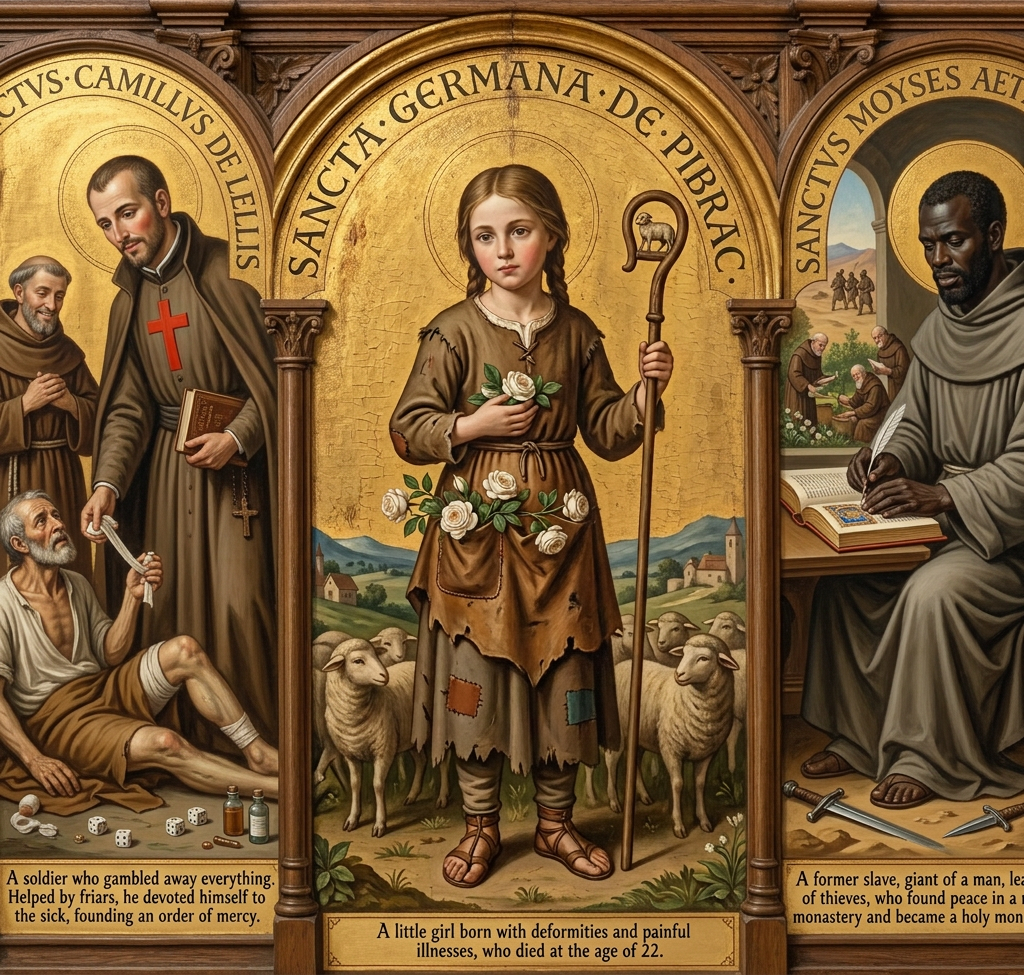
A little girl, born with physical deformities and plagued by painful illnesses, was physically abused by her stepmother, forced to live in a barn, and fed only table scraps. She died at the age of 22, but never turned bitter; instead, she tended sheep, went to Mass, taught children about Christ, and shared what food she had with the hungry.
Blessed are the clean of heart, for they shall see God.
A former slave – a giant of a man – fell in with a gang of thieves and murderers, and eventually became their leader. While fleeing the law, he sought refuge in a desert monastery. The peace, humility, and mercy of the monks there captivated him. He renounced violence, repented completely, and spent the rest of his life with them. Even when a band of robbers attacked his cell, he spared their lives. His peaceful demeanor is said to have contributed to their own conversion to follow Christ.
Blessed are the peacemakers, for they will be called children of God.
A hot-tempered young soldier, unable to control his gambling, eventually gambled away everything. After being helped by some kind Franciscan friars, he devoted himself to caring for the sick, became a priest, and founded a religious order dedicated to serving the physically and spiritually afflicted. Despite his own chronic illnesses, he cared for others with great mercy and kindness until his own death forty years later.
Blessed are the merciful, for they will be shown mercy.
Every saint’s life tells a unique story. Some, like the little girl St. Germaine, are heart-rending. Others, like the reformed outlaw St. Moses the Black, are astonishing. Still others, like St. Camillus, show us holiness in the midst of suffering. Yet all of them, each in their own way, show us one thing above all: the transforming power of God’s grace. And their stories remind us of the old saying that every saint has a past, and every sinner has a future.
The question for all of us is, what story will my life tell? We might think, “Well, my story is nothing like the saints you spoke of. No great events, no drama. What is there to make me a saint?”
Don’t mistake drama for sanctity. Look at the first reading. The author tells of a great multitude in heaven which no one could count. We don’t know their stories. Some of them probably lived lives much like ours. Yet we hear that they survived “great distress.” What could that be? While for some it might be a dramatic martyrdom or great suffering, St. Thérèse of Lisieux reminds us of the “Little Way” – taking up the daily cross of choosing integrity when dishonesty is rewarded, choosing to forgive when resentment is easier, or enduring chronic illnesses, loneliness, or grief while holding onto hope.
John tells us that they have washed their robes and made them white in the Blood of the Lamb. Made white in blood? Yes. The blood of the Lamb cleanses us from sin and makes us holy. The saints did not achieve holiness by their own efforts alone. They were made holy through the saving sacrifice of Christ, and they responded to his grace with lives of faithfulness.
And that cleansing grace is at work even in an “uneventful” life, lived in quiet, consistent reliance on God.
That sounds like us. For we are the people who just sang in the Psalm that we long to see His face; who heard that one day, those called the “children of God” will see Him as He is, and that we who have this hope make ourselves pure as he is pure.
That is what the saints have done. We might imagine, because their stories are so different, that each saint found his or her own path to heaven. But that isn’t so; no one invents their own path to holiness. Rather, they follow the path Christ set before them — the beatitudes he teaches in the Gospel today.
Those beatitudes may seem like a mystery. How can we be happy or “blessed” to be poor in spirit, meek, mourning, or persecuted? Sounds like there’s pain involved. In answer to this, a Dominican theologian compared the Beatitudes to a plow in the fields. A plow turns over the soil, uprooting weeds and preparing the earth for new growth. The Beatitudes do something similar in our hearts. The Holy Spirit overturns our assumptions, challenges our desires, and makes room for the seed of the Gospel.
There’s no getting around it; living out the Beatitudes is difficult. We can’t do it alone. Fortunately, we don’t have to. Through the Holy Spirit, Christ gives us the grace to follow his path. And when we stumble, he calls us back, forgives us, and gives us the grace to begin again.
This is especially important to remember on All Saints Day. The saints aren’t simply people who admired Jesus and tried hard on their own to copy him. They are people who allowed their lives to be transformed by his grace.
So, what story will my life tell? We can’t know now. As John reminded us, what we shall be has not yet been revealed. But we can rejoice in what has been revealed: We are God’s children now; the path to blessedness has been shown to us by Christ; and we’ve been given every gift and grace we need to follow it.
This is our hope: We keep searching for Him, and He will find us and bring us home. Forever.
—


 Angela Merici was a visionary; she saw what was invisible to everyone else. Where others saw the Italian countryside she saw the Kingdom of God; where they saw poor and middle class girls, Angela saw fertile ground waiting for seed. Christ asked her to sow and she obeyed. He asks no less of us. The Kingdom of God is here and now; the ground is fertile and plentiful. All our actions, for good and bad, fall like seeds into that ground. May we always remember what Saint Angela already knew, as given by the spiritual writer James Allen: “The law of the harvest is to reap more than you sow. Sow an act, and you reap a habit. Sow a habit and you reap a character. Sow a character and you reap a destiny.”
 This may sound easy but we know it isn’t, for we too are twisted iron. Perhaps we can’t enter religious life to get twisted straight but we can enter into the silence of our thoughts and the privacy of the confessional to learn how to deal with the sins that are holding us back. Whatever they are, the example of St. Aloysius shows us that while change may be difficult or painful, it is possible.
 The life of Blessed Diana d’Andalo shows us that to those docile to His promptings the Holy Spirit will show both the greatness and the folly inside ourselves. Diana’s folly lay in the selfishness and will to dominate that has plagued mankind since it first heard the voice that whispers You can be like God (Genesis 3:5). Her greatness lay in her steadfast determination to conquer any enemy, especially herself; to cast aside all fear, remain in God’s love, keep faith in Christ, and abandon herself to the power and working of the Holy Spirit, that her love for God and her neighbor may be made as perfect as possible.
 out with rain so intense that Benedict was forced to remain where he was. Seeing this, he became irritated and said, “May God have mercy on you, my sister. Why have you done this?” With tears in her eyes, she replied, “I asked you, and you would not listen to me. So I asked my Lord, and he has listened to me. Now then, go, if you can. Leave me, and go back to the monastery.” Of course, St. Benedict stayed and they talked through the night.