John 8:1-11
Near Antioch in the year 341, a group of bishops met to discuss matters lingering from the Council of Nicaea 16 years earlier. As they spoke, a beautiful woman who was also a known harlot passed by them riding a donkey and wearing little more than jewelry and precious stones. Groaning and sighing, the bishops looked away in disgust in the face of such grave sin. All but one, that is; only bishop Nonnus watched intently as she passed by, and kept watching until she disappeared into the distance. Turning, he then asked his brother bishops if they weren’t delighted with her beauty.
In the gospel passage we read that the scribes and the Pharisees brought a woman who had been caught in adultery and made her stand in the middle (John 8:3). Although the woman in Antioch had passed them by, Nonnus centered her image in the minds of his brother bishops. Like the scribes and Pharisees, they saw nothing more than a woman caught up in worldliness and sin. They remained silent, for they already passed sentence.
Jesus also remained silent, but he did have something to say. The evangelist tells us that he bent down and began to write on the ground with his finger (John 8:6). We don’t know what he wrote, but we are reminded of Jeremiah’s prophecy that those who turn away from God shall be written in the earth, for they have forsaken the LORD, the fountain of living water (Jeremiah 17:13, Revised Standard Version). Only after beginning to write did Jesus speak; not to the woman but to her accusers. If they were concerned about worldliness and sin then their proper focus was themselves, for they were the objects of judgment, not the arbiters of it.
Bishop Nonnus remembered this, for in his brothers’ accusing silence he said, “(W)e have vast promises…stored up with our hidden Lord who cannot be seen. It is he we should please, but we fail to do so; it is for him that we should adorn our bodies and souls, but we totally fail to do so. We should take pains over ourselves in order to scrub away the dirt of sins, to become clean from evil stains; but we have paid no attention to our souls in the attempt to adorn them with good habits so that Christ may desire to dwell in us… (W)e have not taken pains to make ourselves pleasing to God nearly as much as this prostitute… has taken pains to please men – in order to captivate them…” 1
Mercy begins when we look upon someone else and see our own sinfulness. Compassion is born in the eyes of those who see that as others have fallen, so we have fallen. Their pain is our pain; their healing, our healing; their God, our God.
 In the marvelous healing providence of God, it so happened that this same woman heard bishop Nonnus preach the homily the next day at Mass. Whatever he said moved her to repentance. She asked him to make her a Christian. Not long afterward, the same bishops who once looked away in disgust now watched in wonder as this woman threw herself upon the floor of the church, washed the bishop’s feet with her tears, and dried them with her hair. Once baptized, she traded her jewels for a robe and devoted the rest of her life to penance in the strict regimen of a cloistered monastery. The beautiful, bejeweled harlot once known in Antioch as Margarita (meaning “Pearl”) transformed herself into a beautiful model of penitence known to this day by her birth name, Pelagia.
We and bishop Nonnus both know that through the grace of Orders, it was Jesus who preached, Jesus who baptized, and Jesus who transformed Pelagia, just as he does to all who ask him with a contrite and humble heart. Like the woman caught in adultery, the only gaze she knew from him was that of merciful love and the only words those of him who said, Neither do I condemn you. Go, and from now on do not sin any more (John 8:11).
St Pelagia, pray for us.
 This is the strength that has inspired the saints throughout the centuries. Every saint knows what it means to wonder as Habakkuk wondered how and when God will fulfill his promises, but they also know what it means to offer themselves as the instruments through which that promise is fulfilled. Every saint knows what it means to face hardship or to be with others as they face them, but like Timothy and Paul they also know what it means to possess the grace to endure and to support others who need to endure. Finally, every saint knows what it means to feel as if their own faith is inadequate to uproot their mulberry tree full of weaknesses. But they also know what it means to surrender themselves totally to the power of the One who nailed those weaknesses to his own tree and cast them once and for all into the ocean of his infinite mercy.
 Of all the things he might have chosen to begin with, Francis wanted to teach that the best and most mystical encounter we can have with Christ comes not from a voice on a sickbed or even a leper on the road but from the encounter with our own sinfulness. Only when we allow the Lord to lead us from the pain of penance through the conquest of our fears can we too rise and leave the world; not to abandon it, but that we may be Christ to it.
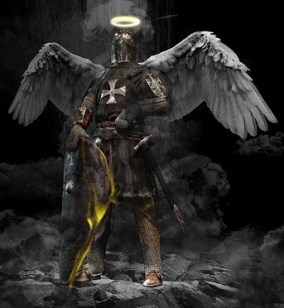 The Archangel Michael, whose name means Who is like unto God?, is the prince of angels. We read in Revelation why Holy Father Leo sought his intercession; it is Michael who leads the heavenly angels in the ultimate battle against Satan and his demons and teaches them why there are none like unto God. Apart from reciting the Pope’s prayer following Mass, let us also ask St. Michael’s intercession for all those who so often find themselves in harm’s way such as soldiers, first responders, and emergency workers. Let us also ask his intercession for ourselves during times of temptation as well as those who have fallen or are in danger of falling away from practice of the faith.
 As Christ commissioned San Lorenzo and his companions, so he commissions us. We are the light of the world; not the light of the rising sun but the light of the risen Son.
 St. Vincent de Paul didn’t begin any better than we, but he ended as well as we can ever hope to. What led him to a healthy, happy life? His relationships to God, his peers, and his flock. How does that help us? At least three ways. First, our relationship with God is at its best when we remember that He dwells not only above but also within each one of us; second, that when we reach out in love to others God is reaching them through us; and third, that we are both sheep and shepherd; the call to holiness is not only a call to take up our cross and follow Christ but to take up our staff and bring others to Him by the example of our lives.
 St. Paul reminds us of this when he says that grace is given to each according to the measure of Christ’s gift (Ephesians 4:11). His measure to Matthew was enough to transform him from a mere money-counter into an artist; indeed the artist who gave us the first portrait of Jesus in our New Testament. His medium wasn’t oil on canvas but words on paper, his subject not simply the man named Jesus but the Son of God and Son of Mary, the prophesied Emmanuel, “God is with us.” His palette held the many colors of Christ: teacher, healer, wonder-worker, Shepherd, Savior. He boldly painted all these images against a dark background for Jesus had come not into a roomful of Roman gamblers but into a land whose people were overshadowed by the darkness of sin and death. Where Caravaggio showed the light coming from behind Christ, Matthew knew that for all times and places Christ is the light – not the light who shines but the light who has arisen (Matthew 4:16). The long night of waiting, hoping, and wondering was over; the bright promise of salvation had dawned in Jesus, the Morning Star who never sets. This is why the great artist put the final brushstroke to his masterpiece in the words of our risen, ascending Master: And behold, I am with you always, until the end of the age (Matthew 28:20).
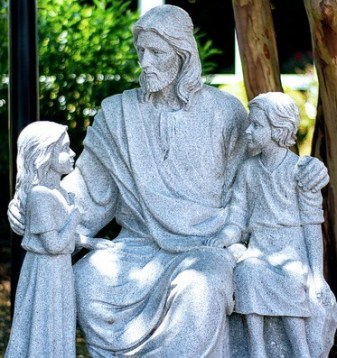 The example of the Korean Church and her martyrs teaches us that every heart open to God and acting on his word becomes a mother, sister, and brother to Christ. Even though we may not have the power of Orders, we do have Christ in the Scriptures and the power of the Holy Spirit through our baptism. We too can evangelize. If you don’t know where to begin, consider: Religious education programs can always use help teaching children the faith; there is a bible study nearby that would teach you more about Christ; there are many ministries that reach out to the hungry, the poor, and the mourning. Be docile to the promptings of the Holy Spirit; He will show you ways to bring Christ to someone in need.
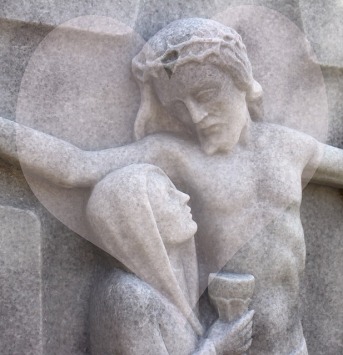 Our gospel closes with this beautiful image:
  It was Simon’s willingness to put out into deep water and lower his nets despite his reservations that yielded him not only an abundant catch but more importantly the grace to see that the one who sent him was not to be called “Master,” but “Lord.” This is the same Lord before Whom we kneel as we say, “O Lord I am not worthy that you should enter under my roof, Speak but the word and my soul shall be healed.”
 Mark 10:45