Romans 12:9-16; Luke 1:39-56
They call it stage presence in the theatre; in movies, star quality. We may know it as charisma, or perhaps in French as je ne sais quoi. By whatever name, it is that “certain something” that some people seem to be born with and others long to acquire, that ability to command attention from the moment they step into the scene. Today, as we meditate on the scene in Sacred Scripture we call the Visitation, we see that even from the womb our Blessed Lord has the ability to make his presence felt.
Of course, the first to feel the presence of Christ is Mary, his mother. Paul reminded us in the first reading that we are to let love be sincere… to love one another with mutual affection; anticipate one another in showing honor (Romans 12:9-10). Soon after learning that she is pregnant with the Son of God, Mary goes “in haste” to visit Elizabeth, pregnant with His forerunner. The most sincere love, the deepest honor Mary could show, was to bring her the very presence of Christ. This is what mission in the Church has always been: the desire to bring Christ to people and allow Him to move them in His own inscrutable ways.
John is the first to be moved, and that literally. Research shows that infants of his age in the womb hear and react to all kinds of sounds around them. For John, already gifted with great sensitivity to the divine presence, the mere sound of Mary’s voice was enough to animate him and send him into ecstasy. From the moment he was filled with the Holy Spirit, John became the epitome of St. Paul’s words, Do not grow slack in zeal, be fervent in spirit, serve the Lord (Romans 12:11). John would serve Christ to the death.
Mary’s greeting also moved Elizabeth. When St. Paul said, Rejoice in hope, endure in affliction, persevere in prayer (Romans 12:12), it almost seems as if he was thinking of her. For many years Elizabeth endured the affliction of barrenness; nevertheless, as a righteous daughter of Aaron she also persevered in prayer (Luke 1:5-7). Now, she reaped the reward of rejoicing in the presence of Christ who is Hope and filled with the Holy Spirit was privileged to be the first to call Mary the Mother of our Lord (Luke 1:43).
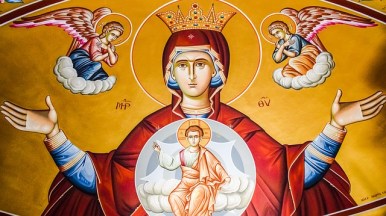 The first reading closes with this exhortation from St. Paul: Rejoice with those who rejoice, weep with those who weep. Have the same regard for one another; do not be haughty but associate with the lowly; do not be wise in your own estimation (Romans 12:15-16). What better or more fitting words are there to describe her whose very soul rejoices in God, her Savior? In the fullness of the grace bestowed on her as a singular gift of God and there visiting Elizabeth and pregnant with the Christ-child, Mary is the very answer to the question Nathanael would ask, “Can anything good come from Nazareth (John 1:46)?” Anything good, indeed! Only she, who by her fiat consented to bring the world Goodness itself; she, not wise in the world’s estimation yet wise enough to leave us with the best advice a mother could tell her children, Do whatever he tells you (John 2:5).
 Leaving Mass, the priest or deacon will say, “Go and announce the gospel of the Lord,” or “Go in peace, glorifying the Lord by your life.” This is our mandate, our call. We have each been given our own unique gifts, not meant only for ourselves. However we do it, our lives are to be a love song to Christ for the world. That our song may be rejected isn’t important. What matters to God is that we sang it for everyone to hear.
 Love is also an act of the will, and to love like Christ requires cooperation with divine grace. This is the love that we are all called to; the love constantly reaches out even to those who push it away; that speaks of healing even to those content only to wound; that speaks of light even to those who love the darkness; that echoes to our neighbor the same words that inspired the artist to paint that famous image of the true Light of the World knocking on the door of our heart: Behold, I stand at the door and knock. If anyone hears my voice and opens the door, then I will enter his house and dine with him, and he with me (Rev 3:20).
 The men and women who we remember today may or may not have had faith in Christ, but in the end what matters is that somehow He spoke to them. In some way known only to Him, Jesus answered their life questions by asking them to be willing to configure themselves to Him; if need be to let go of everything, including their lives, that others may live. Of course, God is never outdone in generosity; we know by the same faith handed on from Peter that each of these fallen soldiers has gone to meet Him face to face and, if so willing, have come to understand the value of the great truth that has confounded mankind throughout the centuries: That only by dying to ourselves do we most truly live; only by letting go of what we want the most do we hold onto what is most truly important: Eternal union with God who is Love itself.
 I remember once talking to my mother as my kids were growing older and leaving home. I questioned whe
 The peace of Augustus won him an altar, the peace of Christ, a cross. Yet look at the result. How many people kneel before an image of Caesar’s Altar of Peace and how many before an image of the cross? The Roman Empire handed Jesus its darkest,
  What’s more, Father’s homilies worked like a match to dry kindling – almost literally. Their consciences convicted, the people built bonfires and threw into the blaze any vain or worldly things they owned that kept them away from God. These fires become known as the “bonfires of the vanities” in every town that welcomed the humble yet fiery preacher, Father Bernardine of Siena.
 With this in mind, we can say that Matthias freely chose to follow Christ who first chose him, called him from his mother’s womb, and gave him the name, “Apostle.” That Matthias was chosen for that office by lot was nothing more or less than confirmation that the journey begun from shore had now moved out into the deeper water that he had already been called to and prepared for.
 Recall Christ’s words: The hour is coming when everyone who kills you will think he is offering worship to God. It is a sad fact that we in the Church are often our own worst enemy. The Arian leadership resolved that what they could not win in Council, they would take by subterfuge. Athanasius, newly elected Patriarch of Alexandria and much loved by his people, was a primary target. The Arians boldly went after him, seeking nothing less than his disgrace and death. They fabricated scandals, perjured themselves and, aided by Arian-leaning or pagan emperors, forced Athanasius into five exiles spanning seventeen years.
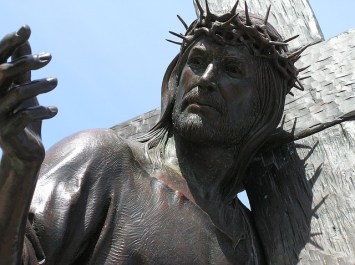 This is the ultimate lesson of Good Friday. Christ’s triumph over self-will and self-reliance did not enable him to merely sympathize with our suffering or feel our pain but to be perfectly in himself the source of eternal salvation for all who obey him (Hebrews 5:9).
 Mark 10:45