Tag: Saints

  • The Bonfire of the Vanities: Memorial of St. Bernardine of Siena, Priest

    Acts 4:8-12; Luke 9:57-62

    What is it that people will run into a burning building to save, apart from their loved ones? Scrapbooks, photographs, keepsakes, and family heirlooms. Over time these personal items acquire an almost sacred aspect; losing them is like losing a part of ourselves.

    Today’s saint, Bernardine of Siena, looked out on the landscape of 15th century Italy and saw something much worse than buildings on fire. He looked into the smoldering ashes of the peoples’ spiritual lives and saw the deadly smoke of fires that rage in the human heart: avarice, selfishness, and sloth. The people burned with desire for worldly possessions, were inflamed with hatred for each other, and had all but abandoned any semblance of religious piety. Even many in the clergy had become lax and neglectful in their practice of the faith.

    These were the parts of themselves that Father Bernardine wanted to see lost in the flames of desire for Christ. Burning with love for them and for his Savior, he traveled across the Italian peninsula laying spiritual siege to every town he could. Father would stay as many days as he thought necessary, said Mass every morning in the town square, and preached tirelessly about the vices he detected in that place. Even though Father was known to have a weak, hoarse voice, when preaching a change came over him; filled with the Holy Spirit, his voice was sonorous, clear, and powerful. In a short time, he became famous his eloquence, forcefulness, wittiness, and piety.

    fire-227291_640What’s more, Father’s homilies worked like a match to dry kindling – almost literally. Their consciences convicted, the people built bonfires and threw into the blaze any vain or worldly things they owned that kept them away from God. These fires become known as the “bonfires of the vanities” in every town that welcomed the humble yet fiery preacher, Father Bernardine of Siena.

    Vanity was not unknown in the time of Jesus any more than it was in 15th century Italy or is now, for that matter. In the gospel we hear people tell Jesus why they can’t follow him; something is holding them back. This reluctance is redolent of the sinfulness in our own lives. Like the people of Christ’s time, there are earthly ties that bind; we may feel ourselves willing but unable to let go of that keepsake, the sin we just cannot seem to break. Nevertheless, Christ has made it clear; following him requires that we allow the reigns of this world to loosen and fall from around us. Let us ask the intercession of St. Bernardine of Siena, who inspired the people of Italy to throw what bound them into the fire, that the Holy Spirit may embolden us to do likewise; to cast every sinful part of ourselves in that eternal bonfire of the vanities: the flames of His infinite, merciful love.

  • Apostle by Destiny: Feast of St. Matthias

    Acts 1:15-17, 20-26; John 15:9-17

    The list of the Apostles given in Matthew, Mark, and Luke do not agree in every detail; one or two of the less familiar names differ by evangelist and, just to complicate matters, Matthew’s list differs depending on which ancient manuscript of Matthew you’re looking at. Naturally these differences have led to confusion and disagreement about exactly who was who. Regardless, everyone agrees about one thing – the name Matthias does not appear in any gospel list of the Twelve.

    However, Peter makes two things clear in today’s reading from Acts. First, he recognizes that Christ chose twelve as a structural number; that is, it was the office that mattered, not the name of the man who filled it. This is why he says in reference to Judas, May another take his office (Psalm 109:8). Second, Peter understands that while men may not have foreseen the need for apostolic succession to that office, God did. By Peter’s reckoning two men, Justus and Matthias, were prepared; as he said, they had accompanied the Apostles the whole time the Lord Jesus came and went among us, beginning from the baptism of John until the day on which he was taken up (Acts 1:21-22).

    Therefore, although only one man was needed to fill the vacancy left by Judas, preparation for the call to apostleship for both men had begun long ago. The same is true for everyone called to any vocation that builds up the Kingdom of God. No man suddenly becomes a deacon, priest, or bishop on the day of ordination; no man or woman is instantly transformed into a spouse, whether of another person or of Christ, merely by speaking vows. Graces are given at those moments and at ordination a man’s state is changed and all the privileges of the office accorded; however, the call to follow that vocation and the discipline needed to prepare for it come well before the administration of any Sacrament (or Consecration prayer).

    What’s more, the whole process is initiated by Christ. We may be tempted to think that we choose a particular vocation and to a degree that is true for we have free will. However, remember the words of the prophet Isaiah: Before birth the LORD called me, from my mother’s womb he gave me my name (Isaiah 49:1) as well as those of Jesus in the gospel: It was not you who chose me, but I who chose you (John 15:16a). If we have truly committed ourselves to follow Christ then, although the steps toward our destiny are our own, the path is lighted by Christ, discerned in union with the Holy Spirit, and freely offered out of love for and in union with the will of the Father.

    fishing-164977_640With this in mind, we can say that Matthias freely chose to follow Christ who first chose him, called him from his mother’s womb, and gave him the name, “Apostle.” That Matthias was chosen for that office by lot was nothing more or less than confirmation that the journey begun from shore had now moved out into the deeper water that he had already been called to and prepared for.
    That we never hear about Matthias in Scripture again is neither surprising nor important. It is the same with most of the other Apostles. Remember why Christ chose Apostles to begin with: to go and bear fruit that will remain (John 15:16b). Somewhere, a line of bishops remains to this day that traces its origin to St. Matthias and continues to bear fruit for love of him who first called them to that glorious destiny – our Lord Jesus Christ.

    St. Matthias, pray for us.

  • Against the World: St. Athanasius, Bishop and Doctor of the Church

    John 15:26-16:4a

    In the gospel reading, Jesus said to his disciples, They will expel you from the synagogues; in fact, the hour is coming when everyone who kills you will think he is offering worship to God. They will do this because they have not known either the Father or me (John 16:1-3). While everything that Jesus said is appropriate for all times and seasons, these words have particular resonance for St. Athanasius, whose feast we now remember and celebrate.

    By all accounts, Athanasius was a man of many gifts. Brilliant in both academics and his understanding of people, at ease as pastor of a large patriarchate yet equally comfortable amid the solitary contemplatives in the desert, a gentle man not prone to anger but at the same time a tenacious defender of the faith.

    Athanasius was born around the year 298 into a Christian world on the throes of tearing itself to pieces over a heresy known as Arianism. Named after its progenitor, a priest named Arius, it sent a shock wave through the world by preaching about Christ that “there was a time when he was not.” The Arians believed that only the Father was truly God; as great as he was, Jesus was a creature, not God. The idea spread like wildfire, and by the time Constantine legalized Christianity, the faith was a house divided threatening to collapse upon itself.

    A good general but no theologian, Constantine convened a worldwide Council in 325 to bring the sides together and solve the problem. Athanasius, then deacon and secretary to the Patriarch of Alexandria, quickly saw that biblical arguments were futile; each side interpreted Scripture to suit its own beliefs. He and a small group of defenders outmaneuvered the Arians by moving from exegesis to philosophy. They argued that Jesus must fully share the eternal, divine nature of the Father; to relegate him to the status of a creature, no matter how godly, would be to say that he was subject to error and to change, including from good to evil. Hearing this horrified even many Arians. Their position was overwhelmingly rejected. To this day, we still recite every week the words first written at that Council, perhaps by Athanasius himself: God from God, Light from Light, true God from true God; begotten not made; consubstantial with the Father…

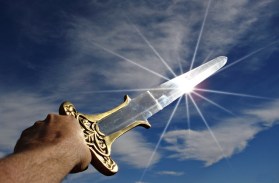
    sword-790815_640Recall Christ’s words: The hour is coming when everyone who kills you will think he is offering worship to God. It is a sad fact that we in the Church are often our own worst enemy. The Arian leadership resolved that what they could not win in Council, they would take by subterfuge. Athanasius, newly elected Patriarch of Alexandria and much loved by his people, was a primary target. The Arians boldly went after him, seeking nothing less than his disgrace and death. They fabricated scandals, perjured themselves and, aided by Arian-leaning or pagan emperors, forced Athanasius into five exiles spanning seventeen years.

    Yet, recall that Jesus also said, And you also testify, because you have been with me from the beginning (John 15:27). If Athanasius did anything, he certainly testified. Instead of spending his years of exile in angst or despair, he took refuge where he could, not least among the desert fathers, and wrote extensively. He taught and encouraged his flock, gave outstanding defenses of the faith, and shaped the Western world’s understanding of monasticism by writing on the life of his friend St. Anthony of the Desert. These works together with treatises on Arianism and theological topics such as the Incarnation earned Athanasius the title Doctor of the Church.

    Some of the histories refer to him as Athanasius contra mundum (Athanasius against the world). He spent his ministry in a world that was increasingly Arian, hostile to the orthodox, and many wanted him silenced. Yet, the bishop kept in mind the words of Jesus: they have not known either the Father or me (John 16:3), and loved the world too much to let it go its own way. Athanasius knew that heresy could only triumph where people were ignorant, where they didn’t know the Father or the Son. God had provided him the office, the education, and the opportunities; it was then up to him to use these gifts to bring the truth to whoever would accept it and leave the consequences to God.

    In a way, little has changed over the centuries. We find ourselves in a world increasingly hostile to Christianity; many would like us silenced as well. This we cannot do. Like Athanasius, we must look with love upon the world, consider the gifts that we have been given, and seize the opportunities that Christ has laid before us.

    St. Athanasius, pray for us.

  • What Can I Teach Him? St. Joseph, husband of the Blessed Virgin Mary

    Suggested Reading: Matthew 1:16, 18-21, 24a

    In one of the many films about the life of Christ, there is a moment that I find particularly poignant and relevant when contemplating St. Joseph. While Mary and Joseph are resting on their way to Bethlehem, Joseph contemplates his impending fatherhood by looking at Mary and wondering out loud, “What can I teach him?”

    We should take a few minutes to contemplate that question for ourselves. If we were Joseph, what would we teach Jesus?

    First, we would teach him about our family. He would learn why we are called sons of David. The family tree given in the gospel of Matthew traces his line through the great kings David and Solomon, all the way back to Father Abraham, who first held the promise of a land flowing with milk, honey, and countless descendants. Of course, the family tree also contains some of the biggest scoundrels ever to call themselves king, as well as a few women whose histories would make for some interesting stories around the campfire. Most of all, we would teach Jesus that, apart from those few exceptionally good or bad people, his ancestry is filled with people like us; the ordinary, whose lives may seem to pass in obscurity but who also have known love and loss, the best and the worst of times, and have spent their lives hoping in the promise once given to our ancestor David.

    Second, we would teach him about the faith of our people. There are so many stories to tell him: Creation, Noah, Abraham, Isaac, and Jacob. We would tell of Jacob’s son, our namesake, Joseph; of his exploits in Egypt; how he was able to interpret dreams and through that gift keep the people fed and himself prospering. Imagine how the eyes of Jesus would light up when we talked about dreams, for that would lead us to talk about our own dream, when the angel said you are to name him Jesus. On our way to the Temple in Jerusalem we would sing the psalms and talk about the feasts, especially Passover and Unleavened Bread. We would remember Moses and Aaron, the plagues, the angel of death, the Red Sea, the pillar of fire; the wandering in the desert; the promised land and then his own namesake, Joshua. From all this, young Jesus would learn that, despite the tendency of some to stray from or misinterpret the faith, we are a faithful people who love God and desire to serve and be faithful to him.

    Third, we would teach Jesus the value of labor; that God himself worked when creating the world, and that we work to maintain and make a living from it. We would teach him that our work as handymen and woodworkers not only puts food on our table but is a great service to our people; we make the yokes for their oxen and the tools for their trades. We would teach him that to do this job he will have to learn how to get along with all sorts of people; the demanding customers who are never satisfied with our work; the destitute who cannot afford it; those who are grateful, and those who never say thank you.

    In his divine wisdom, who else would God choose but a man who already has all these things ingrained into his nature; a man capable of teaching his child simply by virtue of his life? We don’t have to guess; he chose Joseph, of the house of David, a man of deep faith and resilience, worthy of the greatest task he could ever undertake.

    joseph-567996_1920 (2)Of all men, Joseph was chosen to tell the Son of God the human story of the people he created; to teach him about the faith that he gave the world; to show him what it meant to fully engage his world as a man of his times; how to work, to worship, to provide for others, to give of himself, to weep, to laugh, to live. Only Joseph had the incredible privilege and the awesome responsibility of teaching the Son of our heavenly Father how to be the son of a human father as well.
    St. Joseph, pray for us.

  • The True Cornerstone: Memorial of St. Patrick, Bishop

    The True Cornerstone: Memorial of St. Patrick, Bishop

    Genesis 37:3-4, 12-13a, 17b-28a; Psalm 105:18-19; Matthew 21:33-43, 45-46

    August 15th, the Feast of the Assumption, fell on a Sunday in the year 1858; that afternoon, a 22 year-old Irish immigrant named Cormack McCall1 may well have watched as a stone that he had cut with his own hands was blessed as the cornerstone of the new St. Patrick’s Cathedral by New York City’s Archbishop John Hughes. Around Hughes stood seven bishops, 130 priests, and 100 choirboys. The crowd was estimated at 100,000 people or more; New York’s entire fleet of streetcars had been diverted to the area just to accommodate them.

    It is an oddity in keeping with St. Patrick that to this day no one knows exactly where the cathedral’s cornerstone is or when it went missing.2 It has sunk into obscurity like the details of the life of the great saint himself. Nevertheless, St. Patrick’s impact on the faith is every bit as real and foundational as the cathedral’s mysterious cornerstone.

    Patrick was similar in a few ways to Israel’s son Joseph, who we encounter in the first reading. Both became slaves in their youth, both were bright and resourceful men of dreams, and both used their gifts not just to endure their captivity but to be victorious over it.

    Of course, there were differences. Unlike Joseph, Patrick was not raised by parents with a strong and vibrant faith; nevertheless, during his captivity he found his faith was strengthened. Second, while both were men of dreams, Patrick focused on one particular vision from his youth and was determined to see it come to fruition. While a slave he had a vision of Irish children reaching out for him and resolved that should he escape he would return and convert the pagan Irish to Christianity. In fact, he did escape and reunite with his family in Britain for awhile; however, Patrick never lost sight of that vision from his youth. Around the year 431, after being ordained in France, Patrick was sent to Ireland as its bishop by Pope Celestine I.

    At first, Bishop Patrick began by supporting the small band of Christians already on the island but was soon evangelizing far and wide, preaching, writing and baptizing countless people. It is ironic that Patrick was so self-conscious of his lack of formal education for as an evangelizer he was brilliant. He understood that the truth of Christ transcends culture, that certain symbols or practices of the pagan people could be imbued with Christian meaning. For example, an ancient pagan image of two crossed lines and a circle was reinterpreted by Patrick as the Cross of Christ with the circle symbolizing the eternity of God. We know it as the Celtic Cross to this day.

    Over the course his years a missionary bishop to Ireland, Patrick truly was a cornerstone of the Irish Church. He installed and supported church officials, created councils, founded monasteries and organized Ireland into dioceses. He died around the year 461 and was buried in the land that he first came to as a slave and to which he returned, faithful to his promise to the end.

    The psalmist today had Joseph in mind as he sang, they had weighed him down with fetters, and he was bound with chains till his prediction came to pass and the word of the LORD proved him true (Psalm 105:18-19) but it applies to St. Patrick as well. In a larger sense it applies to all of us, for to one degree or another we are all weighed down with the fetters of sin. Many are bound with the additional chains of addiction or illness, either our own or someone we love. Perhaps we have not been given visions or dreams like Joseph or Patrick, but we have been given the vision of Christ, the Eternal Word who proved himself true to the greatest promise ever given mankind: That every fetter would be lifted, every chain broken, every tear wiped away for all those who cling to him as their salvation. As much as they did, as faithful as they were, both Joseph and Patrick humbly bend their knee and fade into the background like an old cathedral cornerstone before the Stone rejected by the builders, the one true Cornerstone who is Christ.

    St. Patrick, pray for us.

  • Going Through the Motions: The Friday after Ash Wednesday

    Isaiah 58:1-9a; Psalm 51:19; Matthew 9:14-15

    After many years of playing the guitar I know that once I’ve learned a song, bad things can happen if I watch my fingers while I play. I make more mistakes, the music sounds too careful, too mechanical; I play without heart. When I forget what my hands are doing, I can focus on the music and everything feels and sounds better to me. I’d guess that many people in the performing arts would agree that at least on some level you just have to “go through the motions.”

    But while going through the motions may be fine in some contexts, it’s a real problem in the spiritual life. As we grow in our faith, we take on its rhythms; its prayers and practices become second-nature to the point that it’s almost as if we could do them in our sleep. But that’s just the problem; our tongues know them so well that our mind thinks that it isn’t needed. As a result, the practices that we learned specifically to grow closer to God can become the same practices that distance ourselves from him.

    Take for example the centuries-old practice of fasting; a good and pious practice that is supposed to remind us of the providence of God who is our only true and lasting nourishment. Yet, in the gospel reading today, the followers of John who were fasting seemed far less occupied with God and his providence and far more occupied with other people, particularly those who were not fasting. Of course, if their minds and hearts were fully engaged in the fast, the practices of Christ and his disciples would have been of little concern to them.

    This isn’t really about those disciples and it isn’t just about fasting. The dangers of routine in the spiritual life affect all of us, all the time. For me, it could be that I’m so used to fasting that I’ve forgotten why I ever began to do it; for you, it may be that your mind wanders during the rosary, the chaplet, the Stations, Adoration, or even Holy Mass. The point isn’t the practice, the point is where the mind and heart are directed while doing it. If we aren’t careful, even the most pious prayers and practices can be emptied of their meaning.

    Worse, our Lord reminds us through the prophet Isaiah that these devotions will not remain empty long; they will be filled with evil. Listen again as Isaiah says: Lo, on your fast day you carry out your own pursuits, and drive all your laborers. Yes, your fast ends in quarreling and fighting (Isaiah 58:3-4). No one who takes up a fast out of love for God wants to see their devotion end like that, but these are the logical conclusion when spiritual practices become a matter of merely going through the motions.

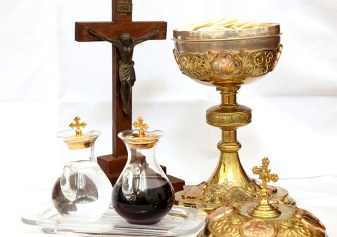
    cross-699617_640This is why our Lord counsels us through Isaiah to break from our routine, to find new ways to express our devotion and recover their original intent. That may mean learning new prayers; becoming active in a ministry that we haven’t done in awhile or ever; coming early to Mass for some quiet time with our Lord or staying after to make thanksgiving; paying greater attention at Mass especially at the Consecration; and taking special care to receive our Lord gratefully in Holy Communion. Whatever we do, God urges us to remember that these actions aren’t mere habits; they are tokens of the love and longing for God borne in our hearts, planted there by him and always drawn to him in whom alone we find rest and true union.

    Let us remember today the importance of vigilance in the spiritual life. It’s good to memorize our prayers and say them every day; it’s better to pray earnestly and from the heart. It’s good to attend daily Mass out of love for God and unity with one another; it’s better to use the healing power of the Mass to let go of the animosity, hatred, or enmity that separates us from others and from God. This takes effort; it takes sacrifice, but it is a sacrifice done from a heart like that of King David, who sang in today’s psalm:

    My sacrifice, O God, is a contrite spirit; a heart contrite and humbled, O God, you will not spurn.

  • Happiness: Tuesday of the Seventh Week in Ordinary Time

    Readings: Sirach 2:1-11; Mark 9:30-37

    Are people who practice their faith happier than people who don’t? It would seem so, if the results of a recent survey on religious practice can be trusted. Data collected from people around the world showed that those who are actively religious tended to describe themselves as very happy more often than people who are not. Here in the United States the difference is remarkable; actively religious people were over 40% more likely to describe themselves as very happy.1

    We might wonder what the non-religious would make of this in light of today’s readings. First they hear Sirach say, “When you come to serve the LORD… prepare yourself for trials… in crushing misfortune be patient… For in fire gold and silver are tested, and worthy people in the crucible of humiliation” (Sirach 2:1-5). This is followed by Jesus predicting his passion and death and then telling his power-hungry disciples that those who wish to be first “shall be the last of all and the servant of all” (Mark 9:35). So, the non-religious person asks, happiness comes to those who endure trials, misfortune, and humiliation; who carry crosses, finish last, and act as everyone’s servant? Sounds like a recipe for making myself unhappier than I already am!

    If we define happiness as feelings of contentment, well-being, or pleasant experiences, then they have a point; trials, humiliation, crosses, and servitude are the furthest thing from pleasant. But this is a misunderstanding. Happiness is not a feeling, it is a state of being; specifically, it is the state of being in union with God.

    Look at it this way: Both religious and non-religious people have good times and bad; they undergo trials, are humiliated from time to time, suffer misfortunes, and know what it means to sacrifice. The difference is that religious people see these times not only as something to endure or to learn from but as opportunities to unite themselves to God and to others and in so doing come closer and closer to loving as God loves.

    hospice-1793998_640Divine love is the key to happiness. Again, although religious and non-religious people know what it means to love, there are at least two important differences. First, the religious person knows that we can only be happy to the degree that we love as God loves and that no one showed greater love than Christ. None endured more trials, suffered more humiliation, was crushed by more infirmity, carried a cross weighed down by more sin, or was more of a suffering servant than he who did it that we his beloved may be spared. With this depth of love as the standard, we are called to imitate Christ in the love we bear toward each other, even and perhaps especially those we think least worthy of it. We can never be happy without doing so.
    Yet even our best effort to show this kind of love is in vain without the second aspect – hope. As the Catechism reminds us, “hope is the theological virtue by which we desire the kingdom of heaven and eternal life as our happiness, placing our trust in Christ’s promises and relying not on our own strength, but on the help of the grace of the Holy Spirit” (CCC §1817). The non-religious may love and will find some contentment in it but without God, there is no happiness; with God, the hope of happiness springs eternal.

    We should not be surprised that those who have received the gift of faith are happy. Christ promised it to the mourning, the meek, and the merciful; to the peacemakers and the persecuted; the humble and hungry; to all those who would imitate the love he showed by offering himself for the life of the world: “Rejoice and be glad, for your reward will be great in heaven” (Matthew 5:12).

    1 Marshall, J. (2019). Are religious people happier, healthier? Our new global study explores this question. Available online as of 02/19/19 at https://pewrsr.ch/2MEWOYx.

  • Fragile Man

    Fragile Man

    Feast of the Chair of Saint Peter, Apostle

    1 Peter 5:1-4; Matthew 16:13-19

    • Pope St. Leo I, who singlehandedly faced down Attila the Hun, preventing him from sacking Rome, and who later spoke so eloquently about the person and nature of Christ that the bishops exclaimed, “Peter has spoken through Leo”;
    • Pope Nicholas II, who turned clerics into kingmakers;
    • Pope St. Gregory VII, who drove the German King Henry IV to his knees begging forgiveness after making him stand four days in the snow waiting for it;
    • Pope Julius II, the warrior pope known for his fierce temper or “terribilita,” yet whose great aesthetic sense drove him to commission Michelangelo, Raphael, and Bramante to create some of their greatest works; and
    • Pope Paul III, who excommunicated the King of England, Henry VIII, organized the Council of Trent against the Protestant Revolt, instituted seminaries to train priests, and founded the Roman Inquisition to enforce purity of doctrine.

    As we celebrate the Feast of the Chair of St. Peter, the Church gives us a selection from the first letter of Peter which tell us that those who tend the flock of Christ are to do so “willingly,” “eagerly,” and to “be examples.” As we look across the centuries, history shows that different popes have interpreted these words in very different ways. There have been forceful shepherds such as

    There have been more pastoral shepherds such as

    • Pope St. Gregory I, the first monk to be pope, such a deeply pastoral man that he saw himself as “the servant of the servants of God,” who took the care of his flock so seriously that he sold papal property to feed them;
    • Pope Innocent III, who approved the Franciscan and Dominican orders, greatly deepening the spiritual lives of the faithful for generations to come;
    • Pope Leo XIII, known as “the worker’s pope,” who laid the groundwork for Catholic social thought in the 20th and into the 21st century; and
    • Pope St. John XXIII, perhaps the most ecumenical pope in history, who called the Second Vatican Council, wrote an encyclical on world peace, and went out of his way to change the relationship of the Church to the world and to other religions.

    Of course, for every one of these shepherds we can name at least one whose pontificates were marred by scandals and abuses of every sort. And for every one of these, we can name perhaps a dozen more who passed through history almost completely unnoticed and who seem to have done nothing at all during their reign.

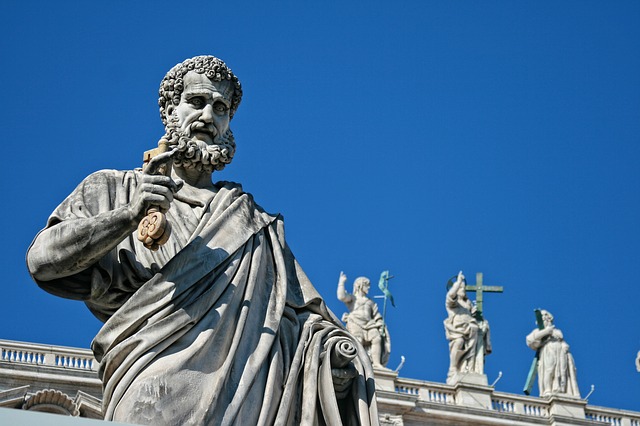
    Yet how like St. Peter they all are! Peter, who grudgingly re-cast his nets after catching nothing on his own, only to have Jesus fill them to the breaking point; who in one breath proclaimed Jesus as the Christ and in the next tried to talk him out of his destiny; who tested the reality of Christ’s presence on the water by walking on it himself and sank as the truth sank into him; who insisted that he would never deny Our Lord but did so three times; and who ran from the cross only to end his life on a cross of his own.

    And how well we know that St. Peter lies within each one of us. We let the Holy Spirit work within us, proclaiming Jesus as the Christ of God, yet at the same time allow the enemy to tempt us to lay down the cross Christ bids us carry. We challenge Christ to prove himself to us yet sink as he does so. We say that we would never deny him yet in fact deny him with every sin we commit.

    So as we look at every man who has ever sat on the Chair of Peter from the greatest to the least, we should see ourselves. Within each of us lies the strength and poetry of Leo I, the “terribilita” of Julius, the compassion of Gregory I, the resolve of Gregory VII, and the openness of John XXIII. The celebration of the Chair of St. Peter is at its heart a call to look within; to be as 1 Peter reminded us, shepherds in our own way, tending those around us with the care of the Shepherd who commissioned Peter himself, giving to fragile man the keys to the Kingdom of Heaven and best of all, who loved, forgave, and strengthened Peter as he loves, forgives, and strengthens us.

  • The True Tower to Heaven – The Seven Holy Founders of the Servite Order

    Genesis 11:1-9; Mark 8:34-9:1

    In the 12th century, Pope Innocent III looked upon a world that seemed to fit Christ’s description in the gospel: A faithless and sinful generation. Germany mired in civil war; the king of England plotting rebellion against Rome; Spain in the grip of the Moors; Jerusalem still under Muslim control. Closer to home things were no better; Italy’s city-states warring with each other and families within cities fighting each other for power and political control.

    As counterpoint to this, the Church tried to be a sanctuary of unity and peace. In Florence, a confraternity was formed known as the Society of Our Blessed Lady, composed of aristocrats, wealthy noblemen and merchants. By 1233, 50 years after its founding, the Society boasted 200 members.

    That same year on the Feast of the Assumption, seven members of the Society, aged 27 to 34, lingered in church after Mass. Separately yet simultaneously each received a vision of the Blessed Mother, who asked them to “Leave the world, retire together into solitude, that you may fight against yourselves, and live wholly for God. You will thus experience heavenly consolations. My protection and assistance will never fail you.”

    It couldn’t have been easy to just “leave the world.” These were businessmen with substantial fortunes and bright futures. Some had families; while three were celibate and two were widowed, two were still married. The call to leave everything might have seemed as difficult to them as it was to the disciples to hear Christ say that the only way to be raised to the glory of Heaven was to take up the cross on Earth.

    The human will naturally resists this. We want the glory but we want it our way. In the first reading, the people tried it their way; they disobeyed God’s command to populate the world, choosing instead to gather in one place to build a tower that would reach the heavens. But as our Lord implied in the gospel, heaven cannot be reached by human will; it can only be reached by the cross. The seven men kneeling in church on that August day knew this. Mary had shown them their cross, so they did as she asked. Renouncing their wealth, they left family and friends and lived outside the city walls in devotion to Christ.

    Finding solitude was no easier than leaving the world. As you might guess, such a radical change of life drew a lot of attention. The faithful, the doubters, and the merely curious all came to visit. Aware that this interfered with the Blessed Mother’s request, the men relocated to an isolated mountain north of Florence. There they took up the life of total devotion to God that Mary had requested. Thus energized to serve others, they began to teach against a popular heresy of the time and achieved great success. For this they were beloved by several popes and ultimately confirmed as the Order of the Servants of Mary, or the Servites.

    suffering-2668413_640In a sense, we are all Servites. Our mission is to witness the gospel, to be at the service of God and all people, inspired by Mary his Mother and most ideal Servant. We can only do this if we do as she did: Conform our wills to that of the Father and do whatever Christ tells us. Only He knows the cross that he has in mind for us. It may be to give up what we hold most dear, to separate from family or friends, and to devote ourselves totally to God. Whatever it is, let us pray for the grace to accept it, to bear it willingly, and to remember in the words of St. Rose of Lima that “apart from the cross there is no other ladder by which we may get to heaven.”
    Seven Founders of the Servite Order, pray for us.

  • The Language of Divine Love – Memorial of Sts Cyril, Monk, and Methodius, Bishop

    Genesis 6:5-8; Mark 8:14-21

    As I was just beginning my teaching career, a professor I once worked for gave me some very good advice. I asked her how I could tell if what I was trying to teach was actually sinking in. She replied, “Here’s my rule: If you see a student nodding her head up and down more than three times while you’re lecturing, she has absolutely no idea what you just said.”

    Mark does not depict the disciples nodding their heads but it’s pretty clear to their Teacher that they too had no idea at all what he had just said. After the disciples discovered that they had forgotten bread, Jesus made a spiritual point about leaven that went so far over their heads that, to paraphrase the ancient saying, he may as well have been speaking Greek.

    Greek would have posed no problem to the saints we remember today. These two brothers, Michael and Constantine, were born in northern Greece in the early 800’s and grew up bilingual, speaking Greek and Slavonic. Although both were well educated and could have attained great success in worldly terms, they were more interested in heavenly rewards. Michael left government service to profess vows, taking the name Methodius, while Constantine left academics, was ordained to the Diaconate, and became a renowned defender of the faith.

    At this time, a prince from what is now the Czech Republic asked the emperor to send missionaries who his people could understand. Constantine and Methodius were sent and they prospered. Not only did they translate the liturgy and the Bible into Slavonic, they invented a written alphabet to do it. Known as the Cyrillic alphabet, it is used in languages such as Russian to this day.

    Sadly, success in ministry sometimes breeds not praise but hostility; so it was for Constantine and Methodius. While the Slavic people took to the faith and loved their liturgy, missionaries from the West complained that they should be using Latin since that was the language of Rome. Pressured to conform, the brothers resisted and were forced to travel to Rome to explain themselves to the Holy Father, Adrian II. Impressed with their arguments and their success, the Pope granted an exemption, authorizing them to continue using Slavonic.

    While still in Rome, Constantine entered the monastery and took the name Cyril. He never returned to the East, dying in Rome just a few months later. His older brother did return, however, and trouble followed him. Without the Pope’s knowledge or consent, the local bishop continued to harass him for not using Latin. He was even horsewhipped and thrown in prison for his refusal. The pope discovered this and had him released, but the precedent had been sent; Methodius was systematically harassed for the rest of his life. His spirit undaunted but his body broken, he died April 6, 885.

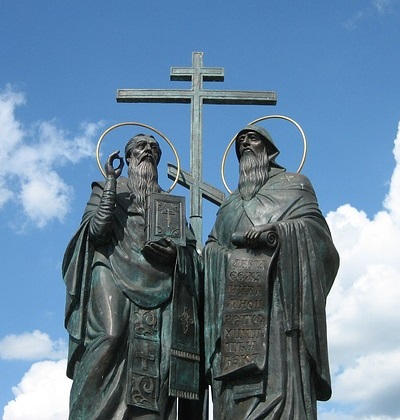
    Of the many lessons that tstatue-2171097_640he lives and ministry of Cyril and Methodius teach us, perhaps the greatest is that the Holy Spirit transcends human barriers by speaking the language of Divine love; His is the tongue of fire that seeks nothing but to speak to every heart and kindle in it the fire of that same love. By using their God-given gifts to foster true understanding of the faith among people despite the cost to themselves, Cyril and Methodius showed that barriers such as human language are nothing to our God, in Whose eyes we are deeply and eternally loved, not for who or what we are, but that we are at all.

    Further, as the reading from Genesis implies, we grieve the heart of God not only when we ourselves remain cold to the Divine flame but when we try to extinguish that flame in others. Like the disciples in the boat, the missionaries who harassed Cyril and Methodius heard but did not understand. Perhaps it was envy or jealousy of the brothers’ ingenuity or success that hardened their hearts. Regardless, we are called to look inside ourselves and ask if we too are envious or jealous of the gifts God gave others. It is true that other people have gifts that we do not, but it is equally true that we possess gifts that they do not. To each has been given the same Spirit; from each is expected the fruits of that gift.

    Therefore, let us resolve to be fluent in the language of love: Pray and thank God for the gifts of the Holy Spirit given to ourselves and to all people of good will; work to develop those gifts that God’s will be done on Earth; rejoice in the success of these gifts and above all, remember that success in ministry means the salvation of souls, each infinitely loved by God, Who is Love itself.


    Saints Cyril and Methodius, pray for us.