Tag: Saints

  • What’s In A Name? Feast of Saints Michael, Gabriel, and Raphael, Archangels

    Revelation 12:7-12ab; John 1:47-51

    It is said that one morning, perhaps in the year 1884, once Pope Leo XIII had finished saying Mass and was leaving the altar, he suddenly stopped. According to witnesses, it was as if he was in a trance; he stood motionless for several minutes and his face turned ashen in color. When he regained his composure the Pope went to his office, asked to be left alone, and began writing. It took him only a short while to produce what became a new prayer to St. Michael the Archangel, which he ordered to be recited after all Low Masses everywhere.

    Only the Holy Father knows what he experienced during the vision; all we have is conjecture. Some say he heard Satan confronting Christ with threats to destroy the Church; others that he saw a terrible vision of dark angels attacking the Church. Whatever it was, Pope Leo left the chapel convinced that demonic forces were gathering and the next 100 years would be a great trial for the Church and the world. From our vantage point of history we see how right he was. The fingerprints of Satan are all over the 20th century: World wars, civil wars, weapons of mass destruction, bloodthirsty tyrants; millions upon millions of lost lives and, as if that isn’t enough, millions more killed in the wombs of their mothers.

    Thanks be to God who has not left us to battle such grave evil alone but has given us good and holy angels like the three whose feast we now celebrate.
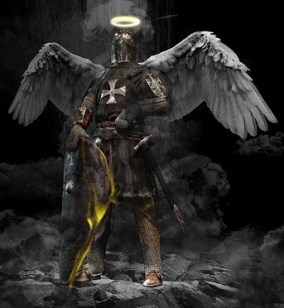
    knight-3003641_640The Archangel Michael, whose name means Who is like unto God?, is the prince of angels. We read in Revelation why Holy Father Leo sought his intercession; it is Michael who leads the heavenly angels in the ultimate battle against Satan and his demons and teaches them why there are none like unto God. Apart from reciting the Pope’s prayer following Mass, let us also ask St. Michael’s intercession for all those who so often find themselves in harm’s way such as soldiers, first responders, and emergency workers. Let us also ask his intercession for ourselves during times of temptation as well as those who have fallen or are in danger of falling away from practice of the faith.

    The Archangel Gabriel, whose name means God is my strength, is the great messenger of Christ. In the book of Daniel he speaks of the coming Messiah; to Zechariah he announces the birth of John the Baptist, forerunner to the Messiah; above all, he is chosen to greet and announce to the Blessed Virgin Mary the great mystery of the Incarnation. Let us ask the intercession of Gabriel on behalf of all those who are charged to carry the message of salvation to others, and ask him to intercede for us, that we may more and more be effective messengers of the Messiah ourselves.

    Finally, there is the Archangel Raphael, whose name means God has healed. He appears in Scripture in only one place: the Old Testament book of Tobit. Full of Messianic undertones, the book tells of a loving father who sends his only son accompanied by a holy spirit (Raphael) to rescue a bride tormented by a demon. During their travels Raphael heals Tobit’s blindness; for this reason many who suffer with diseases of the eye ask his intercession. Let us also ask St. Raphael’s intercession for all those who are in any way blind, morally or spiritually, examining our own inner vision first.

    I am no Pope Leo XIII, but I suggest that we make a habit of praying to these powerful archangels. Something like this:

    St. Michael, Prince of Angels, protect me as I face the many dangers of this world;

    St. Gabriel, strengthen me that I may worthily proclaim Christ to others;

    St. Raphael, ask Our Lord to heal the blindness that keeps me from seeing His Face in everyone I meet.

    Heavenly Father, grant me the grace of the Apostles, that I too may see heaven opened and all the holy angels ascending and descending on the Son of Man: Your only Son, our Lord, Jesus Christ who reigns with You and the Holy Spirit, one God forever and ever. Amen.

    Sts. Michael, Gabriel, and Raphael, pray for us.

  • To the Land of the Rising Sun: St. Lorenzo Ruiz

    Zechariah 8:1-8; Luke 9:46-50

    The readings from Zechariah and Luke may not be a study in contrasts, but they certainly point in different directions. On the one hand, the reading from the prophet Zechariah paints an ideal picture. Jerusalem is restored and at peace; the elderly sit and watch as children play in her streets; God dwells among his people. The gospel, on the other hand, presents us with a different picture; it hints at pride and mistrust among the Apostles; first they dispute who is the greatest in the kingdom, then they attempt to stop the good work done by an outsider in the name of Christ.

    Light can be shed on these contrasting images as we contemplate the life and example of a saint whose memorial we celebrate today. San Lorenzo Ruiz was born around the year 1600 in the Philippines. Raised as a good, practicing Catholic, he married, fathered three children, and worked as a gifted calligrapher. His life was forever altered when, under mysterious and murky circumstances, he was falsely accused of murder. Forced to flee his native country, he learned of a Dominican mission to the Orient and volunteered to serve. During the voyage, Lorenzo learned that the destination was the country of Japan.

    Let us reflect for a moment on a verse from the prophet Zechariah: Lo, I will rescue my people from the land of the rising sun (Zechariah 8:7). Speaking through the prophet, God revealed his plan to rescue Israel from the kingdom of Persia, which was known as the land of the rising sun. A thousand years later in the time of San Lorenzo, the missionaries planned to continue evangelizing in the islands of Japan, known then (and now) as the land of the rising sun.

    They knew there would be trouble. To the Japanese authorities, the missionaries were unwelcome outsiders who were to be brutally put down. Soon after landing, they were captured, imprisoned, and tortured. It is said that when his captors asked if he would renounce his faith to save his life, San Lorenzo responded, “I am a Christian and I shall die for God, and for him I would give many thousands of lives if I had them.” He was martyred not long after this.

    Lo, I will rescue my people from the land of the rising sun. These consoling words spoken by God through Zechariah were also spoken by God through the lives of San Lorenzo Ruiz and his companions who brought the gospel to the land of the rising sun. While there were those who preferred the darkness enough to kill the light-bearers, they could not kill the light, for Christ is the light that the darkness cannot overcome.

    We should not speak of the darkness as if it were always outside ourselves; the Apostles’ behavior shows that darkness exists inside as well. Our own sinfulness works against our efforts to live and preach the gospel. Regardless, the example of San Lorenzo Ruiz demonstrates that when we resolve to put our faith in God’s ability to work in us, through us, and despite us, we will be successful.

    good-morning-695024_640As Christ commissioned San Lorenzo and his companions, so he commissions us. We are the light of the world; not the light of the rising sun but the light of the risen Son.

    San Lorenzo Ruiz, pray for us.

  • A Healthy, Happy Life: Memorial of St. Vincent de Paul

    1 Corinthians 1:26-31; Matthew 9:35-38

    What leads to a healthy, happy life? In the 1930’s, researchers at Harvard selected nearly 300 students and collected data about their personal and social lives for nearly 80 years to try and answer that question. They found that the most powerful influence on these men’s health was how happy they were in their relationships with family, friends, and communities. As one researcher said, “Taking care of your body is important, but tending to your relationships is a form of self-care too. That, I think, is the revelation.”1

    The life of St. Vincent de Paul bears witness to that finding. When he was the same age as the men who began the study, Vincent was a moody, temperamental, lonely young priest who had pursued his calling with mixed motives. While he did love Christ and saw the priesthood as the path to holiness he, like many poor people, also saw it as the path to a better standard of living. His ambition was to rise to bishop as soon as possible (or be the beneficiary of a will), save as much as he could, retire early and return home.

    That ambition unrealized after several years, Vincent found himself spiritually adrift, directionless, and alone in Paris. There, two things happened that changed his life forever. First, he was assigned pastor of a poor rural parish. He expected the material poverty of his parishioners but the depth of their spiritual poverty shocked him. Second, he met a visiting bishop named Francis de Sales. In him Vincent found a kindred spirit, someone he could really connect with. A deep friendship formed. Of all the things he learned from Bishop de Sales he was especially moved by the idea that all people, whatever their station, are called to holiness. Until that moment Vincent assumed like most people that the devout life was reserved for those with a religious vocation.

    These experiences opened his eyes, brought him out of his self-centered shell and gave him the direction he needed. Vincent devoted the rest of his life to care of the poor and the formation of priests. On behalf of the poor, he went to the wealthy, the people of influence, and those in organizations, seeking to provide large-scale, long-term material assistance. He founded an order, the Vincentians, and co-founded another, the Daughters of Charity, to provide for their sacramental and spiritual well-being. For men in priestly formation, Vincent focused on the spiritual life. He did not want them to be as he had once been: Complacent, insulated, seeking only their own holiness. He knew that the priest’s path to holiness was the path of Christ; out in the world feeding and tending the lambs as did the Good Shepherd who knew his flock and whose flock knew him.

    In reality, the Harvard study on happiness confirmed what the Church has long known. Happiness lies in our relationships – with God, with each other, and with the world. In the first reading St. Paul urged us to consider our calling, so let us examine ourselves. We claim to love God but do we do so on our own terms, allowing fear or worldly concerns to take priority? We claim to love each other but do we tend to reserve our time, favors, and affection for a chosen few and pass others by as if they don’t exist? We claim to love all people but do we fail to reach out to those in need, refuse to give of ourselves when it’s inconvenient, or condemn those who disagree with us? The love that is the foundation of all healthy relationships casts aside fear, treats each member of the Body with the same regard, and wishes none to die but all to come to repentance and knowledge of God. It gives totally and without condition. That is the love of Christ.

    positive-2257693_640 St. Vincent de Paul didn’t begin any better than we, but he ended as well as we can ever hope to. What led him to a healthy, happy life? His relationships to God, his peers, and his flock. How does that help us? At least three ways. First, our relationship with God is at its best when we remember that He dwells not only above but also within each one of us; second, that when we reach out in love to others God is reaching them through us; and third, that we are both sheep and shepherd; the call to holiness is not only a call to take up our cross and follow Christ but to take up our staff and bring others to Him by the example of our lives.

    Consider your own calling, brothers and sisters. The harvest is abundant but the laborers are few.

    St. Vincent de Paul, pray for us.

  • The Artist: Feast of St. Matthew

    Ephesians 4:1-7, 11-13; Matthew 9:9-13

    Perhaps the most popular way to contemplate a bible story such as the call of St. Matthew is to imagine ourselves actually in the ancient setting as one of the characters. We see Jesus in that time and place and playing a role in the drama, say Matthew, we contemplate our own reaction to the call to follow Him.

    But there is another way, and that was the one chosen by the 16th century Italian artist Caravaggio. Commissioned to paint an interpretation of the call of St. Matthew, the young artist chose not to portray the scene in its biblical setting. Rather, he set the scene in his own time, moving it from a customs post to a Roman pub. If you’ve never seen the painting, imagine: A giant canvas, mostly dark; to the left, five men in modern clothing clustered around a table in a dimly lit, sparsely furnished room. They could be gamblers; it’s hard to tell. To the right, our Lord and St. Peter in ancient garb have just entered. The only light emanates from behind Christ and illuminates the men in the room. Christ beckons toward them with a gesture reminiscent of the famous Sistine Chapel image of God creating Adam. It’s difficult to tell exactly who He beckons toward. The two men closest to Him appear either annoyed or indifferent. The man in the middle, who may be Matthew, appears shocked and points perhaps at himself, perhaps at the man next to him as if to say, “Me or him?” Finally, the two men furthest away pay no attention either to the light or to Christ; their eyes are fixed on the money.

    The painting, which hangs in a chapel of the church of San Luigi dei Francesi in Rome, shocked the people of its time who were used to sacred art that showed Jesus in the places and with the people of biblical times. By bringing Him to the modern day, Caravaggio reminded them that Jesus is with all of us; He is not confined to any particular time. Gospel verses such as Jesus passed by (Matthew 9:9) are reminders that Jesus is always passing by: He is the child wasting away in a 3rd world country, the immigrant family at the border, the Alzheimer’s patient in the nursing home; the person next to us in the pew; the one looking at us in the mirror.

    Further, Jesus isn’t calling only Matthew. Where Caravaggio was ambiguous let us be clear; Jesus is calling all of us. No matter who we are or how deeply invested in Him we think we already are, Jesus is always calling us into a deeper, more intimate relationship. We speak of a ‘call’ but in reality it’s a challenge; we must ask ourselves if and how we are like those men in the painting. We may be annoyed, thinking that we’ve done enough; we may be indifferent, we’ve stopped caring. Like the man in the middle, we may be astonished, perhaps hoping that Jesus is asking someone else. Or we may be paying no attention at all, too occupied with what we think is important.

    A detail in Caravaggio’s painting should be pointed out. Although Jesus is beckoning toward the table, His feet are facing the exit. Jesus asks us to follow Him but He doesn’t wait. He is on a mission; there are places to go, people to see. The choice is ours. We can get up and follow as Matthew did or we can put it off, wait for a better time. Keep in mind though, that Jesus Himself chose that moment. He has a purpose, a plan, and it includes us. He may demand much but his generosity is never outdone.

    art-2755500_1920St. Paul reminds us of this when he says that grace is given to each according to the measure of Christ’s gift (Ephesians 4:11). His measure to Matthew was enough to transform him from a mere money-counter into an artist; indeed the artist who gave us the first portrait of Jesus in our New Testament. His medium wasn’t oil on canvas but words on paper, his subject not simply the man named Jesus but the Son of God and Son of Mary, the prophesied Emmanuel, “God is with us.” His palette held the many colors of Christ: teacher, healer, wonder-worker, Shepherd, Savior. He boldly painted all these images against a dark background for Jesus had come not into a roomful of Roman gamblers but into a land whose people were overshadowed by the darkness of sin and death. Where Caravaggio showed the light coming from behind Christ, Matthew knew that for all times and places Christ is the light – not the light who shines but the light who has arisen (Matthew 4:16). The long night of waiting, hoping, and wondering was over; the bright promise of salvation had dawned in Jesus, the Morning Star who never sets. This is why the great artist put the final brushstroke to his masterpiece in the words of our risen, ascending Master: And behold, I am with you always, until the end of the age (Matthew 28:20).
    St. Matthew, pray for us.

  • Mother, Sister, and Brother: Sts. Andrew Kim Tae-gŏn, Priest, and Paul Chŏng Ha-sang, and Companions, Martyrs

    Proverbs 21:1-6, 10-13; Luke 8:19-21

    The first in the series of proverbs we read today says, Like a stream is the king’s heart in the hand of the LORD; wherever it pleases him, he directs it. In 1777, the river of mercy that is the heart of Christ the King began trickling into Korea. While visiting China, a small group of aristocrats happened upon some Jesuit literature. They brought it home and as they studied it, God worked his way through their minds and into their hearts.

    The second proverb says, All the ways of a man may be right in his own eyes, but it is the LORD who proves hearts. The Lord took twelve years to prove the hearts of the Korean faithful. In 1789, a Chinese priest stole into Korea on a mission to introduce the people to the Gospel. Imagine his surprise when he discovered an underground Church of 4000 Catholics, none of whom had ever seen a priest.

    The third proverb says To do what is right and just is more acceptable to the LORD than sacrifice. These people, hungry and waiting for Christ, did what was right: They read Scripture and evangelized. When the missionary came and provided what they craved – a taste of the sweetness of the Lord in the Sacraments – they flourished. In just 7 years, 6000 more Koreans were baptized.

    The fourth proverb warns us that Haughty eyes and a proud heart – the tillage of the wicked is sin. If the Korean ruling class was anything, it was proud. The God of the Christians had the audacity to see everyone as equal. Their haughty eyes could not envision a world where elites, workers and slaves could be friends. By 1801 a vicious persecution began; it would last for the next 65 years.

    The fifth proverb says that The plans of the diligent are sure of profit, but all rash haste leads certainly to poverty. Diligent well describes the young Korean boy Kim Taegon who at age 15 embarked on his plan to become a priest. He traveled 1300 miles to attend a seminary in China and was ordained the first Korean-born priest. He returned home and set about the task of smuggling more clergy into Korea but was arrested while doing so. He was executed at the age of 26. Father Taegon was far from alone; in all, the persecution took the lives of 10,000 people; fully half of the Korean Church.

    The Church was diminished, but not impoverished; that would be the fate of the Korean dynasty. The sixth proverb teaches that Whoever makes a fortune by a lying tongue is chasing a bubble over deadly snares. The lying tongues of the despots who reaped profits off the backs of others finally saw their bubble burst; by 1900, the dynasty was eliminated. At long last, the cries of those who had shut their ears to the cries of the poor were, as the last proverb says, not heard themselves.

    Meanwhile, the Church grew. In 1950, the site of the executions of Father Kim Taegon and over a hundred of his colleagues was declared a shrine; in 1984, they were canonized by Pope St. John Paul II in the church built nearby.

    jesus-christ-2516515_640.jpgThe example of the Korean Church and her martyrs teaches us that every heart open to God and acting on his word becomes a mother, sister, and brother to Christ. Even though we may not have the power of Orders, we do have Christ in the Scriptures and the power of the Holy Spirit through our baptism. We too can evangelize. If you don’t know where to begin, consider: Religious education programs can always use help teaching children the faith; there is a bible study nearby that would teach you more about Christ; there are many ministries that reach out to the hungry, the poor, and the mourning. Be docile to the promptings of the Holy Spirit; He will show you ways to bring Christ to someone in need.

    We began with the proverb of the king. Let us close with the prayer that one day, the King of Kings will look at us and say, Amen, I say to you, whatever you did for one of these least brothers of mine, you did for me (Matthew 25:40).

  • The Greatest Gift: Memorial of St. John Chrysostom

    Ephesians 4:1-7, 11-13

    St. Paul urged us to live in a manner worthy of the call we have received (Ephesians 4:1). Sounds like good advice, but very general. How do we do that? What are we to do? Perhaps we can get insight by seeing how a saint did it. Since today we remember St. John Chrysostom, let us take a look at his life and see if we can formulate an answer.

    John was born in Antioch around the year 347, the son of a military commander who died as a young man. His mother, a pious and devout woman, raised him in the faith and saw to it that he had the best education possible. A naturally gifted speaker, he studied under Libanius, a pagan but the greatest orator of his time.

    Following the custom of the age, John was baptized at the age of twenty. Drawn to the life of the desert monks, he spent four years in a monastery and two more in a cave as a hermit. The physical demands of that life proved too much, so he returned to Antioch.

    Soon ordained to the diaconate, John spent the next five years refining his skill as a homilist, becoming so good that upon ordination to the priesthood he was appointed preacher to the bishop. Over the years the grace of ordination infused his natural ability as an orator to produce not only a passionate, articulate man, deeply in love with Christ, but also one unafraid to speak his mind in words that either warmed like a gentle flame or raged like a firestorm. In his great love for the poor he once gently reminded the people, “Do not judge the poor man, do not seek an account of his life, but free him from his misfortune.” Another time, moved to righteous anger he scolded, “You are large and fat, you hold drinking parties until late at night, and sleep in a warm, soft bed. And do you not think of how you must give an account of your misuse of the gifts of God?”1

    Some call that brutal honesty, others tactlessness; John called it truth and knew as our Lord did that even when bluntly spoken, truth has a way of drawing people to itself. So it did; over the years John’s preaching won hearts in great number. But there was more than that. His authenticity was so appealing. All could see that he practiced what he preached. Like our Lord, John led a pious, austere life; gentle with penitents, generous to the poor, and loving to all, even when love meant bringing a whip to the Temple.

    Also like Jesus, John made his share of enemies, chief among them the emperor’s wife and some very powerful clergy. Their dislike turned to outright hatred when three things happened: First, he was appointed bishop of Constantinople, the emperor’s city, over the empress’s choice; second, he instituted a reform of the clergy who he believed were lax in their pastoral duty; and third, he turned his stinging eloquence loose on the debauchery and immodesty of society, up to and including the empress and her friends.

    Not surprisingly, his enemies fought back. Unlike John they didn’t fight fair, seeing to it that he was charged with false crimes, convicted, and banished as far away as possible. Although vindicated in time, John was getting on in years and the physical cruelty of his guards more than sufficient to bring about his eventual death. Bishop John died on the road to exile on the Feast of the Exaltation of the Holy Cross, September 14th, 407.

    Chrysostom means “golden mouth.” It was a name given him long after his death in homage to his giftedness as a preacher. But this was a man blessed with many gifts: great intellect, resilience, compassion, a deep love of God, and keen insight into human nature, to name just a few. Yet, as great as they all were, the greatest of all was the gift of grace given as St. Paul said, according to the measure of Christ’s gift (Ephesians 4:7). Grace builds on nature, enabling us to use our natural gifts for our own good and that of the world. Consider its effect in the life of John Chrysostom: Raised by a holy, faithful mother, baptized as a young man, driven by the Spirit into the desert, preaching the gospel to the all who would listen, struggling against arrogant, worldly power and suffering the passion and death of his own Calvary road in exile. Grace empowered him to live a life not only devoted to Christ but configured to him.

    jesus-3499151_1280Surely his was a life lived in a manner worthy of the call. But the question remains, what about us? Are we to be another St. John Chrysostom? On one level, no; the gifts given to him were his and his alone. God doesn’t want another St. John Chrysostom. But on another level, yes, the gifts given to us are ours and ours alone and God is calling us to sanctity. We are sanctified to the degree that we take advantage of the same grace that was available to John, not to do what he did, but to do as he did. If we do not preach the gospel from a pulpit in a church we still preach it from the pulpit of our lives. Every day, we are the only homily someone will hear. If we do not shepherd a church or diocese we still have a flock; family, friends, everyone we meet. We are to teach, feed, love, and serve them as Christ did. If we do not bear the cross John bore we still take up our own and unite it to the suffering of Christ for the sake of his body, the Church.

    St. John Chrysostom teaches us that living in a manner worthy of the call we have received is using the gifts God has given us, infused by the grace he alone can give, to bring out of our diversity the unity that raises the Church to mature manhood, the full stature of Christ (Ephesians 4:13).

    St. John Chrysostom, pray for us.

    1St. John Chrysostom, 21st homily on 1 Corinthians

  • The Encounter That Changes Everything: St. Bartholomew, Apostle

    John 1:45-51

    If the Church were to have a patron saint for the cynical, St. Bartholomew just might qualify. Matthew, Mark, and Luke call him Bartholomew; John calls him Nathanael. We can call him cynical, for it was he who asked: “Can anything good come from Nazareth?” Yet the question and the cynicism behind it aren’t nearly as important as the answer, which touched Nathanael deeply and goes right to the heart what it means to evangelize.

    It looks like the first to answer his question was Philip, who invited Nathanael to meet Jesus, saying simply, “Come and see.” Inviting people to meet Jesus is an important step in evangelization. Years ago, Pope Paul VI taught us that it the mission of the entire Church to evangelize; that the full meaning of life in Christ is only found in becoming a witness for Christ by what we say and do. Those who make their entire life a witness radiate the self-giving love of Christ and tend to attract other people, for they make them feel special, appreciated, and valued.

    As important as the invitation is, deeper study of this scene in John’s gospel makes it clear that the first to answer Nathanael’s question was really Jesus himself. Note that Jesus said to him: Before Philip called you, I saw you under the fig tree. While no one knows exactly what happened under that tree, Nathanael’s reply, Rabbi, you are the Son of God; you are the King of Israel, betrays a mystical encounter so profound, so compelling, that it forever changed Nathanael’s life and the lives of all those he would touch.

    wild-fig-2760515_640Thus, the encounter with Christ is the key to evangelization. As Cardinal Francis George once said, evangelization consists of introducing people to Christ and allowing him to take over from there. No matter how eloquent, forceful or dramatic we are, the human word pales in comparison with the Eternal Word. Like Nathanael, every person has their own “fig tree” moments; at one time or another, everyone quietly contemplates the eternal, the divine, the transcendent. This is a mystical silence into which we dare not intrude; it is the stillness in which God speaks. The God who sees what we cannot – the heart and soul – speaks to whole person as we cannot. Again like Nathanael, the effect is all-encompassing and all-surpassing.

    As Christ went on to say, Nathanael would see much greater things, but he had already seen all he needed to see. Thanks to the invitation by Philip and his personal encounter with Jesus, the Apostle literally poured out his life evangelizing others.

    Can anything good come from Nazareth? Thanks to St. Bartholomew and all the Apostles, we who were invited and have been touched by Christ no longer need to come and see. At every Eucharist we can now taste and see the goodness of the Nazarene who hung the word Good on Friday. All that remains is that we, like all the saints, use the grace of Communion with Christ to make our lives an open invitation, that everyone may come and see Christ and taste his goodness for themselves.

    St. Bartholomew, pray for us.

  • Memory and Reality: Memorial of Sts. Joachim and Anne

    Sirach 44:1, 10-15; Matthew 13:16-17

    One of my sisters recently found an old family video and circulated a copy through the internet. It was from a Christmas well over 30 years ago and showed my two sisters, my sister’s one year-old son, my Mom and Dad, and one of my daughters.

    I wasn’t good for much after watching it even for a few minutes. Seeing my Dad really moved me. He passed away less than two years after that film. I had memories of him – his voice, mannerisms, the twinkle in his eyes – but when I saw him it was amazing how dim my memories actually were. Equally startling was seeing my daughter. Of course, I remember her as a 4 year old but the video was showing me the actual kid. Once again, it struck me how much my memory was a poor, faded version of the wonderful reality.

    Salvation history is not much different. In the first reading, Ben Sira speaks of those ancestors who will never be forgotten (Sirach 44:10). These were the godly people to whom God spoke in partial and various ways (Hebrews 1:1) and who, century after century, handed down the tradition to those who came after. From the most ancient time when God walked with man in the Garden and later spoke of the woman’s seed who would crush the head of the serpent (Genesis 3:15) onward – through Abraham, Moses, David, Solomon, from first prophet to the last – the wealth of salvation history, which was still alive and waiting to be realized had, like my memory, become a faded version of the original reality.

    cloud-143152_640Today we honor Saints Joachim and Anne, the parents of Mary, for many reasons related to salvation in memory and reality. Most especially we honor them as husband and wife, for it was their marriage, their union that produced the Immaculate Conception, which transformed the dim, distant memory of salvation into a living, breathing, crystal clear reality. We also honor them because, as the last of that long line of generations who patiently waited through the long night for the first rays of salvation’s dawn, doing so honors all the faithful who lived through and, in whatever ways they could, passed on the events of salvation history to those who came after. Finally, we honor them as parents, for they raised their daughter in the faith, taught her the love and goodness of God, and instilled in her the devotion He preferred for the mother of His Only Son.

    The words of Jesus in today’s gospel are a fitting tribute to Sts. Joachim and Anne:

    Blessed are your eyes, because they see, and your ears, because they hear. Amen, I say to you, many prophets and righteous people longed to see what you see but did not see it, and to hear what you hear but did not hear it. (Matthew 13:16-17)

    Sts. Joachim and Anne, pray for us.

  • Can We? The Feast of St. James the Apostle

    Readings: 2 Corinthians 4:7-15; Matthew 20:20-28

    As a young man I attended a classical guitar concert by an internationally recognized master. It was glorious; the music seemed to flow from him as effortlessly as breathing. Inspired, I thought, “I want to play like that,” but when I tried I realized that inspiration is one thing but performance something entirely different.

    Masters in any discipline make what they do look easy. Their work is inspiring and tempts us to believe that we can do it, too. We probably can, but to do so we first must realize that inspiration isn’t enough; commitment is what is needed.

    Perhaps this is what happened to the Apostle James who we remember today. He, his brother, and all of the Apostles watched Jesus teach, heal, and perform wondrous miracles to the adulation of the crowds. Maybe the glory of it all got to him; maybe he was fooled into thinking that such success comes easy, that whatever Jesus did he could do. This would explain why, when Jesus asked James and John if they could drink the chalice He was going to drink they replied, We can (Matthew 20:22). 

    good-friday-2264164_640Of course they could; the question was, did they know the cost? As Pope Francis once said, “I distrust a charity that costs nothing and does not hurt.” Jesus is Charity itself; God is love and there is no greater love than to die that others may live. Such a love virtually promises to hurt. Where James may have imagined sweet wine, a crown of leaves, and the cheers of a crowd, Jesus offered bitter gall, a crown of thorns, and a crowd cheering to see Him die.

    This kind of love asks much; it may ask everything. Still, remember that the Holy Father also said, “Genuine love is demanding, but its beauty lies precisely in the demands it makes.” If we cannot see beauty in the cross, thorns and rejection, consider St. Paul’s perspective in the first reading. Who was ever more afflicted than Christ? Who more persecuted or struck down? Yet He was not constrained, not abandoned, not destroyed. Nor are we; rather, we are raised to new and eternal life. This is why Paul exhorts us to carry in ourselves what James and the other Apostles carried: the body of the dying Jesus (2 Corinthians 4:10). He knew under the only inspiration that matters – the Holy Spirit – that the one who raised the Lord Jesus will raise us also… and place us with you in his presence (2 Corinthians 4:14).

    Although drinking from the chalice is not cheap, the reward is infinite. By so doing we commit ourselves to these life lessons of Christ, the Master: That true freedom is found only in obedience; that the greatest of leaders is the least of the servants; that the conqueror is the one who yields; and that the one who most truly loves life and lives it to the full is the one most willing to empty themselves even to death, that others may live.

    St. James, pray for us.

  • Sheep in Wolves’ Clothing: Memorial of St. Henry

    Readings: Hosea 14:2-10; Matthew 10:16-23

    Today’s saint brings to mind the gospel image of sheep and wolves, for the historical accounts of St. Henry almost paint two distinct pictures. First, there is Henry the lamb; a holy, pious 10th century king and emperor blessed with mystical visions, so favored by God that angels fought in his army. But then there is Henry the wolf; a tenacious power-hungry predator who connived to secure any throne he could and who wantonly made war on his Catholic neighbors. So which was he, sheep or wolf?

    Of course the real man is much more complex; he has aspects of both. Henry was born in the year 972, the son of Duke Henry of Bavaria and his wife, Princess Gisela of Burgundy. As for the lamb, Henry demonstrated as a boy the kind of piety that put him in stark contrast to his father, Henry the Quarrelsome. Well-educated in both secular and religious studies, Henry’s nature seemed more suited to the spiritual life; he thought to become a cleric. However, when his father died at an early age, it became clear that a wolf was needed. Although Henry lacked his father’s temperament he did have his ability to lead; this eventually landed him the crown as King of Germany at the age of 30 and Holy Roman Emperor a few years later.

    Despite his worldly responsibilities, Henry always made time for the spiritual life. Wherever he traveled his first stop was the local church where he spent hours in prayer before the Lord. The king also donated huge amounts for the welfare of the poor and to build churches and monasteries.

    Yet there is also no doubt that Henry was not afraid to go to war even with Catholic nations. His motives are not entirely clear but his concern seems to have been the security of German borders against potential invaders, especially Poland, whose king had expansionist ideas of his own.

    Recall the words of Jesus in today’s gospel: Behold, I am sending you like sheep in the midst of wolves; so be shrewd as serpents and simple as doves (Matthew 10:16). King Henry was a deeply religious man; he adored the Good Shepherd and in his soul gladly bore the brand of His sheep. Nevertheless, he also wore the mantle of emperor; he was a sheep with an empire to rule, people to govern, borders to secure and defend. Christ urged us to be shrewd; what is more shrewd than a sheep in wolves’ clothing?

    For all that, there is evidence that the stress of his earthly duties wore on the king; he longed to retire, to cloister himself behind the walls of a quiet, peaceful Benedictine abbey. He said as much while visiting a monastery and the abbot took him at his word, accepting the king as a postulant and putting him under strict obedience. When Henry asked what his orders were, the abbot replied that he must return to the secular world and discharge his duties as ruler; the empire was in dire need of such a man. Henry obeyed; he left the abbey and ruled until his own premature death at age 52.

    The abbot’s lesson to King Henry is just as appropriate today, for like him we may find ourselves weary and wondering if perhaps we have missed our calling. Over time the drudgery of daily life can take its toll, wear us down, lead us to question who we are and where we’re going, even tempt us to run away in pursuit of a life free of all the responsibilities we carry on our shoulders.

    monastery-569368_640The abbot reminded the king and he reminds us that the church is not a place we run to that we may lose ourselves; it is the place we come to that we may find ourselves. Over the course of his life and reign Henry spent hours on his knees in front of the Tabernacle. He may have meant to empty himself of his problems but Christ had a different plan; He desired to fill him with the grace that would enable him to face and overcome his problems.

    That same grace is available to us but we must be ready, willing, and able to receive it. The prophet Hosea tells us how: Return, O Israel, to the LORD, your God (Hosea 14:2). Return means to repent, to turn from sin, for it is only in so doing that God restores us and instills in us the Holy Spirit that empowers us not just to go out among the wolves but to bring them back with us rejoicing into the flock of Christ.

    St. Henry, pray for us.