Tag: New Testament

  • The Bonfire of the Vanities: Memorial of St. Bernardine of Siena, Priest

    Acts 4:8-12; Luke 9:57-62

    What is it that people will run into a burning building to save, apart from their loved ones? Scrapbooks, photographs, keepsakes, and family heirlooms. Over time these personal items acquire an almost sacred aspect; losing them is like losing a part of ourselves.

    Today’s saint, Bernardine of Siena, looked out on the landscape of 15th century Italy and saw something much worse than buildings on fire. He looked into the smoldering ashes of the peoples’ spiritual lives and saw the deadly smoke of fires that rage in the human heart: avarice, selfishness, and sloth. The people burned with desire for worldly possessions, were inflamed with hatred for each other, and had all but abandoned any semblance of religious piety. Even many in the clergy had become lax and neglectful in their practice of the faith.

    These were the parts of themselves that Father Bernardine wanted to see lost in the flames of desire for Christ. Burning with love for them and for his Savior, he traveled across the Italian peninsula laying spiritual siege to every town he could. Father would stay as many days as he thought necessary, said Mass every morning in the town square, and preached tirelessly about the vices he detected in that place. Even though Father was known to have a weak, hoarse voice, when preaching a change came over him; filled with the Holy Spirit, his voice was sonorous, clear, and powerful. In a short time, he became famous his eloquence, forcefulness, wittiness, and piety.

    fire-227291_640What’s more, Father’s homilies worked like a match to dry kindling – almost literally. Their consciences convicted, the people built bonfires and threw into the blaze any vain or worldly things they owned that kept them away from God. These fires become known as the “bonfires of the vanities” in every town that welcomed the humble yet fiery preacher, Father Bernardine of Siena.

    Vanity was not unknown in the time of Jesus any more than it was in 15th century Italy or is now, for that matter. In the gospel we hear people tell Jesus why they can’t follow him; something is holding them back. This reluctance is redolent of the sinfulness in our own lives. Like the people of Christ’s time, there are earthly ties that bind; we may feel ourselves willing but unable to let go of that keepsake, the sin we just cannot seem to break. Nevertheless, Christ has made it clear; following him requires that we allow the reigns of this world to loosen and fall from around us. Let us ask the intercession of St. Bernardine of Siena, who inspired the people of Italy to throw what bound them into the fire, that the Holy Spirit may embolden us to do likewise; to cast every sinful part of ourselves in that eternal bonfire of the vanities: the flames of His infinite, merciful love.

  • Against the World: St. Athanasius, Bishop and Doctor of the Church

    John 15:26-16:4a

    In the gospel reading, Jesus said to his disciples, They will expel you from the synagogues; in fact, the hour is coming when everyone who kills you will think he is offering worship to God. They will do this because they have not known either the Father or me (John 16:1-3). While everything that Jesus said is appropriate for all times and seasons, these words have particular resonance for St. Athanasius, whose feast we now remember and celebrate.

    By all accounts, Athanasius was a man of many gifts. Brilliant in both academics and his understanding of people, at ease as pastor of a large patriarchate yet equally comfortable amid the solitary contemplatives in the desert, a gentle man not prone to anger but at the same time a tenacious defender of the faith.

    Athanasius was born around the year 298 into a Christian world on the throes of tearing itself to pieces over a heresy known as Arianism. Named after its progenitor, a priest named Arius, it sent a shock wave through the world by preaching about Christ that “there was a time when he was not.” The Arians believed that only the Father was truly God; as great as he was, Jesus was a creature, not God. The idea spread like wildfire, and by the time Constantine legalized Christianity, the faith was a house divided threatening to collapse upon itself.

    A good general but no theologian, Constantine convened a worldwide Council in 325 to bring the sides together and solve the problem. Athanasius, then deacon and secretary to the Patriarch of Alexandria, quickly saw that biblical arguments were futile; each side interpreted Scripture to suit its own beliefs. He and a small group of defenders outmaneuvered the Arians by moving from exegesis to philosophy. They argued that Jesus must fully share the eternal, divine nature of the Father; to relegate him to the status of a creature, no matter how godly, would be to say that he was subject to error and to change, including from good to evil. Hearing this horrified even many Arians. Their position was overwhelmingly rejected. To this day, we still recite every week the words first written at that Council, perhaps by Athanasius himself: God from God, Light from Light, true God from true God; begotten not made; consubstantial with the Father…

    sword-790815_640Recall Christ’s words: The hour is coming when everyone who kills you will think he is offering worship to God. It is a sad fact that we in the Church are often our own worst enemy. The Arian leadership resolved that what they could not win in Council, they would take by subterfuge. Athanasius, newly elected Patriarch of Alexandria and much loved by his people, was a primary target. The Arians boldly went after him, seeking nothing less than his disgrace and death. They fabricated scandals, perjured themselves and, aided by Arian-leaning or pagan emperors, forced Athanasius into five exiles spanning seventeen years.
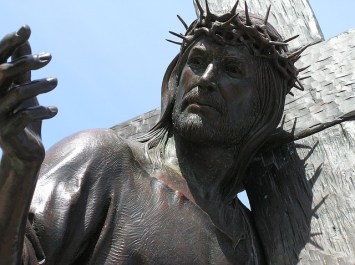
    Yet, recall that Jesus also said, And you also testify, because you have been with me from the beginning (John 15:27). If Athanasius did anything, he certainly testified. Instead of spending his years of exile in angst or despair, he took refuge where he could, not least among the desert fathers, and wrote extensively. He taught and encouraged his flock, gave outstanding defenses of the faith, and shaped the Western world’s understanding of monasticism by writing on the life of his friend St. Anthony of the Desert. These works together with treatises on Arianism and theological topics such as the Incarnation earned Athanasius the title Doctor of the Church.

    Some of the histories refer to him as Athanasius contra mundum (Athanasius against the world). He spent his ministry in a world that was increasingly Arian, hostile to the orthodox, and many wanted him silenced. Yet, the bishop kept in mind the words of Jesus: they have not known either the Father or me (John 16:3), and loved the world too much to let it go its own way. Athanasius knew that heresy could only triumph where people were ignorant, where they didn’t know the Father or the Son. God had provided him the office, the education, and the opportunities; it was then up to him to use these gifts to bring the truth to whoever would accept it and leave the consequences to God.

    In a way, little has changed over the centuries. We find ourselves in a world increasingly hostile to Christianity; many would like us silenced as well. This we cannot do. Like Athanasius, we must look with love upon the world, consider the gifts that we have been given, and seize the opportunities that Christ has laid before us.

    St. Athanasius, pray for us.

  • We Adore You, O Christ and We Praise You: Good Friday

    Hebrews 5:7-9

    From the time we first became Christians, we have learned that the standard for our behavior is not those around us but Christ. Given that, it might be easy to give up and say that we can never reach that standard of perfection.

    That’s true. Left to ourselves, we can’t.

    But as the author of the letter to the Hebrews reminds us, we aren’t left to ourselves. In his infinite mercy, Jesus sympathizes with our weakness. Even though he himself never fell to the many temptations that weighed on him like a cross and surrounded him like a crown of thorns, he knows what it’s like to carry them, to bear their weight and feel their pain, but also to endure and overcome them.

    Fully man, Christ knows what it means to feel the kind of pain that leaves us without words; able only to offer prayers and supplications with loud cries and tears to the one who was able to save him (Hebrews 5:7). Enduring that kind of torment, he must also have felt the natural reaction of the human body to fight against and relieve the pain – on this day, to come down from the cross – yet Son though he was, he learned obedience from what he suffered (Hebrews 5:8).

    But Jesus also taught us through his obedience unto death that glory waits on the other side of suffering; that being made perfect is not a matter of doing all things on our own, but the opposite: Letting go of control and uniting ourselves more and more to the will of the One who is our true strength.

    good-friday-2264164_640This is the ultimate lesson of Good Friday. Christ’s triumph over self-will and self-reliance did not enable him to merely sympathize with our suffering or feel our pain but to be perfectly in himself the source of eternal salvation for all who obey him (Hebrews 5:9).

    We adore you O Christ and we praise you, because by your holy cross you have redeemed the world.

  • The Primacy of Service: Holy Thursday

    Today we read from John’s account of the last evening that Jesus spent with his disciples before his Passion and death. The other evangelists take this opportunity to provide us with the Institution Narrative, or the words spoken by Christ that to this day are repeated by the priest during the Consecration at holy Mass.

    John does not do this; rather, he uses the occasion of the Last Supper to depict Jesus washing the feet of his disciples and commanding them to do likewise. We don’t know why, but it’s possible that by the time the evangelist composed this gospel account the Breaking of the Bread had become an occasion for people to segregate into groups and eat and drink their fill, rather than to unite and commemorate the Passion, Death, and Resurrection of our Lord as one body.

    passion-3807312_640
    By showing Jesus washing the feet of his disciples, the evangelist re-emphasizes the primacy of service. Those who would be greatest must become the least. This is the humility and love behind the gift of his life poured out for our sake, by which he becomes one with us and we become one with each other.

    As we approach the Eucharist this evening let us take his words and his actions to heart, for together they show that love leads naturally to service. Christ has shown us the greatest love through the gift of his Body and Blood broken and poured out for our sake and at the same time that this is the love that allows us to see others not as things to be used but as people to be served.

  • The Leap of Faith: Wednesday of Holy Week

    judasNotice in Matthew’s gospel how 11 disciples say, Surely it is not I, Lord? while only Judas says, Surely it is not I, Rabbi? The evangelist does not do this by accident; to Judas, Jesus may be many things – teacher, sage, a gifted healer, a moving speaker – but whatever he is, he is not Lord.

    Like Judas, many people cannot make the leap from teacher to Lord. Perhaps they are afraid of what it would mean. The words of Jesus could no longer be taken as opinion, his actions no longer regarded as merely well-intended, his death no longer understood as the death that comes to us all. The change of that one word, from teacher to Lord, changes everything.

    This is the leap of faith.

    Take a moment to thank God for that gift, to pray that others may cast aside their fear and make the faith their own, and that our own faith may be strengthened not only to see him as Lord but to do all he asked; to love as he loved, to the death.

    Only therein lies the resurrection to eternal glory that faith promises.

  • The Power of the Passion: Palm Sunday, Cycle C

    Reading: Luke 22:14-23:56

    Today we hear Luke’s version of the passion and death of our Lord Jesus Christ. Like all great dramas it is most effective when we place ourselves in it; see it through the eyes of those on the inside. As we do so we find such a rich array of characters that we cannot help but ask ourselves which ones we most resemble.

    There are those who fall: the Apostles, who argue at the Last Supper about which of them is the greatest; Judas, the follower turned betrayer; Peter, the follower who denies even knowing Jesus; Herod, anxious only to see Him perform a sign; Pilate, whose resolve over Our Lord’s innocence weakens under pressure; the crowd, who stand by and watch silently as others abuse Him; the thief who reviles and bullies Him.

    But there is also virtue: Simon the Cyrenian, who carries the cross on behalf of the struggling Christ; the women of Jerusalem who weep in mourning; the thief who recognizes that Jesus has done nothing wrong and begs to be with Him in eternity; the crowd who regret their actions; the centurion who proclaims His innocence; and Joseph of Arimathea, who provides for Him to the end and beyond.

    passion-3807331_640

    What makes the Passion of Our Lord so powerful is not only that it is the story of our Redeemer, although it certainly is that; it is also the story of us, the redeemed. We don’t have to imagine ourselves as characters in the drama; we already are those people. As flesh and spirit, virtue and vice, it is we who in one breath swear to follow Christ, to bear the cross, to proclaim His innocence, and to beg Him for salvation, only in the next breath to deny even knowing Him, shout to crucify Him, and bully Him into doing things our way.

    We might think that the struggle between virtue and vice is what makes us human; yet throughout the Passion, Jesus shows us what being fully human really means. As Pope St. John Paul said in his encyclical Redemptor Hominis, Jesus Christ the Redeemer “fully reveals man to himself.” Consider His words to the arguing Apostles, let the greatest among you be as the youngest, and the leader as the servant (Luke 22:26); to Peter, once you have turned back, you must strengthen your brothers (Luke 22:32); to the jeering crowd, Father, forgive them, they know not what they do (Luke 23:34); and to the repentant thief, today you will be with me in Paradise (Luke 23:43). In Christ do we find our proper point of reflection. Being most fully human is not measured by how much we are like the people around Jesus, but how much we are like Jesus to the people around us.

    Today we leave the story unfinished, with Jesus buried in the tomb. This is fitting; it reminds us that if we are truly like Christ, we were indeed buried with him through baptism into death, so that, just as Christ was raised from the dead by the glory of the Father, we too might live in newness of life (Romans 6:4).

  • The Deepest Truth: Friday of the Fifth Week of Lent

    Jeremiah 20:10-13; John 6:63c, 68c; 10:31-42

    In these last few weekdays of Lent, the Church presents us with a series of readings from the gospel of St. John. In each one, Jesus is accused in various ways of making himself equal to God. In today’s reading, Jesus tries a different way of responding to his opponents’ charges.

    First, he quoted Sacred Scripture. On the surface, this seems only fair; after all, his critics used Scripture in their arguments against him frequently. However, Jesus wasn’t trying to get even. He quoted Scripture because he knew that it was his critics’ highest authority. Indeed, its value could not be overestimated then or now. As the Fathers of the Second Vatican Council wrote, Sacred Scripture is the word of God inasmuch as it is consigned to writing under the inspiration of the divine Spirit. That Jesus quotes and interprets Sacred Scripture confirms our belief in its power to reveal God to us; to tell us of his ways, make known his deeds, proclaim his steadfast love, and teach much of what the human mind can understand about God.

    Yet Jesus went deeper; he likened his own works to the actions of God written of in Sacred Scripture. Doing this, he made the point that the revelation of God to the world is really the unity of word and action; in other words, God’s actions in salvation history demonstrate what the words teach, while the words proclaim the deeds and enlighten the mysteries they contain.

    Ultimately, Christ’s deepest point was not merely that he was an interpreter of God’s word; he is God’s word. If God’s actions were displayed in the signs that he performed and the words of Scripture were confirmed in those same actions, then Christ himself is the living embodiment of the unity between Almighty God and Sacred Scripture. The Fathers of the Second Vatican Council understood this when they wrote that the deepest truth about God and the salvation of man shines out for our sake in Christ, who is both the mediator and the fullness of all revelation.

    Thus, the face of Christ is revealed in the many passages of Scripture. We think of Gethsemane, as his betrayer and the guards approach, and can almost hear the foreboding words of today’s reading from Jeremiah: All those who were my friends are on the watch for any misstep of mine; and perhaps his consolation as we read: But the LORD is with me, like a mighty champion: my persecutors will stumble, they will not triumph or the words of Psalm 18: In my distress I called upon the Lord, and he heard my voice.

    jesus-1250023_640Jesus Christ, not Sacred Scripture, is the highest and greatest revelation of God to the world. Next is the Church, because Jesus instituted her and gave her the authority to teach in his name. This teaching authority is called the Magisterium; it safeguards the teaching which we call Sacred Tradition and in communion with the Holy Spirit has given us the Bible, which is the third source of revelation. Thus sacred tradition, Sacred Scripture and the teaching authority of the Church … are so linked and joined together that one cannot stand without the others… They all together and each in its own way under the action of the one Holy Spirit contribute effectively to the salvation of souls (Dei Verbum, §10).

    The salvation of souls: the promise of everlasting life won for us by Christ in his passion, death, and resurrection. No wonder that the Gospel Acclamation today proclaimed, Your words, Lord, are spirit and life. You have the words of everlasting life. We can just as well acclaim, “You, the Eternal Word, are spirit and life. You are the word of everlasting life.”

  • Thinking Rightly: Friday of the Fourth Week of Lent

    Thinking Rightly: Friday of the Fourth Week of Lent

    Wisdom 2:1a, 12-22; John 7:1-2, 10, 25-30

    A man once walked by my office while I was talking to someone. After he passed by my visitor said, “Boy, that guy is lazy.” I didn’t know the passerby very well but I heard that he was often absent, got others to cover his duties, and generally avoided taking any extra assignments. I have to admit that from then on I eyed him with a little suspicion. Only much later, when I got to know him well, did I discover that during that time his wife was suffering through a terrible battle with cancer. His manager had very kindly given him consent to work at home as much as possible so he could spend time being with and caring for her as well as for their two young daughters.

    Today’s readings remind us that before we say we know someone we should stop to consider whether we are thinking rightly. In the first reading the people knew the just one well enough to know that he was an annoyance; a reminder of what they did not want to be. Somehow, they had strayed so far from right thinking that even the sight of a good person had become too much for them. In reality, it wasn’t the just man himself who was an annoyance to these people as much as it was the voice of their own consciences.

    The words from this section of the book of Wisdom may sound very familiar. They very effectively prophesy the mocking that Jesus endured on the Cross; Jesus, the epitome of goodness and righteousness. We would never want to be associated with those who mock, taunt, or belittle Him. However, we must ask ourselves if we do that to any of the least of His brothers and sisters; if so, we are doing it to Him. If we have been annoyed or bothered by the piety or spiritual practices of others, then perhaps the voice of our own conscience is calling us to remember that our standard for piety and all the virtues is not other people. It is Jesus. To know virtue, we must know Jesus.

    As today’s selection from the gospel according to John teaches, knowing Jesus means much more than knowing where He was born or raised. Apparently, there was a belief among some Jews of the time that when the Christ appeared, no one would know where he was from. Since they knew where Jesus was from they reasoned that He could not be the one. The evangelist loves irony; it is fitting that these people in fact did not know where Jesus was from. They acknowledged his human origins but were completely blind to his divinity.

    The question for us is, do we know where Jesus is from? That is, although we know him as our Savior, do we really acknowledge him as Lord over all parts of our life? Whenever we refuse to give ourselves totally to Christ, we keep Him at a distance. For example, perhaps in the quiet of some evening the Spirit urges me to turn the television off and spend a few minutes in silence examining my conscience. I could do that now; on the other hand, I could wait. This show isn’t really that bad. Maybe I should say grace even when I’m out with my non-religious friends; on the other hand, that might make them self-conscious. As for that pro-life bumper sticker or rally, maybe I should forget it; others might be offended and I don’t want to start any trouble. Isn’t my Catholic faith a private matter, after all?

    These are the kind of things that keep Christ at a distance for they are at odds with the example he gave us. Jesus devoted his life and death to showing us that faith is not private, it’s public: He called people publicly, healed publicly, taught about His Father publicly, and died publicly. Again, the standard for our profession of faith is not the feelings or self-consciousness of others, it is Christ. If Jesus wasn’t ashamed to profess God as His Father and act in his Name publicly then we shouldn’t be, either.

  • What Can I Teach Him? St. Joseph, husband of the Blessed Virgin Mary

    Suggested Reading: Matthew 1:16, 18-21, 24a

    In one of the many films about the life of Christ, there is a moment that I find particularly poignant and relevant when contemplating St. Joseph. While Mary and Joseph are resting on their way to Bethlehem, Joseph contemplates his impending fatherhood by looking at Mary and wondering out loud, “What can I teach him?”

    We should take a few minutes to contemplate that question for ourselves. If we were Joseph, what would we teach Jesus?

    First, we would teach him about our family. He would learn why we are called sons of David. The family tree given in the gospel of Matthew traces his line through the great kings David and Solomon, all the way back to Father Abraham, who first held the promise of a land flowing with milk, honey, and countless descendants. Of course, the family tree also contains some of the biggest scoundrels ever to call themselves king, as well as a few women whose histories would make for some interesting stories around the campfire. Most of all, we would teach Jesus that, apart from those few exceptionally good or bad people, his ancestry is filled with people like us; the ordinary, whose lives may seem to pass in obscurity but who also have known love and loss, the best and the worst of times, and have spent their lives hoping in the promise once given to our ancestor David.

    Second, we would teach him about the faith of our people. There are so many stories to tell him: Creation, Noah, Abraham, Isaac, and Jacob. We would tell of Jacob’s son, our namesake, Joseph; of his exploits in Egypt; how he was able to interpret dreams and through that gift keep the people fed and himself prospering. Imagine how the eyes of Jesus would light up when we talked about dreams, for that would lead us to talk about our own dream, when the angel said you are to name him Jesus. On our way to the Temple in Jerusalem we would sing the psalms and talk about the feasts, especially Passover and Unleavened Bread. We would remember Moses and Aaron, the plagues, the angel of death, the Red Sea, the pillar of fire; the wandering in the desert; the promised land and then his own namesake, Joshua. From all this, young Jesus would learn that, despite the tendency of some to stray from or misinterpret the faith, we are a faithful people who love God and desire to serve and be faithful to him.

    Third, we would teach Jesus the value of labor; that God himself worked when creating the world, and that we work to maintain and make a living from it. We would teach him that our work as handymen and woodworkers not only puts food on our table but is a great service to our people; we make the yokes for their oxen and the tools for their trades. We would teach him that to do this job he will have to learn how to get along with all sorts of people; the demanding customers who are never satisfied with our work; the destitute who cannot afford it; those who are grateful, and those who never say thank you.

    In his divine wisdom, who else would God choose but a man who already has all these things ingrained into his nature; a man capable of teaching his child simply by virtue of his life? We don’t have to guess; he chose Joseph, of the house of David, a man of deep faith and resilience, worthy of the greatest task he could ever undertake.

    joseph-567996_1920 (2)Of all men, Joseph was chosen to tell the Son of God the human story of the people he created; to teach him about the faith that he gave the world; to show him what it meant to fully engage his world as a man of his times; how to work, to worship, to provide for others, to give of himself, to weep, to laugh, to live. Only Joseph had the incredible privilege and the awesome responsibility of teaching the Son of our heavenly Father how to be the son of a human father as well.
    St. Joseph, pray for us.

  • Going Through the Motions: The Friday after Ash Wednesday

    Isaiah 58:1-9a; Psalm 51:19; Matthew 9:14-15

    After many years of playing the guitar I know that once I’ve learned a song, bad things can happen if I watch my fingers while I play. I make more mistakes, the music sounds too careful, too mechanical; I play without heart. When I forget what my hands are doing, I can focus on the music and everything feels and sounds better to me. I’d guess that many people in the performing arts would agree that at least on some level you just have to “go through the motions.”

    But while going through the motions may be fine in some contexts, it’s a real problem in the spiritual life. As we grow in our faith, we take on its rhythms; its prayers and practices become second-nature to the point that it’s almost as if we could do them in our sleep. But that’s just the problem; our tongues know them so well that our mind thinks that it isn’t needed. As a result, the practices that we learned specifically to grow closer to God can become the same practices that distance ourselves from him.

    Take for example the centuries-old practice of fasting; a good and pious practice that is supposed to remind us of the providence of God who is our only true and lasting nourishment. Yet, in the gospel reading today, the followers of John who were fasting seemed far less occupied with God and his providence and far more occupied with other people, particularly those who were not fasting. Of course, if their minds and hearts were fully engaged in the fast, the practices of Christ and his disciples would have been of little concern to them.

    This isn’t really about those disciples and it isn’t just about fasting. The dangers of routine in the spiritual life affect all of us, all the time. For me, it could be that I’m so used to fasting that I’ve forgotten why I ever began to do it; for you, it may be that your mind wanders during the rosary, the chaplet, the Stations, Adoration, or even Holy Mass. The point isn’t the practice, the point is where the mind and heart are directed while doing it. If we aren’t careful, even the most pious prayers and practices can be emptied of their meaning.

    Worse, our Lord reminds us through the prophet Isaiah that these devotions will not remain empty long; they will be filled with evil. Listen again as Isaiah says: Lo, on your fast day you carry out your own pursuits, and drive all your laborers. Yes, your fast ends in quarreling and fighting (Isaiah 58:3-4). No one who takes up a fast out of love for God wants to see their devotion end like that, but these are the logical conclusion when spiritual practices become a matter of merely going through the motions.

    cross-699617_640This is why our Lord counsels us through Isaiah to break from our routine, to find new ways to express our devotion and recover their original intent. That may mean learning new prayers; becoming active in a ministry that we haven’t done in awhile or ever; coming early to Mass for some quiet time with our Lord or staying after to make thanksgiving; paying greater attention at Mass especially at the Consecration; and taking special care to receive our Lord gratefully in Holy Communion. Whatever we do, God urges us to remember that these actions aren’t mere habits; they are tokens of the love and longing for God borne in our hearts, planted there by him and always drawn to him in whom alone we find rest and true union.

    Let us remember today the importance of vigilance in the spiritual life. It’s good to memorize our prayers and say them every day; it’s better to pray earnestly and from the heart. It’s good to attend daily Mass out of love for God and unity with one another; it’s better to use the healing power of the Mass to let go of the animosity, hatred, or enmity that separates us from others and from God. This takes effort; it takes sacrifice, but it is a sacrifice done from a heart like that of King David, who sang in today’s psalm:

    My sacrifice, O God, is a contrite spirit; a heart contrite and humbled, O God, you will not spurn.