Judges 13:2-7, 24-25a; Luke 1:5-25
I remember once years ago sitting with my mother, watching TV. The shows were full of young people and I jokingly remarked, “I guess no one over 40 can be on TV.” Mom saw no humor in it; she replied, “Our society has no use for us older people, especially women. In their eyes, once we’re past childbearing age we’ve outlived our usefulness.”
That got me thinking about the Hebrew world of today’s readings. Elizabeth and the mother of Sampson could probably identify with my mother’s feelings. They lived in a culture where barrenness was seen by many as a punishment from God (Genesis 16:2, 20:18). For such women the future was bleak; nothing but loneliness and insecurity to look forward to. No wonder some of them were prompted to despair (Genesis 30:1).
Especially during seasons such as Advent and Christmas when we exalt the virtue of hope, people still fall prey to the loneliness, depression, and anxiety that lead to despair. Rather than consolation they are in desolation, the sense that God sees our hopelessness yet has abandoned us, left us in the dark, and is never coming back. We cannot see that it is only an inner sense and not the outward reality; the voice of the Prince of Lies telling us we are worthless, that God doesn’t love us and is far, far away. The truth is that God is as near as our next breath and loves us so much that we are worth dying for.
It is the wait that fools us. If God loves us so much, why do we seem to wait forever for him to answer? The women in the readings must have wondered the same thing. Day after day, week after week, year after year they waited; still no answer. It would have been easy to give up. Yet what does Scripture say? Elizabeth, like her husband, was “righteous in the eyes of God, observing all the commandments and ordinances of the Lord blamelessly” (Luke 1:6).
In other words Elizabeth persevered, and it was this that kept her from falling into despair. This is a lesson for us. We too must not only endure times of desolation but use them to strengthen our spiritual gifts. We cannot learn prudence when the way is always clear, justice when all is fair, fortitude when times are easy, or temperance when we get everything in just the right amount. We cannot strengthen our faith when all is seen, or charity when all is given. In the same way, the virtue of hope grows stronger as we persevere in waiting and through that perseverance appreciate ever more deeply the coming of that which we most long for: Unity with God, the object of our hope. Desolation is not the time to turn away from God but toward him; to reinvigorate our hope in the everlasting joy of heaven. The time is now, for Advent is the definitive season of waiting, when hope longs to be rekindled.
 The great gift of fertility given to Samson’s mother and to Elizabeth are confirmation that perseverance is rewarded. God sees all of us who endure desolation and, in his own time and manner, provides from the storehouse of his infinite mercy the life-giving consolation of his Spirit. When we find ourselves in times of desolation remember to ask the intercession of St. Elizabeth; she understands very well not only the pain of endless waiting but also the indescribable joy of the Holy Spirit’s three priceless consolations: The new life of St. John within her womb; the love and help of Mary, the Mother of Hope; and most of all the fulfillment of Hope itself: Our Lord and Savior, Jesus Christ.
St. Elizabeth, pray for us.
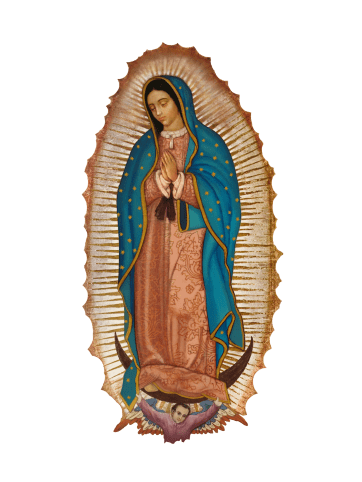 She became known as Our Lady of Guadalupe, and as word of the miraculous appearance and image spread, she became the most effective tool of evangelization that Mexico or the world had ever known. In the gospel, Mary carried the Eternal Word into the Judean countryside where the babe within Elizabeth’s womb leaped for joy; 15 centuries later, Mary’s maternal word went out into the Mexican countryside where millions leaped for joy. Conversions increased so dramatically that for a couple of years the missionaries could almost not keep up with them. More than that, the peoples’ faith was strong; to this day, the faith of the Mexican people remains vibrant, with deep devotion to Our Lady of Guadalupe.
 The two themes of fidelity and love are interwoven in the feast of the Presentation of the Blessed Virgin Mary. The presentation of oneself to God is an act of great faith and deep love. Whether Mary demonstrated her faith and love in a formal consecration to God in the Temple as described in the ancient non-biblical documents is irrelevant. Every day of Mary’s life was a presentation, a self-offering, an abandonment to the divine will made possible by the movement of grace within her. Long before he dwelled within her womb, indeed from the moment of her immaculate conception, our Lord dwelled within her soul and bestowed upon it the fullness of grace, his very life. By her response to that grace, Mary most truly defines what it means to be a Temple of the Holy Spirit.
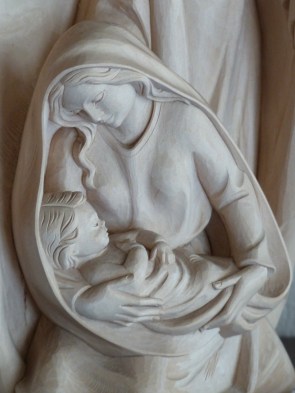 As the Catechism teaches, hope is “the theological virtue by which we desire the kingdom of heaven and eternal life as our happiness, placing our trust in Christ’s promises and relying not on our own strength” (CCC 1817). Joel pointed toward Christ our hope when he spoke of the spring that
  Today we honor Saints Joachim and Anne, the parents of Mary, for many reasons related to salvation in memory and reality. Most especially we honor them as husband and wife, for it was their marriage, their union that produced the Immaculate Conception, which transformed the dim, distant memory of salvation into a living, breathing, crystal clear reality. We also honor them because, as the last of that long line of generations who patiently waited through the long night for the first rays of salvation’s dawn, doing so honors all the faithful who lived through and, in whatever ways they could, passed on the events of salvation history to those who came after. Finally, we honor them as parents, for they raised their daughter in the faith, taught her the love and goodness of God, and instilled in her the devotion He preferred for the mother of His Only Son.
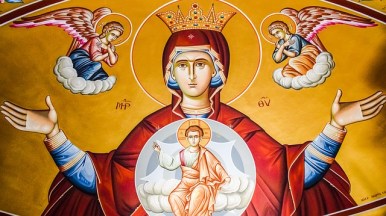 The first reading closes with this exhortation from St. Paul: Rejoice with those who rejoice, weep with those who weep. Have the same regard for one another; do not be haughty but associate with the lowly; do not be wise in your own estimation (Romans 12:15-16). What better or more fitting words are there to describe her whose very soul rejoices in God, her Savior? In the fullness of the grace bestowed on her as a singular gift of God and there visiting Elizabeth and pregnant with the Christ-child, Mary is the very answer to the question Nathanael would ask, “Can anything good come from Nazareth (John 1:46)?” Anything good, indeed! Only she, who by her fiat consented to bring the world Goodness itself; she, not wise in the world’s estimation yet wise enough to leave us with the best advice a mother could tell her children, Do whatever he tells you (John 2:5).
 Mark 10:45