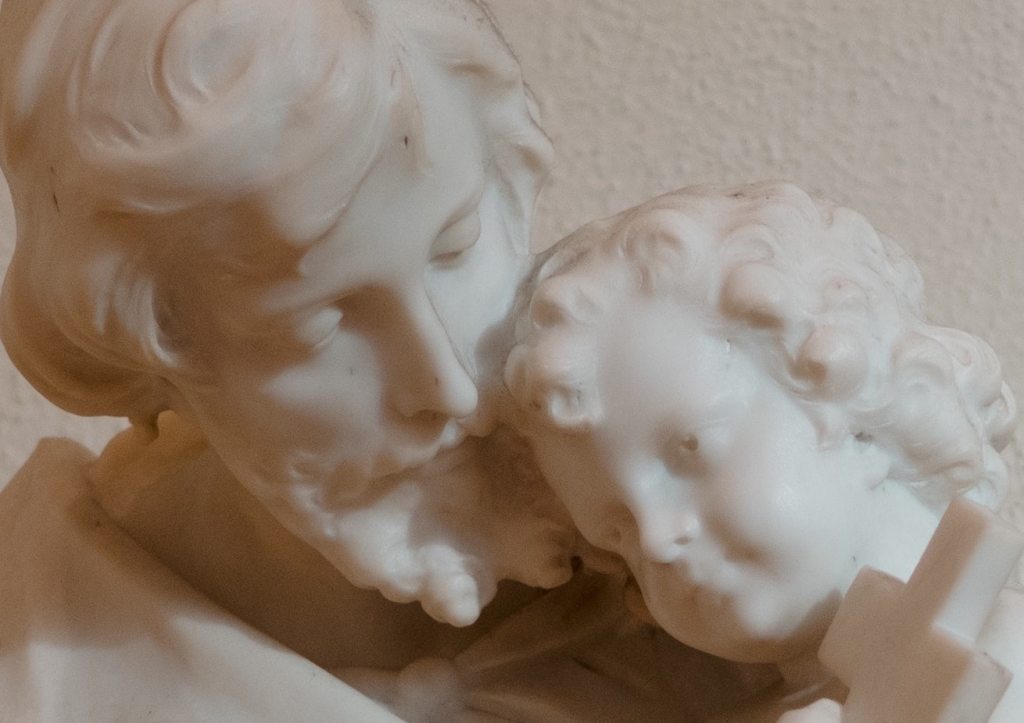
Tag: Joseph

  • Being Who We Were Made to Be

    Being Who We Were Made to Be

    Solemnity of St. Joseph, husband of the Blessed Virgin Mary

    Matthew 1:16, 18-21, 24a

    A theologian once said that “great occasions do not make heroes or cowards; they simply unveil them to our eyes. Silently and imperceptibly, as we wake or sleep, we grow strong or weak; and at last some crisis shows what we have become.”1 When I read that, I wondered if he was thinking of St. Joseph. It fits him so beautifully.

    Joseph was certainly not a man accustomed to great occasions. The ordinary ones were enough: Learn a trade, get married, bring up a family. By the time we meet him in Matthew’s gospel, Joseph had already checked two of those boxes. It was the third that brought about the crisis.

    We know the basic story well: Learning that Mary is pregnant and unwilling to expose her to shame, Joseph intends to divorce her quietly. What we may not know are a couple of details. First, in that time and culture, “expose her to shame” meant the legal right to “make a show” or public mockery of her. That Joseph would not do this speaks of his love for Mary and sensitivity toward her. This brings us to the second point: his intention to divorce her quietly. Where we read “intention,” Matthew’s original word implies a decision made in angst, in the heat of a deep and inner passion. It might even go so far as to mean that Joseph was tempted to feelings of anger, shame, or indignation.

    Who can blame him? How would we feel? Joseph had plans for his life and had worked, maybe even suffered, to achieve them. Now, on the verge of actually realizing them, he found his plans shattered to pieces. Even more, Joseph loved Mary; he knew that divorce meant disgrace for her and the child, not to mention very dim prospects for their future. This was the heart of the crisis. He had to make a decision, to do something, but what could he do? Mary was pregnant, he was not the father, and the law was clear. His decision for a quiet divorce was the best he could think of. Even if it meant pain or distress for the woman he loved so much, the law came from God, who Joseph loved above all.

    This I think is the key. Remember the theologian’s words: “Silently and imperceptibly, as we wake or sleep, we grow strong or weak.” Joseph came to this crisis with a strong moral center; born into the faith of his fathers, he was raised in it, steeped in it, and guided by it. He wasn’t going to abandon it now or ever. No matter the cost to his own or to anyone’s honor, Joseph would honor his heavenly Father first.

    In its section on the 4th commandment, the Catechism lists two qualities of a respectful child: docility and obedience. As they apply to our role as children of God, docility is our readiness to follow God’s will rather than our own, and obedience is our willingness to do whatever God asks of us.

    Joseph had both of these gifts in abundance, and in time God would ask him to use them to their fullest measure. For now, though, what He asked was more than enough: First, that Joseph set aside his plan of being husband of Mary of Nazareth and instead be the husband of Mary, the Mother of God; second, that he set aside any plan he might have of raising his own children and instead raise the Son of God as his own.

    This is a lot to ask, but as we know, God is never outdone in generosity. In return for all Joseph was willing to do, God bestowed many honors on him: Joseph, called ‘son of David’ by God himself, would see the Son of God; Joseph, whose family line had held the God’s promise in their hearts for so long was now chosen to hold His fulfillment in his arms; and he, Joseph, was now the only one ever asked to give that Promise a name: Jesus, or “God Saves.” Ultimately, Joseph would be honored as the greatest saint of all time next to Mary, for as Blessed William Chaminade has reminded us, “To give life to someone is the greatest of all gifts. To save a life is the next. Who gave life to Jesus? It was Mary. Who saved his life? It was Joseph.”

    Let us pray that we become like St. Joseph; that every day, in the silence he modeled so well, we too grow stronger in our love for God, our faith in him, and our willingness to do whatever He asks. Then, like St. Joseph, when our own crises come, as they always do, we too can show God exactly what Joseph showed Him: The person He has called us from all eternity to be.

    St. Joseph, pray for us.

    1 The 19th-century Anglican bishop and theologian, Brooke Foss Westcott.

  • I Will Make You Great: Friday of the 14th Week in Ordinary Time

    Genesis 46:1-7, 28-30

    An important part of getting to know someone is finding out about their background – their childhood, family, whatever details they’d like to share. It gives us a fuller, richer picture of the person, puts what they say and do in context, and helps us come to a better understanding and appreciation of them.

    Of course, we’re much more limited when it comes to getting to know people in the bible, but that doesn’t mean there is nothing to learn. Sometimes, important details lie hidden between the lines, and knowing them helps us not only to learn more about that person but also more about us and God. This is true for one of the most important, indeed foundational, biblical characters we have heard about this week – Jacob, the son of Isaac and grandson of Abraham.

    As we study the chapters of Genesis that tell us about his life, one thing is clear: Jacob came from a dysfunctional family. It began from the twin brothers’ birth. The name Jacob means “to supplant” or “replace,” and that is what he did, first duping Esau out of his inheritance, then tricking his father into giving him the blessing intended for his slightly older brother. But their parents, Isaac and Rebecca, are the real problem; they play favorites, Rebecca going so far as to help her favorite (Jacob) steal from his brother and get away, while Isaac sat idly by as his favorite (Esau) plotted murder against Jacob. Not what anyone would call a healthy family dynamic.

    Sadly the problem followed Jacob into adulthood, for he too played favorites. We heard this week how his favoritism of Joseph led to such envy in Jacob’s other sons that like their uncle Esau they too plotted to kill their brother – and nearly succeeded.

    Yet we also saw that things don’t always work out the way we think they will. Where in Jacob’s family revenge would be expected, by the grace of God Joseph took a different tack; just yesterday we heard him say to his brothers, It was really for the sake of saving lives that God sent me here ahead of you (Genesis 45:5).

    And therein lies the lesson: With God’s help, the unchangeable can change. Like Jacob, we are born with problems, born into problems, problems plague us all our lives. They may be dysfunctional relationships, addictions, abuse, the list is endless. Whatever they are we feel powerless to change them, and on our own we probably are. But the story of Jacob teaches us that we are not alone, that no matter what the problems are God has ways of dealing with them that we do not, and that as St. Paul once said, all things work for good for those who love God, who are called according to his purpose (Romans 8:28).

    Although Jacob may have taken too much pride in himself and his own schemes over the years, he never forgot God’s purpose and to humble himself before it. In today’s reading we find him doing exactly that at Beersheba. He’s been there before; recall on Monday Scripture told of him fleeing from Esau as a frightened young man. Then, God spoke to him in a dream and, although the words are slightly different, the main points are exactly the same today: I am God… do not be afraid… I will make you great… I will be with you… I will bring you home. Through all that had happened to him from that first moment on – the joys, the sorrows, the love, the loss, the bliss, and the agony – Jacob was never alone. God was right there with him, doing what he said he would do.

    So let us resolve to respond as Jacob did. Scripture tells us that he took everything he owned and everyone in his family with him to Egypt (Genesis 46:6-7). That is, he was totally committed to whatever God wanted him to do. This takes great faith but that is ours for the asking. Jacob asked for it at Beersheba; we have the present moment, here in His presence. And let us remember too that God is never outdone in generosity. For his act of faith, Jacob was rewarded not only with the joy of holding his long-lost son in his arms once again but also, through the great prosperity and growth that Israel, the nation named after him, would come to enjoy, he could rest secure in the knowledge that God’s plan is far above any of human schemes and His merciful love infinitely bigger than any of our problems.

    The best news of all is that to those who commit themselves to Him as Jacob did hear the same words that Jacob heard. Keep them with you today and everyday. Here they are again: I am God… do not be afraid… I will make you great… I will be with you… I will bring you home.

  • The True Cornerstone: Memorial of St. Patrick, Bishop

    August 15th, the Feast of the Assumption, fell on a Sunday in the year 1858; that afternoon, a 22 year-old Irish immigrant named Cormack McCall1 may well have watched as a stone that he had cut with his own hands was blessed as the cornerstone of the new St. Patrick’s Cathedral by New York City’s Archbishop John Hughes. Around Hughes stood seven bishops, 130 priests, and 100 choirboys. The crowd was estimated at 100,000 people or more; New York’s entire fleet of streetcars had been diverted to the area just to accommodate them.

    It is an oddity in keeping with St. Patrick that to this day no one knows exactly where the cathedral’s cornerstone is or when it went missing.2 It has sunk into obscurity like the details of the life of the great saint himself. Nevertheless, St. Patrick’s impact on the faith is every bit as real and foundational as the cathedral’s mysterious cornerstone.

    Patrick was similar in a few ways to Israel’s son Joseph, whose life story closes the book of Genesis. Both became slaves in their youth, both were bright and resourceful men of dreams, and both used their gifts not just to endure their captivity but to be victorious over it.

    Of course, there were differences. Unlike Joseph, Patrick was not raised by parents with a strong and vibrant faith; nevertheless, during his captivity he found that his faith was strengthened. Moreover, although both were men of dreams, Patrick focused on one particular vision from his youth and was determined to see it come to fruition. While a slave he had a vision of Irish children reaching out for him and resolved that should he escape he would return and convert the pagan Irish to Christianity. In fact, he did escape and reunite with his family in Britain for awhile; however, Patrick never lost sight of that vision from his youth. Around the year 431, after being ordained in France, Patrick was sent to Ireland as its bishop by Pope Celestine I.

    At first, Bishop Patrick began by supporting the small band of Christians already on the island but was soon evangelizing far and wide, preaching, writing and baptizing countless people. It is ironic that Patrick was so self-conscious of his lack of formal education for as an evangelizer he was brilliant. He understood that the truth of Christ transcends culture, that certain symbols or practices of the pagan people could be imbued with Christian meaning. For example, an ancient pagan image of two crossed lines and a circle was reinterpreted by Patrick as the Cross of Christ with the circle symbolizing the eternity of God. We know it as the Celtic Cross to this day.

    Over the course his years a missionary bishop to Ireland, Patrick truly was a cornerstone of the Irish Church. He installed and supported church officials, created councils, founded monasteries and organized Ireland into dioceses. He died around the year 461 and was buried in the land that he first came to as a slave and to which he returned, faithful to his promise to the end.

    ireland-2184916_640The psalmist must have had Joseph in mind as he sang, they had weighed him down with fetters, and he was bound with chains till his prediction came to pass and the word of the LORD proved him true (Psalm 105:18-19) but it applies to St. Patrick as well. In a larger sense it applies to all of us, for to one degree or another we are all weighed down with the fetters of sin. Many are bound with the additional chains of addiction or illness, either our own or someone we love. Perhaps we have not been given visions or dreams like Joseph or Patrick, but we have been given the vision of Christ, the Eternal Word who proved himself true to the greatest promise ever given mankind: That every fetter would be lifted, every chain broken, every tear wiped away for all those who cling to him as their salvation. As much as they did, as faithful as they were, both Joseph and Patrick humbly bend their knee and fade into the background like an old cathedral cornerstone before the Stone rejected by the builders, the one true Cornerstone who is Christ.

    St. Patrick, pray for us.

  • Living Stones: The Feast of the Holy Family

    Sirach 3:2-6, 12-14; Colossians 3:12-17; Matthew 2:13-15,19-23

    Recently on Catholic radio I heard of a church called the basilica of the Holy Family. It stands in downtown Barcelona and, from the images I’ve seen, is as breathtaking as it is hard to describe. I urge you to look up the pictures and videos online and see this majestic, cavernous, awe-inspiring structure for yourself.

    There isn’t time to talk about the brilliant architects, artists, and builders who have contributed their time and energy to the project but a couple of events deserve mention. In 2010, Pope Benedict XVI consecrated the basilica and in 2015 it was proclaimed nearly complete. What makes these events noteworthy? Three things: First, the planned completion date is 2026; second, the permit to begin construction wasn’t granted until 2019; and third, the building permit was applied for in 1885.

    That’s right, 1885. Actually, ground was broken on the feast of St. Joseph, March 19 1882 and construction has continued – off and on – since then. No one planned for Holy Family to take that long. Various things have gotten in the way – like the Spanish Civil War. Needless to say, the basilica is a work in progress.

    This is important to remember because it says a few things that touch on the idea of family and its holiness.

    First, good things can be a long time in the making. Holy Family basilica has taken over 130 years already and its scheduled completion date may come and go. Clearly, hitting the date is not the priority; the priority is that things are done well. The same is true for the holiness of the family. Parents are charged with the responsibility of seeing that their children grow in holiness; to do that well they must be holy themselves. Pope St. John Paul II called his childhood home his first seminary. His father was not afraid to pray in front of his children or to live a life in service of God and his neighbor; he did so every day. Obviously this is a long, slow process, but like Holy Family basilica a holy family is built bit by bit, stone by stone, day after day.

    Second, things don’t always go according to plan. As the history of Holy Family basilica shows, we make plans but life happens. Few knew this better than St. Joseph. He had plans: Wed Mary of Nazareth, have a family, and work to provide for them. As he came to learn, God had another plan: Be father of the Holy Family. Think of the tremendous responsibility this laid on his shoulders: The very life of the Savior, the Son of the Most High, was in his hands. God was depending on him to keep that child safe from people like Herod. Although fathers and mothers of our own holy families do not have exactly this same responsibility, theirs is still an awesome task. God lays on their shoulders the task of properly raising their children, of keeping them safe from whatever life throws at them and teaching them as Joseph and Mary taught our Lord in his human nature how to get along in the world, what is important and what isn’t, what it means to be married, what happiness is and how and where it is found. As every parent knows, this makes building a basilica seem easy by comparison! But the blueprint for such holiness exists; St. Paul gives it when he urges us to put on heartfelt compassion, kindness, humility, gentleness, and patience, bearing with one another and forgiving one another (Colossians 3:12-13).

    gaudi-2419961_640Finally, the basilica of the Holy Family teaches us that joy is not necessarily the destination but the journey. Every year, millions of people take the time to tour the basilica of the Holy Family in Barcelona. Whether they are watching as the builders add to its structure, marveling as artisans craft the artwork that adorns it, or attending the Masses offered there, the faithful are uplifted and sanctified even though the basilica is a work in progress. The same is true for our families, for they too are works in progress. Every day brings the happiness and sorrow, the cataclysms and quiet moments through which families progress either closer to God or further away from him. Let us pray that our families take every moment of life and find the joy in it; for each moment, whatever it holds, is an opportunity given to us by Almighty God to build up our own domestic Church in virtue, crafting ourselves more and more into what we are called to be – living stones built upon the cornerstone that is Christ.
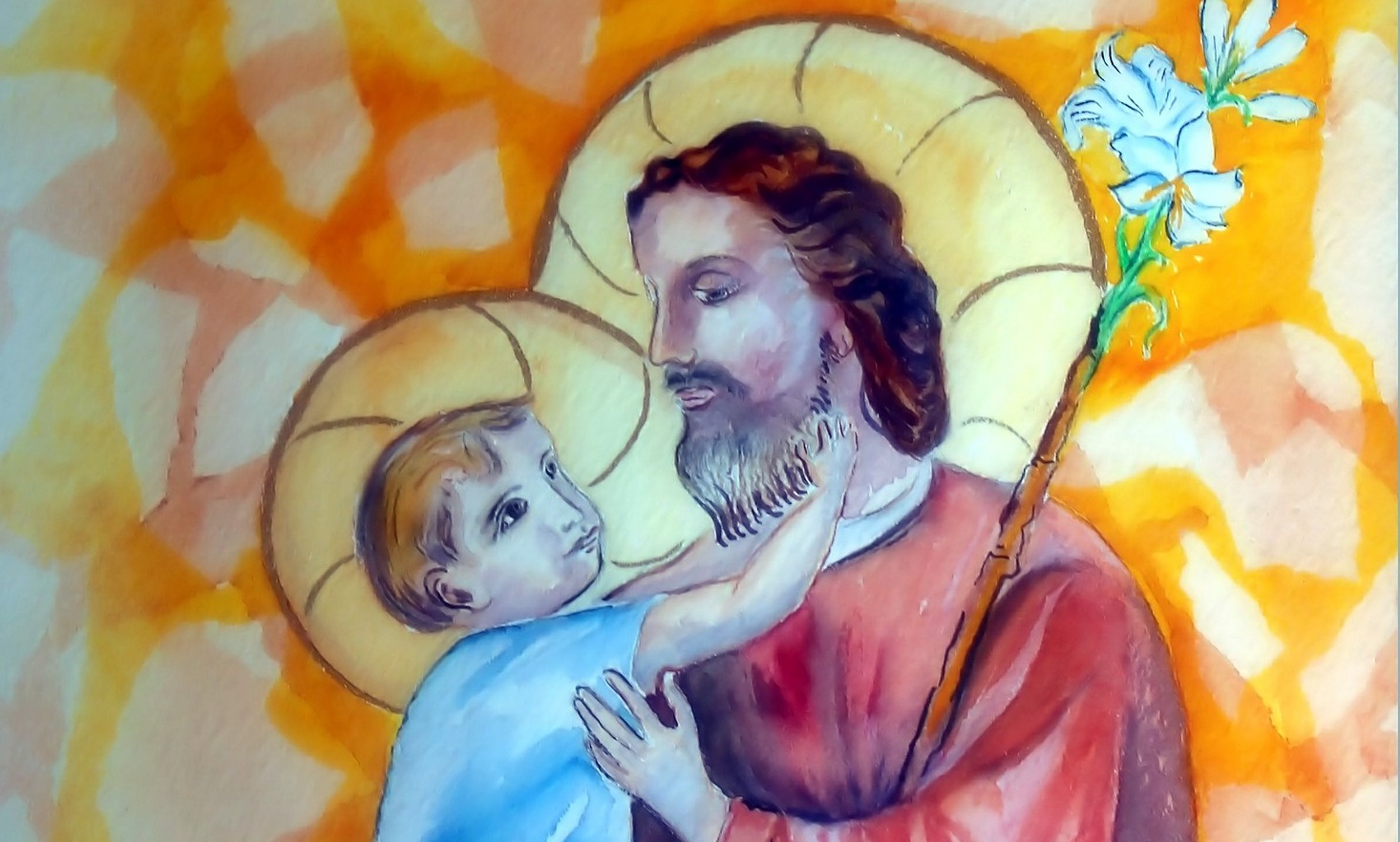
  • What Can I Teach Him? St. Joseph, husband of the Blessed Virgin Mary

    Suggested Reading: Matthew 1:16, 18-21, 24a

    In one of the many films about the life of Christ, there is a moment that I find particularly poignant and relevant when contemplating St. Joseph. While Mary and Joseph are resting on their way to Bethlehem, Joseph contemplates his impending fatherhood by looking at Mary and wondering out loud, “What can I teach him?”

    We should take a few minutes to contemplate that question for ourselves. If we were Joseph, what would we teach Jesus?

    First, we would teach him about our family. He would learn why we are called sons of David. The family tree given in the gospel of Matthew traces his line through the great kings David and Solomon, all the way back to Father Abraham, who first held the promise of a land flowing with milk, honey, and countless descendants. Of course, the family tree also contains some of the biggest scoundrels ever to call themselves king, as well as a few women whose histories would make for some interesting stories around the campfire. Most of all, we would teach Jesus that, apart from those few exceptionally good or bad people, his ancestry is filled with people like us; the ordinary, whose lives may seem to pass in obscurity but who also have known love and loss, the best and the worst of times, and have spent their lives hoping in the promise once given to our ancestor David.

    Second, we would teach him about the faith of our people. There are so many stories to tell him: Creation, Noah, Abraham, Isaac, and Jacob. We would tell of Jacob’s son, our namesake, Joseph; of his exploits in Egypt; how he was able to interpret dreams and through that gift keep the people fed and himself prospering. Imagine how the eyes of Jesus would light up when we talked about dreams, for that would lead us to talk about our own dream, when the angel said you are to name him Jesus. On our way to the Temple in Jerusalem we would sing the psalms and talk about the feasts, especially Passover and Unleavened Bread. We would remember Moses and Aaron, the plagues, the angel of death, the Red Sea, the pillar of fire; the wandering in the desert; the promised land and then his own namesake, Joshua. From all this, young Jesus would learn that, despite the tendency of some to stray from or misinterpret the faith, we are a faithful people who love God and desire to serve and be faithful to him.

    Third, we would teach Jesus the value of labor; that God himself worked when creating the world, and that we work to maintain and make a living from it. We would teach him that our work as handymen and woodworkers not only puts food on our table but is a great service to our people; we make the yokes for their oxen and the tools for their trades. We would teach him that to do this job he will have to learn how to get along with all sorts of people; the demanding customers who are never satisfied with our work; the destitute who cannot afford it; those who are grateful, and those who never say thank you.

    In his divine wisdom, who else would God choose but a man who already has all these things ingrained into his nature; a man capable of teaching his child simply by virtue of his life? We don’t have to guess; he chose Joseph, of the house of David, a man of deep faith and resilience, worthy of the greatest task he could ever undertake.

    joseph-567996_1920 (2)Of all men, Joseph was chosen to tell the Son of God the human story of the people he created; to teach him about the faith that he gave the world; to show him what it meant to fully engage his world as a man of his times; how to work, to worship, to provide for others, to give of himself, to weep, to laugh, to live. Only Joseph had the incredible privilege and the awesome responsibility of teaching the Son of our heavenly Father how to be the son of a human father as well.

    St. Joseph, pray for us.