Tag: inspiration

  • Increase Our Faith: 27th Sunday in Ordinary Time

    Habakkuk 1:2-3; 2:2-4; 2 Timothy 1:6-8, 13-14; Luke 17:5-10

    People sometimes speak as though there are saints and then there is everybody else. I know; I’ve done it. Somebody says, “You know, you’re a good person,” and I reply, “Well, thanks, but I’m no saint.” We might begin to think that saints are people of superhuman faith who go around rebuilding the Church, baptizing thousands, levitating, going into ecstasy, healing the sick, and finally converting thousands through their own martyrdom.

    And although many people have done exactly those things, the readings today remind us that saints are ordinary people who know what it means to have their faith tested; to get frustrated, to need encouragement, and even to ask God for an increase in faith. We just heard the prophet Habakkuk cry out to God, clearly frustrated and bewildered because God had not put an end to the violence and misery all around. We should be able to sympathize with him; we pray week after week, year after year for an end to violence in the world, yet it continues. Why doesn’t God stop it? Next, the Apostle Paul tells Timothy to stir into flame the grace of his ordination, for he’s going to face his share of hardship. Don’t we too know how it feels to face hardship yet still be asked to keep on giving? Then in the gospel the apostles ask our Lord to increase their faith and little wonder, for Jesus had just told them that if your brother wrongs you seven times in one day and returns to you seven times saying, ‘I am sorry,’ you should forgive him (Luke 17:4). I don’t know about you but on a bad day forgiving the same offense even twice can be a struggle; seven times is going to take some real moral fiber.

    But the readings don’t stop there; they also show God’s responses. Habakkuk is told that fulfillment will come and it won’t disappoint; have faith and wait. In other words, be patient and don’t lose hope. As hardship looms, Paul says to Timothy: Take as your norm the sound words that you heard from me, in the faith and love that are in Christ Jesus (2 Timothy 1:13). That is, hold on to what you’ve been taught; Christ gave us the plan and he is our strength. Finally, Jesus talks about strength in two ways. First, he speaks of faith as powerful enough to uproot a mulberry tree. As the Apostles knew, that’s a lot of power. Mulberry trees are hard to pull; their roots are thick, wide and dense. Second, he talks about a servant who labors outside all day but still must serve when he comes inside. He’s talking about the power of fidelity to our call. Jesus reminds us that servants don’t stop being servants depending on where they are or what time it is. When I was ordained, Christ didn’t tell me that I’m a servant only when I’m wearing my vestments; I am called to serve God’s people, period. Similarly for you; all of us who are baptized in Christ receive a new garment; we put on Christ and we can’t just take him off. We are servants of God and each other; our attitudes and our behavior are to reflect that every hour of the day, every day of the week.

    This story of the servant is only found in the gospel of Luke and I think there is a good reason for that. Luke sees Jesus as that servant. Consider: The servant worked in the field, plowing or tending sheep. Jesus did both; he spent his entire ministry planting the seed of the gospel until the harvest was abundant (Luke 10:2) and called himself the Good Shepherd (John 10:11). Then when Jesus “went in” for dinner for the last time with his disciples, he remained a servant, washing the apostles’ feet (John 13:5). As the servant provided the dinner for his master, so at the Last Supper Jesus instituted the Eucharist, feeding his apostles the bread of life (Luke 22:19). Finally, as the servant said that he had done what he was obliged to do, so the Good Thief looked at the dying Jesus and said, this man has done nothing wrong (Luke 23:41, RSV). Then after his resurrection he walked with two disciples, opening the Scriptures until they felt their hearts burn within them. Finally, the flame of the Spirit was poured upon the apostles (Acts 2:3), strengthening them to proclaim the gospel in Jerusalem, throughout Judea and Samaria, and to the ends of the earth (Acts 1:8).

    cropped-awake-o-sleeper-graphicThis is the strength that has inspired the saints throughout the centuries. Every saint knows what it means to wonder as Habakkuk wondered how and when God will fulfill his promises, but they also know what it means to offer themselves as the instruments through which that promise is fulfilled. Every saint knows what it means to face hardship or to be with others as they face them, but like Timothy and Paul they also know what it means to possess the grace to endure and to support others who need to endure. Finally, every saint knows what it means to feel as if their own faith is inadequate to uproot their mulberry tree full of weaknesses. But they also know what it means to surrender themselves totally to the power of the One who nailed those weaknesses to his own tree and cast them once and for all into the ocean of his infinite mercy.

    This is the consolation that speaks in the silence of God’s replies to every prayer. What makes a saint is not that they understand the mind or the providence of God but that they never allow their incomprehension, frustration, or anger overwhelm the great promise of the cross; that faith overcomes and will always triumph over fear. Thus could Augustine rightly say that every saint has a past, and every sinner has a future.

  • The Mystical Encounter: St. Francis of Assisi

    Galatians 6:14-18; Matthew 11:25-30

    In the gospel, Jesus said that no one knows the Son except the Father, and no one knows the Father except the Son and anyone to whom the Son chooses to reveal him (Matthew 11:30).

    Sometimes the Son chooses to make the Father known in a dramatic way. Recall His encounter with St. Paul on the road to Damascus. Other times He is much more subtle; such was His encounter with the man we know and celebrate as Francis of Assisi.

    Francis has born around the year 1181 and baptized as Giovanni di Bernadone. His father Pietro, probably the wealthiest merchant in Assisi, renamed him Francesco in honor of his profitable business dealings with France. He no doubt wanted his son to take after him but by all accounts the boy really did not; except perhaps in his grandiose dreams, for Francesco enjoyed envisioning himself as a great Knight of Assisi: Dashing, popular, the life of every party, full of wine and song, surrounded by friends and, of course, ladies in waiting.

    It was in pursuit of his dreams that God first came to him. When Francesco was about 23, he set out on his quest to fight as a knight for Pope Innocent III. On the way, he fell ill and while recovering heard a strange voice ask, “Francesco, who can do more for you, the lord or the servant?” He answered, “The Lord.” The reply came, “Then why do you leave the lord for the servant, a rich lord for a poor man?” Sensing the voice of God, he asked, “Lord, what would you have me do?” to which the voice said, “Return home and you will be told what to do.” Soon after, Francesco returned home.

    While he did not hear the voice again, God had a much more subtle and unexpected revelation in store.

    The next year Francesco once again found himself on a journey; not as a warrior this time, just a young man on routine business. On the road he saw someone coming toward him. As they neared each other, it became evident that the man was a leper. In the words of Francesco’s first biographer, Thomas of Celano: “So greatly loathsome was the sight of lepers to him at one time, he used to say, that, in the days of his vanity, he would look at their houses only from a distance of two miles and he would hold his nostrils with his hands.” Nevertheless, on this day as this man approached, Thomas wrote that Francesco was somehow “made stronger than himself” and even kissed the man. Francis left that encounter feeling like a changed man.

    There are many versions of that meeting and by now it’s difficult if not impossible to determine exactly what happened. It might have been an embrace; the leper may have kissed Francis in thanks for alms given; there are many possibilities. Regardless, I believe that this was the moment Francis first met Christ – not only in the leper but in himself.

    Only God dwelling and alive within us has the power to make us stronger than ourselves. Only through the eyes of grace can we see as Francis came to see that in fact we are the lepers, sin is the disease; we are that man hobbling along the road of life, suffering, ragged, in need of healing in the hospital of the Church, the refuge and sanctuary for all the afflicted.

    The treatment is penance. Its words are easy to say but as we have all learned, including Francis, its actions require dying to self; in the words of St. Paul, being crucified to the world and the world to us. The wounds of Christ given to Francis later in life are the most perfect outward sign of this inner reality.

    So deeply was Francis affected by that encounter on the road, so great was its impact upon him that even as he lay dying, he dictated this first:

    This is how the Lord gave me, brother Francis, the power to do penance. When I was in sin the sight of lepers was too bitter for me. And the Lord himself led me among them, and I pitied and helped them. And when I left them I discovered that what had seemed bitter to me was changed into sweetness in my soul and body. And shortly afterward I rose and left the world.

    cropped-st-francis-1758485_1280.jpgOf all the things he might have chosen to begin with, Francis wanted to teach that the best and most mystical encounter we can have with Christ comes not from a voice on a sickbed or even a leper on the road but from the encounter with our own sinfulness. Only when we allow the Lord to lead us from the pain of penance through the conquest of our fears can we too rise and leave the world; not to abandon it, but that we may be Christ to it.
    St. Francis of Assisi, pray for us.

  • What’s In A Name? Feast of Saints Michael, Gabriel, and Raphael, Archangels

    Revelation 12:7-12ab; John 1:47-51

    It is said that one morning, perhaps in the year 1884, once Pope Leo XIII had finished saying Mass and was leaving the altar, he suddenly stopped. According to witnesses, it was as if he was in a trance; he stood motionless for several minutes and his face turned ashen in color. When he regained his composure the Pope went to his office, asked to be left alone, and began writing. It took him only a short while to produce what became a new prayer to St. Michael the Archangel, which he ordered to be recited after all Low Masses everywhere.

    Only the Holy Father knows what he experienced during the vision; all we have is conjecture. Some say he heard Satan confronting Christ with threats to destroy the Church; others that he saw a terrible vision of dark angels attacking the Church. Whatever it was, Pope Leo left the chapel convinced that demonic forces were gathering and the next 100 years would be a great trial for the Church and the world. From our vantage point of history we see how right he was. The fingerprints of Satan are all over the 20th century: World wars, civil wars, weapons of mass destruction, bloodthirsty tyrants; millions upon millions of lost lives and, as if that isn’t enough, millions more killed in the wombs of their mothers.

    Thanks be to God who has not left us to battle such grave evil alone but has given us good and holy angels like the three whose feast we now celebrate.

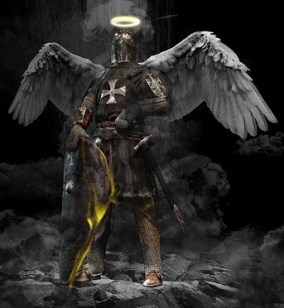
    knight-3003641_640The Archangel Michael, whose name means Who is like unto God?, is the prince of angels. We read in Revelation why Holy Father Leo sought his intercession; it is Michael who leads the heavenly angels in the ultimate battle against Satan and his demons and teaches them why there are none like unto God. Apart from reciting the Pope’s prayer following Mass, let us also ask St. Michael’s intercession for all those who so often find themselves in harm’s way such as soldiers, first responders, and emergency workers. Let us also ask his intercession for ourselves during times of temptation as well as those who have fallen or are in danger of falling away from practice of the faith.

    The Archangel Gabriel, whose name means God is my strength, is the great messenger of Christ. In the book of Daniel he speaks of the coming Messiah; to Zechariah he announces the birth of John the Baptist, forerunner to the Messiah; above all, he is chosen to greet and announce to the Blessed Virgin Mary the great mystery of the Incarnation. Let us ask the intercession of Gabriel on behalf of all those who are charged to carry the message of salvation to others, and ask him to intercede for us, that we may more and more be effective messengers of the Messiah ourselves.

    Finally, there is the Archangel Raphael, whose name means God has healed. He appears in Scripture in only one place: the Old Testament book of Tobit. Full of Messianic undertones, the book tells of a loving father who sends his only son accompanied by a holy spirit (Raphael) to rescue a bride tormented by a demon. During their travels Raphael heals Tobit’s blindness; for this reason many who suffer with diseases of the eye ask his intercession. Let us also ask St. Raphael’s intercession for all those who are in any way blind, morally or spiritually, examining our own inner vision first.

    I am no Pope Leo XIII, but I suggest that we make a habit of praying to these powerful archangels. Something like this:

    St. Michael, Prince of Angels, protect me as I face the many dangers of this world;

    St. Gabriel, strengthen me that I may worthily proclaim Christ to others;

    St. Raphael, ask Our Lord to heal the blindness that keeps me from seeing His Face in everyone I meet.

    Heavenly Father, grant me the grace of the Apostles, that I too may see heaven opened and all the holy angels ascending and descending on the Son of Man: Your only Son, our Lord, Jesus Christ who reigns with You and the Holy Spirit, one God forever and ever. Amen.

    Sts. Michael, Gabriel, and Raphael, pray for us.

  • To the Land of the Rising Sun: St. Lorenzo Ruiz

    Zechariah 8:1-8; Luke 9:46-50

    The readings from Zechariah and Luke may not be a study in contrasts, but they certainly point in different directions. On the one hand, the reading from the prophet Zechariah paints an ideal picture. Jerusalem is restored and at peace; the elderly sit and watch as children play in her streets; God dwells among his people. The gospel, on the other hand, presents us with a different picture; it hints at pride and mistrust among the Apostles; first they dispute who is the greatest in the kingdom, then they attempt to stop the good work done by an outsider in the name of Christ.

    Light can be shed on these contrasting images as we contemplate the life and example of a saint whose memorial we celebrate today. San Lorenzo Ruiz was born around the year 1600 in the Philippines. Raised as a good, practicing Catholic, he married, fathered three children, and worked as a gifted calligrapher. His life was forever altered when, under mysterious and murky circumstances, he was falsely accused of murder. Forced to flee his native country, he learned of a Dominican mission to the Orient and volunteered to serve. During the voyage, Lorenzo learned that the destination was the country of Japan.

    Let us reflect for a moment on a verse from the prophet Zechariah: Lo, I will rescue my people from the land of the rising sun (Zechariah 8:7). Speaking through the prophet, God revealed his plan to rescue Israel from the kingdom of Persia, which was known as the land of the rising sun. A thousand years later in the time of San Lorenzo, the missionaries planned to continue evangelizing in the islands of Japan, known then (and now) as the land of the rising sun.

    They knew there would be trouble. To the Japanese authorities, the missionaries were unwelcome outsiders who were to be brutally put down. Soon after landing, they were captured, imprisoned, and tortured. It is said that when his captors asked if he would renounce his faith to save his life, San Lorenzo responded, “I am a Christian and I shall die for God, and for him I would give many thousands of lives if I had them.” He was martyred not long after this.

    Lo, I will rescue my people from the land of the rising sun. These consoling words spoken by God through Zechariah were also spoken by God through the lives of San Lorenzo Ruiz and his companions who brought the gospel to the land of the rising sun. While there were those who preferred the darkness enough to kill the light-bearers, they could not kill the light, for Christ is the light that the darkness cannot overcome.

    We should not speak of the darkness as if it were always outside ourselves; the Apostles’ behavior shows that darkness exists inside as well. Our own sinfulness works against our efforts to live and preach the gospel. Regardless, the example of San Lorenzo Ruiz demonstrates that when we resolve to put our faith in God’s ability to work in us, through us, and despite us, we will be successful.

    good-morning-695024_640As Christ commissioned San Lorenzo and his companions, so he commissions us. We are the light of the world; not the light of the rising sun but the light of the risen Son.

    San Lorenzo Ruiz, pray for us.

  • A Healthy, Happy Life: Memorial of St. Vincent de Paul

    1 Corinthians 1:26-31; Matthew 9:35-38

    What leads to a healthy, happy life? In the 1930’s, researchers at Harvard selected nearly 300 students and collected data about their personal and social lives for nearly 80 years to try and answer that question. They found that the most powerful influence on these men’s health was how happy they were in their relationships with family, friends, and communities. As one researcher said, “Taking care of your body is important, but tending to your relationships is a form of self-care too. That, I think, is the revelation.”1

    The life of St. Vincent de Paul bears witness to that finding. When he was the same age as the men who began the study, Vincent was a moody, temperamental, lonely young priest who had pursued his calling with mixed motives. While he did love Christ and saw the priesthood as the path to holiness he, like many poor people, also saw it as the path to a better standard of living. His ambition was to rise to bishop as soon as possible (or be the beneficiary of a will), save as much as he could, retire early and return home.

    That ambition unrealized after several years, Vincent found himself spiritually adrift, directionless, and alone in Paris. There, two things happened that changed his life forever. First, he was assigned pastor of a poor rural parish. He expected the material poverty of his parishioners but the depth of their spiritual poverty shocked him. Second, he met a visiting bishop named Francis de Sales. In him Vincent found a kindred spirit, someone he could really connect with. A deep friendship formed. Of all the things he learned from Bishop de Sales he was especially moved by the idea that all people, whatever their station, are called to holiness. Until that moment Vincent assumed like most people that the devout life was reserved for those with a religious vocation.

    These experiences opened his eyes, brought him out of his self-centered shell and gave him the direction he needed. Vincent devoted the rest of his life to care of the poor and the formation of priests. On behalf of the poor, he went to the wealthy, the people of influence, and those in organizations, seeking to provide large-scale, long-term material assistance. He founded an order, the Vincentians, and co-founded another, the Daughters of Charity, to provide for their sacramental and spiritual well-being. For men in priestly formation, Vincent focused on the spiritual life. He did not want them to be as he had once been: Complacent, insulated, seeking only their own holiness. He knew that the priest’s path to holiness was the path of Christ; out in the world feeding and tending the lambs as did the Good Shepherd who knew his flock and whose flock knew him.

    In reality, the Harvard study on happiness confirmed what the Church has long known. Happiness lies in our relationships – with God, with each other, and with the world. In the first reading St. Paul urged us to consider our calling, so let us examine ourselves. We claim to love God but do we do so on our own terms, allowing fear or worldly concerns to take priority? We claim to love each other but do we tend to reserve our time, favors, and affection for a chosen few and pass others by as if they don’t exist? We claim to love all people but do we fail to reach out to those in need, refuse to give of ourselves when it’s inconvenient, or condemn those who disagree with us? The love that is the foundation of all healthy relationships casts aside fear, treats each member of the Body with the same regard, and wishes none to die but all to come to repentance and knowledge of God. It gives totally and without condition. That is the love of Christ.

    positive-2257693_640 St. Vincent de Paul didn’t begin any better than we, but he ended as well as we can ever hope to. What led him to a healthy, happy life? His relationships to God, his peers, and his flock. How does that help us? At least three ways. First, our relationship with God is at its best when we remember that He dwells not only above but also within each one of us; second, that when we reach out in love to others God is reaching them through us; and third, that we are both sheep and shepherd; the call to holiness is not only a call to take up our cross and follow Christ but to take up our staff and bring others to Him by the example of our lives.

    Consider your own calling, brothers and sisters. The harvest is abundant but the laborers are few.

    St. Vincent de Paul, pray for us.

  • The Artist: Feast of St. Matthew

    Ephesians 4:1-7, 11-13; Matthew 9:9-13

    Perhaps the most popular way to contemplate a bible story such as the call of St. Matthew is to imagine ourselves actually in the ancient setting as one of the characters. We see Jesus in that time and place and playing a role in the drama, say Matthew, we contemplate our own reaction to the call to follow Him.

    But there is another way, and that was the one chosen by the 16th century Italian artist Caravaggio. Commissioned to paint an interpretation of the call of St. Matthew, the young artist chose not to portray the scene in its biblical setting. Rather, he set the scene in his own time, moving it from a customs post to a Roman pub. If you’ve never seen the painting, imagine: A giant canvas, mostly dark; to the left, five men in modern clothing clustered around a table in a dimly lit, sparsely furnished room. They could be gamblers; it’s hard to tell. To the right, our Lord and St. Peter in ancient garb have just entered. The only light emanates from behind Christ and illuminates the men in the room. Christ beckons toward them with a gesture reminiscent of the famous Sistine Chapel image of God creating Adam. It’s difficult to tell exactly who He beckons toward. The two men closest to Him appear either annoyed or indifferent. The man in the middle, who may be Matthew, appears shocked and points perhaps at himself, perhaps at the man next to him as if to say, “Me or him?” Finally, the two men furthest away pay no attention either to the light or to Christ; their eyes are fixed on the money.

    The painting, which hangs in a chapel of the church of San Luigi dei Francesi in Rome, shocked the people of its time who were used to sacred art that showed Jesus in the places and with the people of biblical times. By bringing Him to the modern day, Caravaggio reminded them that Jesus is with all of us; He is not confined to any particular time. Gospel verses such as Jesus passed by (Matthew 9:9) are reminders that Jesus is always passing by: He is the child wasting away in a 3rd world country, the immigrant family at the border, the Alzheimer’s patient in the nursing home; the person next to us in the pew; the one looking at us in the mirror.

    Further, Jesus isn’t calling only Matthew. Where Caravaggio was ambiguous let us be clear; Jesus is calling all of us. No matter who we are or how deeply invested in Him we think we already are, Jesus is always calling us into a deeper, more intimate relationship. We speak of a ‘call’ but in reality it’s a challenge; we must ask ourselves if and how we are like those men in the painting. We may be annoyed, thinking that we’ve done enough; we may be indifferent, we’ve stopped caring. Like the man in the middle, we may be astonished, perhaps hoping that Jesus is asking someone else. Or we may be paying no attention at all, too occupied with what we think is important.

    A detail in Caravaggio’s painting should be pointed out. Although Jesus is beckoning toward the table, His feet are facing the exit. Jesus asks us to follow Him but He doesn’t wait. He is on a mission; there are places to go, people to see. The choice is ours. We can get up and follow as Matthew did or we can put it off, wait for a better time. Keep in mind though, that Jesus Himself chose that moment. He has a purpose, a plan, and it includes us. He may demand much but his generosity is never outdone.

    art-2755500_1920St. Paul reminds us of this when he says that grace is given to each according to the measure of Christ’s gift (Ephesians 4:11). His measure to Matthew was enough to transform him from a mere money-counter into an artist; indeed the artist who gave us the first portrait of Jesus in our New Testament. His medium wasn’t oil on canvas but words on paper, his subject not simply the man named Jesus but the Son of God and Son of Mary, the prophesied Emmanuel, “God is with us.” His palette held the many colors of Christ: teacher, healer, wonder-worker, Shepherd, Savior. He boldly painted all these images against a dark background for Jesus had come not into a roomful of Roman gamblers but into a land whose people were overshadowed by the darkness of sin and death. Where Caravaggio showed the light coming from behind Christ, Matthew knew that for all times and places Christ is the light – not the light who shines but the light who has arisen (Matthew 4:16). The long night of waiting, hoping, and wondering was over; the bright promise of salvation had dawned in Jesus, the Morning Star who never sets. This is why the great artist put the final brushstroke to his masterpiece in the words of our risen, ascending Master: And behold, I am with you always, until the end of the age (Matthew 28:20).

    St. Matthew, pray for us.

  • Mother, Sister, and Brother: Sts. Andrew Kim Tae-gŏn, Priest, and Paul Chŏng Ha-sang, and Companions, Martyrs

    Proverbs 21:1-6, 10-13; Luke 8:19-21

    The first in the series of proverbs we read today says, Like a stream is the king’s heart in the hand of the LORD; wherever it pleases him, he directs it. In 1777, the river of mercy that is the heart of Christ the King began trickling into Korea. While visiting China, a small group of aristocrats happened upon some Jesuit literature. They brought it home and as they studied it, God worked his way through their minds and into their hearts.

    The second proverb says, All the ways of a man may be right in his own eyes, but it is the LORD who proves hearts. The Lord took twelve years to prove the hearts of the Korean faithful. In 1789, a Chinese priest stole into Korea on a mission to introduce the people to the Gospel. Imagine his surprise when he discovered an underground Church of 4000 Catholics, none of whom had ever seen a priest.

    The third proverb says To do what is right and just is more acceptable to the LORD than sacrifice. These people, hungry and waiting for Christ, did what was right: They read Scripture and evangelized. When the missionary came and provided what they craved – a taste of the sweetness of the Lord in the Sacraments – they flourished. In just 7 years, 6000 more Koreans were baptized.

    The fourth proverb warns us that Haughty eyes and a proud heart – the tillage of the wicked is sin. If the Korean ruling class was anything, it was proud. The God of the Christians had the audacity to see everyone as equal. Their haughty eyes could not envision a world where elites, workers and slaves could be friends. By 1801 a vicious persecution began; it would last for the next 65 years.

    The fifth proverb says that The plans of the diligent are sure of profit, but all rash haste leads certainly to poverty. Diligent well describes the young Korean boy Kim Taegon who at age 15 embarked on his plan to become a priest. He traveled 1300 miles to attend a seminary in China and was ordained the first Korean-born priest. He returned home and set about the task of smuggling more clergy into Korea but was arrested while doing so. He was executed at the age of 26. Father Taegon was far from alone; in all, the persecution took the lives of 10,000 people; fully half of the Korean Church.

    The Church was diminished, but not impoverished; that would be the fate of the Korean dynasty. The sixth proverb teaches that Whoever makes a fortune by a lying tongue is chasing a bubble over deadly snares. The lying tongues of the despots who reaped profits off the backs of others finally saw their bubble burst; by 1900, the dynasty was eliminated. At long last, the cries of those who had shut their ears to the cries of the poor were, as the last proverb says, not heard themselves.

    Meanwhile, the Church grew. In 1950, the site of the executions of Father Kim Taegon and over a hundred of his colleagues was declared a shrine; in 1984, they were canonized by Pope St. John Paul II in the church built nearby.

    jesus-christ-2516515_640.jpgThe example of the Korean Church and her martyrs teaches us that every heart open to God and acting on his word becomes a mother, sister, and brother to Christ. Even though we may not have the power of Orders, we do have Christ in the Scriptures and the power of the Holy Spirit through our baptism. We too can evangelize. If you don’t know where to begin, consider: Religious education programs can always use help teaching children the faith; there is a bible study nearby that would teach you more about Christ; there are many ministries that reach out to the hungry, the poor, and the mourning. Be docile to the promptings of the Holy Spirit; He will show you ways to bring Christ to someone in need.

    We began with the proverb of the king. Let us close with the prayer that one day, the King of Kings will look at us and say, Amen, I say to you, whatever you did for one of these least brothers of mine, you did for me (Matthew 25:40).

  • In This Sign, Victory: Feast of the Exaltation of the Holy Cross

    Philippians 2:6-11

    In the early 4th century, the Roman world hovered on the brink of civil war. Constantine, fighting for control of the empire, looked into the ancient sky and to his amazement saw emblazoned the cross of Christ along with the words in hoc signo vinces, “In this sign, victory.” This became the insignia of Constantine’s army, who went on to secure the empire for him by crushing his rival Maxentius at the battle of the Milvian bridge.

    Contrast that to a time centuries later when, during the Second World War, a Nazi official attending a dinner party remarked that he much preferred the ancient pagan gods to the God of the Christians. To him, true godhood was found in the image of the commanding, conquering Zeus; not the suffering, crucified Christ.

    It seems that such disparate views remain to this day. On the one hand, the cross is arguably the most popular icon of Christianity; its silhouette dots our landscape, adorns our homes. We enshrine it in jewelry and even trace its outline our bodies. On the other hand the cross conjures up images of humiliation, rejection, suffering, and failure. We use it as a put-down, calling people or things a cross; we complain of the crosses we bear; we pray that they are taken away.

    It is a mistake to see these views as opposed; they are in fact two sides of the same coin. On this feast of the Exaltation of the Holy Cross, let us contemplate more deeply what the cross signifies.

    First, the cross is a sign of obedience. As we read in Philippians, Jesus Christ was glorified, but only by emptying himself, taking the form of a slave, and humbly accepting even death on a cross. Thus, the cross is a sign of defeat, but it is the defeat of self-will through obedience to the will of God; it is the triumph of Christ-like selflessness.

    Second, the cross is a sign of love. In fact, the cross combines the greatest commandment – to love the Lord God with our whole heart, soul, and mind and our neighbor as ourselves – with the greatest love – to lay down our lives for one another. The suffering is obvious; a love so deep requires that we die to ourselves. Yet the triumph is equally obvious: this love is deeper than death and unites us with the Trinity, who is Love itself.

    jesus-3149505_640Finally, the cross is a sign of victory. It is the apparent irony seen throughout salvation history that God works for good by turning evil upon itself. It was Pharaoh who pronounced the curse by which his own people would most suffer: the death of every firstborn. In the desert it was the emblem of the serpent, reminiscent of the one whose envy brought death into the world, that would be lifted up on a tree as a sign of healing and life. It was Caiaphas, plotting to have Jesus executed, who unwittingly prophesied that it was better for one man to die than for the whole nation to perish. It was the Roman governor Pilate who first asked “What is truth?” and then went on to write the truth fixed to the top of the cross: Jesus of Nazareth, King of the Jews. Ultimately it was those in power, both nation and empire, who lifted Jesus up on the most humiliating instrument of death only to watch helplessly as he transformed it into the instrument through which death itself would die and by which the truly repentant would, like the Good Thief, receive the gift of eternal life with God.

    In hoc signo vinces; in this sign, victory. We adore you, O Christ, and we praise you because by your holy cross you have redeemed the world.

  • The Greatest Gift: Memorial of St. John Chrysostom

    Ephesians 4:1-7, 11-13

    St. Paul urged us to live in a manner worthy of the call we have received (Ephesians 4:1). Sounds like good advice, but very general. How do we do that? What are we to do? Perhaps we can get insight by seeing how a saint did it. Since today we remember St. John Chrysostom, let us take a look at his life and see if we can formulate an answer.

    John was born in Antioch around the year 347, the son of a military commander who died as a young man. His mother, a pious and devout woman, raised him in the faith and saw to it that he had the best education possible. A naturally gifted speaker, he studied under Libanius, a pagan but the greatest orator of his time.

    Following the custom of the age, John was baptized at the age of twenty. Drawn to the life of the desert monks, he spent four years in a monastery and two more in a cave as a hermit. The physical demands of that life proved too much, so he returned to Antioch.

    Soon ordained to the diaconate, John spent the next five years refining his skill as a homilist, becoming so good that upon ordination to the priesthood he was appointed preacher to the bishop. Over the years the grace of ordination infused his natural ability as an orator to produce not only a passionate, articulate man, deeply in love with Christ, but also one unafraid to speak his mind in words that either warmed like a gentle flame or raged like a firestorm. In his great love for the poor he once gently reminded the people, “Do not judge the poor man, do not seek an account of his life, but free him from his misfortune.” Another time, moved to righteous anger he scolded, “You are large and fat, you hold drinking parties until late at night, and sleep in a warm, soft bed. And do you not think of how you must give an account of your misuse of the gifts of God?”1

    Some call that brutal honesty, others tactlessness; John called it truth and knew as our Lord did that even when bluntly spoken, truth has a way of drawing people to itself. So it did; over the years John’s preaching won hearts in great number. But there was more than that. His authenticity was so appealing. All could see that he practiced what he preached. Like our Lord, John led a pious, austere life; gentle with penitents, generous to the poor, and loving to all, even when love meant bringing a whip to the Temple.

    Also like Jesus, John made his share of enemies, chief among them the emperor’s wife and some very powerful clergy. Their dislike turned to outright hatred when three things happened: First, he was appointed bishop of Constantinople, the emperor’s city, over the empress’s choice; second, he instituted a reform of the clergy who he believed were lax in their pastoral duty; and third, he turned his stinging eloquence loose on the debauchery and immodesty of society, up to and including the empress and her friends.

    Not surprisingly, his enemies fought back. Unlike John they didn’t fight fair, seeing to it that he was charged with false crimes, convicted, and banished as far away as possible. Although vindicated in time, John was getting on in years and the physical cruelty of his guards more than sufficient to bring about his eventual death. Bishop John died on the road to exile on the Feast of the Exaltation of the Holy Cross, September 14th, 407.

    Chrysostom means “golden mouth.” It was a name given him long after his death in homage to his giftedness as a preacher. But this was a man blessed with many gifts: great intellect, resilience, compassion, a deep love of God, and keen insight into human nature, to name just a few. Yet, as great as they all were, the greatest of all was the gift of grace given as St. Paul said, according to the measure of Christ’s gift (Ephesians 4:7). Grace builds on nature, enabling us to use our natural gifts for our own good and that of the world. Consider its effect in the life of John Chrysostom: Raised by a holy, faithful mother, baptized as a young man, driven by the Spirit into the desert, preaching the gospel to the all who would listen, struggling against arrogant, worldly power and suffering the passion and death of his own Calvary road in exile. Grace empowered him to live a life not only devoted to Christ but configured to him.

    jesus-3499151_1280Surely his was a life lived in a manner worthy of the call. But the question remains, what about us? Are we to be another St. John Chrysostom? On one level, no; the gifts given to him were his and his alone. God doesn’t want another St. John Chrysostom. But on another level, yes, the gifts given to us are ours and ours alone and God is calling us to sanctity. We are sanctified to the degree that we take advantage of the same grace that was available to John, not to do what he did, but to do as he did. If we do not preach the gospel from a pulpit in a church we still preach it from the pulpit of our lives. Every day, we are the only homily someone will hear. If we do not shepherd a church or diocese we still have a flock; family, friends, everyone we meet. We are to teach, feed, love, and serve them as Christ did. If we do not bear the cross John bore we still take up our own and unite it to the suffering of Christ for the sake of his body, the Church.

    St. John Chrysostom teaches us that living in a manner worthy of the call we have received is using the gifts God has given us, infused by the grace he alone can give, to bring out of our diversity the unity that raises the Church to mature manhood, the full stature of Christ (Ephesians 4:13).

    St. John Chrysostom, pray for us.

    1St. John Chrysostom, 21st homily on 1 Corinthians

  • No Longer Judas: Tuesday of the 23rd Week in Ordinary Time

    1 Corinthians 6:1-11; Luke 6:12-19

    What images cross your mind when you hear the name Judas? Over the centuries, the name Judas has become synonymous with a person who seems to be your friend but eventually turns on you; who betrays you in some way. The first goat, the one that leads the others inside a slaughterhouse, is nicknamed “the Judas goat.” I have even heard that, at least at one time, it was illegal to name a child Judas in Germany.

    Yet, as the gospel today reminds us, Jesus selected Judas as one of the Twelve. People have wondered about this throughout the centuries. Why would Jesus do this?

    Although we cannot know what was in the mind of Christ, it does help to pay particular attention to the words used in the gospel. Luke says that Judas became a traitor, implying that he didn’t start out that way. At some point during his time with Jesus, the heart of Judas changed. John the Evangelist says that the breaking point came when Jesus revealed himself as the true Bread whose Body and Blood must be consumed in order to gain eternal life. As the disciples of Jesus begin to desert him, John subtly brings up Judas, saying that Jesus knew from the beginning the ones who would not believe and the one who would betray him (John 6:64).

    However the change within Judas occurred and whatever the reason for his betrayal of our Lord, the real issue for us concerns how we ourselves respond to the challenge of following Christ as his disciples. In what way is my own name Judas? What is the teaching of Christ that we find particularly hard to accept? If it isn’t the Real Presence of Jesus in the Eucharist, maybe it’s his command that we love our enemies, his teaching that we must be servants of all, his teaching through St. Paul that we simply put up with injustice or let ourselves be cheated (1 Corinthians 6:7), or any one of a dozen other commands he left us that run counter to our fallen human nature.

    The tragedy of Judas runs deep, for Judas is not just the name of a historical man whose betrayal put Christ on the Cross. My name and the names of every sinner ever born are also on that crime; even Peter, who declared his undying fidelity to Christ and then three times denied that he even knew him. Moreover, the tragedy of Judas is not that he was unrepentant; to the contrary, Matthew wrote that Judas deeply regretted what he had done and returned the thirty pieces of silver to the chief priests and elders (Matthew 27:3). The real tragedy of Judas is that he allowed himself to give in to despair after his sin by declaring himself his own judge, jury, and executioner (Matthew 27:5).

    This is exactly what St. Paul counseled against in 1st Corinthians when he reminded those who had once betrayed Christ through their own grievous sins: That is what some of you used to be; but now you have had yourselves washed, you were sanctified, you were justified in the name of the Lord Jesus Christ and in the Spirit of our God (1 Corinthians 6:11).

    jesus-284515_640Our gospel closes with this beautiful image: Everyone in the crowd sought to touch him because power came forth from him and healed them all (Luke 6:19). In every sacrament, especially the Blessed Sacrament, Christ continues to allow us to touch him, to behold his power, that it may cleanse, heal, and sanctify all who hope in him. It is only through this power that we are no longer Judas; we are redeemed.