Tag: inspiration

  • The True Cornerstone: Memorial of St. Patrick, Bishop

    August 15th, the Feast of the Assumption, fell on a Sunday in the year 1858; that afternoon, a 22 year-old Irish immigrant named Cormack McCall1 may well have watched as a stone that he had cut with his own hands was blessed as the cornerstone of the new St. Patrick’s Cathedral by New York City’s Archbishop John Hughes. Around Hughes stood seven bishops, 130 priests, and 100 choirboys. The crowd was estimated at 100,000 people or more; New York’s entire fleet of streetcars had been diverted to the area just to accommodate them.

    It is an oddity in keeping with St. Patrick that to this day no one knows exactly where the cathedral’s cornerstone is or when it went missing.2 It has sunk into obscurity like the details of the life of the great saint himself. Nevertheless, St. Patrick’s impact on the faith is every bit as real and foundational as the cathedral’s mysterious cornerstone.

    Patrick was similar in a few ways to Israel’s son Joseph, whose life story closes the book of Genesis. Both became slaves in their youth, both were bright and resourceful men of dreams, and both used their gifts not just to endure their captivity but to be victorious over it.

    Of course, there were differences. Unlike Joseph, Patrick was not raised by parents with a strong and vibrant faith; nevertheless, during his captivity he found that his faith was strengthened. Moreover, although both were men of dreams, Patrick focused on one particular vision from his youth and was determined to see it come to fruition. While a slave he had a vision of Irish children reaching out for him and resolved that should he escape he would return and convert the pagan Irish to Christianity. In fact, he did escape and reunite with his family in Britain for awhile; however, Patrick never lost sight of that vision from his youth. Around the year 431, after being ordained in France, Patrick was sent to Ireland as its bishop by Pope Celestine I.

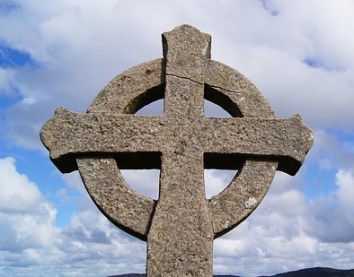
    At first, Bishop Patrick began by supporting the small band of Christians already on the island but was soon evangelizing far and wide, preaching, writing and baptizing countless people. It is ironic that Patrick was so self-conscious of his lack of formal education for as an evangelizer he was brilliant. He understood that the truth of Christ transcends culture, that certain symbols or practices of the pagan people could be imbued with Christian meaning. For example, an ancient pagan image of two crossed lines and a circle was reinterpreted by Patrick as the Cross of Christ with the circle symbolizing the eternity of God. We know it as the Celtic Cross to this day.

    Over the course his years a missionary bishop to Ireland, Patrick truly was a cornerstone of the Irish Church. He installed and supported church officials, created councils, founded monasteries and organized Ireland into dioceses. He died around the year 461 and was buried in the land that he first came to as a slave and to which he returned, faithful to his promise to the end.

    ireland-2184916_640The psalmist must have had Joseph in mind as he sang, they had weighed him down with fetters, and he was bound with chains till his prediction came to pass and the word of the LORD proved him true (Psalm 105:18-19) but it applies to St. Patrick as well. In a larger sense it applies to all of us, for to one degree or another we are all weighed down with the fetters of sin. Many are bound with the additional chains of addiction or illness, either our own or someone we love. Perhaps we have not been given visions or dreams like Joseph or Patrick, but we have been given the vision of Christ, the Eternal Word who proved himself true to the greatest promise ever given mankind: That every fetter would be lifted, every chain broken, every tear wiped away for all those who cling to him as their salvation. As much as they did, as faithful as they were, both Joseph and Patrick humbly bend their knee and fade into the background like an old cathedral cornerstone before the Stone rejected by the builders, the one true Cornerstone who is Christ.

    St. Patrick, pray for us.

  • The Outsiders: Tuesday of the Sixth Week in Ordinary Time

    James 1:12-18; Mark 8:14-21

    We may as well answer the question Jesus asked the disciples at the end of the gospel passage: Do you still not understand (Mark 8:21)? No, they do not understand at all. The question is, why? So far in Mark’s gospel they have heard him teach, seen him heal, witness him expelling demons, raising a girl from the dead, and feeding thousands with a few loaves. Who or what kept them from seeing him as the Christ? And more to the point, who or what does the same thing to us?

    It certainly isn’t God. As the first reading reminds us, God tempts no one (James 1:15). Here, James echoes the ancient truth revealed through the prophet Habakkuk that God cannot even look upon evil (Habakkuk 1:13). Rather, the reading goes on to say, evil comes from within each person who is lured and enticed by his desire (James 1:14). Let us briefly consider three different kinds of enticement.

    First, we entice ourselves to sin by failing to guard against temptation. Just as a person struggling with alcoholism would be foolish to hang around liquor stores so anyone who struggles with a certain sin is foolish to put themselves in situations where they are tempted to it. This is called the near occasion of evil and is what we promise to avoid every time we say the Act of Contrition.

    Second, we entice others to sin by becoming an occasion of evil ourselves. Some do this by dressing immodestly, others by gossiping. We rationalize such behavior in true Adam-and-Eve fashion by blaming the victims – “They shouldn’t look at me that way,” or “I only told the truth” – but deep down we know that we are far from innocent.

    Finally, we are enticed to sin by the dark angels whose master goes by many names: the father of lies (John 8:44), the tempter (Matthew 4:3), the devil (Matthew 4:1). By whatever name he sows confusion, preys on our weakness, encourages selfishness. The wise listen to Christ who urges us to fear the demons for they can destroy us body and soul (Matthew 10:28); the prudent avoid them, and the persevering cling to God with the assurance of St. Paul that no one and nothing can ever separate us from the love of God that is in Christ Jesus (Romans 8:38-39).

    Earlier in Mark, Jesus defined two kinds of people. The “insiders,” or those to whom the mysteries of the Kingdom had been revealed; and the “outsiders,” who did not. Of the outsiders he said, they may look and see but not perceive, and hear and listen but not understand, in order that they may not be converted and be forgiven (Mark 4:12). The irony is that the disciples, who should be the definitive insiders, act more like outsiders than the real outsiders! For example in today’s gospel the disciples, who just witnessed Jesus feeding four thousand people now have the chance to share a quiet boat ride with him. What a shame that this perfect opportunity to unpack all they have seen is wasted on worrying about how little bread they brought along!

    fishing boat and feetStill, Mark’s purpose is not to make us wonder at their behavior but to evaluate our own. Are we insiders or outsiders? Some of us witness Christ feeding a multitude every day, and every day share time with him in the Church, the barque of Peter. Are we focused on our own loaf of bread – be it the next place we have to go, the people we have to see, or things we have to do – or on the Living Bread that is Christ? We see the many wonderful people he gives us – our families, friends, each other; do perceive Christ living within them? We hear his word in the Scriptures; do we understand his voice speaking through all those crying for help? At the Mass he gives us himself Body, Blood, Soul, and Divinity in the Holy Eucharist; are our hearts hardened or are they being converted through the forgiveness of sins in Confession, that we may partake most fully in the infinite grace he offers?
    We conclude where we began, in the letter of James. Consider how the passage begins: Blessed is he who perseveres in temptation, for when he has been proven he will receive the crown of life that he promised to those who love him (James 1:12). Let us pray for perseverance, that gift of the Holy Spirit that empowers us to remain in the state of grace until the end of our lives; may we like the Saints see and perceive, hear and understand, that our hearts be converted, our many sins forgiven, and our focus on the things above.

  • The Holy Spirit and Us: Memorial of Sts. Cyril and Methodius, bishops

    Acts 13:46-49; Luke 10:1-9

    As a young musician and singer I had many opportunities to play and sing for wedding and funeral Masses. At first this was no problem, but eventually it became one. Parishes had begun to hire their own musicians who weren’t thrilled to see outsiders like me coming in. I remember at one wedding the local musician came up and told me that he was on the parish staff, this was his parish, and he would be playing. I don’t recall my reply but I know it infuriated him. He stormed off saying “I’m going to the pastor right now. One of us is leaving and it won’t be me!” Well, it was him. I stayed and did the wedding Mass, smugly condemning him for his attitude, never considering my own.

    There’s an old saying that when the Church isn’t being persecuted from the outside she persecutes herself. Many of us have seen it; the place we expect to find the most unity too often seems the model of disunity. We want the Church to grow, we want to bring Christ to people, but when they challenge us with new ideas, expectations, or ways of doing things we find ourselves at odds with them.

    This phenomenon is as old as the Church. In the first reading Paul and Barnabas turn their attention to the Gentiles, frustrated with their stalling mission to the Jews. And we hear how the Gentiles were delighted and the Church grew. What we have not heard (yet) is that with this growth came conflict. On one side the Gentiles resisted adopting Judaic ritual and dietary practices. What do circumcision and kosher law have to do with salvation? On the other side the Jewish Christians resisted the idea of abandoning them. After all, Jesus and his Apostles were Jews! Two groups, each with its own interests: More disputes, more hard feelings, more disunity.

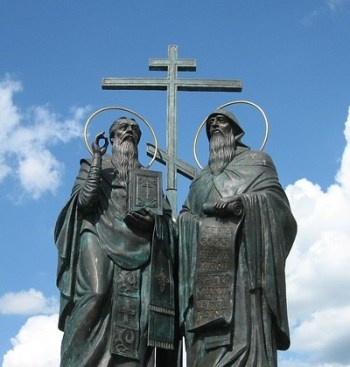
    Sts. Cyril and Methodius might well sympathize. In their time (the 9th century) the Church was struggling to grow in Eastern Europe. The two brothers were the perfect choice for missionaries; they were well-educated, devout, and had grown up speaking Slavic as a second language. Best of all they possessed keen pastoral sensibility; they knew that Christ is the Word who transcends language, whether Greek, Latin, or Slavic. Therefore, when they arrived in the missions they not only preached in Slavic but also translated and conducted liturgical services in it as well. The people responded and the Church grew.

    As in the gospel they went out like lambs among wolves, only this time the wolves wore clericals. The missionaries of the region resented Cyril and Methodius. For one thing, they made the old guard look bad. Under them the Church withered; with the brothers here she blossomed. Second, they took issue with the way the Church grew. As they saw it, no one had the right to translate the liturgy into the native language and teach it to the people. Surely these upstart missionaries must be reprimanded.

    Not surprisingly the embittered clerics appealed to Rome about the liturgical changes, demanding action. When summoned, Cyril and Methodius went to Rome and gave a spirited, eloquent defense. After listening carefully in person, Pope Adrian II blessed their mission and gave them permission to continue celebrating the liturgy in Slavic.

    Cyril stayed in Rome and died not long afterward; Methodius returned to the missions. Sadly but not surprisingly, the pope’s decision settled nothing in many minds. For the rest of his life Methodius was hounded and frustrated by clerics who disagreed with him. Although he stayed the course and remained successful, the stress took its toll; he died April 6, 885.

    cropped-dove-3951312_1920.jpgThe pattern of disagreement, debate, and decision is how things get most productively settled in the Church provided it is done in the right spirit; that is, the Holy Spirit. Since the Council of Jerusalem was called to settle the dispute between the Gentile and Jewish Christians this has been the model, its justification found in the letter issued from that Council, specifically the sentence that begins, It seems good to the Holy Spirit and to us (Acts 15:28). The Holy Spirit promised by Christ continually works within us, finding ways to maintain unity despite our differences. In all our human affairs but especially between the members of the Church what matters is not that we disagree but that we dialog, not the heat of our words but the light of the Holy Spirit, not the distance we keep but the fellowship we extend, and not the hostility throughout the debate but the peace of Christ we give in the resolution. As with Cyril and Methodius, some will not accept us or the decisions reached but we cannot help that. All we can do is what Methodius did: Continue to act in union with Christ and his Church, remembering always that it is not about us but about the Holy Spirit and us.
    Sts. Cyril and Methodius, pray for us.

  • Holy and Immaculate: Memorial of Our Lady of Lourdes

    Isaiah 66:10-14c; John 2:1-11

    Between 1830 and 1858 the Blessed Mother made three separate visits to France. First in Paris to Sr. Catherine Laboure, whence came the Miraculous Medal and the prayer, “Mary, conceived without sin, pray for us who have recourse to thee.” Next she appeared to two shepherd children near La Salette in the French Alps, where she pleaded for a return to prayer and the Sacraments. Finally and most famously she appeared 18 times to the young teenager Marie-Bernarde Soubirous, also known as Bernadette, near Lourdes in the foothills of the Pyrenees.

    In all these we see that Mary appeared not to the powerful or influential but to the lowly – mostly, to children. Simple, honest, and unsophisticated, they were not interested in either notoriety or personal gain. Indeed Bernadette in her typical, straightforward fashion said, “When I’m dead they’ll come and touch holy pictures and rosaries to me, and all the while I’ll be getting boiled on a grill in purgatory.” Hardly the words of someone looking to sell the book and movie rights.

    Not that she couldn’t have used the money. Those such as Bernadette were not only innocents but familiar with suffering, people who understood poverty of spirit and body. In fact, she first met Our Lady while gathering sticks so that her family, mostly children who would not survive to adulthood, could have some heat in what they called home but everyone else called a musty, abandoned prison block.

    But as Mary knows, home is where the heart is and the heart of the Soubirous family was faith in Christ. Although the prosperity and wealth of nations spoken of in the first reading (Isaiah 66:12) eluded them, spiritual wealth was theirs in abundance. On hearing of the mystical vision in the grotto, Bernadette’s father said to his family, “Let us pray.” He knew that, whether a heavenly vision or one from the lower depths, their only recourse was to fall to their knees. Perhaps this is why Bernadette was chosen; she like Mary was raised from birth to understand that true wealth, true prosperity, comes only from the hand of God.

    This was the same God who said, As a mother comforts her child, so will I comfort you (Isaiah 66:13), who gave Bernadette visions of his mother, and who defined comfort in her words, “I do not promise to make you happy in this world but in the next.” It is true that Bernadette, who suffered terrible pain in her body in the later years of her short life, never sought the healing waters that Christ gave the world in that little grotto. She knew that Mary had given her the only promise of happiness that means anything: Eternal union with God. This is why Mary constantly urges meditation on the gospel of Christ through the rosary, why she begs the conversion of sinners, and especially why she asks that chapels be built, for there her Son dwells in the complete sacramental fullness of his Body, Blood, Soul, and Divinity.

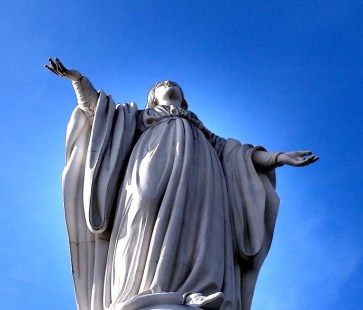
    virgin-1615390_1920At every apparition Mary is highly honored and rightly so for she is as she said, the Immaculate Conception. But the honor we give her goes far beyond her identity to the two-fold reality behind it. First, Mary points us to Christ. Through the grace bestowed on her by the will of God and her total abandonment to it, Mary has perfectly heeded her own advice: Do whatever he tells you (John 2:5). In this, she is the first and best example of a Christian. Second, Mary points to our own destiny. Like her, we are asked to abandon our will to his, be perfect as the Father is perfect (Matthew 5:28), and so be presented to him holy and immaculate (Colossians 1:22). For this we need neither the water of Lourdes nor the water turned to wine, but that which wells up to eternal life (John 4:14), our Lord Jesus Christ, by whose love wine becomes the blood poured out for the forgiveness of sins (Matthew 26:28).
  • Heart Speaks to Heart: Sts. Basil the Great and Gregory Nazianzen

    1 John 2:22-28; John 1:19-28

    The first reading begins, Beloved: Who is the liar? Whoever denies that Jesus is the Christ. John seems to be thinking of someone in particular who had strayed from the truth about Christ. This was not uncommon; the early Church was plagued with heretics whose theories about Jesus ran the gamut, from the Ebionites who believed that Jesus was not divine at all, to the Docetists who believed that Jesus was only divine and merely pretended to be human for our sake.

    In the 4th century, one particular heresy took center stage. It was popularized by a priest named Arius, who used Scripture to teach that Jesus, although as close to divine as a human being could be, wasn’t actually divine; he was a creature and therefore less than God. The heresy was appealing; it made sense to people who couldn’t understand how God could die on a cross. Throughout the Christian world, Arianism spread like wildfire.

    At the same time, God was raising up a river to put that fire out. It came in the form of the two men we remember today, Basil and Gregory. Basil was born in what is now central Turkey in the year 330 AD; Gregory was born in the same area nine years later. Both left their native land to go to Athens where, as Gregory would later write,

    We had come, like streams of a river, from the same source in our native land… and were now united… as if by plan, for God so arranged it.

    Indeed, God arranged not just friendship; Basil and Gregory became soulmates. Blessed John Henry Newman used the phrase, cor ad cor loquitur – heart speaks to heart – and that describes these two men. Gregory further wrote

    When, in the course of time, we acknowledged our friendship and recognized that our ambition was a life of true wisdom, we became everything to each other: we shared the same lodging, the same table, the same desires, the same goal. Our love for each other grew daily warmer and deeper… We seemed to be two bodies with a single spirit.

    What united them was their common love of Christ. In the gospel the priests, Levites, and Pharisees also had ambitions; ironically, although Wisdom Himself had dawned upon the world and was so near them, they lived in the darkness of self-absorption and wished only to see that He satisfied their requirements. Unlike them, Basil and Gregory took to heart John’s words when he said, let what you heard from the beginning remain in you. From childhood they were taught the truth about Christ and sought to ensure that they satisfied His requirements. They asked questions of the faith only to see where their own understanding was darkened and prayed that Christ would shed His light upon them.

    United in this purpose, both men poured themselves into their studies and infused their knowledge with the grace of ordination. Gifted by God as powerful writers, orators, theologians, and shepherds, they fearlessly and eloquently defended the Church against Arius and all who opposed the truth that Father, Son, and Holy Spirit are a perfect Unity. As Patriarch of Constantinople, Gregory presided over the Council of Constantinople in 381, which completed the Nicene creed that we recite every Sunday. Not only that, both men wrote masterpieces of theology that are studied and used to this day.

    statue-2171097_640Saints Basil and Gregory can teach us many things, but today we focus on two. First, they teach us that faith in God requires true humility. Heresies are born from the pride that sees ourselves as the measure of all things; that interprets our failure to understand the truths of the faith to mean that the truths are wrong. True humility is as John admonished us, to remain in him; to see that God is the measure of all things and that our inability to understand means that we still have work to do. Second, in these days when the word “love” is so easily limited to physical expressions of self-gratification, the love of Basil and Gregory is a shining example of the most uplifting, life-giving love possible between people. This is the love that is modeled on God; that seeks only the good of the other; that finds its union with others in the heart and soul because that is where God dwells, and God is love. This is the love where heart speaks to heart and says, “I want for you what God wants for you.” My prayer is that all of us come to have that love for one another. What a world this would be.

    Saints Basil and Gregory, pray for us.

  • The Three Consolations: Thursday of the 3rd Week of Advent

    Judges 13:2-7, 24-25a; Luke 1:5-25

    I remember once years ago sitting with my mother, watching TV. The shows were full of young people and I jokingly remarked, “I guess no one over 40 can be on TV.” Mom saw no humor in it; she replied, “Our society has no use for us older people, especially women. In their eyes, once we’re past childbearing age we’ve outlived our usefulness.”

    That got me thinking about the Hebrew world of today’s readings. Elizabeth and the mother of Sampson could probably identify with my mother’s feelings. They lived in a culture where barrenness was seen by many as a punishment from God (Genesis 16:2, 20:18). For such women the future was bleak; nothing but loneliness and insecurity to look forward to. No wonder some of them were prompted to despair (Genesis 30:1).

    Especially during seasons such as Advent and Christmas when we exalt the virtue of hope, people still fall prey to the loneliness, depression, and anxiety that lead to despair. Rather than consolation they are in desolation, the sense that God sees our hopelessness yet has abandoned us, left us in the dark, and is never coming back. We cannot see that it is only an inner sense and not the outward reality; the voice of the Prince of Lies telling us we are worthless, that God doesn’t love us and is far, far away. The truth is that God is as near as our next breath and loves us so much that we are worth dying for.

    It is the wait that fools us. If God loves us so much, why do we seem to wait forever for him to answer? The women in the readings must have wondered the same thing. Day after day, week after week, year after year they waited; still no answer. It would have been easy to give up. Yet what does Scripture say? Elizabeth, like her husband, was “righteous in the eyes of God, observing all the commandments and ordinances of the Lord blamelessly” (Luke 1:6).

    In other words Elizabeth persevered, and it was this that kept her from falling into despair. This is a lesson for us. We too must not only endure times of desolation but use them to strengthen our spiritual gifts. We cannot learn prudence when the way is always clear, justice when all is fair, fortitude when times are easy, or temperance when we get everything in just the right amount. We cannot strengthen our faith when all is seen, or charity when all is given. In the same way, the virtue of hope grows stronger as we persevere in waiting and through that perseverance appreciate ever more deeply the coming of that which we most long for: Unity with God, the object of our hope. Desolation is not the time to turn away from God but toward him; to reinvigorate our hope in the everlasting joy of heaven. The time is now, for Advent is the definitive season of waiting, when hope longs to be rekindled.

    stained-glass-4522405_640The great gift of fertility given to Samson’s mother and to Elizabeth are confirmation that perseverance is rewarded. God sees all of us who endure desolation and, in his own time and manner, provides from the storehouse of his infinite mercy the life-giving consolation of his Spirit. When we find ourselves in times of desolation remember to ask the intercession of St. Elizabeth; she understands very well not only the pain of endless waiting but also the indescribable joy of the Holy Spirit’s three priceless consolations: The new life of St. John within her womb; the love and help of Mary, the Mother of Hope; and most of all the fulfillment of Hope itself: Our Lord and Savior, Jesus Christ.
    St. Elizabeth, pray for us.

  • How Not to Lean: Thursday of the First Week of Advent

    Isaiah 26:1-6; 55:6; Matthew 7:21, 24-27

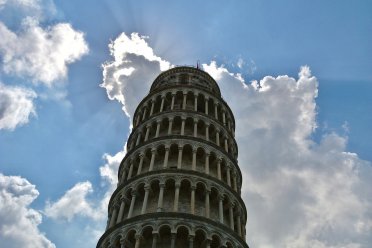
    In the 12th century the people of Pisa, Italy could say like Judah in the first reading, A strong city have we (Isaiah 26:1). A military, political, and economic force, they had recently triumphed over Palermo in Sicily and returned home with the fortunes of war – millions in booty and a shipload of soil from Golgotha in the Holy Land. Eager to show off their wealth, the people set aside a large plot of land called the Field of Miracles and in it filled a new cemetery with the sacred soil, built a majestic cathedral and baptistery, and set to work on what was to be the largest bell tower in the world – 200 feet high.

    Unfortunately, Pisa could also say that the Lord humbles those in high places (Isaiah 26:5). Before it had risen 3 floors it was obvious the tower was leaning. Perhaps they forgot that the word Pisa is Greek for marshy land, its ground too soft to support such a structure. Construction stopped and started for centuries as different architects tried different things, all with the same result: Fixed on one side, the tower would lean the other. By 1990 it leaned so badly that it had to be closed to the public. Finally, after millions in repairs it reopened, still leaning. As one expert said, “Sandy and soggy ground is definitely not ideal for tall, heavy towers unless they have rock solid foundations.”

    As we begin a new Church year in these early days of Advent let us consider our own spiritual foundation. Like ancient Pisa we have been given so much. We are a strong city – the City of God. Strong walls and ramparts protect us – the four walls of the one, holy, catholic, and apostolic Church. We have neither the marshland of Pisa nor the dirt of Golgotha but something infinitely better: The Father, the eternal Rock (Isaiah 26:4), his Only Son who died on Golgotha giving birth to the Church, and the Holy Spirit sent by them to guide her into all truth. And we have every tool needed to build our faith: Sacred Scripture, Tradition, and the teaching authority vested by Christ in his Church.

    But all of that goes for nothing if we build our faith on the sand of ourselves and not on the rock foundation of God. How do we do that? By reading Scripture with our own mind rather than the mind of the Church; failing to give the assent of faith to Church teachings we find difficult; following whatever preaching tickles our ear; taking for granted or ignoring the Sacraments as the means of receiving sanctifying grace; and failing to see all people, especially those we don’t like, as made in the image and likeness of God and loved infinitely by him as we are.

    italy-3577677_1280These and many more are like the soft, marshy soil below the tower of Pisa. Like that tower, a faith built on human weakness will lean and no amount of stopping and starting, tinkering and refining will fix it. It must be torn to the ground and rebuilt on the foundation of Christ and his Church, for we must take the faith as it is, not as we would like it to be.
    This is painful but growth often is; to be fertile and capable of bearing fruit, soil must be dug into, plowed, upturned and weeded. It’s no different in the spiritual life; we must go deep into our minds and hearts, tear them open if need be, do all that we can to prepare them for the foundation of Christ. This will require that we come to him by repenting, admitting our weaknesses and failings, and resolving to amend our lives; trusting in God and all that he has revealed, whether we fully understand it or not.

    These first two weeks of Advent are a time set aside by the Church for exactly this. Now is the time! As the gospel acclamation says, call to him while he is still near (Isaiah 55:6). In the end each of us will stand before him from one of two places: A tower of faith built solidly on the rock of Christ or one built on sand. The Master Builder has already given us his advice; we find it in Proverbs: Trust in the Lord with all your heart and lean not on your own understanding (Proverbs 3:5).

    In other words, remember the tower of Pisa: When we lean on our own understanding, we simply lean.

  • An Attitude of Gratitude: Thanksgiving Day

    Sirach 50:22-24; 1 Corinthians 1:3-9; Luke 17:11-19

    I recently came across an article written by a psychologist who believes that developing an “attitude of gratitude” is important for our mental health. In her words, “Being able to appreciate what is important to us is a truly valuable way of stepping back from the stresses we are experiencing and re-framing our thoughts and attention, our feelings and behavior.”1

    With all due respect, she should have checked Scripture first. If she had gone even as far as today’s readings she would have found much more insight.

    The author of Sirach goes right to the heart of the matter when he reminds us to be grateful for the gift of life itself from conception onward. The grim realities of abortion and euthanasia are evidence of a culture where people do not understand the value of their own life let alone anyone else’s. The kind of social sickness that breeds such an attitude will be hard to heal but we have on call the Divine Physician who knows how to treat it. As we continue to pray for his intervention let us not forget our part; that is, showing thankfulness to God for the gift of all human life by doing whatever we can to support it, whether that means women in crisis pregnancies, people suffering from abuse or neglect, or those who are encouraged to end their lives. The world must come to see through Christ and his Church that every human life is infinitely valuable because it is made in God’s image and fashioned according to his will (Sirach 50:22).

    God’s will, that we have life and have it abundantly now and in eternity, comes to the fore as St. Paul reminds us of the grace bestowed on us in Christ Jesus (1 Corinthians 1:4). While human life is certainly enough to be thankful for in and of itself, God has given us the opportunity to share in so much more: Eternal life through the gift of his only Son, our Lord Jesus Christ, with whom we have fellowship and of whom we partake at every Eucharist just for this purpose.

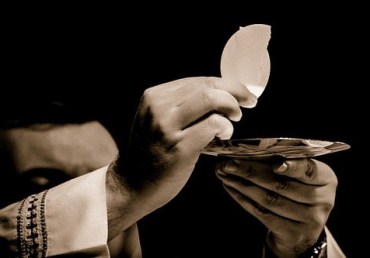
    eucharist-1591663_640Still, a common problem is that we tend to take this fellowship for granted and forget gratitude. We fall into a routine of receiving Communion with little or no thought as to what – or rather Who – we are receiving. Like the nine lepers in today’s gospel passage, we are given what we ask for but then go back on our way with little regard either for the gift or what it cost the Giver. St. Paul goes on to warn about the grave danger of such ingratitude: That is why many among you are ill and infirm, and a considerable number are dying (1 Corinthians 11:30). The healthier, more grateful response is to first discern whether we are in the state of grace to receive Christ and, if not, to make ourselves a more worthy vessel. Like the leper who, once cleansed, remembered to be thankful, we thank God for what he has given us through the Church – the gifts of faith and the Sacraments through which he touches, heals, and sanctifies us.
    Today is Thanksgiving Day here in the United States, a day set aside to show our gratitude. Wherever you are, I urge you to stop and think about all that God has given you. No matter who you are or how many problems you struggle with, there is reason to be grateful. First and foremost, be grateful for life; each breath is a gift from God given that we may live life to the full. Secondly let us be grateful for each other; each person is a gift from God, sent to make us holy. Finally, let us thank God for the gift of the Church, through which Christ comes to us in Word and Sacrament to be one with us and above all to make us one with him, now and in Eternity.

    A very blessed and happy Thanksgiving.

  • Viva, Cristo Rey: Blessed Miguel Pro

    Daniel 1:1-6, 8-20; Luke 21:1-4

    In biblical studies, as in life, things aren’t always what they seem. For example, some books of the bible seem like history; they mention real historical people and places and the situations they describe seem real enough. However, clues such as language and historical inaccuracies show that the author had another purpose in mind; he is speaking symbolically.

    Thus it is with the book of Daniel. Scholars tell us that the symbolism running through its stories points to two particularly strong themes: The ability of the Jews to thrive in a Gentile world and the importance of remaining true to the traditions of the faith.

    Both themes appear in Daniel and the gospel according to Luke. By successfully bargaining with the Gentile authorities about their diet, four young Hebrew men were able to remain true to their religious identity. Not only that, when the king discovered that their wisdom and understanding far surpassed that of his own people, these men, who it seemed were the conquered, were in fact conquerors.

    These themes also run through the ministry of Blessed Miguel Pro. Born in Mexico, Pro was sent abroad as a seminarian and ordained a Jesuit priest in Belgium in 1925. Finding that he could not thrive abroad due to stomach ailments that nearly killed him, Father was returned to Mexico, despite the great persecution of Catholics currently underway.

    This might seem like the worst thing for an ailing priest, but things aren’t always what they seem. In fact, his ministry to the people of Mexico restored Father’s health. Like Christ and the saints, his food was to do the will of the One who sent him, and he greatly delighted in doing God’s will right under the authorities’ noses. A master of disguise, Father was never what he seemed. He ministered in prisons posing as a policeman; in posh neighborhoods dressed as a rich man; in slums dressed as a beggar. Hiding in plain sight, he taught, gave Communion, said Mass, absolved sins, confirmed the faithful, and prayed over the dead. Father Miguel Pro, like the widow in the gospel, seemed to have almost nothing, but in reality had everything, and freely gave it. He who seemed to be conquered was the conqueror.

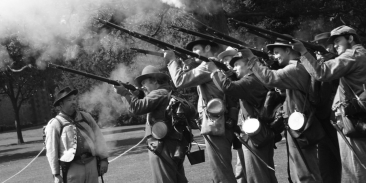
    miguel proEventually, Father was caught, imprisoned on a false charge and on the morning of November 23rd 1927 faced a firing squad. Even here, he was a conqueror. Before the cameras and all assembled, he forgave and blessed his persecutors, held out his arms in the shape of the cross and shouted “Viva, Cristo Rey (Long live Christ, the King)!” With that, Father Miguel Pro died.

    The government published a photograph of his execution, believing that it would frighten Catholics into submission. Once again, things were not what they seemed. Father Pro, arms outstretched like a cross, displayed such Christ-like strength, such fearlessness in the face of unjust persecution, that the photograph and Father’s last words became the symbols around which Catholics rallied to resist the repression even more strongly. This was not a photograph of the conquered but of the conqueror. Ironically, the government quickly banned their own photograph.

    Like the young men in the first chapter of Daniel, Blessed Miguel Pro thrived in a hostile environment because he remained faithful to his calling and his religious heritage. While our culture and our authorities are not as openly hostile as was Mexico in the early 20th century, there is constant and perhaps growing pressure to minimize the voice of Christ and his Church in the public arena. While the times may seem bleak, remember: Things are not always what they seem. Let us imitate Blessed Miguel Pro by being in the culture but not of it; by ministering in whatever way we can to preserve and build on the good that has come before. Finally, let us remember that, in the end, we bow to only one authority – that of the Triune God.

    Viva Cristo Rey. Long live Christ the King.

    Blessed Miguel Pro, pray for us.

  • Mother and Disciple: The Feast of the Presentation of the Blessed Virgin Mary

    Zechariah 2:14-17; Matthew 12:46-50

    We may hear today’s gospel and wonder how any son could treat his mother like that, let alone the Son of God. Hearing that his mother is outside he doesn’t stop speaking and invite her in; rather, he uses her appearance to make the point that everyone who does the will of God is his mother. Shouldn’t Mary be insulted?

    No. She is doubly honored.

    First, remember that this is not just any son; this is Jesus, the only-begotten Son of God. Engaged in the mission for which he was sent, the salvation of souls, he was speaking about radical fidelity to the will of God. Faith binds us to Christ and to each other with a love born not in the blood of kinship but in his own precious blood. If his teaching shocked people, so be it. His point was not about Mary’s faithfulness, it was about ours.

    Indeed, faithfulness is her first honor. As St. Augustine said, Mary conceived her Son in faith before she conceived him in her womb. We think of her as his mother and rightly so for it was by her fiat that he came into the world, but we must also remember that she was his first and best disciple. Mary is the only person to appear in the gospels from before his conception until the coming of the Holy Spirit at Pentecost.

    It may seem ironic that from the faithful dwelling of her motherhood Mary invited him in yet he, her Son, refused to return the favor. But again Mary loved him as both mother and disciple. As mother she might feel the sting of his words as he broadened “family” from the ties of blood to those of faith, but as disciple she knew and lived their truth. Despite whatever personal pain the truth may cause it is always the source of joy, for joy is happiness in pursuit of the good and Mary lived her life in hope of attaining the greatest good: Eternal union in heaven with God who is love.

    Love is the second honor of Mary. Only through love do we live life to the full and this necessarily includes all the joys and sorrows that go with it. We might think that in his mercy Christ would spare his own mother the pain of suffering but actually the opposite is true: He loved her too much to deprive her of it. What kind of love knows no sorrow, feels no pain, and never suffers? Rightly is Mary the Mother of Sorrows for in her great love she suffered many times over, from the mystical sword that pierced her heart to her Son’s burial in the tomb. Yet as Scripture reminds us, love bears all things, believes all things, hopes all things, endures all things (1 Corinthians 13:7) and is as deep as death (Song of Songs 8:6); Mary’s love for Jesus could not be broken by any boundary of space or time, but did reach perfection in his love for her: her own glorious Assumption.

    stained-glass-4506616_640The two themes of fidelity and love are interwoven in the feast of the Presentation of the Blessed Virgin Mary. The presentation of oneself to God is an act of great faith and deep love. Whether Mary demonstrated her faith and love in a formal consecration to God in the Temple as described in the ancient non-biblical documents is irrelevant. Every day of Mary’s life was a presentation, a self-offering, an abandonment to the divine will made possible by the movement of grace within her. Long before he dwelled within her womb, indeed from the moment of her immaculate conception, our Lord dwelled within her soul and bestowed upon it the fullness of grace, his very life. By her response to that grace, Mary most truly defines what it means to be a Temple of the Holy Spirit.

    What does all this mean for us? It means that as Mary has done so we are invited to do. St. Paul said, “Do you not know that you are the temple of God, and that the Spirit of God dwells in you? … Therefore, glorify God in your body” (1 Corinthians 3:16, 6:20). May we never forget that every time we receive Holy Communion we present ourselves to God in an act of faith and love like Mary his handmaid, that we too may glorify God in our bodies.

    Blessed Mother intercede for us, that like you we may be among those to whom Christ says, “whoever does the will of my heavenly Father is my brother, and sister, and mother” (Matthew 12:50).