Tag: Hope

  • Thinking Rightly: Friday of the Fourth Week of Lent

    Thinking Rightly: Friday of the Fourth Week of Lent

    Wisdom 2:1a, 12-22; John 7:1-2, 10, 25-30

    A man once walked by my office while I was talking to someone. After he passed by my visitor said, “Boy, that guy is lazy.” I didn’t know the passerby very well but I heard that he was often absent, got others to cover his duties, and generally avoided taking any extra assignments. I have to admit that from then on I eyed him with a little suspicion. Only much later, when I got to know him well, did I discover that during that time his wife was suffering through a terrible battle with cancer. His manager had very kindly given him consent to work at home as much as possible so he could spend time being with and caring for her as well as for their two young daughters.

    Today’s readings remind us that before we say we know someone we should stop to consider whether we are thinking rightly. In the first reading the people knew the just one well enough to know that he was an annoyance; a reminder of what they did not want to be. Somehow, they had strayed so far from right thinking that even the sight of a good person had become too much for them. In reality, it wasn’t the just man himself who was an annoyance to these people as much as it was the voice of their own consciences.

    The words from this section of the book of Wisdom may sound very familiar. They very effectively prophesy the mocking that Jesus endured on the Cross; Jesus, the epitome of goodness and righteousness. We would never want to be associated with those who mock, taunt, or belittle Him. However, we must ask ourselves if we do that to any of the least of His brothers and sisters; if so, we are doing it to Him. If we have been annoyed or bothered by the piety or spiritual practices of others, then perhaps the voice of our own conscience is calling us to remember that our standard for piety and all the virtues is not other people. It is Jesus. To know virtue, we must know Jesus.

    As today’s selection from the gospel according to John teaches, knowing Jesus means much more than knowing where He was born or raised. Apparently, there was a belief among some Jews of the time that when the Christ appeared, no one would know where he was from. Since they knew where Jesus was from they reasoned that He could not be the one. The evangelist loves irony; it is fitting that these people in fact did not know where Jesus was from. They acknowledged his human origins but were completely blind to his divinity.

    The question for us is, do we know where Jesus is from? That is, although we know him as our Savior, do we really acknowledge him as Lord over all parts of our life? Whenever we refuse to give ourselves totally to Christ, we keep Him at a distance. For example, perhaps in the quiet of some evening the Spirit urges me to turn the television off and spend a few minutes in silence examining my conscience. I could do that now; on the other hand, I could wait. This show isn’t really that bad. Maybe I should say grace even when I’m out with my non-religious friends; on the other hand, that might make them self-conscious. As for that pro-life bumper sticker or rally, maybe I should forget it; others might be offended and I don’t want to start any trouble. Isn’t my Catholic faith a private matter, after all?

    These are the kind of things that keep Christ at a distance for they are at odds with the example he gave us. Jesus devoted his life and death to showing us that faith is not private, it’s public: He called people publicly, healed publicly, taught about His Father publicly, and died publicly. Again, the standard for our profession of faith is not the feelings or self-consciousness of others, it is Christ. If Jesus wasn’t ashamed to profess God as His Father and act in his Name publicly then we shouldn’t be, either.

  • What Can I Teach Him? St. Joseph, husband of the Blessed Virgin Mary

    Suggested Reading: Matthew 1:16, 18-21, 24a

    In one of the many films about the life of Christ, there is a moment that I find particularly poignant and relevant when contemplating St. Joseph. While Mary and Joseph are resting on their way to Bethlehem, Joseph contemplates his impending fatherhood by looking at Mary and wondering out loud, “What can I teach him?”

    We should take a few minutes to contemplate that question for ourselves. If we were Joseph, what would we teach Jesus?

    First, we would teach him about our family. He would learn why we are called sons of David. The family tree given in the gospel of Matthew traces his line through the great kings David and Solomon, all the way back to Father Abraham, who first held the promise of a land flowing with milk, honey, and countless descendants. Of course, the family tree also contains some of the biggest scoundrels ever to call themselves king, as well as a few women whose histories would make for some interesting stories around the campfire. Most of all, we would teach Jesus that, apart from those few exceptionally good or bad people, his ancestry is filled with people like us; the ordinary, whose lives may seem to pass in obscurity but who also have known love and loss, the best and the worst of times, and have spent their lives hoping in the promise once given to our ancestor David.

    Second, we would teach him about the faith of our people. There are so many stories to tell him: Creation, Noah, Abraham, Isaac, and Jacob. We would tell of Jacob’s son, our namesake, Joseph; of his exploits in Egypt; how he was able to interpret dreams and through that gift keep the people fed and himself prospering. Imagine how the eyes of Jesus would light up when we talked about dreams, for that would lead us to talk about our own dream, when the angel said you are to name him Jesus. On our way to the Temple in Jerusalem we would sing the psalms and talk about the feasts, especially Passover and Unleavened Bread. We would remember Moses and Aaron, the plagues, the angel of death, the Red Sea, the pillar of fire; the wandering in the desert; the promised land and then his own namesake, Joshua. From all this, young Jesus would learn that, despite the tendency of some to stray from or misinterpret the faith, we are a faithful people who love God and desire to serve and be faithful to him.

    Third, we would teach Jesus the value of labor; that God himself worked when creating the world, and that we work to maintain and make a living from it. We would teach him that our work as handymen and woodworkers not only puts food on our table but is a great service to our people; we make the yokes for their oxen and the tools for their trades. We would teach him that to do this job he will have to learn how to get along with all sorts of people; the demanding customers who are never satisfied with our work; the destitute who cannot afford it; those who are grateful, and those who never say thank you.

    In his divine wisdom, who else would God choose but a man who already has all these things ingrained into his nature; a man capable of teaching his child simply by virtue of his life? We don’t have to guess; he chose Joseph, of the house of David, a man of deep faith and resilience, worthy of the greatest task he could ever undertake.

    joseph-567996_1920 (2)Of all men, Joseph was chosen to tell the Son of God the human story of the people he created; to teach him about the faith that he gave the world; to show him what it meant to fully engage his world as a man of his times; how to work, to worship, to provide for others, to give of himself, to weep, to laugh, to live. Only Joseph had the incredible privilege and the awesome responsibility of teaching the Son of our heavenly Father how to be the son of a human father as well.
    St. Joseph, pray for us.

  • Going Through the Motions: The Friday after Ash Wednesday

    Isaiah 58:1-9a; Psalm 51:19; Matthew 9:14-15

    After many years of playing the guitar I know that once I’ve learned a song, bad things can happen if I watch my fingers while I play. I make more mistakes, the music sounds too careful, too mechanical; I play without heart. When I forget what my hands are doing, I can focus on the music and everything feels and sounds better to me. I’d guess that many people in the performing arts would agree that at least on some level you just have to “go through the motions.”

    But while going through the motions may be fine in some contexts, it’s a real problem in the spiritual life. As we grow in our faith, we take on its rhythms; its prayers and practices become second-nature to the point that it’s almost as if we could do them in our sleep. But that’s just the problem; our tongues know them so well that our mind thinks that it isn’t needed. As a result, the practices that we learned specifically to grow closer to God can become the same practices that distance ourselves from him.

    Take for example the centuries-old practice of fasting; a good and pious practice that is supposed to remind us of the providence of God who is our only true and lasting nourishment. Yet, in the gospel reading today, the followers of John who were fasting seemed far less occupied with God and his providence and far more occupied with other people, particularly those who were not fasting. Of course, if their minds and hearts were fully engaged in the fast, the practices of Christ and his disciples would have been of little concern to them.

    This isn’t really about those disciples and it isn’t just about fasting. The dangers of routine in the spiritual life affect all of us, all the time. For me, it could be that I’m so used to fasting that I’ve forgotten why I ever began to do it; for you, it may be that your mind wanders during the rosary, the chaplet, the Stations, Adoration, or even Holy Mass. The point isn’t the practice, the point is where the mind and heart are directed while doing it. If we aren’t careful, even the most pious prayers and practices can be emptied of their meaning.

    Worse, our Lord reminds us through the prophet Isaiah that these devotions will not remain empty long; they will be filled with evil. Listen again as Isaiah says: Lo, on your fast day you carry out your own pursuits, and drive all your laborers. Yes, your fast ends in quarreling and fighting (Isaiah 58:3-4). No one who takes up a fast out of love for God wants to see their devotion end like that, but these are the logical conclusion when spiritual practices become a matter of merely going through the motions.

    cross-699617_640This is why our Lord counsels us through Isaiah to break from our routine, to find new ways to express our devotion and recover their original intent. That may mean learning new prayers; becoming active in a ministry that we haven’t done in awhile or ever; coming early to Mass for some quiet time with our Lord or staying after to make thanksgiving; paying greater attention at Mass especially at the Consecration; and taking special care to receive our Lord gratefully in Holy Communion. Whatever we do, God urges us to remember that these actions aren’t mere habits; they are tokens of the love and longing for God borne in our hearts, planted there by him and always drawn to him in whom alone we find rest and true union.

    Let us remember today the importance of vigilance in the spiritual life. It’s good to memorize our prayers and say them every day; it’s better to pray earnestly and from the heart. It’s good to attend daily Mass out of love for God and unity with one another; it’s better to use the healing power of the Mass to let go of the animosity, hatred, or enmity that separates us from others and from God. This takes effort; it takes sacrifice, but it is a sacrifice done from a heart like that of King David, who sang in today’s psalm:

    My sacrifice, O God, is a contrite spirit; a heart contrite and humbled, O God, you will not spurn.

  • Happiness: Tuesday of the Seventh Week in Ordinary Time

    Readings: Sirach 2:1-11; Mark 9:30-37

    Are people who practice their faith happier than people who don’t? It would seem so, if the results of a recent survey on religious practice can be trusted. Data collected from people around the world showed that those who are actively religious tended to describe themselves as very happy more often than people who are not. Here in the United States the difference is remarkable; actively religious people were over 40% more likely to describe themselves as very happy.1

    We might wonder what the non-religious would make of this in light of today’s readings. First they hear Sirach say, “When you come to serve the LORD… prepare yourself for trials… in crushing misfortune be patient… For in fire gold and silver are tested, and worthy people in the crucible of humiliation” (Sirach 2:1-5). This is followed by Jesus predicting his passion and death and then telling his power-hungry disciples that those who wish to be first “shall be the last of all and the servant of all” (Mark 9:35). So, the non-religious person asks, happiness comes to those who endure trials, misfortune, and humiliation; who carry crosses, finish last, and act as everyone’s servant? Sounds like a recipe for making myself unhappier than I already am!

    If we define happiness as feelings of contentment, well-being, or pleasant experiences, then they have a point; trials, humiliation, crosses, and servitude are the furthest thing from pleasant. But this is a misunderstanding. Happiness is not a feeling, it is a state of being; specifically, it is the state of being in union with God.

    Look at it this way: Both religious and non-religious people have good times and bad; they undergo trials, are humiliated from time to time, suffer misfortunes, and know what it means to sacrifice. The difference is that religious people see these times not only as something to endure or to learn from but as opportunities to unite themselves to God and to others and in so doing come closer and closer to loving as God loves.

    hospice-1793998_640Divine love is the key to happiness. Again, although religious and non-religious people know what it means to love, there are at least two important differences. First, the religious person knows that we can only be happy to the degree that we love as God loves and that no one showed greater love than Christ. None endured more trials, suffered more humiliation, was crushed by more infirmity, carried a cross weighed down by more sin, or was more of a suffering servant than he who did it that we his beloved may be spared. With this depth of love as the standard, we are called to imitate Christ in the love we bear toward each other, even and perhaps especially those we think least worthy of it. We can never be happy without doing so.
    Yet even our best effort to show this kind of love is in vain without the second aspect – hope. As the Catechism reminds us, “hope is the theological virtue by which we desire the kingdom of heaven and eternal life as our happiness, placing our trust in Christ’s promises and relying not on our own strength, but on the help of the grace of the Holy Spirit” (CCC §1817). The non-religious may love and will find some contentment in it but without God, there is no happiness; with God, the hope of happiness springs eternal.

    We should not be surprised that those who have received the gift of faith are happy. Christ promised it to the mourning, the meek, and the merciful; to the peacemakers and the persecuted; the humble and hungry; to all those who would imitate the love he showed by offering himself for the life of the world: “Rejoice and be glad, for your reward will be great in heaven” (Matthew 5:12).

    1 Marshall, J. (2019). Are religious people happier, healthier? Our new global study explores this question. Available online as of 02/19/19 at https://pewrsr.ch/2MEWOYx.

  • The Language of Divine Love – Memorial of Sts Cyril, Monk, and Methodius, Bishop

    Genesis 6:5-8; Mark 8:14-21

    As I was just beginning my teaching career, a professor I once worked for gave me some very good advice. I asked her how I could tell if what I was trying to teach was actually sinking in. She replied, “Here’s my rule: If you see a student nodding her head up and down more than three times while you’re lecturing, she has absolutely no idea what you just said.”

    Mark does not depict the disciples nodding their heads but it’s pretty clear to their Teacher that they too had no idea at all what he had just said. After the disciples discovered that they had forgotten bread, Jesus made a spiritual point about leaven that went so far over their heads that, to paraphrase the ancient saying, he may as well have been speaking Greek.

    Greek would have posed no problem to the saints we remember today. These two brothers, Michael and Constantine, were born in northern Greece in the early 800’s and grew up bilingual, speaking Greek and Slavonic. Although both were well educated and could have attained great success in worldly terms, they were more interested in heavenly rewards. Michael left government service to profess vows, taking the name Methodius, while Constantine left academics, was ordained to the Diaconate, and became a renowned defender of the faith.

    At this time, a prince from what is now the Czech Republic asked the emperor to send missionaries who his people could understand. Constantine and Methodius were sent and they prospered. Not only did they translate the liturgy and the Bible into Slavonic, they invented a written alphabet to do it. Known as the Cyrillic alphabet, it is used in languages such as Russian to this day.

    Sadly, success in ministry sometimes breeds not praise but hostility; so it was for Constantine and Methodius. While the Slavic people took to the faith and loved their liturgy, missionaries from the West complained that they should be using Latin since that was the language of Rome. Pressured to conform, the brothers resisted and were forced to travel to Rome to explain themselves to the Holy Father, Adrian II. Impressed with their arguments and their success, the Pope granted an exemption, authorizing them to continue using Slavonic.

    While still in Rome, Constantine entered the monastery and took the name Cyril. He never returned to the East, dying in Rome just a few months later. His older brother did return, however, and trouble followed him. Without the Pope’s knowledge or consent, the local bishop continued to harass him for not using Latin. He was even horsewhipped and thrown in prison for his refusal. The pope discovered this and had him released, but the precedent had been sent; Methodius was systematically harassed for the rest of his life. His spirit undaunted but his body broken, he died April 6, 885.

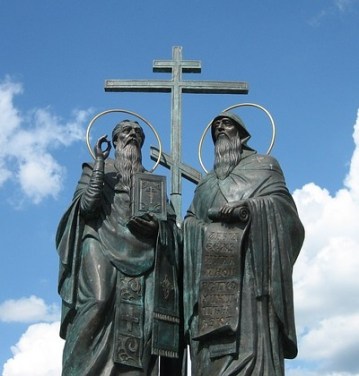
    Of the many lessons that tstatue-2171097_640he lives and ministry of Cyril and Methodius teach us, perhaps the greatest is that the Holy Spirit transcends human barriers by speaking the language of Divine love; His is the tongue of fire that seeks nothing but to speak to every heart and kindle in it the fire of that same love. By using their God-given gifts to foster true understanding of the faith among people despite the cost to themselves, Cyril and Methodius showed that barriers such as human language are nothing to our God, in Whose eyes we are deeply and eternally loved, not for who or what we are, but that we are at all.

    Further, as the reading from Genesis implies, we grieve the heart of God not only when we ourselves remain cold to the Divine flame but when we try to extinguish that flame in others. Like the disciples in the boat, the missionaries who harassed Cyril and Methodius heard but did not understand. Perhaps it was envy or jealousy of the brothers’ ingenuity or success that hardened their hearts. Regardless, we are called to look inside ourselves and ask if we too are envious or jealous of the gifts God gave others. It is true that other people have gifts that we do not, but it is equally true that we possess gifts that they do not. To each has been given the same Spirit; from each is expected the fruits of that gift.

    Therefore, let us resolve to be fluent in the language of love: Pray and thank God for the gifts of the Holy Spirit given to ourselves and to all people of good will; work to develop those gifts that God’s will be done on Earth; rejoice in the success of these gifts and above all, remember that success in ministry means the salvation of souls, each infinitely loved by God, Who is Love itself.


    Saints Cyril and Methodius, pray for us.


  • The True Reward – Tuesday of the 4th Week in Ordinary Time

    Hebrews 12:1-4; Mark 5:21-43

    Today we are presented with two characters who are among the easiest in the entire gospel of Mark to sympathize with. The first is Jairus, the father of a dying twelve year-old girl; the second, an unnamed woman plagued with continuous menstrual bleeding. Who cannot sympathize with a man helplessly watching as life ebbs from the body of his daughter, or a woman left broke from futile medical treatments whose perpetual state of uncleanness condemns her to live out her life suffering and isolated from her family, friends, and society at large?

    Yet for all that the evangelist doesn’t want to evoke sympathy; rather, his intention is to draw us into the action, to see ourselves in the stories and characters. This is an effective technique not only for contemplating and better understanding the actions of Christ and those around him but ourselves as well.

    These characters make this easier because their stories resonate across time. We’ve all known people whose children have suffered life-threatening illnesses or who have gone from doctor to doctor with no relief of their suffering. We may be those people! What did we do? Being believers we prayed, asking God for relief. Certainly Jairus and the woman prayed; however, neither had gotten the answer they wanted. The question is, what would our reaction be to that?

    If we’re honest with ourselves we must admit that sometimes when our prayers are not answered as we want, we’re tempted to stop praying; to be angry at or resentful toward God. While this is perfectly normal the honesty works both ways; that is, if we’re going to question God’s motives then we must question our own by asking if our image of God is as a Father or as an instrument to be used (CCC §2734)? That is, are we praying “Thy will be done” or “My will be done”?

    Consider Jairus. Mark calls him a “synagogue official” and in his gospel they are no friends of Christ. Even if he was a disciple, the scandal of association might have kept him away. No matter; his love for his daughter eclipsed everything. Even if his prayer at the feet of our Lord was tinged with ambivalence or fear, Jesus rewarded him for overcoming it and trusting in God’s providence rather than his own understanding.

    Next, consider the woman by the side of the road. She was afraid to approach our Lord, perhaps because of her impurity. Nevertheless, her desperation and frustration drove her to find Jesus, if only to touch his garment. While her immediate healing implied faith on her part, Jesus wanted her faith expressed.church-753815_1920 Even so, he doesn’t demand, only asks, “Who touched me?” Now think about her response. She could have hidden or run away; instead, she approached him and confessed all. Only then did he say that her faith cured her.

    The letter to the Hebrews exhorts us to “rid ourselves of every burden and sin that clings to us and persevere in running the race that lies before us” (Hebrews 12:1-2). This is much easier said than done when we are suffering but the key lies in the next phrase of that verse: “while keeping our eyes fixed on Jesus, the leader and perfecter of faith” (Hebrews 12:2). The important thing is not that Jairus and the woman understood or were unafraid; they may have understood nothing and been completely afraid. The important thing is that they persevered, they kept their eyes fixed on Jesus. They allowed faith to be their guide and in so doing went beyond their understanding, beyond their fear.

    That is the boldness of faith, founded on divine love and rewarded with transformation of the heart (CCC §2739). It is true that both women in today’s gospel story were healed, and that is a reward in itself, but the true reward given to Jairus and the woman was transformation of the heart. This transformation causes us to seek only what pleases the Father, and it’s why St. Josemaria Escriva urged us to begin our prayers of petition with the words, If it pleases you, Lord…. He knew, as the Catechism teaches, that “If our prayer is resolutely united with that of Jesus, in trust and boldness as children, we obtain all that we ask in his name, even more than any particular thing: the Holy Spirit himself, who contains all gifts” (CCC §2741).


  • The Greatest Gift – The Purification

    Luke 2:22-35

    Although St. Luke writes in his gospel account that the time was fulfilled for “their” purification, he really was referring only to the Blessed Virgin Mary. We have always known and honored her as Immaculate Mary, sinless from the moment of her conception by the gracious act of her Son and Lord. Given that, how could she possibly be in need of purification?

    This isn’t the time or the place for a lecture on ritual impurity laws, but suffice it to say that it had nothing necessarily to do with sinfulness. For example, it wasn’t sinful to bury the dead; that was and still is an act of mercy. However, even standing in the shadow of a coffin was terribly defiling for an ancient Jew. Similarly, it wasn’t sinful to give birth; one was fulfilling the command of God to be fruitful and multiply. However, because it put a woman in danger of death – and many women did die in those days due to the complications of giving birth – it put her in a state of ritual impurity.

    The book of Leviticus chapter 12 says that 40 days after a woman has given birth to a son, she is to be purified. So, the first thing that Mary needed to do was to come to the Temple.

    Jewish historical tradition holds that the Temple was built on Mount Moriah, the mountain where, by the command of God, Abraham was to sacrifice his son, Isaac. Carrying up the mountain the wood for the burnt offering, Isaac asked his father where they would find the sheep for the sacrifice. Abraham’s answer was mysterious, yet prophetic: God would provide the sheep.

    With this in mind, consider that the second thing a woman seeking purification needed to do was to bring a lamb to the Temple for a burnt offering. Only after the lamb had been sacrificed was she made clean. If she could not afford a lamb, then two turtledoves or pigeons could be substituted, and St. Luke does note that these were what the Holy Family did bring.

    Yet for her purification the Blessed Virgin Mary has in reality brought the greatest gift that both the Temple and the world have ever known. God himself is the deliverance; He has fulfilled Abraham’s prophecy and answered Isaac’s question by sending his only Son as the lamb for the sacrifice.

    On the one hand, this is a moment of great rejoicing, and we hear how Simeon does rejoice. These people had waited centuries for deliverance and, by a singular grace of the Holy Spirit, Simeon had been allowed to see and hold in person the long-awaited deliverance and glory of his people, Israel.

    maria-100112_1280

    On the other hand and by the same grace, he sees the bitterness that lies ahead. As certainly the shadow of the cross stretches from the dawn of human history to the twilight of the Second Coming, so Simeon sees its shadow across the face of infant and mother. Just as this little baby would one day grow up to speak words that cut as sharply as a two-edged sword, even so would the God-man’s side feel the wound of a different blade on a different mount in Jerusalem. As for the mother, while Abraham was spared the grief of losing his son, the Blessed Mother would be asked to endure his loss twice: first from the family and then from earthly life itself.

    Thus in the purification of Mary we learn that God keeps his promises, not on our terms or in our time, but on his terms and in his time; not for our understanding, but for our benefit; not in the warm light of earthly glory, but in the cold shadow of a cross; and not to spare us the pains of separation in and from this life, but to lavish upon us the joy of eternal union with Him in the life to come.


  • From Little Seeds – Friday, the 3rd Week in Ordinary Time

    Psalm 37:5; Mark 4:26-34

    Tradition dating from the second century tells us that St. Mark was writing to a Christian community in Rome that had experienced its share of persecution and failure. This was a community where it seems that people were leaving the faith under the threat of torture or death, leaders were more interested in preserving their own well-being than in leading the community, and evangelization was met with indifference or at times hostile rejection. Under these conditions, it would be hard not to lose hope.

    Given that, it might be hard to understand how such a community would benefit from grasses-1939673_1280hearing parables about farmers and seeds. For that matter, it may be hard for us in the modern age to see the point. Jesus teaches us that seeds grow in the ground of their own accord and mustard seeds are small but grow into bushes large enough for birds to nest in. OK, but what is the point of this?

    Simply put, Jesus is giving both them and us very good reason to hope.

    Earlier this week, we heard him explain that the seed is the word of God. Once, those seeds were sowed within us. We heard them and over time they took root and grew. Now we are called to sow the same seeds in the hearts and minds of other people.

    Here though we must remember one important point. Jesus teaches that those who sow the word do not control the growth. Just as a farmer can cultivate the soil, plant at the right time, and rotate the crops, but cannot control the elements, so it is with us. We sow the word in whatever ways our talents lead us, but we cannot worry about how to control its growth. That must be left to God. We are asked only to have faith that God will bring forth abundance in his own time according to his own design.

    The second point concerns the seed itself. Namely, the seed is not only the word; it is also the person in whom the word has taken root. Jesus reminds us that from something as tiny and insignificant as a mustard seed comes a bush that can flower and grow several feet high. Imagine that one little seed as one seemingly insignificant person. Isn’t that how God has always worked? In the Old Testament, think of Joseph with the coat of many colors; Moses; David. In the New Testament, think of Mary, the mother of our Savior. It’s always the little people, the human mustard seeds, in whom the word of God flourishes and through whom mighty things are accomplished.

    Taken together, these parables told St. Mark’s community exactly what they needed to hear, and they do the same for us. First, the seed is the word of God. It has been sown in us and we are to sow it in others. It will flourish, but it will do so according to a design over which God alone has control. Second, no person, no community is too small or insignificant to serve as an instrument for God. There is great hope, for all that is needed is openness to hear the word of God and do it.

    As Psalm 37 reminds us: Commit to the LORD your way; trust in him, and he will act (Psalm 37:5).