Tag: Homily

  • The Invitation to Dare: Divine Mercy Sunday

    The Invitation to Dare: Divine Mercy Sunday

    Acts 4:32-35; 1 John 5:1-6; John 20:19-31

    The gospel according to John has been called the gospel of encounters. Each follows the same basic pattern: Jesus encounters someone, they test him, there is an exchange, and the encounter ends with those who tested Jesus finding that in reality they are the ones being tested: Will they believe or not? Of course, Jesus wants them to rise to the challenge but he never forces them; it’s their choice and a test of their faith.

    Between last Sunday and this, John gives us five encounters, each posing its own challenge to faith. First, the Beloved Disciple: Will he believe in the resurrection based only on the testimony of an empty tomb? No; he has to see the tomb himself and the burial cloths neatly arranged, perhaps as proof that the body of Jesus was not stolen. Then Mary Magdalene: Will she recognize the risen Lord if she sees him? No; she must hear his voice. Next, the Apostles: Will they believe if they see and hear? Only when Jesus shows them his hands and side. Then Thomas: Will he believe his brother Apostles, now eyewitnesses? No; he needs to touch the wounds of Christ. The fifth challenge is from the evangelist to us: Will we believe without being able to see, hear, or touch Jesus?

    We might be tempted to say no, for if the Beloved Disciple, Mary Magdalene, and the Apostles struggled with faith, what hope do we have? But that’s not the attitude of Christ; he calls us “blessed.” Why? Because his encounters with us are not about human failure but about the triumph of divine mercy. Jesus didn’t resent the Beloved Disciple going to the tomb; rather, he used it to inspire John to recall the words that made that trip unnecessary: Destroy this temple and in three days I will raise it up (John 2:19). He wasn’t disappointed that Mary Magdalene needed to hear him; he is the Good Shepherd whose sheep follow him because they recognize his voice (John 10:4). He wasn’t angry that the Apostles had to see his wounds; rather, he bid them peace and gave them authority to forgive sins, so that others may know the same peace and all might take to heart his words at the Last Supper: Do not let your hearts be troubled. You have faith in God; have faith also in me (John 14:1). He was perhaps kindest of all to Thomas, that from he who seemed weakest in faith came the greatest affirmation of Christ’s divinity in all the gospel: My Lord and my God (John 20:28). Finally, Jesus spoke encouragingly to us, calling us blessed because we have not seen and have believed (John 20:29).

    This is how God shows mercy: By encouraging rather than cajoling, inspiring rather than depressing, and building up rather than putting down (although justice sometimes demands the whip). For his goal is and always has been to raise us up to himself. God is love and as one spiritual writer has noted, “mercy is love bending over misery to relieve it, to redeem it, to raise it up to itself.”[1] Time and again God has shown that this is what he will do, even to the giving of his only Son, that in his infinite mercy, he might draw us closer and closer to himself.

    Today we have the opportunity to draw very close indeed, for on the Feast of Divine Mercy, Christ offers us a great gift: The renewal of baptismal grace; the complete forgiveness of sins and punishment. This grace is usually received only through baptism itself or a “perfect” sacramental confession – one made purely for the love for God.

    Of course, like all encounters with Christ, there is a challenge. We can only obtain this extraordinary grace if we worthily receive the Eucharist on the Feast of Divine Mercy or its vigil Mass. Since we are at that Mass now we’re off to a good start, but that’s not all; worthily means that we have made a good sacramental confession in the recent past (say, Lent), that we’re still in the state of grace, and that we trust in the infinite mercy of God. Also, our Lord revealed to St. Faustina that if we are to receive mercy, we must show mercy. We don’t have to do what the Christians did in the first reading – sell our homes and give the proceeds to the poor – but we do have to practice the works of mercy listed in the Catechism: Spiritual works such as teaching the faith, advising, consoling or comforting others, forgiving and bearing all wrongs patiently, and the corporal works such as feeding the hungry, sheltering the homeless, clothing the naked, visiting the sick and imprisoned, and respectfully burying the dead.

    Fr. Michael Gaitley, who has dedicated himself to spreading the Divine Mercy devotion, advises us to remember that we do these things out of love and gratitude to God, not to try and earn his mercy. Asked what the biggest misconception is about Divine Mercy, he said that many active Catholics have somehow gotten the idea that “God’s love must be earned by following all the rules, saying all the prayers, and giving money to the right causes… that the more perfect we are, the more worthy we are to draw close to Jesus. The reality is that Jesus invites us spiritually poor, weak, broken, and overburdened people to draw as close as we dare…”[2]

    Every encounter with Christ is an invitation to dare; to “become who we are.” It requires us to face who we are – poor, weak, and broken – but also to see ourselves as God sees us – eternally willed, infinitely precious, and worth any sacrifice. In this lies the wound to our pride, the admission that there is nothing we can do to earn our own salvation but also the healing truth that there is nothing we need to do, for God has already done it. All he asks is that we accept it and, on this feast of Divine Mercy, show our gratitude for it. The only question is, will we?

    1 Fr. Gabriel of St. Mary Magdalene, Divine Intimacy, #236, Section 1.

    2 Catholic Digest, April/May 2020, page 16

  • The Slave of the Slaves: Memorial of St. Peter Claver

    Although I am free in regard to all, I have made myself a slave to all so as to win over as many as possible.

    1 Corinthians 9:19

    Imagine being dragged aboard a ship, naked and chained in the darkness below deck, lying helpless for several weeks, through rough seas and stifling heat. There are over 500 of you; males here, females there. You are fed just enough to keep you alive. Starvation, disease, and death are rampant. No one knows where you’re going or what awaits you when the hatch finally opens. Over the centuries of the slave trade, millions of people saw that hatch open only to a lifetime of slavery in a strange New World.

    Yet, like a drop of mercy from heaven, hundreds of thousands of these same people saw that hatch open to reveal the caring, concerned face of a gentle Spanish Jesuit. He would come below and find the newborns who were still alive, pour water over them, make the sign of the Cross and pray. He then ministered to the dying, and the dead he had respectfully removed. To the sick he brought medicine and bandaged their wounds. Those too sick to leave the ship on their own he helped carry above. When he got to you, he would clean you, give you food, clothing, and fresh water. He would speak warmly and gently through an interpreter, although no translation was needed for his touch. This was a man fluent in the language of love and by the time he had finished, he had restored a measure of the dignity so shamefully taken away. Every moment, this man acted as if he was your slave and happy to be nothing more.

    That’s because he was.

    The man was Peter Claver, a 17th century priest and Jesuit who devoted his life to ministering however he could to every slave shackled in the darkness aboard the hundreds of ships landing in the port city of Cartagena. Fr. Claver took to heart the words of St. Paul, who said, Although I am free in regard to all, I have made myself a slave to all so as to win over as many as possible (1 Corinthians 9:19).

    Father’s devotion to the service of slaves sprang from his desire to imitate the service of his model, the Blessed Mother, to whom he was devoted. As a young novice he was so moved by a pilgrimage to one her shrines that he wrote, “I must dedicate myself to the service of God until death, on the understanding that I am like a slave, wholly occupied in the service of his master.” He traveled to the New World after hearing that millions of enslaved people died there knowing nothing of Christ. After his first few years serving them, Father signed the document of his final profession to the Society of Jesus with the words, “Peter Claver, slave of the slaves, forever.”

    Before the slaves were sent on, Father took whatever time was given him to teach them about Christ. He used pictures, rosaries, crucifixes, anything he could find. He concluded every session by teaching them to say, “Lord Jesus Christ, Son of God, You are my Father. I am sorry for having offended You. I love You very much. I love You very much.” It is said that he personally baptized over 300,000 slaves.

    Fr. Claver continued his ministry for 40 years. Finally, sick, frail and exhausted, he knelt and kissed the feet of his young Jesuit successor and on the day he predicted – the Feast of the Nativity of the Blessed Virgin Mary, September 8th, 1654 – he died at the age of 73.

    portsoy-1244572_640Although the slave trade of that era is thankfully no more, slavery still abounds. Who are the people in our own lives, chained in the darkness of sin, feeling helpless, uncertain and fearful of their destiny? Who are those with wounded or even dying spirits, on the brink of losing hope? Who are those starving for affection, for shelter, for safety, for dignity? Will you be the one to open the hatch to descend into their suffering and restore what dignity you can?

    Let us pray that we, like St. Peter Claver, may be the slave of the slaves, forever.

    St. Peter Claver, pray for us.

  • The Wounds of Love: St. Birgitta of Sweden

    The Wounds of Love: St. Birgitta of Sweden

    Galatians 2:19-20; John 15:1-8

    I once instructed a woman in the RCIA program who excelled in her studies of the faith. After receiving the sacraments she moved away and I lost track of her. Years later, I learned that she had stopped practicing the faith. She was now “spiritual but not religious.” I think that means she believes that while there is a spiritual dimension to the world, it isn’t what we understand as the faith most fully revealed to us in Christ.

    The sticking point for her, as for many, may well have been the passion and death of our Lord. Indeed, the crucifixion was called by St. Paul a stumbling block to Jews and foolishness to Gentiles (1 Corinthians 1:23). But to one of the saints, St. Birgitta of Sweden, the crucifixion held a special place; it was the nexus of the physical and spiritual worlds.

    Birgitta lived a life full of the joys and sorrows of family. Born in Sweden around the year 1303, the daughter of a governor, by age 42 she had already been a wife for 28 years and a widow for one. She had a wide and deep experience of motherhood; as mother of 4 boys and 4 girls, she saw one daughter run off to marry a troublemaker, one son die as a boy, one as a man, and another daughter grow up to become St. Catherine of Sweden.

    She also knew the life of the working world. While raising her own children she served as lady-in-waiting to the queen of Sweden. Her kind, motherly way drew her into the confidence of the king and queen, both of whom tended to enjoy worldly life too much for their own good. Birgitta worked as hard as she could to keep their religious concerns before them; this became a frustrating and unfortunately futile struggle.

    Finally, Birgitta knew the religious life as well. After becoming a widow and devoting herself to care of the poor, who greatly loved her, she dedicated buildings and land on family property to a new contemplative order. She wrote the rule for her order which became known as the Order of the Most Holy Savior.

    At the same time, Birgitta lived a full life in the spiritual world. She was a mystic. At age seven, she had a vision of being crowned by the Blessed Mother. Three years later came her most profound mystical experience: The crucified Christ appeared to her and bid her gaze upon him. When she asked who had so cruelly treated him, he replied, “Those who despise me and spurn my love for them.” This was her own Damascus road moment; although she had many visions, dreams, and locutions afterwards, she devoted the rest of her life to the contemplation of Christ’s suffering.

    After wisely consulting her spiritual advisor and obtaining his approval, Birgitta began to share her visions with the world. She met with Magnus, the king of Sweden, and advised him that Christ would visit a plague on the land if he and the queen did not change their ways. As usual, he laughed off her vision. The Black Death came two years later, wiping out half the population. Needless to say, the king stopped laughing.

    Birgitta next focused her attention on the popes, who had long since deserted Rome in fear for their lives. Leaving Sweden with her daughter Catherine, she moved to Rome. In the midst of its crumbling churches and society, Birgitta ministered to the sick, fed the poor, housed pilgrims, and called on the pope to return. Her call took on a special intensity due to her dislike of pope Clement VI, who she called “a murderer of souls, more unjust than Pilate and more cruel than Judas.” During a thunderstorm on the night of December 3rd 1350, lightning struck the bells of St. Peter’s, melting them. Birgitta prophesied this as a sign that Clement’s life was coming to an end. He died a few days later. When the next pope fled to get away from her Birgitta literally chased him down, begged him to approve her order, which he did, and to return to Rome, which he did not do. After her death in 1373, her call for the popes to return was taken up by St. Catherine of Siena. Not long after, the papacy returned to Rome to stay. Birgitta was vindicated.

    In the first reading, St. Paul wrote:

    I have been crucified with Christ; yet I live, no longer I, but Christ lives in me; insofar as I now live in the flesh, I live by faith in the Son of God who has loved me and given himself up for me (Galatians 2:19-20).

    jesus-753063_640

    Birgitta’s life is a testament to the triumph of St. Paul’s words. From the moment of that first overwhelming spiritual encounter with the suffering, crucified Christ when she was 10 years old, she began to internalize them; to sense as we all must, not only the pain of Christ’s passion but the passion behind his pain. The ultimate reality of the cross is love, a love so great it unites heaven and earth, the physical and spiritual. What else could it be but love that would cause God himself to take on our humanity, our sinfulness, and in the face of humanity’s rejection, nail it to the cross? Birgitta spent her life contemplating not the pain of futility but the pain which Oscar Wilde called the wounds of love. In her own way, St. Birgitta spent her life showing her family, her king, her people, and her pope that this is not only a love worth dying for; it is a love worth living for – eternally.

    St. Birgitta, pray for us.

  • The Standard of Love: Tuesday of Holy Week

    So he dipped the morsel and took it and handed it to Judas (John 13:26).

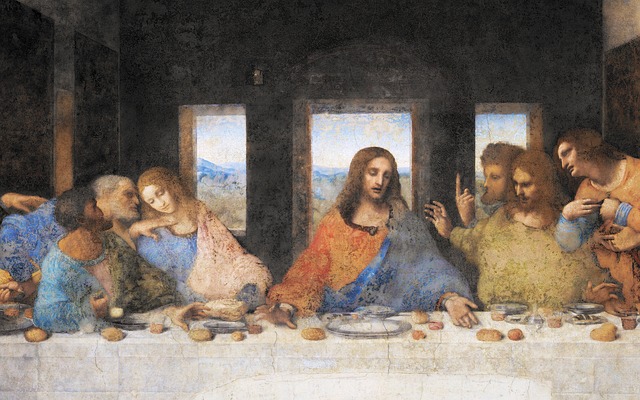
    Judas was chosen by Christ; he accompanied Him throughout his ministry. Like every disciple, he was fed spiritually and physically. Empowered by our Lord, Judas healed, expelled demons, preached the coming of the kingdom, and shook the dust of unbelieving towns off of his feet. On top of that, he witnessed countless signs and miracles.

    Yet still Judas betrayed Jesus.

    Nevertheless, even to the end Jesus fed him; He never shook the dust of his betrayer off of his own feet. To the contrary, Jesus extended hospitality toward him; He put him first.

    last-supper-1921277_640Let us keep this in mind as we prepare to receive the Sacred Morsel of our Lord in the most Holy Eucharist. For we are all like Judas; we have all betrayed our Lord’s innocent blood with every sin, no matter how small. And as He did with Judas, so does our Lord do to us; He continues to feed us, to respect our dignity, to love us unconditionally.
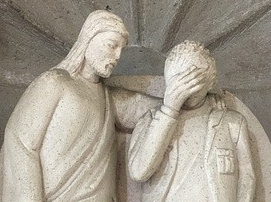
    This is the standard of a love that is bigger than any sin; this is the love that we are called every day to imitate. This is the love of Christ.

  • Mother and Baby: The Solemnity of the Annunciation of the Lord

    Isaiah 7:10-14; 8:10; Psalm 40:7-11; Hebrews 10:4-10; Luke 1:26-38

    Everyone knows the bond between a mother and her baby is special and that there is nothing in the world quite like it. But recently I came across some research that taught me things about it I didn’t know and that gave me new perspectives on the Blessed Mother.

    First, there is a physical basis to the phenomenon scientists call the “maternal instinct,” or others know as “Mommy brain.” Others like my older son who as a young child once inspected the back of his mother’s head, searching for the eyes hidden there. He wasn’t far wrong. During pregnancy a woman’s brain actually changes; areas related to the protection and nurturing of her baby develop as never before. This is nature’s way of attuning a mother to the needs and well-being of her children.

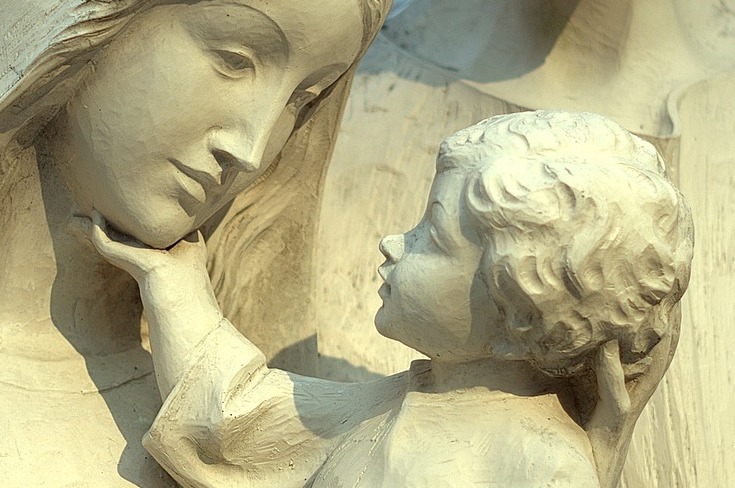
    It was no different for the Blessed Mother. From the moment the Holy Spirit came upon her and the power of the Most High overshadowed her (Luke 1:35), Mary began to develop the maternal instinct toward God himself. She alone among all women was to know the singular joy and tremendous responsibility of nurturing the Son of God; of protecting him from and preparing him for the world he came to save; of feeding him who thirsted for souls; and of providing a home for him who sought nowhere to lay his head except upon her breast, first as a helpless babe and then as a lifeless son taken down from the cross.

    It was from the cross that Christ raised Mary’s maternal instinct from the natural to the spiritual. With his words, Woman, behold your son (John 19:26) he gave her motherhood of his disciples, of all those like her who hear the word of God and do it (Luke 11:28). He made the bond complete when he told the Beloved Disciple, Behold, your mother (John 19:27), for in imitation of her Son we too have nowhere else to lay our heads. As her spiritual children we trust her, as he did, to see to our well-being and protection.

    The second thing I learned about the bond between mothers and babies is that children learn to recognize their mother’s voice in the womb and even prefer the language she speaks to any other they hear. By the time he was born, Mary’s voice was already very familiar to Jesus. And of course he prefers her language, for she speaks the language of total and selfless love. This is why we ask the Blessed Mother to speak to Jesus on our behalf; hers is the voice he heard from the time he was old enough to hear anything at all, the voice he could not refuse at Cana. Once again in imitation of him, Mary’s is the voice we too must not refuse, that says to us what it said to the servers at the wedding feast at Cana: Do whatever he tells you (John 2:5).

    Finally, I learned that perhaps the most important aspect of the bond between mother and baby is responsiveness. From the womb, mothers instinctively respond to the needs of their babies, giving from their own bodies whatever they have to give. This continues into childhood. Studies have shown that children thrive when their mothers respond to them in ways that foster growth and security; these especially include support and encouragement in difficult or stressful times. As Scripture makes clear, our Lord was no stranger to difficulty or stress, from his birth in a stable and flight into Egypt to his suffering and death on the cross. But Scripture also makes clear that Mary was with him at each of those times; in fact, she is the only one in all of Scripture to be present from his conception to his ascension. As such, Mary is the epitome of the supporting and encouraging mother.

    mother and baby

    One phrase in the readings perfectly summarizes the bond between Mary and her Son: I come to do your will (Psalm 40:8-9; Hebrews 10:7). For Mary this meant motherhood born of a love for God so deep that she, as Augustine once said, would conceive Christ in her heart before her womb. For Jesus it meant the Incarnation; a love so deep that he would take his own creation’s flesh and offer it back to his Father for the redemption of all who would accept him. Their obedience sets the pattern for us for we too are called to the same kind of obedience; to conceive Christ in our hearts; to offer to the Father the gift of ourselves in total dedication to Him; to love as Jesus and Mary loved. Without grace this is not possible, but this is the great hope of the Solemnity of the Annunciation, when the angel reminds us as he told the Fullness of Grace: nothing will be impossible for God (Luke 1:37).

  • The Choice to Forgive: The 7th Sunday in Ordinary Time

    Leviticus 19:1-2, 17-18; 1 Corinthians 3:16-23; Matthew 5:38-48

    As a young married woman, Edith Eger emigrated to the United States just after World War II and settled in Texas with her husband and first child. If she didn’t carry much material baggage, she carried a lot inside. A Jew, she and her family had been taken by rail along with hundreds of others to Auschwitz. Her parents were immediately put to death. A gymnast and dancer, she got the attention of a camp physician and was forced to dance for him; this was the notorious war criminal Jozef Mengele. Months later she was forced to march to another death camp and was one of the very few who survived. Her way of dealing with the trauma was to dedicate her life to helping others so in the 1970’s, her children grown, she went to college and became a psychologist. Now Dr. Eger, she began treating soldiers suffering from post-traumatic stress syndrome.

    One day Dr. Eger met with two patients, both Viet Nam veterans. They suffered identical injuries; the war left them paraplegics. The first man was angry, bitter, and resentful; all he saw was the world’s evil and his own limitations. His attitude was, “Why me?” The second man was just the opposite. Grateful to have survived, he was determined to focus on the good things in life and on its possibilities. His attitude was, “What next?”

    Both patients deeply affected her. Through the first man she realized two things. First, her wartime experiences had left her like him: Angry, bitter, and resentful inside. More importantly she realized those feelings not only remained unresolved but had taken over, made things worse. Like that patient, she too was defined more by hatred than by love. But the second man showed her that she had a choice. She could choose life over death, to be a victor and not a victim, to celebrate the good and stop mourning the evil; to ask “What next?” and not “Why me?” That is the path she chose and, to coin a phrase, it has made all the difference.

    In her book “The Choice,” Dr. Eger writes, “Maybe to heal isn’t to erase the scar… to heal is to cherish the wound.” May be; we know from the book of Leviticus that we are to cherish no grudge (Leviticus 19:18), for that is the opposite of healing. No wonder the same verse advises us to take no revenge. Although it may seem satisfying for a time, especially when someone has really hurt us, Dr. Eger also said that revenge keeps us revolving, not evolving. Our goal is to get past the pain, not pay it forward, to make a positive change in our lives.

    But when someone has hurt you badly, how do you get past that kind of anger? By acknowledging it and giving it to God. Hiding it or pretending it doesn’t exist aren’t realistic solutions. You must be honest and admit that the anger you feel is the normal response to being badly hurt, but you must also resolve that anger will not win, will not define you, is not who you are. St. Paul told you who you are; you are the temple of God (1 Corinthians 3:16); don’t let anger defile that temple. Then give it to God in prayer. Be completely honest; tell God that the hurt and anger are too big for you, that you cannot do it alone. Ask him to help you forgive those who hurt you.

    Finally, have a realistic understanding of love in the context of forgiveness. When our Lord says love your enemies he isn’t asking us to forget what happened and be friends; rather he is challenging us to see other people, including our enemies, as God sees them. Therefore, forgiveness doesn’t mean complete reconciliation of all differences with all people; it means freeing ourselves to love as God loves. Edith Eger didn’t reconcile with the Nazis but she did forgive them because she came to see them as they were: People who, although created good by God, learned as children to fear and hate what they could not understand. We come to forgiveness the same way; not by total reconciliation of our differences but by accepting first and foremost that all people, even those who have hurt us, are created and loved by God just as we are and in need of the same salvation we need.

    prodigal-son-3388599_640It’s tempting to dismiss all this as foolishness but remember what St. Paul says: If any one among you considers himself wise in this age, let him become a fool so as to become wise (1 Corinthians 3:18). It may be wisdom in the eyes of the world to hate those who have hurt us and foolishness to forgive them but in Christ’s world it’s just the opposite; his is the world where hatred keeps us bound and love frees us, where judgment takes a back seat to mercy, and where God alone sees the heart, knows the pain, calms the fear, heals the wounds, and breaks the chains.

    As Lent approaches I invite you to find that one person in your life most in need of your forgiveness. Make forgiving that person your Lenten project. It may not take you all of Lent or you may not have succeeded come Christmas; regardless, keep working at it. Pray for them; your prayers are the greatest gift you can give and are truly sacrificial. Forgiving others from the heart may be the one thing we do that God loves the most, for it shows how much we want to be like him. After all, God has forgiven us.

  • The Outsiders: Tuesday of the Sixth Week in Ordinary Time

    James 1:12-18; Mark 8:14-21

    We may as well answer the question Jesus asked the disciples at the end of the gospel passage: Do you still not understand (Mark 8:21)? No, they do not understand at all. The question is, why? So far in Mark’s gospel they have heard him teach, seen him heal, witness him expelling demons, raising a girl from the dead, and feeding thousands with a few loaves. Who or what kept them from seeing him as the Christ? And more to the point, who or what does the same thing to us?

    It certainly isn’t God. As the first reading reminds us, God tempts no one (James 1:15). Here, James echoes the ancient truth revealed through the prophet Habakkuk that God cannot even look upon evil (Habakkuk 1:13). Rather, the reading goes on to say, evil comes from within each person who is lured and enticed by his desire (James 1:14). Let us briefly consider three different kinds of enticement.

    First, we entice ourselves to sin by failing to guard against temptation. Just as a person struggling with alcoholism would be foolish to hang around liquor stores so anyone who struggles with a certain sin is foolish to put themselves in situations where they are tempted to it. This is called the near occasion of evil and is what we promise to avoid every time we say the Act of Contrition.

    Second, we entice others to sin by becoming an occasion of evil ourselves. Some do this by dressing immodestly, others by gossiping. We rationalize such behavior in true Adam-and-Eve fashion by blaming the victims – “They shouldn’t look at me that way,” or “I only told the truth” – but deep down we know that we are far from innocent.

    Finally, we are enticed to sin by the dark angels whose master goes by many names: the father of lies (John 8:44), the tempter (Matthew 4:3), the devil (Matthew 4:1). By whatever name he sows confusion, preys on our weakness, encourages selfishness. The wise listen to Christ who urges us to fear the demons for they can destroy us body and soul (Matthew 10:28); the prudent avoid them, and the persevering cling to God with the assurance of St. Paul that no one and nothing can ever separate us from the love of God that is in Christ Jesus (Romans 8:38-39).

    Earlier in Mark, Jesus defined two kinds of people. The “insiders,” or those to whom the mysteries of the Kingdom had been revealed; and the “outsiders,” who did not. Of the outsiders he said, they may look and see but not perceive, and hear and listen but not understand, in order that they may not be converted and be forgiven (Mark 4:12). The irony is that the disciples, who should be the definitive insiders, act more like outsiders than the real outsiders! For example in today’s gospel the disciples, who just witnessed Jesus feeding four thousand people now have the chance to share a quiet boat ride with him. What a shame that this perfect opportunity to unpack all they have seen is wasted on worrying about how little bread they brought along!

    fishing boat and feetStill, Mark’s purpose is not to make us wonder at their behavior but to evaluate our own. Are we insiders or outsiders? Some of us witness Christ feeding a multitude every day, and every day share time with him in the Church, the barque of Peter. Are we focused on our own loaf of bread – be it the next place we have to go, the people we have to see, or things we have to do – or on the Living Bread that is Christ? We see the many wonderful people he gives us – our families, friends, each other; do perceive Christ living within them? We hear his word in the Scriptures; do we understand his voice speaking through all those crying for help? At the Mass he gives us himself Body, Blood, Soul, and Divinity in the Holy Eucharist; are our hearts hardened or are they being converted through the forgiveness of sins in Confession, that we may partake most fully in the infinite grace he offers?

    We conclude where we began, in the letter of James. Consider how the passage begins: Blessed is he who perseveres in temptation, for when he has been proven he will receive the crown of life that he promised to those who love him (James 1:12). Let us pray for perseverance, that gift of the Holy Spirit that empowers us to remain in the state of grace until the end of our lives; may we like the Saints see and perceive, hear and understand, that our hearts be converted, our many sins forgiven, and our focus on the things above.

  • Holy and Immaculate: Memorial of Our Lady of Lourdes

    Isaiah 66:10-14c; John 2:1-11

    Between 1830 and 1858 the Blessed Mother made three separate visits to France. First in Paris to Sr. Catherine Laboure, whence came the Miraculous Medal and the prayer, “Mary, conceived without sin, pray for us who have recourse to thee.” Next she appeared to two shepherd children near La Salette in the French Alps, where she pleaded for a return to prayer and the Sacraments. Finally and most famously she appeared 18 times to the young teenager Marie-Bernarde Soubirous, also known as Bernadette, near Lourdes in the foothills of the Pyrenees.

    In all these we see that Mary appeared not to the powerful or influential but to the lowly – mostly, to children. Simple, honest, and unsophisticated, they were not interested in either notoriety or personal gain. Indeed Bernadette in her typical, straightforward fashion said, “When I’m dead they’ll come and touch holy pictures and rosaries to me, and all the while I’ll be getting boiled on a grill in purgatory.” Hardly the words of someone looking to sell the book and movie rights.

    Not that she couldn’t have used the money. Those such as Bernadette were not only innocents but familiar with suffering, people who understood poverty of spirit and body. In fact, she first met Our Lady while gathering sticks so that her family, mostly children who would not survive to adulthood, could have some heat in what they called home but everyone else called a musty, abandoned prison block.

    But as Mary knows, home is where the heart is and the heart of the Soubirous family was faith in Christ. Although the prosperity and wealth of nations spoken of in the first reading (Isaiah 66:12) eluded them, spiritual wealth was theirs in abundance. On hearing of the mystical vision in the grotto, Bernadette’s father said to his family, “Let us pray.” He knew that, whether a heavenly vision or one from the lower depths, their only recourse was to fall to their knees. Perhaps this is why Bernadette was chosen; she like Mary was raised from birth to understand that true wealth, true prosperity, comes only from the hand of God.

    This was the same God who said, As a mother comforts her child, so will I comfort you (Isaiah 66:13), who gave Bernadette visions of his mother, and who defined comfort in her words, “I do not promise to make you happy in this world but in the next.” It is true that Bernadette, who suffered terrible pain in her body in the later years of her short life, never sought the healing waters that Christ gave the world in that little grotto. She knew that Mary had given her the only promise of happiness that means anything: Eternal union with God. This is why Mary constantly urges meditation on the gospel of Christ through the rosary, why she begs the conversion of sinners, and especially why she asks that chapels be built, for there her Son dwells in the complete sacramental fullness of his Body, Blood, Soul, and Divinity.

    virgin-1615390_1920At every apparition Mary is highly honored and rightly so for she is as she said, the Immaculate Conception. But the honor we give her goes far beyond her identity to the two-fold reality behind it. First, Mary points us to Christ. Through the grace bestowed on her by the will of God and her total abandonment to it, Mary has perfectly heeded her own advice: Do whatever he tells you (John 2:5). In this, she is the first and best example of a Christian. Second, Mary points to our own destiny. Like her, we are asked to abandon our will to his, be perfect as the Father is perfect (Matthew 5:28), and so be presented to him holy and immaculate (Colossians 1:22). For this we need neither the water of Lourdes nor the water turned to wine, but that which wells up to eternal life (John 4:14), our Lord Jesus Christ, by whose love wine becomes the blood poured out for the forgiveness of sins (Matthew 26:28).
  • Heart Speaks to Heart: Sts. Basil the Great and Gregory Nazianzen

    1 John 2:22-28; John 1:19-28

    The first reading begins, Beloved: Who is the liar? Whoever denies that Jesus is the Christ. John seems to be thinking of someone in particular who had strayed from the truth about Christ. This was not uncommon; the early Church was plagued with heretics whose theories about Jesus ran the gamut, from the Ebionites who believed that Jesus was not divine at all, to the Docetists who believed that Jesus was only divine and merely pretended to be human for our sake.

    In the 4th century, one particular heresy took center stage. It was popularized by a priest named Arius, who used Scripture to teach that Jesus, although as close to divine as a human being could be, wasn’t actually divine; he was a creature and therefore less than God. The heresy was appealing; it made sense to people who couldn’t understand how God could die on a cross. Throughout the Christian world, Arianism spread like wildfire.

    At the same time, God was raising up a river to put that fire out. It came in the form of the two men we remember today, Basil and Gregory. Basil was born in what is now central Turkey in the year 330 AD; Gregory was born in the same area nine years later. Both left their native land to go to Athens where, as Gregory would later write,

    We had come, like streams of a river, from the same source in our native land… and were now united… as if by plan, for God so arranged it.

    Indeed, God arranged not just friendship; Basil and Gregory became soulmates. Blessed John Henry Newman used the phrase, cor ad cor loquitur – heart speaks to heart – and that describes these two men. Gregory further wrote

    When, in the course of time, we acknowledged our friendship and recognized that our ambition was a life of true wisdom, we became everything to each other: we shared the same lodging, the same table, the same desires, the same goal. Our love for each other grew daily warmer and deeper… We seemed to be two bodies with a single spirit.

    What united them was their common love of Christ. In the gospel the priests, Levites, and Pharisees also had ambitions; ironically, although Wisdom Himself had dawned upon the world and was so near them, they lived in the darkness of self-absorption and wished only to see that He satisfied their requirements. Unlike them, Basil and Gregory took to heart John’s words when he said, let what you heard from the beginning remain in you. From childhood they were taught the truth about Christ and sought to ensure that they satisfied His requirements. They asked questions of the faith only to see where their own understanding was darkened and prayed that Christ would shed His light upon them.

    United in this purpose, both men poured themselves into their studies and infused their knowledge with the grace of ordination. Gifted by God as powerful writers, orators, theologians, and shepherds, they fearlessly and eloquently defended the Church against Arius and all who opposed the truth that Father, Son, and Holy Spirit are a perfect Unity. As Patriarch of Constantinople, Gregory presided over the Council of Constantinople in 381, which completed the Nicene creed that we recite every Sunday. Not only that, both men wrote masterpieces of theology that are studied and used to this day.

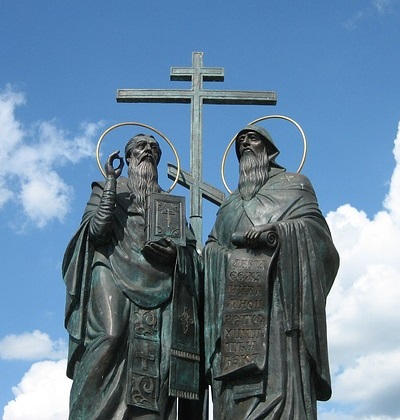
    statue-2171097_640Saints Basil and Gregory can teach us many things, but today we focus on two. First, they teach us that faith in God requires true humility. Heresies are born from the pride that sees ourselves as the measure of all things; that interprets our failure to understand the truths of the faith to mean that the truths are wrong. True humility is as John admonished us, to remain in him; to see that God is the measure of all things and that our inability to understand means that we still have work to do. Second, in these days when the word “love” is so easily limited to physical expressions of self-gratification, the love of Basil and Gregory is a shining example of the most uplifting, life-giving love possible between people. This is the love that is modeled on God; that seeks only the good of the other; that finds its union with others in the heart and soul because that is where God dwells, and God is love. This is the love where heart speaks to heart and says, “I want for you what God wants for you.” My prayer is that all of us come to have that love for one another. What a world this would be.

    Saints Basil and Gregory, pray for us.

  • The Song of the Dove: Feast of Saint Stephen

    Acts 6:8-10; 7:54-59; Matthew 10:17-22

    Of all the customs that have ever arisen during the celebration of the Twelve Days of Christmas, perhaps the strangest occurred in the 18th and 19th centuries. Beginning on the Feast of Stephen, young boys in Southern France, Great Britain, and Ireland would hunt and kill a bird; specifically a wren, then display it and parade it around town asking for money.

    It’s hard to understand how this bizarre ritual started or why it was done, let alone how it could continue for two hundred years, but a good dose of superstition was probably involved. In certain places the wren was considered symbolic of priesthood or prophecy. An old Irish word for wren meant “bird of prophecy,” and some Irishmen associated it with a type of pagan priest who foretold the future. Although we have no idea what the poor little bird was supposedly prophesying, one thing is known: The wrens’ song is very loud; allegedly ten times louder than other birds their size. Who knows; perhaps the boys thought they were doing their town a favor.

    In the reading from Acts, the members of the local synagogue may have thought that they were doing their town a favor when they silenced Stephen. But his was the song of the Dove, not the wren. Luke says that Stephen was filled with the Holy Spirit; as Jesus made clear in the gospel, His wisdom cannot be overcome. Like Jesus, the only way to try and silence Stephen was to kill him; it is no coincidence that Luke patterns Stephen’s passion and death after that of Christ. For example, in Luke Jesus tells the Sanhedrin before he dies that from this time on the Son of Man will be seated at the right hand of the power of God (Luke 2:69); here, Luke has Stephen say Behold, I see the heavens opened and the Son of Man standing at the right hand of God (Acts 7:56).

    snow wrenLike the mysterious sacrifice of the wren, this may leave us curious. Why does the Church take the first day after Christmas to remember the first martyr? The answer lies precisely in the similarity of Stephen’s passion and death to Christ’s. Christmas is the celebration of the birth of Jesus; the same Jesus who came not to be served but to serve and to give his life as a ransom for many (Mark 10:45). It was in the giving of his life that Christ most profoundly served, for only by the perfect sacrifice of himself could his disciples have hope of being born into eternal life. Thus with Stephen; he could most greatly honor his Savior by imitating him in life even if that meant dying, that he might be born into eternal life with Christ.

    It might seem odd for the Church to see death as the way to honor life; after all, if Church members die, how can the Church survive? That brings up another fact about the wren. Although winter can devastate its population, the bird is extremely hardy; it always finds a way to survive. What is true for the wren is doubly true of the Dove; those who have been graced to speak with the power of the Holy Spirit have been hunted, killed, and displayed for over two thousand years; still, the Church continues to find ways not only to survive but to thrive. In fact, it is the irony of man and the glory of the Holy Spirit that the martyrdom of Stephen gave rise to the greatest come back in Church history. Notice near the end of the first reading, Luke tells us that the witnesses laid down their cloaks at the feet of a young man named Saul (Acts 7:58). Saul, the same man who stood silently by at the death of the first martyr, in time became Paul, the loudest and hardiest wren of all.

    St. Stephen, pray for us.