Tag: Holy Week

  • The Slave of the Slaves: Memorial of St. Peter Claver

    Although I am free in regard to all, I have made myself a slave to all so as to win over as many as possible.

    1 Corinthians 9:19

    Imagine being dragged aboard a ship, naked and chained in the darkness below deck, lying helpless for several weeks, through rough seas and stifling heat. There are over 500 of you; males here, females there. You are fed just enough to keep you alive. Starvation, disease, and death are rampant. No one knows where you’re going or what awaits you when the hatch finally opens. Over the centuries of the slave trade, millions of people saw that hatch open only to a lifetime of slavery in a strange New World.

    Yet, like a drop of mercy from heaven, hundreds of thousands of these same people saw that hatch open to reveal the caring, concerned face of a gentle Spanish Jesuit. He would come below and find the newborns who were still alive, pour water over them, make the sign of the Cross and pray. He then ministered to the dying, and the dead he had respectfully removed. To the sick he brought medicine and bandaged their wounds. Those too sick to leave the ship on their own he helped carry above. When he got to you, he would clean you, give you food, clothing, and fresh water. He would speak warmly and gently through an interpreter, although no translation was needed for his touch. This was a man fluent in the language of love and by the time he had finished, he had restored a measure of the dignity so shamefully taken away. Every moment, this man acted as if he was your slave and happy to be nothing more.

    That’s because he was.

    The man was Peter Claver, a 17th century priest and Jesuit who devoted his life to ministering however he could to every slave shackled in the darkness aboard the hundreds of ships landing in the port city of Cartagena. Fr. Claver took to heart the words of St. Paul, who said, Although I am free in regard to all, I have made myself a slave to all so as to win over as many as possible (1 Corinthians 9:19).

    Father’s devotion to the service of slaves sprang from his desire to imitate the service of his model, the Blessed Mother, to whom he was devoted. As a young novice he was so moved by a pilgrimage to one her shrines that he wrote, “I must dedicate myself to the service of God until death, on the understanding that I am like a slave, wholly occupied in the service of his master.” He traveled to the New World after hearing that millions of enslaved people died there knowing nothing of Christ. After his first few years serving them, Father signed the document of his final profession to the Society of Jesus with the words, “Peter Claver, slave of the slaves, forever.”

    Before the slaves were sent on, Father took whatever time was given him to teach them about Christ. He used pictures, rosaries, crucifixes, anything he could find. He concluded every session by teaching them to say, “Lord Jesus Christ, Son of God, You are my Father. I am sorry for having offended You. I love You very much. I love You very much.” It is said that he personally baptized over 300,000 slaves.

    Fr. Claver continued his ministry for 40 years. Finally, sick, frail and exhausted, he knelt and kissed the feet of his young Jesuit successor and on the day he predicted – the Feast of the Nativity of the Blessed Virgin Mary, September 8th, 1654 – he died at the age of 73.

    portsoy-1244572_640Although the slave trade of that era is thankfully no more, slavery still abounds. Who are the people in our own lives, chained in the darkness of sin, feeling helpless, uncertain and fearful of their destiny? Who are those with wounded or even dying spirits, on the brink of losing hope? Who are those starving for affection, for shelter, for safety, for dignity? Will you be the one to open the hatch to descend into their suffering and restore what dignity you can?

    Let us pray that we, like St. Peter Claver, may be the slave of the slaves, forever.

    St. Peter Claver, pray for us.

  • Holy Thursday: The Primacy of Service

    John 13:1-15

    Today we read from John’s account of the last evening that Jesus spent with his disciples before his Passion and death. The other evangelists take this opportunity to provide us with the Institution Narrative, or the words spoken by Christ that to this day are repeated by the priest during the Consecration at holy Mass.

    John does not do this; rather, he uses the occasion of the Last Supper to depict Jesus washing the feet of his disciples and commanding them to do likewise. We don’t know why, but it’s possible that by the time the evangelist composed this gospel account the Breaking of the Bread had become an occasion for people to segregate into groups and eat and drink their fill, rather than to unite and commemorate the Passion, Death, and Resurrection of our Lord as one body.

    passion-3807312_640By showing Jesus washing the feet of his disciples, the evangelist re-emphasizes the primacy of service. Those who would be greatest must become the least. This is the humility and love behind the gift of his life poured out for our sake, by which he becomes one with us and we become one with each other.

    As we approach the Eucharist this evening let us take his words and his actions to heart, for together they show that love leads naturally to service. Christ has shown us the greatest love through the gift of his Body and Blood broken and poured out for our sake and at the same time that this is the love that allows us to see others not as things to be used but as people to be served.

  • The Standard of Love: Tuesday of Holy Week

    So he dipped the morsel and took it and handed it to Judas (John 13:26).

    Judas was chosen by Christ; he accompanied Him throughout his ministry. Like every disciple, he was fed spiritually and physically. Empowered by our Lord, Judas healed, expelled demons, preached the coming of the kingdom, and shook the dust of unbelieving towns off of his feet. On top of that, he witnessed countless signs and miracles.

    Yet still Judas betrayed Jesus.

    Nevertheless, even to the end Jesus fed him; He never shook the dust of his betrayer off of his own feet. To the contrary, Jesus extended hospitality toward him; He put him first.

    last-supper-1921277_640Let us keep this in mind as we prepare to receive the Sacred Morsel of our Lord in the most Holy Eucharist. For we are all like Judas; we have all betrayed our Lord’s innocent blood with every sin, no matter how small. And as He did with Judas, so does our Lord do to us; He continues to feed us, to respect our dignity, to love us unconditionally.

    This is the standard of a love that is bigger than any sin; this is the love that we are called every day to imitate. This is the love of Christ.

  • A Fragrant Aroma: Monday of Holy Week

    John 12:1-8

    Awhile after my father died, my mother asked if I would help her sort out his things. As I took some clothes out of his dresser it struck me; they still smelled like him. It was as if my father was right there. It took me several minutes to regain my composure.

    Scientists have known for years that the sense of smell is intimately tied to memory and emotion. In fact, smell is the only sense that works directly with the area of the brain that controls emotions. We’ve all experienced it; no matter how far away or far removed we are from a certain time, the aroma of something – perhaps a certain food, a perfume – can bring it all back again. It is if we are there.

    In the gospel we see how one of the sisters of Lazarus gave to their home a sense memory of our Lord: Mary took a liter of costly perfumed oil made from genuine aromatic nard and anointed the feet of Jesus and dried them with her hair; the house was filled with the fragrance of the oil (John 12:3).

    This is significant on many levels. First, it is the perfect counterbalance to the family’s recent experience at the tomb of Lazarus; the foul air of death is literally blown away by the fragrance of new life found in Christ. But second, this perfume is costly; the price of victory is high. As if she senses that his enemies are as near as Judas and plotting his demise, Mary anoints not the head of Christ the King but the feet of Christ the Servant which shall soon be pierced with nails and placed in a tomb. Finally, it may seem odd that Mary wipes away some of the perfume with her hair but I see in it a sign of her devotion; a way to identify herself with Christ and his sacrifice, personifying St. Paul’s meaning in 2 Corinthians when he said, we are a fragrance of Christ to God among those who are being saved and among those who are perishing (2 Corinthians 2:15).

    glass-4108085_640There is an ancient rabbinic saying that “the fragrance of a good perfume spreads from the bedroom to the dining room; so does a good name spread from one end of the world to the other.”1 As Mary filled her house and her hair with the fragrance of Christ, so may we fill the world and ourselves with his holy and glorious Name. And may be as untiring and devoted as she, willing to sacrifice whatever is costly to ourselves to do it. There is no greater identification with Christ than this, as St. Paul knew when he prayed that we may be imitators of God, as beloved children; and walk in love, just as Christ also loved you and gave Himself up for us, an offering and a sacrifice to God as a fragrant aroma (Ephesians 5:1-2).
    1Based on Ecclesiastes 7:1 and cited in Brown, R.E. (1966) The Anchor Bible: The Gospel According to John I-XII. New York: Doubleday & Company, Inc., p. 453.

  • We Adore You, O Christ and We Praise You: Good Friday

    Hebrews 5:7-9

    From the time we first became Christians, we have learned that the standard for our behavior is not those around us but Christ. Given that, it might be easy to give up and say that we can never reach that standard of perfection.

    That’s true. Left to ourselves, we can’t.

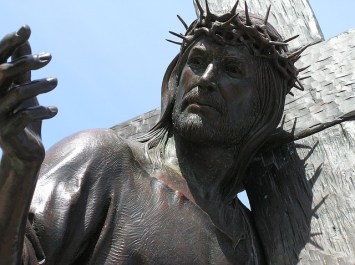
    But as the author of the letter to the Hebrews reminds us, we aren’t left to ourselves. In his infinite mercy, Jesus sympathizes with our weakness. Even though he himself never fell to the many temptations that weighed on him like a cross and surrounded him like a crown of thorns, he knows what it’s like to carry them, to bear their weight and feel their pain, but also to endure and overcome them.

    Fully man, Christ knows what it means to feel the kind of pain that leaves us without words; able only to offer prayers and supplications with loud cries and tears to the one who was able to save him (Hebrews 5:7). Enduring that kind of torment, he must also have felt the natural reaction of the human body to fight against and relieve the pain – on this day, to come down from the cross – yet Son though he was, he learned obedience from what he suffered (Hebrews 5:8).

    But Jesus also taught us through his obedience unto death that glory waits on the other side of suffering; that being made perfect is not a matter of doing all things on our own, but the opposite: Letting go of control and uniting ourselves more and more to the will of the One who is our true strength.

    good-friday-2264164_640This is the ultimate lesson of Good Friday. Christ’s triumph over self-will and self-reliance did not enable him to merely sympathize with our suffering or feel our pain but to be perfectly in himself the source of eternal salvation for all who obey him (Hebrews 5:9).

    We adore you O Christ and we praise you, because by your holy cross you have redeemed the world.

  • The Primacy of Service: Holy Thursday

    Today we read from John’s account of the last evening that Jesus spent with his disciples before his Passion and death. The other evangelists take this opportunity to provide us with the Institution Narrative, or the words spoken by Christ that to this day are repeated by the priest during the Consecration at holy Mass.

    John does not do this; rather, he uses the occasion of the Last Supper to depict Jesus washing the feet of his disciples and commanding them to do likewise. We don’t know why, but it’s possible that by the time the evangelist composed this gospel account the Breaking of the Bread had become an occasion for people to segregate into groups and eat and drink their fill, rather than to unite and commemorate the Passion, Death, and Resurrection of our Lord as one body.

    passion-3807312_640
    By showing Jesus washing the feet of his disciples, the evangelist re-emphasizes the primacy of service. Those who would be greatest must become the least. This is the humility and love behind the gift of his life poured out for our sake, by which he becomes one with us and we become one with each other.

    As we approach the Eucharist this evening let us take his words and his actions to heart, for together they show that love leads naturally to service. Christ has shown us the greatest love through the gift of his Body and Blood broken and poured out for our sake and at the same time that this is the love that allows us to see others not as things to be used but as people to be served.

  • The Leap of Faith: Wednesday of Holy Week

    judasNotice in Matthew’s gospel how 11 disciples say, Surely it is not I, Lord? while only Judas says, Surely it is not I, Rabbi? The evangelist does not do this by accident; to Judas, Jesus may be many things – teacher, sage, a gifted healer, a moving speaker – but whatever he is, he is not Lord.

    Like Judas, many people cannot make the leap from teacher to Lord. Perhaps they are afraid of what it would mean. The words of Jesus could no longer be taken as opinion, his actions no longer regarded as merely well-intended, his death no longer understood as the death that comes to us all. The change of that one word, from teacher to Lord, changes everything.

    This is the leap of faith.

    Take a moment to thank God for that gift, to pray that others may cast aside their fear and make the faith their own, and that our own faith may be strengthened not only to see him as Lord but to do all he asked; to love as he loved, to the death.

    Only therein lies the resurrection to eternal glory that faith promises.

  • Small Kindnesses: Monday of Holy Week

    Reading: Isaiah 42:1-2

    The first reading begins: Here is my servant whom I uphold, my chosen one with whom I am pleased, Upon whom I have put my Spirit; he shall bring forth justice to the nations, Not crying out, not shouting, not making his voice heard in the street (Isaiah 42:1-2).

    hands-1797401_640Think for a moment how we as servants of God are so blessed (upheld). What mercy He pours upon us. He has chosen to give us the grace to do His will and is so pleased when we cooperate with Him. And what a gift: God gives His Spirit – His very life – so that we may try to give to Him what we owe Him.

    Of course, we can never repay God for all that He has given to us. Fortunately we are not asked to; rather, we are asked to learn from and imitate the one true Servant, our Lord Jesus Christ, who repaid our debt for us. So today, out of love for and in imitation of Him, consider giving from your own storehouse of the “little way;” the small kindnesses, the often unnoticed gifts that we make of ourselves to others. Not crying out, not shouting, not drawing attention to ourselves but emptying ourselves in imitation of Christ, who by His Cross and Resurrection has taught us what a powerful, life-giving gift the merciful love of God truly is, and what a blessing it is to the world when we love as God loves.

  • The Power of the Passion: Palm Sunday, Cycle C

    Reading: Luke 22:14-23:56

    Today we hear Luke’s version of the passion and death of our Lord Jesus Christ. Like all great dramas it is most effective when we place ourselves in it; see it through the eyes of those on the inside. As we do so we find such a rich array of characters that we cannot help but ask ourselves which ones we most resemble.

    There are those who fall: the Apostles, who argue at the Last Supper about which of them is the greatest; Judas, the follower turned betrayer; Peter, the follower who denies even knowing Jesus; Herod, anxious only to see Him perform a sign; Pilate, whose resolve over Our Lord’s innocence weakens under pressure; the crowd, who stand by and watch silently as others abuse Him; the thief who reviles and bullies Him.

    But there is also virtue: Simon the Cyrenian, who carries the cross on behalf of the struggling Christ; the women of Jerusalem who weep in mourning; the thief who recognizes that Jesus has done nothing wrong and begs to be with Him in eternity; the crowd who regret their actions; the centurion who proclaims His innocence; and Joseph of Arimathea, who provides for Him to the end and beyond.

    passion-3807331_640

    What makes the Passion of Our Lord so powerful is not only that it is the story of our Redeemer, although it certainly is that; it is also the story of us, the redeemed. We don’t have to imagine ourselves as characters in the drama; we already are those people. As flesh and spirit, virtue and vice, it is we who in one breath swear to follow Christ, to bear the cross, to proclaim His innocence, and to beg Him for salvation, only in the next breath to deny even knowing Him, shout to crucify Him, and bully Him into doing things our way.

    We might think that the struggle between virtue and vice is what makes us human; yet throughout the Passion, Jesus shows us what being fully human really means. As Pope St. John Paul said in his encyclical Redemptor Hominis, Jesus Christ the Redeemer “fully reveals man to himself.” Consider His words to the arguing Apostles, let the greatest among you be as the youngest, and the leader as the servant (Luke 22:26); to Peter, once you have turned back, you must strengthen your brothers (Luke 22:32); to the jeering crowd, Father, forgive them, they know not what they do (Luke 23:34); and to the repentant thief, today you will be with me in Paradise (Luke 23:43). In Christ do we find our proper point of reflection. Being most fully human is not measured by how much we are like the people around Jesus, but how much we are like Jesus to the people around us.

    Today we leave the story unfinished, with Jesus buried in the tomb. This is fitting; it reminds us that if we are truly like Christ, we were indeed buried with him through baptism into death, so that, just as Christ was raised from the dead by the glory of the Father, we too might live in newness of life (Romans 6:4).