Tag: Holy Men and Women

  • The Story My Life Will Tell

    The Story My Life Will Tell

    The Solemnity of All Saints

    Revelation 7:2-4, 9-14; Psalm 24:1bc-2, 3-4ab, 5-6; 1 John 3:1-3; Matthew 5:1-12a

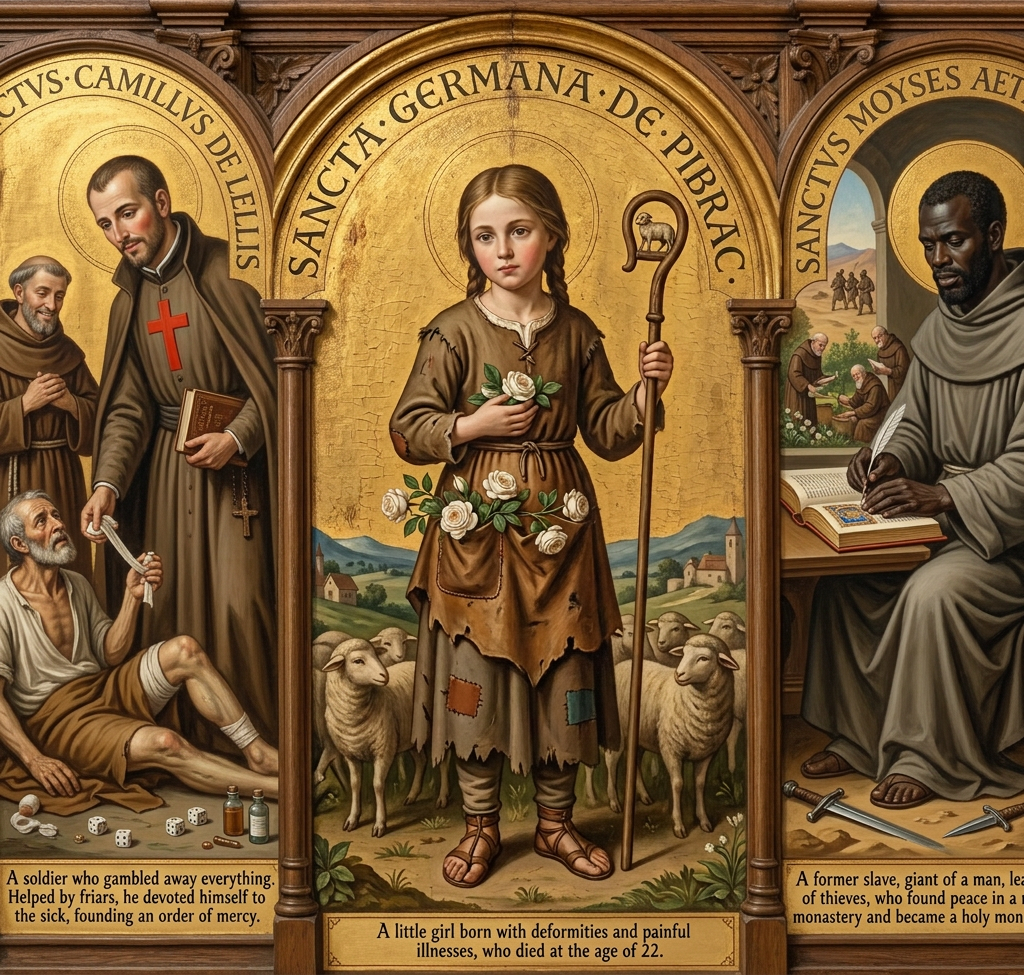
    A little girl, born with physical deformities and plagued by painful illnesses, was physically abused by her stepmother, forced to live in a barn, and fed only table scraps. She died at the age of 22, but never turned bitter; instead, she tended sheep, went to Mass, taught children about Christ, and shared what food she had with the hungry.

    Blessed are the clean of heart, for they shall see God.

    A former slave – a giant of a man – fell in with a gang of thieves and murderers, and eventually became their leader. While fleeing the law, he sought refuge in a desert monastery. The peace, humility, and mercy of the monks there captivated him. He renounced violence, repented completely, and spent the rest of his life with them. Even when a band of robbers attacked his cell, he spared their lives. His peaceful demeanor is said to have contributed to their own conversion to follow Christ.

    Blessed are the peacemakers, for they will be called children of God.

    A hot-tempered young soldier, unable to control his gambling, eventually gambled away everything. After being helped by some kind Franciscan friars, he devoted himself to caring for the sick, became a priest, and founded a religious order dedicated to serving the physically and spiritually afflicted. Despite his own chronic illnesses, he cared for others with great mercy and kindness until his own death forty years later.

    Blessed are the merciful, for they will be shown mercy.

    Every saint’s life tells a unique story. Some, like the little girl St. Germaine, are heart-rending. Others, like the reformed outlaw St. Moses the Black, are astonishing. Still others, like St. Camillus, show us holiness in the midst of suffering. Yet all of them, each in their own way, show us one thing above all: the transforming power of God’s grace. And their stories remind us of the old saying that every saint has a past, and every sinner has a future.

    The question for all of us is, what story will my life tell? We might think, “Well, my story is nothing like the saints you spoke of. No great events, no drama. What is there to make me a saint?”

    Don’t mistake drama for sanctity. Look at the first reading. The author tells of a great multitude in heaven which no one could count. We don’t know their stories. Some of them probably lived lives much like ours. Yet we hear that they survived “great distress.” What could that be? While for some it might be a dramatic martyrdom or great suffering, St. Thérèse of Lisieux reminds us of the “Little Way” – taking up the daily cross of choosing integrity when dishonesty is rewarded, choosing to forgive when resentment is easier, or enduring chronic illnesses, loneliness, or grief while holding onto hope.

    John tells us that they have washed their robes and made them white in the Blood of the Lamb. Made white in blood? Yes. The blood of the Lamb cleanses us from sin and makes us holy. The saints did not achieve holiness by their own efforts alone. They were made holy through the saving sacrifice of Christ, and they responded to his grace with lives of faithfulness.

    And that cleansing grace is at work even in an “uneventful” life, lived in quiet, consistent reliance on God.

    That sounds like us. For we are the people who just sang in the Psalm that we long to see His face; who heard that one day, those called the “children of God” will see Him as He is, and that we who have this hope make ourselves pure as he is pure.

    That is what the saints have done. We might imagine, because their stories are so different, that each saint found his or her own path to heaven. But that isn’t so; no one invents their own path to holiness. Rather, they follow the path Christ set before them — the beatitudes he teaches in the Gospel today.

    Those beatitudes may seem like a mystery. How can we be happy or “blessed” to be poor in spirit, meek, mourning, or persecuted? Sounds like there’s pain involved. In answer to this, a Dominican theologian compared the Beatitudes to a plow in the fields. A plow turns over the soil, uprooting weeds and preparing the earth for new growth. The Beatitudes do something similar in our hearts. The Holy Spirit overturns our assumptions, challenges our desires, and makes room for the seed of the Gospel.

    There’s no getting around it; living out the Beatitudes is difficult. We can’t do it alone. Fortunately, we don’t have to. Through the Holy Spirit, Christ gives us the grace to follow his path. And when we stumble, he calls us back, forgives us, and gives us the grace to begin again.

    This is especially important to remember on All Saints Day. The saints aren’t simply people who admired Jesus and tried hard on their own to copy him. They are people who allowed their lives to be transformed by his grace.

    So, what story will my life tell? We can’t know now. As John reminded us, what we shall be has not yet been revealed. But we can rejoice in what has been revealed: We are God’s children now; the path to blessedness has been shown to us by Christ; and we’ve been given every gift and grace we need to follow it.

    This is our hope: We keep searching for Him, and He will find us and bring us home. Forever.

    —
  • Minute Meditation: St. Martin de Porres

    Minute Meditation: St. Martin de Porres

    Philippians 2:5-11

    Among the most important things we ever say, our last words probably rank pretty high. That is certainly the time to say the one thing that is closest to our heart; the thing we want others to hear and perhaps even remember us by.

    The last words of the man we remember today, St. Martin de Porres, are a perfect case in point. Brief yet the height of eloquence, they capture him as no other words could. As he lay near death, Martin continued to do what he so often did in life – he prayed. As he and his Dominican community recited the Creed, St. Martin breathed his last at the words of the Incarnation: “et homo factus est” (“And became man”).

    It is fortuitous that the first reading today gives us those beautiful words of Philippians that sing of our Lord, Jesus Christ: though he was in the form of God, (he) did not regard equality with God something to be grasped. Rather, he emptied himself, taking the form of a slave… (Philippians 2:6-7). Since those words were first written, humanity has struggled to understand this depth of humility; how the all-powerful, indivisible, unseen God could so humble himself as to take up the fragile flesh of his own creation and, through the perfect oblation of his passion, death, and resurrection lift, redeem and exalt it to the glory of God the Father.

    Imagine the mercy; imagine the kind of love that would do this.

    This was the love that St. Martin de Porres poured himself out to imitate: To be himself that same model of charity; to plumb the depths of humility that would bring him closer and closer to Christ. Driven by this, Martin spent his life doing the things that Christ did – praying constantly, working incessantly, serving the servants, offering himself whenever and wherever he could. All this made his last words not only an affirmation of the Incarnation but the most eloquent and fitting summary of his life: Humility born of love, given completely to service, that others may live.

    St. Martin de Porres, pray for us.

  • The Slave of the Slaves: Memorial of St. Peter Claver

    Although I am free in regard to all, I have made myself a slave to all so as to win over as many as possible.

    1 Corinthians 9:19

    Imagine being dragged aboard a ship, naked and chained in the darkness below deck, lying helpless for several weeks, through rough seas and stifling heat. There are over 500 of you; males here, females there. You are fed just enough to keep you alive. Starvation, disease, and death are rampant. No one knows where you’re going or what awaits you when the hatch finally opens. Over the centuries of the slave trade, millions of people saw that hatch open only to a lifetime of slavery in a strange New World.

    Yet, like a drop of mercy from heaven, hundreds of thousands of these same people saw that hatch open to reveal the caring, concerned face of a gentle Spanish Jesuit. He would come below and find the newborns who were still alive, pour water over them, make the sign of the Cross and pray. He then ministered to the dying, and the dead he had respectfully removed. To the sick he brought medicine and bandaged their wounds. Those too sick to leave the ship on their own he helped carry above. When he got to you, he would clean you, give you food, clothing, and fresh water. He would speak warmly and gently through an interpreter, although no translation was needed for his touch. This was a man fluent in the language of love and by the time he had finished, he had restored a measure of the dignity so shamefully taken away. Every moment, this man acted as if he was your slave and happy to be nothing more.

    That’s because he was.

    The man was Peter Claver, a 17th century priest and Jesuit who devoted his life to ministering however he could to every slave shackled in the darkness aboard the hundreds of ships landing in the port city of Cartagena. Fr. Claver took to heart the words of St. Paul, who said, Although I am free in regard to all, I have made myself a slave to all so as to win over as many as possible (1 Corinthians 9:19).

    Father’s devotion to the service of slaves sprang from his desire to imitate the service of his model, the Blessed Mother, to whom he was devoted. As a young novice he was so moved by a pilgrimage to one her shrines that he wrote, “I must dedicate myself to the service of God until death, on the understanding that I am like a slave, wholly occupied in the service of his master.” He traveled to the New World after hearing that millions of enslaved people died there knowing nothing of Christ. After his first few years serving them, Father signed the document of his final profession to the Society of Jesus with the words, “Peter Claver, slave of the slaves, forever.”

    Before the slaves were sent on, Father took whatever time was given him to teach them about Christ. He used pictures, rosaries, crucifixes, anything he could find. He concluded every session by teaching them to say, “Lord Jesus Christ, Son of God, You are my Father. I am sorry for having offended You. I love You very much. I love You very much.” It is said that he personally baptized over 300,000 slaves.

    Fr. Claver continued his ministry for 40 years. Finally, sick, frail and exhausted, he knelt and kissed the feet of his young Jesuit successor and on the day he predicted – the Feast of the Nativity of the Blessed Virgin Mary, September 8th, 1654 – he died at the age of 73.

    portsoy-1244572_640Although the slave trade of that era is thankfully no more, slavery still abounds. Who are the people in our own lives, chained in the darkness of sin, feeling helpless, uncertain and fearful of their destiny? Who are those with wounded or even dying spirits, on the brink of losing hope? Who are those starving for affection, for shelter, for safety, for dignity? Will you be the one to open the hatch to descend into their suffering and restore what dignity you can?

    Let us pray that we, like St. Peter Claver, may be the slave of the slaves, forever.

    St. Peter Claver, pray for us.

  • The Sanctity of Suffering: Feast of St. Germaine

    The Sanctity of Suffering: Feast of St. Germaine

    2 Corinthians 5:14-21; Luke 10:29-37

    Of all of life’s difficult questions, perhaps the most challenging concerns suffering. It can be put very simply: Why do good people suffer? Of all the saints, the one whose life most clearly poses that question is the young girl known as St. Germaine.

    She was born Germaine Cousin in 1579 in Pibrac, a small village in south central France. When Germaine was just a baby her mother died. Laurent, her father, soon married a woman named Hortense who for some reason intensely disliked Germaine. It may have been because Germaine was born with a deformed arm, prone to illness, and suffered from a disease that caused unsightly, discharging lesions on her neck.

    Under the pretense that she might infect others, Hortense insisted that the little girl live outside, either in the unheated barn or under the stairs. So, Germaine slept on mat, was given only table scraps to eat, and never owned a pair of shoes. By the age of five, Hortense forced her to work every day shepherding sheep or spinning a quota of wool, a difficult task given the deformity of her arm. Regardless, failure meant starvation. As if all this weren’t enough, neighbors saw her stepmother regularly beating the child.

    Her one consolation was also the greatest; Germaine loved our Lord and His Mother. Denied a formal education, she taught herself enough about the faith to receive First Communion. She loved adoring and receiving Our Lord in the Holy Eucharist and never missed daily Mass even though this meant leaving the flock, which she innocently and simply entrusted to the Good Shepherd. No harm ever came to it. She loved to pray the rosary and would fall to her knees to recite the Angelus at the sound of the bells, no matter where she was. The other children noticed Germaine’s piety and would gather around her to listen as she taught them about Jesus and Mary.

    Adults also noticed but dismissed her as either a lunatic or religious fanatic. Still, no one could deny her charity. Even though all she had to eat was bread, she gave it to the poor whenever she came upon them. When some townspeople witnessed the waters of a local stream part for Germaine on her way to holy Mass, everyone began to realize that God was specially present to this starved, frail, abused young girl.

    Once this news reached her family, they began to repent. Her father finally put a stop to his wife’s abusive behavior and offered his daughter a place at home with the other children. In her humility, Germaine begged to be allowed to remain outside and it was there, early in the summer of her 22nd year, that her father found her. She had passed away during the night, lying on her bed made of twigs.

    The life of St. Germaine is so compelling, so heartrending that we cannot help but ask again: Why would God allow such suffering to happen? I think that before we focus on God, we should use the story of St. Germaine to take a deeper look inside ourselves.

    First, we cannot blame God for the suffering we willfully inflict on each other. Of her own free will, Hortense banished Germaine from the house, starved her, overworked her, and beat her. While few of us have ever gone this far, we have all found ways to hurt others. In anger, pain, or frustration, we’ve banished people from our lives, starved them of affection, demanded too much from them, and even been verbally abusive toward them. Like Hortense, they may be some of the people closest to us.

    Then there is the suffering we don’t cause but also don’t do anything about. Laurent stood idly by for years and allowed his wife to abuse his daughter. On top of this, neighbors watched in silence as Hortense physically abused Germaine. They may have thought it was none of their business, but the parable of the Good Samaritan reminds us that the true neighbor is the one who shows mercy (Luke 10:35-37). Again we must ask ourselves how we are Good Samaritans to the hungry, sick, addicted, imprisoned – all the needy of our time.

    Finally and most mysteriously, there is suffering that just seems to happen. No one caused Germaine’s birth defect, frailty, or skin disease. We look to God and wonder why He would allow anyone to suffer like this.

    Although we cannot know the answer in this lifetime, the example of this little saint gives us some insight into it. St. Germaine did not endure suffering, she triumphed over it. Suffering was not a test given to her but a means through which she might glorify God and sanctify herself. No one likes to have misfortunes or hardships come their way, but how would virtues such as fortitude, patience, humility, or long-suffering develop without them? Without virtue, the terrible conditions in which Germaine found herself would have been a living hell; with them, they became a sanctifying fire. Thus, it was not anger or revenge but love of Christ that impelled her (2 Corinthians 5:14); for the sake of that love she drew closer to Him and in imitation of it she brought others to Him. Such is the marvelous, inscrutable way of God that Germaine would become the instrument by which Hortense herself, the source of so much of her suffering, would repent and be converted.

    Let the example of St. Germaine always remind us that we are not defined by what we’ve been given but by what we give; not by who we are but by who we become; and not by our suffering but by our God-given dignity.

    St. Germaine, pray for us.

  • The True Beauty of a Pearl: St. Pelagia the Penitent

    John 8:1-11

    Near Antioch in the year 341, a group of bishops met to discuss matters lingering from the Council of Nicaea 16 years earlier. As they spoke, a beautiful woman who was also a known harlot passed by them riding a donkey and wearing little more than jewelry and precious stones. Groaning and sighing, the bishops looked away in disgust in the face of such grave sin. All but one, that is; only bishop Nonnus watched intently as she passed by, and kept watching until she disappeared into the distance. Turning, he then asked his brother bishops if they weren’t delighted with her beauty.

    In the gospel passage we read that the scribes and the Pharisees brought a woman who had been caught in adultery and made her stand in the middle (John 8:3). Although the woman in Antioch had passed them by, Nonnus centered her image in the minds of his brother bishops. Like the scribes and Pharisees, they saw nothing more than a woman caught up in worldliness and sin. They remained silent, for they already passed sentence.

    Jesus also remained silent, but he did have something to say. The evangelist tells us that he bent down and began to write on the ground with his finger (John 8:6). We don’t know what he wrote, but we are reminded of Jeremiah’s prophecy that those who turn away from God shall be written in the earth, for they have forsaken the LORD, the fountain of living water (Jeremiah 17:13, Revised Standard Version). Only after beginning to write did Jesus speak; not to the woman but to her accusers. If they were concerned about worldliness and sin then their proper focus was themselves, for they were the objects of judgment, not the arbiters of it.

    Bishop Nonnus remembered this, for in his brothers’ accusing silence he said, “(W)e have vast promises…stored up with our hidden Lord who cannot be seen. It is he we should please, but we fail to do so; it is for him that we should adorn our bodies and souls, but we totally fail to do so. We should take pains over ourselves in order to scrub away the dirt of sins, to become clean from evil stains; but we have paid no attention to our souls in the attempt to adorn them with good habits so that Christ may desire to dwell in us… (W)e have not taken pains to make ourselves pleasing to God nearly as much as this prostitute… has taken pains to please men – in order to captivate them…” 1

    Mercy begins when we look upon someone else and see our own sinfulness. Compassion is born in the eyes of those who see that as others have fallen, so we have fallen. Their pain is our pain; their healing, our healing; their God, our God.

    shell-3480818In the marvelous healing providence of God, it so happened that this same woman heard bishop Nonnus preach the homily the next day at Mass. Whatever he said moved her to repentance. She asked him to make her a Christian. Not long afterward, the same bishops who once looked away in disgust now watched in wonder as this woman threw herself upon the floor of the church, washed the bishop’s feet with her tears, and dried them with her hair. Once baptized, she traded her jewels for a robe and devoted the rest of her life to penance in the strict regimen of a cloistered monastery. The beautiful, bejeweled harlot once known in Antioch as Margarita (meaning “Pearl”) transformed herself into a beautiful model of penitence known to this day by her birth name, Pelagia.

    We and bishop Nonnus both know that through the grace of Orders, it was Jesus who preached, Jesus who baptized, and Jesus who transformed Pelagia, just as he does to all who ask him with a contrite and humble heart. Like the woman caught in adultery, the only gaze she knew from him was that of merciful love and the only words those of him who said, Neither do I condemn you. Go, and from now on do not sin any more (John 8:11).

    St Pelagia, pray for us.

  • The Mystical Encounter: St. Francis of Assisi

    Galatians 6:14-18; Matthew 11:25-30

    In the gospel, Jesus said that no one knows the Son except the Father, and no one knows the Father except the Son and anyone to whom the Son chooses to reveal him (Matthew 11:30).

    Sometimes the Son chooses to make the Father known in a dramatic way. Recall His encounter with St. Paul on the road to Damascus. Other times He is much more subtle; such was His encounter with the man we know and celebrate as Francis of Assisi.

    Francis has born around the year 1181 and baptized as Giovanni di Bernadone. His father Pietro, probably the wealthiest merchant in Assisi, renamed him Francesco in honor of his profitable business dealings with France. He no doubt wanted his son to take after him but by all accounts the boy really did not; except perhaps in his grandiose dreams, for Francesco enjoyed envisioning himself as a great Knight of Assisi: Dashing, popular, the life of every party, full of wine and song, surrounded by friends and, of course, ladies in waiting.

    It was in pursuit of his dreams that God first came to him. When Francesco was about 23, he set out on his quest to fight as a knight for Pope Innocent III. On the way, he fell ill and while recovering heard a strange voice ask, “Francesco, who can do more for you, the lord or the servant?” He answered, “The Lord.” The reply came, “Then why do you leave the lord for the servant, a rich lord for a poor man?” Sensing the voice of God, he asked, “Lord, what would you have me do?” to which the voice said, “Return home and you will be told what to do.” Soon after, Francesco returned home.

    While he did not hear the voice again, God had a much more subtle and unexpected revelation in store.

    The next year Francesco once again found himself on a journey; not as a warrior this time, just a young man on routine business. On the road he saw someone coming toward him. As they neared each other, it became evident that the man was a leper. In the words of Francesco’s first biographer, Thomas of Celano: “So greatly loathsome was the sight of lepers to him at one time, he used to say, that, in the days of his vanity, he would look at their houses only from a distance of two miles and he would hold his nostrils with his hands.” Nevertheless, on this day as this man approached, Thomas wrote that Francesco was somehow “made stronger than himself” and even kissed the man. Francis left that encounter feeling like a changed man.

    There are many versions of that meeting and by now it’s difficult if not impossible to determine exactly what happened. It might have been an embrace; the leper may have kissed Francis in thanks for alms given; there are many possibilities. Regardless, I believe that this was the moment Francis first met Christ – not only in the leper but in himself.

    Only God dwelling and alive within us has the power to make us stronger than ourselves. Only through the eyes of grace can we see as Francis came to see that in fact we are the lepers, sin is the disease; we are that man hobbling along the road of life, suffering, ragged, in need of healing in the hospital of the Church, the refuge and sanctuary for all the afflicted.

    The treatment is penance. Its words are easy to say but as we have all learned, including Francis, its actions require dying to self; in the words of St. Paul, being crucified to the world and the world to us. The wounds of Christ given to Francis later in life are the most perfect outward sign of this inner reality.

    So deeply was Francis affected by that encounter on the road, so great was its impact upon him that even as he lay dying, he dictated this first:

    This is how the Lord gave me, brother Francis, the power to do penance. When I was in sin the sight of lepers was too bitter for me. And the Lord himself led me among them, and I pitied and helped them. And when I left them I discovered that what had seemed bitter to me was changed into sweetness in my soul and body. And shortly afterward I rose and left the world.

    cropped-st-francis-1758485_1280.jpgOf all the things he might have chosen to begin with, Francis wanted to teach that the best and most mystical encounter we can have with Christ comes not from a voice on a sickbed or even a leper on the road but from the encounter with our own sinfulness. Only when we allow the Lord to lead us from the pain of penance through the conquest of our fears can we too rise and leave the world; not to abandon it, but that we may be Christ to it.

    St. Francis of Assisi, pray for us.

  • Sheep in Wolves’ Clothing: Memorial of St. Henry

    Readings: Hosea 14:2-10; Matthew 10:16-23

    Today’s saint brings to mind the gospel image of sheep and wolves, for the historical accounts of St. Henry almost paint two distinct pictures. First, there is Henry the lamb; a holy, pious 10th century king and emperor blessed with mystical visions, so favored by God that angels fought in his army. But then there is Henry the wolf; a tenacious power-hungry predator who connived to secure any throne he could and who wantonly made war on his Catholic neighbors. So which was he, sheep or wolf?

    Of course the real man is much more complex; he has aspects of both. Henry was born in the year 972, the son of Duke Henry of Bavaria and his wife, Princess Gisela of Burgundy. As for the lamb, Henry demonstrated as a boy the kind of piety that put him in stark contrast to his father, Henry the Quarrelsome. Well-educated in both secular and religious studies, Henry’s nature seemed more suited to the spiritual life; he thought to become a cleric. However, when his father died at an early age, it became clear that a wolf was needed. Although Henry lacked his father’s temperament he did have his ability to lead; this eventually landed him the crown as King of Germany at the age of 30 and Holy Roman Emperor a few years later.

    Despite his worldly responsibilities, Henry always made time for the spiritual life. Wherever he traveled his first stop was the local church where he spent hours in prayer before the Lord. The king also donated huge amounts for the welfare of the poor and to build churches and monasteries.

    Yet there is also no doubt that Henry was not afraid to go to war even with Catholic nations. His motives are not entirely clear but his concern seems to have been the security of German borders against potential invaders, especially Poland, whose king had expansionist ideas of his own.

    Recall the words of Jesus in today’s gospel: Behold, I am sending you like sheep in the midst of wolves; so be shrewd as serpents and simple as doves (Matthew 10:16). King Henry was a deeply religious man; he adored the Good Shepherd and in his soul gladly bore the brand of His sheep. Nevertheless, he also wore the mantle of emperor; he was a sheep with an empire to rule, people to govern, borders to secure and defend. Christ urged us to be shrewd; what is more shrewd than a sheep in wolves’ clothing?

    For all that, there is evidence that the stress of his earthly duties wore on the king; he longed to retire, to cloister himself behind the walls of a quiet, peaceful Benedictine abbey. He said as much while visiting a monastery and the abbot took him at his word, accepting the king as a postulant and putting him under strict obedience. When Henry asked what his orders were, the abbot replied that he must return to the secular world and discharge his duties as ruler; the empire was in dire need of such a man. Henry obeyed; he left the abbey and ruled until his own premature death at age 52.

    The abbot’s lesson to King Henry is just as appropriate today, for like him we may find ourselves weary and wondering if perhaps we have missed our calling. Over time the drudgery of daily life can take its toll, wear us down, lead us to question who we are and where we’re going, even tempt us to run away in pursuit of a life free of all the responsibilities we carry on our shoulders.

    monastery-569368_640The abbot reminded the king and he reminds us that the church is not a place we run to that we may lose ourselves; it is the place we come to that we may find ourselves. Over the course of his life and reign Henry spent hours on his knees in front of the Tabernacle. He may have meant to empty himself of his problems but Christ had a different plan; He desired to fill him with the grace that would enable him to face and overcome his problems.

    That same grace is available to us but we must be ready, willing, and able to receive it. The prophet Hosea tells us how: Return, O Israel, to the LORD, your God (Hosea 14:2). Return means to repent, to turn from sin, for it is only in so doing that God restores us and instills in us the Holy Spirit that empowers us not just to go out among the wolves but to bring them back with us rejoicing into the flock of Christ.

    St. Henry, pray for us.

  • The Sanctity of Suffering: St. Germaine

    2 Corinthians 5:14-21; Luke 10:29-37

    Of all of life’s difficult questions, perhaps the most challenging concerns suffering. It can be put very simply: Why do good people suffer? Of all the saints whose life most clearly poses that question it is the young girl known as St. Germaine.

    She was born Germaine Cousin in 1579 in Pibrac, a small village in south central France. When Germaine was just a baby her mother died. Laurent, her father, soon married a woman named Hortense who for some reason intensely disliked Germaine. It may have been because Germaine was born with a deformed arm, prone to illness, and suffered from a disease that caused unsightly, discharging lesions on her neck.

    Under the pretense that she might infect others, Hortense insisted that the little girl live outside, either in the unheated barn or under the stairs. So, Germaine slept on mat, was given only table scraps to eat, and never owned a pair of shoes. By the age of five, Hortense forced her to work every day shepherding sheep or spinning a quota of wool, a difficult task given the deformity of her arm. Regardless, failure meant starvation. As if all this weren’t enough, neighbors saw her stepmother regularly beating the child.

    Her one consolation was also the greatest; Germaine loved our Lord and His Mother. Denied a formal education, she taught herself enough about the faith to receive First Communion. She loved adoring and receiving Our Lord in the Holy Eucharist and never missed daily Mass even though this meant leaving the flock, which she innocently and simply entrusted to the Good Shepherd. No harm ever came to it. She loved to pray the rosary and would fall to her knees to recite the Angelus at the sound of the bells, no matter where she was. The other children noticed Germaine’s piety and would gather around her to listen as she taught them about Jesus and Mary.

    Adults also noticed but dismissed her as either a lunatic or religious fanatic. Still, no one could deny her charity. Even though all she had to eat was bread, she gave it to the poor whenever she came upon them. When some townspeople witnessed the waters of a local stream part for Germaine on her way to holy Mass, everyone began to realize that God was specially present to this starved, frail, abused young girl.

    Once this news reached her family, they began to repent. Her father finally put a stop to his wife’s abusive behavior and offered his daughter a place at home with the other children. In her humility, Germaine begged to be allowed to remain outside and it was there, early in the summer of her 22nd year, that her father found her. She had passed away during the night, lying on her bed made of twigs.

    The life of St. Germaine is so compelling, so heartrending that we cannot help but ask again: Why would God allow such suffering to happen? I think that before we focus on God, we should use the story of St. Germaine to take a deeper look inside ourselves.

    First, we cannot blame God for the suffering we willfully inflict on each other. Of her own free will, Hortense banished Germaine from the house, starved her, overworked her, and beat her. While few of us have ever gone this far, we have all found ways to hurt others. In anger, pain, or frustration, we’ve banished people from our lives, starved them of affection, demanded too much from them, and even been verbally abusive toward them. Like Hortense, they may be some of the people closest to us.

    Then there is the suffering we don’t cause but also don’t do anything about. Laurent stood idly by for years and allowed his wife to abuse his daughter. On top of this, neighbors watched in silence as Hortense physically abused Germaine. They may have thought it was none of their business, but the parable of the Good Samaritan reminds us that the true neighbor is the one who shows mercy (Luke 10:35-37). Again we must ask ourselves how we are Good Samaritans to the hungry, sick, addicted, imprisoned – all the needy of our time.

    Finally and most mysteriously, there is suffering that just seems to happen. No one caused Germaine’s birth defect, frailty, or skin disease. We look to God and wonder why He would allow anyone to suffer like this.

    fire-8837_640Although we cannot know the answer in this lifetime, the example of this little saint gives us some insight into it. St. Germaine did not endure suffering, she triumphed over it. Suffering was not a test given to her but a means through which she might glorify God and sanctify herself. No one likes to have misfortunes or hardships come their way, but how would virtues such as fortitude, patience, humility, or long-suffering develop without them? Without virtue, the terrible conditions in which Germaine found herself would have been a living hell; with them, they became a sanctifying fire. Thus, it was not anger or revenge but love of Christ that impelled her (2 Corinthians 5:14); for the sake of that love she drew closer to Him and in imitation of it she brought others to Him. Such is the marvelous, inscrutable way of God that Germaine would become the instrument by which Hortense herself, the source of so much of her suffering, would repent and be converted.

    Let the example of St. Germaine always remind us that we are not defined by what we’ve been given but by what we give; not by who we are but by who we become; and not by our suffering but by our God-given dignity.

    St. Germaine, pray for us.

  • What Can I Teach Him? St. Joseph, husband of the Blessed Virgin Mary

    Suggested Reading: Matthew 1:16, 18-21, 24a

    In one of the many films about the life of Christ, there is a moment that I find particularly poignant and relevant when contemplating St. Joseph. While Mary and Joseph are resting on their way to Bethlehem, Joseph contemplates his impending fatherhood by looking at Mary and wondering out loud, “What can I teach him?”

    We should take a few minutes to contemplate that question for ourselves. If we were Joseph, what would we teach Jesus?

    First, we would teach him about our family. He would learn why we are called sons of David. The family tree given in the gospel of Matthew traces his line through the great kings David and Solomon, all the way back to Father Abraham, who first held the promise of a land flowing with milk, honey, and countless descendants. Of course, the family tree also contains some of the biggest scoundrels ever to call themselves king, as well as a few women whose histories would make for some interesting stories around the campfire. Most of all, we would teach Jesus that, apart from those few exceptionally good or bad people, his ancestry is filled with people like us; the ordinary, whose lives may seem to pass in obscurity but who also have known love and loss, the best and the worst of times, and have spent their lives hoping in the promise once given to our ancestor David.

    Second, we would teach him about the faith of our people. There are so many stories to tell him: Creation, Noah, Abraham, Isaac, and Jacob. We would tell of Jacob’s son, our namesake, Joseph; of his exploits in Egypt; how he was able to interpret dreams and through that gift keep the people fed and himself prospering. Imagine how the eyes of Jesus would light up when we talked about dreams, for that would lead us to talk about our own dream, when the angel said you are to name him Jesus. On our way to the Temple in Jerusalem we would sing the psalms and talk about the feasts, especially Passover and Unleavened Bread. We would remember Moses and Aaron, the plagues, the angel of death, the Red Sea, the pillar of fire; the wandering in the desert; the promised land and then his own namesake, Joshua. From all this, young Jesus would learn that, despite the tendency of some to stray from or misinterpret the faith, we are a faithful people who love God and desire to serve and be faithful to him.

    Third, we would teach Jesus the value of labor; that God himself worked when creating the world, and that we work to maintain and make a living from it. We would teach him that our work as handymen and woodworkers not only puts food on our table but is a great service to our people; we make the yokes for their oxen and the tools for their trades. We would teach him that to do this job he will have to learn how to get along with all sorts of people; the demanding customers who are never satisfied with our work; the destitute who cannot afford it; those who are grateful, and those who never say thank you.

    In his divine wisdom, who else would God choose but a man who already has all these things ingrained into his nature; a man capable of teaching his child simply by virtue of his life? We don’t have to guess; he chose Joseph, of the house of David, a man of deep faith and resilience, worthy of the greatest task he could ever undertake.

    joseph-567996_1920 (2)Of all men, Joseph was chosen to tell the Son of God the human story of the people he created; to teach him about the faith that he gave the world; to show him what it meant to fully engage his world as a man of his times; how to work, to worship, to provide for others, to give of himself, to weep, to laugh, to live. Only Joseph had the incredible privilege and the awesome responsibility of teaching the Son of our heavenly Father how to be the son of a human father as well.

    St. Joseph, pray for us.