Zechariah 2:14-17; Matthew 12:46-50
We may hear today’s gospel and wonder how any son could treat his mother like that, let alone the Son of God. Hearing that his mother is outside he doesn’t stop speaking and invite her in; rather, he uses her appearance to make the point that everyone who does the will of God is his mother. Shouldn’t Mary be insulted?
No. She is doubly honored.
First, remember that this is not just any son; this is Jesus, the only-begotten Son of God. Engaged in the mission for which he was sent, the salvation of souls, he was speaking about radical fidelity to the will of God. Faith binds us to Christ and to each other with a love born not in the blood of kinship but in his own precious blood. If his teaching shocked people, so be it. His point was not about Mary’s faithfulness, it was about ours.
Indeed, faithfulness is her first honor. As St. Augustine said, Mary conceived her Son in faith before she conceived him in her womb. We think of her as his mother and rightly so for it was by her fiat that he came into the world, but we must also remember that she was his first and best disciple. Mary is the only person to appear in the gospels from before his conception until the coming of the Holy Spirit at Pentecost.
It may seem ironic that from the faithful dwelling of her motherhood Mary invited him in yet he, her Son, refused to return the favor. But again Mary loved him as both mother and disciple. As mother she might feel the sting of his words as he broadened “family” from the ties of blood to those of faith, but as disciple she knew and lived their truth. Despite whatever personal pain the truth may cause it is always the source of joy, for joy is happiness in pursuit of the good and Mary lived her life in hope of attaining the greatest good: Eternal union in heaven with God who is love.
Love is the second honor of Mary. Only through love do we live life to the full and this necessarily includes all the joys and sorrows that go with it. We might think that in his mercy Christ would spare his own mother the pain of suffering but actually the opposite is true: He loved her too much to deprive her of it. What kind of love knows no sorrow, feels no pain, and never suffers? Rightly is Mary the Mother of Sorrows for in her great love she suffered many times over, from the mystical sword that pierced her heart to her Son’s burial in the tomb. Yet as Scripture reminds us, love bears all things, believes all things, hopes all things, endures all things (1 Corinthians 13:7) and is as deep as death (Song of Songs 8:6); Mary’s love for Jesus could not be broken by any boundary of space or time, but did reach perfection in his love for her: her own glorious Assumption.
 The two themes of fidelity and love are interwoven in the feast of the Presentation of the Blessed Virgin Mary. The presentation of oneself to God is an act of great faith and deep love. Whether Mary demonstrated her faith and love in a formal consecration to God in the Temple as described in the ancient non-biblical documents is irrelevant. Every day of Mary’s life was a presentation, a self-offering, an abandonment to the divine will made possible by the movement of grace within her. Long before he dwelled within her womb, indeed from the moment of her immaculate conception, our Lord dwelled within her soul and bestowed upon it the fullness of grace, his very life. By her response to that grace, Mary most truly defines what it means to be a Temple of the Holy Spirit.
What does all this mean for us? It means that as Mary has done so we are invited to do. St. Paul said, “Do you not know that you are the temple of God, and that the Spirit of God dwells in you? … Therefore, glorify God in your body” (1 Corinthians 3:16, 6:20). May we never forget that every time we receive Holy Communion we present ourselves to God in an act of faith and love like Mary his handmaid, that we too may glorify God in our bodies.
Blessed Mother intercede for us, that like you we may be among those to whom Christ says, “whoever does the will of my heavenly Father is my brother, and sister, and mother” (Matthew 12:50).
 Persistence in prayer does not test God’s patience or change his mind; rather, it tests our faith and changes our attitude. Through his life and the Scriptures he has given the world, Jesus has told us that God loves each of us with a love beyond our understanding and knows our needs before we ask. That being so, God wants our prayer to consistently express the trust we have in him and his providence; that is the faith that Christ wants to find upon his return.
 No wonder. Internet scans, scrolls, and searches cannot bring the wisdom we need. As the first reading tells us, Wisdom is a spirit… Firm, secure, tranquil, all-powerful, all-seeing… the spotless mirror of the power of God, the image of his goodness (Wisdom 7:22, 23, 26). Wisdom is Christ, and his gift to us is wisdom as the fruit of the Spirit. A fruit born of the love of God, wisdom desires not only to be one with God but to see things as God sees them. Like any fruit, wisdom takes time to mature; its development a function of our life experience as seen through the lens of long-suffering that strengthens us to finish what we start, docility to listen as God speaks, and humility to remember that we are servants of God and each other.
 We who have inherited this faith must never forget these two lessons from the readings: First, the worth of the human body was not, is not, and never will be ours to decide. God has given us freedom, so we can define and re-define who is and who is not worthy to live, but in the end these are just words; our laws
 Finally, the parables teach us that the love of God works mysteriously through the process of conversion so that no matter how hard we search for Christ, it isn’t we who find him but he who finds us. Our life stories are a testament to the truth of the parables and Isaiah’s words that we have
 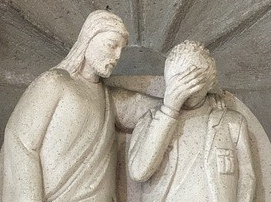 The psalmist today sings Save me O Lord in your mercy (Psalm 109:26). The readings are God’s answer to that prayer. In his infinite love and mercy he assures us that no matter how hypocritical we are, how much a Pharisee, or how much we deserve it, we are never alone. God is always true to his word and today his word is that there is nothing – neither death, nor life, nor angels, nor principalities, nor present things, nor future things, nor powers, nor height, nor depth, nor any other creature – that can separate us from the love of Jesus Christ our Lord (Romans 8:38-39).
 That is the image I think of now when I think of saints. Not images set in glass that glow with the sunlight, but people who now and forever glow with the radiance of the one true Light – Christ, the Morning Star who never sets.
 To win this combat and know the peace of Christ we need the armor of the virtues; prudence, to discern where our good lies; temperance, to know when we should move on; justice, to understand that the love we give our neighbor and God is the love we owe them; and fortitude, to constantly yield our will to that of Christ, for only his is the love that casts out all fear, not only restoring us to right relationship with the Father, but reconciling us with each other.
 In Luke’s gospel, Jesus said
  There is much more we could say on this, the day we remember him, but it would only belabor the point, which is that none of his work would have been possible unless this man had given himself completely over to the will of the Father, in devotion to our Lord Jesus Christ, through the power and inspiration of the Holy Spirit. But he did, and this masterpiece was the result.
 Mark 10:45