Tag: Gospel

  • To See and Understand

    To See and Understand

    Saturday of the 6th Week in Ordinary Time

    Mark 9:2-13

    As we read the gospel of Mark, we might catch ourselves wondering about the Apostles. They never seem to get it! No matter what they see Jesus do – healing after healing, miracle after miracle – they end up asking the same question: ā€œWho is this?ā€

    Although Mark probably intended us to wonder, and for good reason, we shouldn’t take it too far. We have the benefit of hindsight, not to mention an evangelist who tells us everything we need to know in his first line: the gospel of Jesus Christ, the Son of God (Mark 1:1). The Apostles had to figure it out as it was happening. They did have some success; Mark tells us that Peter recognized Jesus as the Messiah (8:29). However, he also says that they didn’t understand the cross (8:32; 9:32; 10:35ff). That’s probably because they pictured the Messiah as the son of David, not the Son of God; a conquering king, not a suffering servant; someone who would free them from emperors and tyrants, not from sin and death.

    So, the question really isn’t why the Apostles never got it. They did, as Mark well knew, especially if his gospel came from Peter himself. The question is what moved a man like Peter to go from a terrified disciple asking if he should set up tents on a mountain to a faithful shepherd of the Church who, nearing his martyrdom, wrote with such conviction of that same unforgettable, mystical experience (2 Peter 1:16-18).

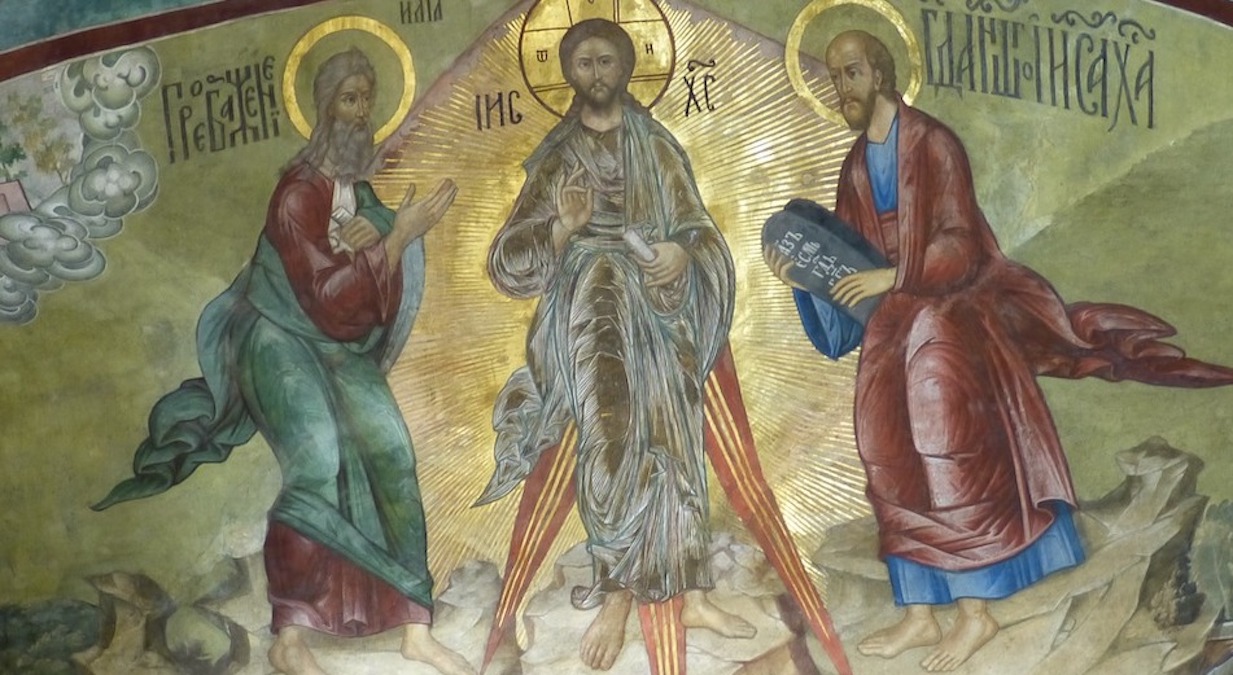
    I think the answer lies in the gifts given to him by the Holy Spirit, particularly the gift of understanding. It has been called a ā€œpenetratingā€ or ā€œpermanentā€ intuition of divine truth,1 and it certainly was for St. Peter; who could intuit any truth greater than Jesus, who is the way, the truth, and the life? Indeed, given his experience – seeing Moses, Elijah, and the glorified Christ, and hearing the voice of the Father – Peter must have devoted many hours to contemplating what the Transfiguration of our Lord meant for him and for the Church.

    So should we, for the gift of understanding is given to us, too. It works in many ways. First, it helps us find the hidden meanings of Scripture. Certainly it was used by the Apostles and Fathers of the Church as they read and discovered the many Old Testament references to Christ. The pages of our bibles have much of the fruits of their labor. I urge you to find the notes and footnotes for today’s gospel passage (two are Exodus and 1 Kings) and see how they inform and enrich your understanding of the Transfiguration. Second, the gift of understanding helps us see the relationships between symbols and what they point to. One example is the cloud that surrounded the Apostles on the mountain; that is a symbol of the Lord’s presence, just as it was in the time of Moses. Third, the gift of understanding shows us how God works in our own lives. Think of your own ā€œmountaintopā€ experiences or consolations; the times during Mass or other prayer when you felt especially close to God, or moved by his presence and power. Finally, the gift of understanding strengthens our appreciation for the Sacraments. For example, when the bread and wine are consecrated, we are led to a deeper, more profound awareness of Jesus Christ, most truly present. It is as St. Thomas Aquinas once said: ā€œWhen the eye of the spirit is purified by the gift of understanding, one can in a certain way see God.ā€

    Let us pray today and every day for an increase in the gift of understanding, that we may more and more clearly see the face of God in Scripture, the Church, the Sacraments, and perhaps most especially in our own lives.

    1 Aumann, Fr. Jordan, OP. The Gift of Understanding. Available online at http://www.domcentral.org/study/aumann/st/st10.htm#tgou.

    https://catholicstraightanswers.com/gifts-understanding-wisdom/

  • Don’t Mess with Perfection: Saturday of the 5th Week in Ordinary Time

    Don’t Mess with Perfection: Saturday of the 5th Week in Ordinary Time

    1 Kings 12:26-32; 13:33-34; Matthew 4:4; Mark 8:1-10

    In the first reading we hear of Jeroboam, the first in a series of problematic kings, and the huge changes he made in the way the people of Israel worshipped. We’ll get to the reason why but it’s important to note that this tendency to mess with perfection isn’t limited to him. We have only to go back to the time just after the Second Vatican Council to see something very similar. I’ll mention just a few things I myself witnessed.

    First, the music changed. That’s no big deal in and of itself; music always changes. But the words changed, and words matter. For example, now we sang about eating ā€œbreadā€ and drinking ā€œwineā€ at Communion. This was followed in my parish by a nun wearing an alb, assisting the priest at Mass, and preaching what sounded like homilies. Next, the words of the readings began to change. I remember going up to the ambo and seeing that, throughout the lectionary, words were crossed out and others pencilled in. Awhile later, I moved to a new parish that had been remodeled so that the Tabernacle was moved to another room, the altar was where the pews used to be, and the pews were replaced by chairs. No kneeling. Finally came the Sacraments. Baptisms were “in the name of the Creator, the Redeemer, and the Sanctifier.” At Confession, the priest said to me, ā€œJesus absolves you of your sins.ā€ The worst cut of all came on a road trip to the parish of an old personal friend, a priest. At Mass he changed the words of consecration. Even with what little education I had at the time, I knew you couldn’t just do that.

    Too often, religious changes are made for political reasons. The book of 1 Kings is clear: Jeroboam wasn’t concerned at all about the hearts of the people, only what losing them meant for him. Similarly, in the local Church, those making changes to the Mass and Sacraments saw an opportunity to express their ideologies or advance political agendas.

    Of course, that isn’t what religion is all about. As our faith teaches us, religion is an exercise of the virtue of justice; through it, we try to give God what we owe him, which is everything. If we make it about what we think is important rather than what God knows is important, then we risk reaping the rewards of Jeroboam’s pride and arrogance: Alienating God and losing the hearts of his people. That is why St. John Paul II and Benedict XVI went to such great lengths to speak about liturgical reform; they wanted us to remember that the Sacraments belong to Jesus Christ. Treating them as if they are our own personal property results only in confusion, disunity and spiritual hunger.

    This is the same kind of hunger so obviously felt by the people flocking around our Lord in the gospel reading. Mark tells us that they had chosen to be with him for three days (8:2), even at the expense of not eating. He rewards their bodily and spiritual hunger by giving them a foretaste of the Holy Mass; having already fed them with the word that comes forth from the mouth of God (Matthew 4:4), he then took the seven loaves, gave thanks, broke them, and gave them to his disciples to distribute (8:6). Mark concludes by telling us everything we need to know: They ate and were satisfied (8:8).

    The lesson is clear: Don’t mess with perfection. Every time we approach our Lord with a humble, contrite heart that asks him only to remember us, he answers by giving us perfectly, in word and Sacrament, everything we need to be with him for eternity.

    Who would want to change that?

  • Is the King Glad? Saturday of the 1st Week in Ordinary Time

    1 Samuel 9:1-4; 17-19; 10:1; Psalm 21:2; Mark 2:13-17


    Guided and inspired by the Holy Spirit, the Church takes great care to choose readings for each day that highlight certain themes, most often represented by the psalm that comes between them. Today we hear a wonderful case in point, Psalm 21. On a purely human level, this is a joyful song of praise that God has endowed authority on an earthly king. On a divine level and as a messianic psalm it speaks of Christ, who indeed is glad and rejoices in the full authority given him by the Father. With good reason we repeat the second verse: Lord, in your strength the king is glad. But that doesn’t answer how the readings highlight that theme. As we will see, they do so in very different ways.


    As the story of Saul begins, it’s hard to know what he would have been glad about. It must have come as such a surprise! One minute he’s out looking for his father’s animals; the next, he is anointed as the first king of Israel. But although we can’t tell his mindset in the beginning, as the story unfolds it becomes clear: This king isn’t glad in the Lord at all. To the contrary, he has little regard for God’s authority; he has his own ideas and doesn’t want anyone, even God, to correct him. Worse, despite Samuel’s warnings, Saul never sees the problem; he remains blind to his own arrogance and self-exaltation until everything ends for him in complete disaster.


    By contrast, the story of Matthew doesn’t end with disaster but it does begin that way. Like Saul, Matthew is a man going about his business; unlike Saul, his business was what most Jews would have called a complete disaster: the customs post. Such men were among the worst of sinners; quislings who took money from their own people, gave it to their conquerors, and even kept some for themselves. Yet this is the kind of darkness where the light of Christ most brightly shines; passing by, the Divine Physician diagnoses Matthew, and in two words prescribes the remedy: Follow me.


    As with Saul, we have no idea what went through Matthew’s mind at that moment, but as always Mark invites us to put ourselves in the scene and contemplate. What would we do? Would we have doubts, fears, or misgivings? Did Matthew? Perhaps. All we know is what Matthew actually did, and here Mark couldn’t be clearer: He got up and followed Jesus. Again, this is only the beginning; the story unfolds in the fullness of time. Mark tells us that Jesus went to his house, ate with him and his friends, and told others that he came to call sinners. Though Mark then goes silent about it, that doesn’t mean we know nothing. We know that Matthew was glad in the strength of the Lord who called him out of his sinful life and offered him another, so glad that he followed Christ to the end and to the point that a gospel account would bear his name for all time.


    Two men, two calls, two responses, two completely different endings, yet the same theme: Lord, in your strength the king is glad. How does this apply to us? In two ways:


    First, we must understand that we, the baptized, are kings. At our baptism we were anointed kings and called as Christ was called – not to be served but to serve (Mark 10:45). And if we are kings, then we are glad in the strength of the Lord from the moment we decide to be a king less like Saul and more like Matthew; when we see every day as a call to live not on our own strength but on God’s, for it is he and he alone who points the way, who leads the way, who makes a way, and who is the way.


    Second, we must remember that good intentions aren’t enough; actions are required. How we act will depend on the gifts God has given us and the circumstances we find ourselves in. Whatever they are, the time is now and we will not be – we cannot be – glad in the Lord’s strength until we take what the Father has given us and, through the power and gifts of the Holy Spirit, put it at the service of the kingdom he gave us through his Son.

  • Of Prophets and Prophecy: The 6th Day of Christmas

    Of Prophets and Prophecy: The 6th Day of Christmas

    1 John 2:12-17; Luke 2:36-40

    When we hear the word ā€œprophet,ā€ we may think of men like Isaiah, Jeremiah, or Ezekiel, and ā€œprophecyā€ as the word of God given to them concerning things that would happen in times to come. If so, Anna in today’s gospel is a good reminder that we have more thinking to do.

    First, she reminds us that prophets aren’t always men. Indeed, Anna is the first woman referred to in the New Testament as a prophet, but other women follow, namely Philip’s daughters (Acts 21:9) and the women of Acts 2:17-18 and 1 Corinthians 11:4-5. What’s more, she follows in the line of Old Testament prophetesses: Miriam, the sister of Moses and Aaron, Deborah, Huldah, and the mysterious woman in Isaiah (8:3), to name a few.

    These prophetesses, Anna included, also remind us that prophecy isn’t limited to oracles of future events. Miriam is noted for leading a beautiful song of thanksgiving for God’s deliverance of his people (Exodus 15:20), Deborah as one of the great Judges of Israel (Judges 4:4), and Huldah as the wise counselor who king Josiah relied on (2 Kings 22:14-20). Similarly, Anna speaks not of the future but of the here and now, giving thanks and proclaiming God’s long-awaited redemption.

    The Jewish scholar Abraham Heschel once said that the greatness of a prophet ā€œlies not only in the ideas he expressed, but also in the moments he experienced. The prophet is a witness, and his words a testimony – to God’s power, to His justice and mercy.ā€1 What more sublime moment could any prophet experience than Anna’s encounter with the infant Christ? She, in whom the word of God remained (1 John 2:14) now gazed upon that Living Word; she who had long ago forsaken the world for love of the Father (1 John 2:15) now looked on Him who would offer the world His infinite love and mercy; and she who night and day devoted herself to the will of God (1 John 2:17) now adored Him who would see that same will done, to the Cross and far beyond.

    We don’t have Anna’s words; Luke says only that she gave thanks to God and spoke about the child to all who were awaiting the redemption of Jerusalem (2:38). But this is all we need to know, for as Heschel also said, ā€œIn speaking, the prophet reveals God. This is the marvel of the prophet’s work; in his words, the invisible God becomes audible. He does not prove or argue. The thought he has to convey is more than language can contain. Divine power bursts in the words.ā€2 Whatever Anna said on that glorious day in the Temple or any day thereafter, divine power burst from her words; nothing she said could contain the God-Man revealed to her. Still, her job was not to prove or argue; it was to reveal God to those who had not seen; to make Him audible and by so doing reach their hearts with His, in hopes of making them burn as hers surely must have.

    This is our task as well. By our baptism we too are anointed priest, prophet, and king and by His gift of the Holy Eucharist we have him here with us as surely as Anna did in the Temple. So, let us do as she did: Old or young, widowed or not, at every Mass let us come forward, receive him, give thanks to him, and then speak about him to all. Even after two thousand years, we have no better words than Anna did; nevertheless, we have all we need. We too have the testimony of our lives. We must make them speak.

    St. Anna the Prophetess, pray for us.

    1Abraham J. Heschel. The Prophets. New York: HarperCollins Publishers, p 27.

    2Ibid.

  • Minute Meditation: Thank God

    1 Thessalonians 1:1-5, 8b-10

    In the first reading today, St. Paul says,

    We give thanks to God always for all of you,
    remembering you in our prayers,
    unceasingly calling to mind your work of faith and labor of love
    and endurance in hope of our Lord Jesus Christ,
    before our God and Father,
    knowing, brothers and sisters loved by God, how you were chosen.
    For our Gospel did not come to you in word alone,
    but also in power and in the Holy Spirit and with much conviction.

    I don’t. Thank God, I mean. At least, not enough.

    I know the ACTS of prayer – Adoration, Contrition, Thanksgiving, and Supplication – but tend to get stuck on the letter “S,” asking God for things. Of course I need to ask, but if that’s all I do then I risk treating God as little more than a divine vending machine. I also want to show God that I adore him, am sincerely sorry for my sins, and am grateful for all he has given.

    Which is where you come in. For as St. Paul reminded me this morning, God has given me you: People practicing the faith in your daily life, working to love all you meet, and enduring in great hope of the promises of Jesus Christ. I do thank God for you.

    But I can’t properly do that unless I also thank God for how you were chosen. Being self-centered and self-conscious, I get in the habit of behaving as if it all depends on me, that I must be eloquent enough, loving enough, patient enough. Those things are important but your faith doesn’t depend on them. No; as St. Paul reminded us, the Gospel comes to us not in word alone, but also in power and in the Holy Spirit and with much conviction. There is a power to the process far beyond any of us, working in ways we cannot understand, reaching us in depths no human being can go, touching and moving us in ways that nothing and no one else can.

    If that’s not worthy of thanksgiving, then what is?

  • The Paradox of Love: Friday of the 19th Week in Ordinary Time

    Joshua 24:1-13; Psalm 136:1; Matthew 19:3-12

    Today’s readings remind me of that famous scene in the musical Fiddler on the Roof when Tevye asks Golde, his wife of 25 years, do you love me? She replies, ā€œDo I love you? For 25 years I’ve washed your clothes, cooked your meals, cleaned your house, given you children, milked the cow, after 25 years, why talk about love right now?ā€ He repeats, do you love me? ā€œI’m your wife.ā€ I know… But do you love me? She thinks out loud, ā€œDo I love him? For 25 years I’ve lived with him, fought him, starved with him, 25 years my bed is his, if that’s not love, what is?ā€ Then you love me? Finally, she replies, ā€œI suppose I do…ā€

    Why does this scene remind me of the readings? Because today Scripture focuses on what love is in its essence, and that scene highlights three key aspects of it.

    First, love is a verb. We love not in what we say but in what we do. Through Joshua, God speaks to people who, from the time of Abraham, through the oppression in Egypt, the fleeing, struggling, and starving in the desert, might well have asked, ā€œGod, do you love us?ā€ Today we hear God reply: ā€œDo I love you? Remember all the things I’ve done for you, and look what lies before you: You’ve made it to the Promised Land!ā€

    That reply echoes through the ages to today, to every one of us. We each have our own struggles, physical and spiritual. Through all of them, God isn’t sitting silently in the background; he is in every moment, working in ways beyond our understanding. His work may be unknown to us this moment, this month, or this year, but like the Promised Land, its fruit lies waiting. We must never mistake silence for inaction or indifference; God is eternally vigilant, eternally loving, always acting for our good.

    This brings up the second point: Love is timeless. How fitting that we hear Psalm 136 today, especially the antiphon, His mercy endures forever. The Hebrew word translated as ā€œmercyā€ is hesed, which includes mercy but implies action, things we do when we are motivated by love and loyalty to someone else. In the scene from Fiddler on the Roof, remember that Golde replied, ā€œAfter 25 years, why talk about love right now?ā€ To her, the amount of time was not the point; she had committed her life to her marriage.

    Jesus speaks of this kind of commitment in the gospel when he quotes the passage from Genesis that a man is joined to his wife, and the two shall become one flesh (Genesis 2:24). Again to go back to the ancient language, the word for ā€œjoinedā€ literally means, ā€œglued.ā€ Imagine gluing two pieces of paper, allowing them to dry, then trying to tear them apart. We know what will happen; the kind of pain and suffering that only such tearing can bring.

    This leads us to a third aspect of love, which in the words of venerable Fulton Sheen is that love is the soul of sacrifice. Recall how Golde replied when Tevye asked if she loved him: all the sacrifices she had made, the things she had endured, for him. But not just for him, for herself as well. Only those willing to make the greatest sacrifice for love’s sake can know the deepest joys that love brings. When it comes to love, joy and sacrifice can never be separated; in married life, in ministry, in whatever kind of service we are called, only those who are most fully open, who risk the greatest vulnerability, can know the deepest, most fulfilling joy: to know and to be known, to accept and be accepted; to love and to be loved.

    As in all things, the best model for all these aspects of love is our Lord, Jesus Christ. Who performed greater works of love than he? Whose love is more timeless? Who is the soul of sacrifice more than he who was willing to empty himself into his own creation to show us that those who risk the ultimate sacrifice of themselves are given the ultimate joy of resurrection to eternal life? Only Christ could most perfectly show us all this, the great paradox of love: that giving is receiving; that most fully knowing means to be most fully known; and that only by dying to ourselves can we reach the promised land of eternal life.

  • All Things to One Man: The Solemnity of the Sacred Heart of Jesus

    All Things to One Man: The Solemnity of the Sacred Heart of Jesus

    Hosea 11:1, 3-4, 8c-9; Ephesians 3:8-12, 14-19; John 19:31-37

    In high school we once did an exercise on self-perception. Sister began by asking us to take out a sheet of paper and write down 3 negative things about ourselves. After a couple of minutes she said, ā€œAlright, now write down 3 positive things about yourself.ā€ I can’t remember what I wrote but I know I didn’t list three; I’m not sure I even wrote two. That was Sister’s point; self-conscious teen-agers aside, people in general tend to be very good when it comes to focusing on their negative qualities but not so good when it comes to the positive.

    The same goes for our relationship with God. If you’re anything like me, it’s probably much easier to come up with reasons why He shouldn’t think very highly of you than reasons why He should. Today, on the Solemnity of the Most Sacred Heart of Jesus, our Lord gives us at least three reasons to focus on the positive.

    First, listen again to his words in the 11th chapter of Hosea: When Israel was a child I loved him… I taught Ephraim to walk… took them in my arms… fostered them like one who raises an infant to his cheeks… stooped to feed my child… I will not let the flames consume you (Hosea 11:1, 3-4, 8-9). This isn’t the imagery of a God who loves from a distance, impersonally, or until we leave or hurt him; no, this is a God who loves intimately, with a deeply personal, boundless, and most of all, healing and merciful love.

    Second, as St. Paul makes clear, this is a love that goes beyond all words except the one, Eternal Word – Jesus. We can hear Paul struggling to express the inexpressible as he prays that we may have the strength to comprehend with all the holy ones what is the breadth and length and height and depth, and to know the love of Christ which surpasses knowledge (Ephesians 3:18-19). This is the key; divine love surpasses human knowledge and can be known only by faith (Ephesians 3:17), the gift of the Father possible only by the strength that comes from the Holy Spirit (CCC §683). To those who have faith, all the riches of grace are available.

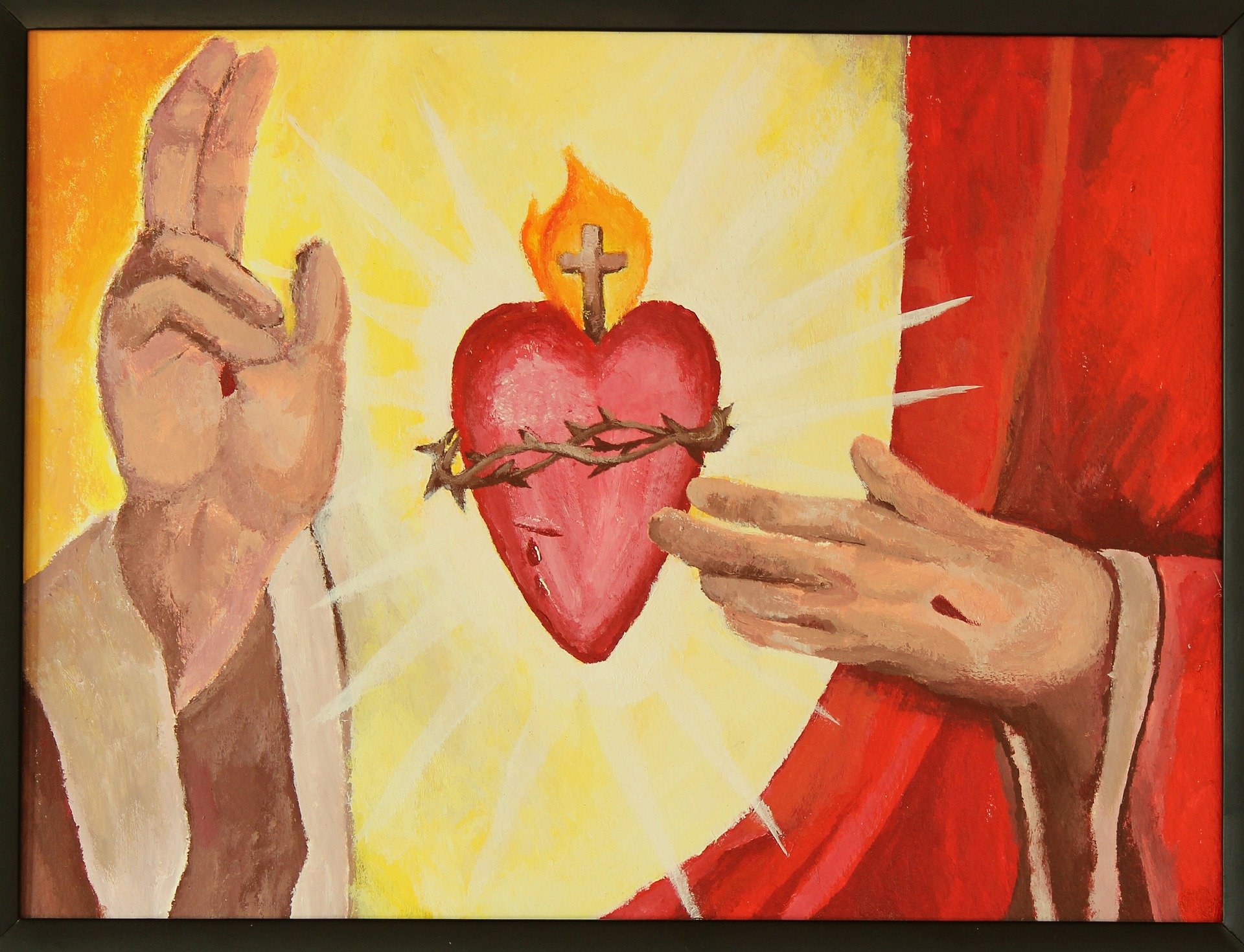
    Finally, every image of the Sacred Heart reminds us with its crown of thorns of the cost of this love. We hear in the gospel of the soldier who thrust his lance into his side, and immediately blood and water flowed out (John 19:34). There is no love worthy of the name that is not asked to endure insult, temptation, and suffering. From the dawn of humankind it is written into our nature; it’s in our blood. But it isn’t in the blood of Christ, either from his Heavenly Father or his holy Mother, the Immaculate Conception. He willingly took it on. This is perhaps the greatest and most positive of all – that God, purely out of his infinite and merciful love for us, gave his only Son that we would be raised to life eternal. As Christ himself said, there is no greater love than this.

    St. Pio of Pietrelcina, Padre Pio, understood that very well. While passing through a crowd of people all clamoring to get near him, someone shouted, ā€œPadre, you are all things to all men!ā€ He replied, ā€œNo, I am all things to one Man.ā€

    May we all come to that kind of understanding! May we all see the Solemnity of the Sacred Heart of Jesus as a day to set aside the negatives and focus on the overwhelming positive – that we too are all things to one Man. We are loved infinitely, personally, and mercifully; we are given the gift of faith which alone can make this love known to us beyond any human understanding; and finally, that as the ultimate expression of this love the Second Person of the Blessed Trinity took human form and allowed his own heart to be pierced that we may not only look upon him in mourning for the sinfulness that put him there but with rejoicing that divine love can take even the passion and death of Christ, the greatest insult of all time, and transform it into the greatest victory the world will ever know – the resurrection to eternal life for all who believe and return to God with their whole heart (Joel 2:12).

    Sacred Heart of Jesus, have mercy on us.

  • Ready or Not: Sunday of the 32nd Week in Ordinary Time

    Ready or Not: Sunday of the 32nd Week in Ordinary Time

    Wisdom 6:12-16; Thessalonians 4:13-18; Matthew 25:1-13

    My father died when he was 55 years old. He went out golfing with one of my brothers and had a massive coronary on the golf course. According to the coroner, Dad died from a total blockage of the left anterior descending artery of his heart – known as the ā€œwidowmaker.ā€ He died in less than a minute.

    Awhile after his funeral, my Mom told me something I hadn’t known. Over the last year or so Dad had been going to Confession every two weeks like clockwork. That wasn’t typical of my Dad; he was a practicing Catholic and no stranger to Confession, but when I was a kid he didn’t go every two weeks. Now he was. It got me to wondering whether he had a sense that he going to die soon.

    It also got me wondering about my own life. For example, if I knew that today was my last day on Earth, what would I change? What would I do? I think, like the foolish virgins, I would be calling out, ā€œLord, Lord!ā€

    But even more to the point, I wondered what Christ would say in reply. Today and the next two Sundays are the time the Church gives us to contemplate that question and we must ask it now because Jesus makes it clear that there comes a time when it’s too late.

    As we saw in the parable, that is the fate of the foolish. Desperate, they seek help from those around them: Give us some of your oil (Matthew 25:8). It seems like a reasonable request. Why can’t the others share? Isn’t their refusal cruel or selfish? No; not when we understand what the oil represents. The oil in the parable is everything we have done to build up the Kingdom of Heaven. So even if they wanted to, the wise couldn’t give away their good works to someone else; each person has to go out and earn their own.

    That’s why it’s so important to seek wisdom like the first reading recommends, for when we seek wisdom it will be given to us. In fact, the reading says, she will make herself known in anticipation of our desire; will wait for us, will seek us, will graciously appear to us. It sounds simple. So then, why isn’t everyone wise? Because wisdom tends to come slowly, through trial and error; those who are wise most often got that way by learning from their mistakes, suffering some loss, making some real sacrifices.

    It’s human nature to avoid that but ask yourself, when I’ve wanted something in life, really wanted it, haven’t I been willing to sacrifice time, money, comfort, or whatever I needed to, to get it? As Venerable Fulton Sheen once said, love is the soul of sacrifice. In the parable our Lord isn’t really talking about young women and a wedding; he’s talking about loving him and being his disciple. Well, what are we willing to sacrifice to get that oil of service in our lamps? Are we willing to give up even the sins that are dearest to us?

    As we know, this takes work. It’s far easier to put it off, to let ourselves drift into that deadly sin of sloth, the spiritual laziness that rationalizes sin away. The problem is that sins don’t just go away; they build silently within us like a blockage to our heart that, if we let it go long enough, becomes our own spiritual widowmaker. By then, it’s too late.

    But again there is the lesson of my father. He didn’t make any drastic, sudden changes in his life; he simply started spending a little more time every month examining his conscience and cleansing himself of sin. One small step, but regularly made. Like the first reading said, taking thought of wisdom is the perfection of prudence, and whoever for her sake keeps vigil shall quickly be free from care (Wisdom 6:15).

    It’s not that we have to be that vigilant in this pursuit. Notice that both the foolish and the wise virgins fell asleep waiting for the bridegroom. In the second reading, St. Paul was dealing with people in Thessalonika whose loved ones had died while waiting for Christ’s return. But our Lord did not emphasize vigilance as much as he emphasized being prepared. When our flask is full of the oil of doing justly, loving mercy, and walking humbly with our God, it won’t matter if we have fallen asleep while waiting for Him to return. All that will matter is that we are ready.

    So then, take the time given to you and ask yourself before it’s too late: ā€œAm I ready?ā€

  • The Slave of the Slaves: Memorial of St. Peter Claver

    Although I am free in regard to all, I have made myself a slave to all so as to win over as many as possible.

    1 Corinthians 9:19

    Imagine being dragged aboard a ship, naked and chained in the darkness below deck, lying helpless for several weeks, through rough seas and stifling heat. There are over 500 of you; males here, females there. You are fed just enough to keep you alive. Starvation, disease, and death are rampant. No one knows where you’re going or what awaits you when the hatch finally opens. Over the centuries of the slave trade, millions of people saw that hatch open only to a lifetime of slavery in a strange New World.

    Yet, like a drop of mercy from heaven, hundreds of thousands of these same people saw that hatch open to reveal the caring, concerned face of a gentle Spanish Jesuit. He would come below and find the newborns who were still alive, pour water over them, make the sign of the Cross and pray. He then ministered to the dying, and the dead he had respectfully removed. To the sick he brought medicine and bandaged their wounds. Those too sick to leave the ship on their own he helped carry above. When he got to you, he would clean you, give you food, clothing, and fresh water. He would speak warmly and gently through an interpreter, although no translation was needed for his touch. This was a man fluent in the language of love and by the time he had finished, he had restored a measure of the dignity so shamefully taken away. Every moment, this man acted as if he was your slave and happy to be nothing more.

    That’s because he was.

    The man was Peter Claver, a 17th century priest and Jesuit who devoted his life to ministering however he could to every slave shackled in the darkness aboard the hundreds of ships landing in the port city of Cartagena. Fr. Claver took to heart the words of St. Paul, who said, Although I am free in regard to all, I have made myself a slave to all so as to win over as many as possible (1 Corinthians 9:19).

    Father’s devotion to the service of slaves sprang from his desire to imitate the service of his model, the Blessed Mother, to whom he was devoted. As a young novice he was so moved by a pilgrimage to one her shrines that he wrote, ā€œI must dedicate myself to the service of God until death, on the understanding that I am like a slave, wholly occupied in the service of his master.ā€ He traveled to the New World after hearing that millions of enslaved people died there knowing nothing of Christ. After his first few years serving them, Father signed the document of his final profession to the Society of Jesus with the words, ā€œPeter Claver, slave of the slaves, forever.ā€

    Before the slaves were sent on, Father took whatever time was given him to teach them about Christ. He used pictures, rosaries, crucifixes, anything he could find. He concluded every session by teaching them to say, ā€œLord Jesus Christ, Son of God, You are my Father. I am sorry for having offended You. I love You very much. I love You very much.ā€ It is said that he personally baptized over 300,000 slaves.

    Fr. Claver continued his ministry for 40 years. Finally, sick, frail and exhausted, he knelt and kissed the feet of his young Jesuit successor and on the day he predicted – the Feast of the Nativity of the Blessed Virgin Mary, September 8th, 1654 – he died at the age of 73.

    portsoy-1244572_640Although the slave trade of that era is thankfully no more, slavery still abounds. Who are the people in our own lives, chained in the darkness of sin, feeling helpless, uncertain and fearful of their destiny? Who are those with wounded or even dying spirits, on the brink of losing hope? Who are those starving for affection, for shelter, for safety, for dignity? Will you be the one to open the hatch to descend into their suffering and restore what dignity you can?

    Let us pray that we, like St. Peter Claver, may be the slave of the slaves, forever.

    St. Peter Claver, pray for us.

  • The Leader as Servant: Feast of Pope St. Gregory the Great

    The Leader as Servant: Feast of Pope St. Gregory the Great

    2 Corinthians 4:1-2, 5-7; Luke 22:24-30

    In the gospel we hear Jesus say to the Apostles, let the greatest among you be as the youngest, and the leader as the servant. Few people epitomize those words better than the successor of the Apostles we remember today, Pope St. Gregory I.

    Born around the year 540 into a wealthy, aristocratic Roman family, Gregory received the best education of the day, designed to form him as an effective political and social leader. He was also deeply grounded in the faith; indeed, his family tree boasted two popes, several consecrated religious, and at least one saint: his mother, Sylvia. If not born great, Gregory was certainly bred for greatness.

    Greatness was certainly needed, for Rome was in dire straits. No longer the capital of the empire, it was barely guarded; vandals regularly overran it. Plague, war, and famine decimated the population from a high of one million to about fifty thousand. Although Gregory wanted nothing more than to pursue his dream of life as a Benedictine monk, his sense of public service prevailed; at the age of 30 he became mayor and served for two years. When his father died Gregory resigned, turned the family palace into a monastery, and became a monk. He called these the happiest years of his life.

    They didn’t last long. Knowing of Gregory’s talent, Pope Pelagius summoned him, ordained him a deacon, briefly put him in charge of social assistance to Rome and then sent him to Constantinople, where for 6 years he served as ambassador, learning the workings of the imperial court. When he returned to Rome he was delighted to learn that he had been made abbot; however, that too didn’t last long; when Pope Pelagius died, Gregory was unanimously elected pope. He appealed to the emperor to reject the election but he refused. Against his will, Gregory served as pope for 14 years.

    It is difficult to summarize briefly everything Gregory did to merit the title ā€œGreat,ā€ but let me focus on two particular areas.

    First was his great love of the missions. Gregory was the first pope to send missionaries to a distant land, dispatching 40 monks to England led by the man who would become St. Augustine of Canterbury. No less important was his acumen and sense of balance; Gregory advised Augustine to bring Christ in His fullness to the Anglo-Saxons but at the same time to adapt the faith where he could to the customs and ways of the people. This bore great fruit; the subsequent centuries saw England and Ireland send out missionaries of their own whose evangelization forever changed the face of Europe. But Gregory’s care and concern for the missions didn’t stop there. Hundreds of his letters still remain, and reveal the pope’s involvement in and knowledge of the missions in places as far away as Africa, Spain and Greece.

    Second, Gregory was a great shepherd to his local flock. For bishops he wrote a book called Pastoral Care, really a treatise on preaching that became popular for centuries, as well as a book on St. Benedict. His own homilies are read to this day; in fact, it is for them that he was made Doctor of the Church. He also transformed Rome into a real diocese, organized under a bishop and seven regional deacons assisted by seven sub-deacons. Using this structure, Gregory systematized outreach to the poor, orphans, and widows. Charity burned so greatly within this man that for years he fed Rome’s poor with money out of his own pocket.

    That’s not to say that the pope never used Church money. To the contrary, he used it whenever he could but did so to protect Rome from invaders. He was a good diplomat and a brilliant negotiator, doing whatever he could to keep the people safe, whether that meant paying imperial troops or bribing vandals to keep away. He was so effective that eventually the city put him in complete charge of the military.

    We could say much more but let us close with St. Paul’s words: God who said, ā€˜Let light shine out of darkness,’ has shone in our hearts to bring to light the knowledge of the glory of God on the face of Jesus Christ (2 Corinthians 4:6). Pope St. Gregory was the lamp God set on Vatican Hill to shine in a very dark time and that light still shines today. In summary and in essence, Gregory’s greatness is the man himself. From him we learn these life lessons: First, we must be aware not only of our power and ability but also our weakness and fragility; this teaches us humility. Second, no matter how much we know or plan, not all decisions or circumstances will work out in our favor; this teaches us patience, perseverance, and fortitude. Finally, although we may want a certain life for ourselves, the love of Christ impels us to put that aside for the greater good of service to God and the world in which we find ourselves. From this we learn the greatest gift of all: Charity. In the end Gregory teaches us that those who are most truly leader most truly serve.

    Pope St. Gregory the Great, pray for us.