Tag: Gospel

  • The Things We Bring to Heaven: Friday of the 18th Week of Ordinary Time

    For whoever wishes to save his life will lose it,
    but whoever loses his life for my sake will find it.

    Matthew 16:25

    This saying of Jesus appears to be a paradox. How can we lose our life by saving it or save our life by losing it? Like any paradox, if we take the words at face value we can’t. However, if we look below the surface we find a nuance hidden, lost in translation, from which a deeper meaning emerges.

    As far as we know, the original language of the New Testament is Greek and in Greek, the verb used by Matthew for “save” really means “to keep safe.” Thus, Jesus is counseling us not to keep safe; that is, to risk being hurt, for only when we do that can we enjoy eternal life with God in heaven.

    Although that might help us understand the paradox, it doesn’t make things any easier. It seems as if Jesus is teaching that the way to avoid suffering in the afterlife is to endure suffering in this life. That seems cruel! Does Jesus really want us to suffer?

    Perhaps it’s best to answer that question by remembering that God is Love, that we are made in the image of God, and that no one modeled that image better than Jesus, his only Son. By his Incarnation Jesus taught that true love seeks neither isolation nor safety but entanglement and risk. God could have chosen to save fallen humanity from the safety of pure divinity. He didn’t; he chose to dwell among us, to take on the nature he created and raise it from within; to bind himself to the human condition beyond any untying and restore it to its original capacity for the deepest love possible: Eternal union with him.

    jesus-1844445_640Jesus spent his life and ministry showing us what it means to love as God loves: He made himself vulnerable in the sight of others, exposed his deepest longings, deepest fears, deepest joys, his deepest self. Of course, he risked rejection and it cost him his life, but that is what love does; it was in the nature of his perfect divinity that from the depths of his infinite love and mercy, he glorified what mankind so quickly crucified.

    This tells us that Jesus doesn’t want us to suffer, he wants us to love; by its very nature, love risks suffering and will endure it for the sake of the beloved. Of course we are free to refuse, but refusing to love means that we give nothing, share nothing, resist the promptings of the Holy Spirit, and remain isolated even from God himself. Some may call that safety but Christ calls it loss, for he knows that the only thing we bring to heaven is the love that we have given away.

  • A Tale of Two Mountains: The Transfiguration

    Daniel 7:9-10, 13-14; 2 Peter 1:16-19; Luke 9:28b-36

    The evangelists Matthew, Mark, and Luke all write of the Transfiguration of our Lord. While they share many aspects of the event, the version from Luke we heard today is distinct in some important ways. Let us begin by briefly considering what they have in common and then see how Luke’s unique perspective deepens that.

    All three men place the Transfiguration just after Peter’s confession of Jesus as the Messiah and the announcement by our Lord of his upcoming passion. Recognizing this, the Church set the feast of the Transfiguration on August 6, exactly 40 days before the feast of the Exaltation of the Holy Cross. Thus, the Transfiguration must be understood in light of the paschal mystery and the recognition that Jesus is the Christ.

    With this in mind, let us consider the events of the Transfiguration the authors have in common. First, Jesus, along with Peter, James, and John ascend the mountain. Next, Jesus appears in brilliant light, accompanied by Moses and Elijah. Peter begins to speak but the Father’s voice is heard from the cloud, “This is my beloved (chosen) Son. Listen to him.” Finally, Jesus is alone with the apostles again.

    These basic facts reveal several things. First, the Transfiguration is the Father’s own confirmation of Peter’s confession that Jesus is the Christ, the Son of Man as foretold in Daniel. Note that the voice from the cloud does not speak to Jesus but to the apostles. Second, it is at the same time a visible sign of future glory and a foretaste of the beatific vision. Moses and Elijah, alive in the spirit, stand in the presence of Christ, who shines with the bright light of God. Third, it is a consolation to the apostles, who have witnessed hostility, rejection, plots against Jesus, along with no little misunderstanding and confusion on their own part. Finally, it is a sign that the law and the prophets find their ultimate meaning in Christ and therefore in love – both love of God, since Christ went to his death in obedience to the Father’s will, and love of neighbor, since his life was poured out for the many.

    jesus-3149505_640What is unique to Luke in the Transfiguration is the dimension of prayer. Only he tells us that Jesus ascended the mountain to pray. Luke properly understands it as a tale of two mountains: On the one, the unnamed mount of Transfiguration, the prayer of Jesus results in a glorious vision, he dazzling white, his face shining, his Father speaking to the apostles awakened. On the other, the mount of Gethsemane, the prayer of Jesus will end in the passion, his face sweating blood, his Father silent, and these same apostles sleeping. Luke is clear: We cannot have the glory of the Transfiguration without the suffering of the cross. In Christ, the two are inextricably bound. What’s more, this is the cost of discipleship; later in Luke Jesus will say, Whoever does not carry his own cross and come after me cannot be my disciple (Luke 14:27)

    Beyond this, the context of prayer adds depth to the experience of the apostles on the mountain and informs our own. Earlier, I mentioned that the vision given to the apostles was a consolation. We too can receive consolations in prayer. Perhaps you recall a time that you have attended Mass, knelt in Adoration, or sat in quiet contemplation and suddenly had a strong if not overwhelming sense of God’s presence. No wonder Peter asked about setting up tents! Our second reading showed how deeply the vision was ingrained in him; we can feel the imagery and power of it in his words years later.

    Of course no mountaintop experience lasts forever; sooner or later we have to come down. And we will have our share of desolations as well; times we pray as Jesus did: My God, my God, why have you forsaken me (Matthew 27:46)? But always, no matter how dark the valley, we also have those most consoling words of Luke after the vision was over: Jesus was found alone (Luke 9:36).

    Who could ask for more than the Light of the World?

  • We Have Met the Enemy: Monday of the 18th Week in Ordinary Time

    Numbers 11:4b-15; Matthew 14:13-21

    On September 10, 1813, after defeating the British on Lake Erie during the War of 1812, Commodore Oliver Perry famously said, “We have met the enemy and they are ours.” A century and a half later, the cartoonist Walt Kelly made a different point when he changed this to “We have met the enemy, and he is us.”

    We in the Church tend to be our own worst enemy. In fact, we have centuries of experience at it. Take for example the scene we just read from the book of Numbers. First the people reminisce about the “good old days” in Egypt when they had plenty to eat, somehow forgetting the fact that starving people make poor slaves. These same people then complain about being famished and at the same time complain about the manna they are freely being fed by the hand of God. The irony isn’t lost on Moses, who is so angered by the whining that he actually prays to die rather than lead these ingrates another step of the way. If that isn’t a house divided then nothing is.

    We see a second, more subtle example in the gospel reading from St. Matthew. Jesus hears of the death of John the Baptist and seeks time away from the crowds, perhaps to mourn the loss. Is he allowed to? Absolutely not; the people follow right behind wanting more healing, more miracles which, in his infinite mercy, Jesus does. However, the disciples don’t appear angry but do seem to have had enough; they try to talk Jesus into sending the crowd away. After all, the people got what they wanted; now it’s late and they need to go. Again, a house divided.

    It would be easy to dismiss this divisiveness as examples of what people only do under pressure, but that isn’t true. Time and again, history shows that when the world isn’t attacking the Church, the Church is attacking herself. We see it in every parish; we see it in ourselves. Perhaps these lines sound familiar: “What a boring homily”; “That musician is terrible”; “If I ever work on this committee with so-and-so again, I swear I’ll quit”; or “If they don’t like the way we do things around here, then maybe they should go somewhere else!”

    That isn’t the way of Christ and it isn’t the way of his Church. Our business isn’t to get people out, it’s to bring them in; not to tear them down, but to build them up; and not to get fed up with them, but to get them fed.

    The root of the problem is our passion and our pride. It was in his frustration that Moses cried, “I cannot carry all these people by myself, for they are too heavy for me.” God never demanded this. It was the enemy within telling him that he alone must carry the people; telling the crowd that they were starving in spite of the manna; telling the disciples that no one could feed a crowd so big.

    eucharist-1591663_640Jesus could; Jesus did. He “took” the loaves and fish, “looked” to heaven, “said” the blessing, “broke” the loaves, and “gave” them to the disciples. If that sounds a lot like the actions of Jesus instituting the Eucharist, that’s because it is. In feeding the multitudes, Jesus showed that only God could carry the world; only God could unite a house divided. The Eucharist foreshadowed by Christ in the gospel is the sacrament of unity; it is the antidote to the enemy within that seeks to divide.
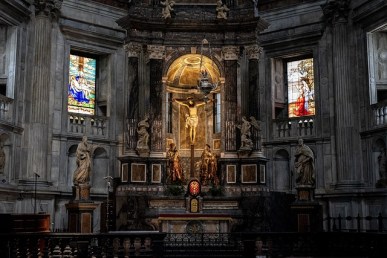
    We have met the enemy, and it is us; let us go up and meet the victor, for it is Christ.

  • Familiarity Breeds Love: Friday of the 17th Week of Ordinary Time

    Matthew 13:54-58

    As part of a pilgrimage to Italy, we were privileged to visit all of the major cathedrals in Rome. It was very easy to be bowled over by their beauty. They were truly a feast for the eyes; majestic and overwhelming. I remember visiting St. Mary Major while daily Mass was going on. As all the tourists walked around admiring the magnificence, the local people went to Mass and, when it was over, simply got up and left. To me, this was a wonder to explore; to them, it was just “their church.”

    It reminded me of the old saying that “familiarity breeds contempt.” Not that the people were in any way contemptuous of their church; they weren’t. I just mean that to them St. Mary’s was “home,” a familiar place, one many of them had known all their lives.

    However, there does seem to be some contempt for Jesus in the questions and attitude of the people in his home town. They had known Jesus most of his life and seem somewhat bemused as they ask one of the most crucial and ironic questions in the gospel: Is he not the carpenter’s son? (Matthew 13:55). From our perspective we might wonder at their wonderment; this is the Son of God, announced by the angel to the Blessed Virgin Mary. But those asking the question weren’t reading the gospel; to them, this was Jesus, who grew up among them. They knew his mother, they knew his family, they knew him.

    Or did they?

    It’s human nature to want to know things, and to think that we do. We’re used to learning; we’ve done it from birth. But our intellect is limited; no matter how much we know about anything, certain aspects remain hidden from us. We see this in our own relationships. If you’re married, think of your spouse; if not, perhaps brothers, sisters, or other family. Think even of places, like this church. We know them, right?

    Yes and no. Although we do know a lot, there are limits, things we can never know. Take even the most familiar person. No matter how well we know them, they will ultimately remain a mystery simply because we cannot know their inmost being – their soul. At church we can see the pews, the walls, the statues, the tabernacle, the hosts inside it, but the supernatural realities also remain a mystery: the substance of the bread and wine, the outpouring of the Holy Spirit, the Real Presence of Christ. Hidden from our senses, these are revealed only to the eyes of faith.

    church-4365346_640The complication is that our senses can actually keep us from seeing the spiritual reality. We become so preoccupied with what they’re telling us that we miss what lies beyond them. When I walked through St. Mary Major I saw every artistic and architectural wonder she could reveal but missed the revelation that all of it pointed to, the greatest one possible – Christ in the most holy Eucharist. As for the people at Mass, they were also at risk of preoccupation, not with works of art but with their own thoughts or problems. In either case, the task before us is to concentrate on the glory being revealed to us, for it alone is the more lasting and soul-satisfying.

    The key to success is faith; the free assent of our mind and submission of our will to divine revelation. When faith guides where senses fail we find that familiarity breeds not contempt but love, that familiarity is not a barrier to a deeper experience of God but actually the road by which we enter more and more deeply into it.

  • Can We? The Feast of St. James the Apostle

    Readings: 2 Corinthians 4:7-15; Matthew 20:20-28

    As a young man I attended a classical guitar concert by an internationally recognized master. It was glorious; the music seemed to flow from him as effortlessly as breathing. Inspired, I thought, “I want to play like that,” but when I tried I realized that inspiration is one thing but performance something entirely different.

    Masters in any discipline make what they do look easy. Their work is inspiring and tempts us to believe that we can do it, too. We probably can, but to do so we first must realize that inspiration isn’t enough; commitment is what is needed.

    Perhaps this is what happened to the Apostle James who we remember today. He, his brother, and all of the Apostles watched Jesus teach, heal, and perform wondrous miracles to the adulation of the crowds. Maybe the glory of it all got to him; maybe he was fooled into thinking that such success comes easy, that whatever Jesus did he could do. This would explain why, when Jesus asked James and John if they could drink the chalice He was going to drink they replied, We can (Matthew 20:22). 

    good-friday-2264164_640Of course they could; the question was, did they know the cost? As Pope Francis once said, “I distrust a charity that costs nothing and does not hurt.” Jesus is Charity itself; God is love and there is no greater love than to die that others may live. Such a love virtually promises to hurt. Where James may have imagined sweet wine, a crown of leaves, and the cheers of a crowd, Jesus offered bitter gall, a crown of thorns, and a crowd cheering to see Him die.

    This kind of love asks much; it may ask everything. Still, remember that the Holy Father also said, “Genuine love is demanding, but its beauty lies precisely in the demands it makes.” If we cannot see beauty in the cross, thorns and rejection, consider St. Paul’s perspective in the first reading. Who was ever more afflicted than Christ? Who more persecuted or struck down? Yet He was not constrained, not abandoned, not destroyed. Nor are we; rather, we are raised to new and eternal life. This is why Paul exhorts us to carry in ourselves what James and the other Apostles carried: the body of the dying Jesus (2 Corinthians 4:10). He knew under the only inspiration that matters – the Holy Spirit – that the one who raised the Lord Jesus will raise us also… and place us with you in his presence (2 Corinthians 4:14).

    Although drinking from the chalice is not cheap, the reward is infinite. By so doing we commit ourselves to these life lessons of Christ, the Master: That true freedom is found only in obedience; that the greatest of leaders is the least of the servants; that the conqueror is the one who yields; and that the one who most truly loves life and lives it to the full is the one most willing to empty themselves even to death, that others may live.

    St. James, pray for us.

  • Love and Sacrifice: Friday of the Fifteenth Week in Ordinary Time

    Exodus 11:10-12:14; Matthew 12:1-8

    I remember pulling a priest aside after Mass one Sunday to ask him about a verse in Scripture that I didn’t understand. It appears in today’s gospel but also in various forms in both the Old and New Testaments. As spoken by Jesus, the verse is, If you knew what this meant, ‘I desire mercy, not sacrifice’ (Matthew 12:7).

    If you knew what this meant. That was exactly my question; what does it mean for God to say I desire mercy, not sacrifice? It turned out that Father didn’t know. If you don’t know either, then apparently we have lots of company, including the Pharisees – those ostensibly pious laypeople who loved to snipe at Jesus, this time for looking the other way while his disciples plucked heads of grain from a wheat field on the Sabbath.

    A better understanding requires us to go to the source, a verse that appears in the book of the prophet Hosea. In the translation approved by the American bishops the verse reads: For it is loyalty that I desire, not sacrifice, and knowledge of God rather than burnt offerings (Hosea 6:6). In place of “loyalty” other translations use “love” or “mercy.” It can be all of these because the original Hebrew word, hesed, defies easy translation. Perhaps it is best to think of hesed as the infinite love, mercy, and faithfulness of God. Thus, Jesus underscores the prophet’s teaching that God desires love, mercy, and faithfulness, not sacrifice.

    It’s easy to understand God desiring that we love as He does but doesn’t God also desire sacrifice? It would seem so. Consider the Mass. We call it the holy sacrifice of the Mass; in it we go out of our way to remember the sacrifice of Abraham our father in faith, and the bread and wine offered by the high priest Melchizedek. In confecting the Eucharist we recall the Last Supper, when Christ celebrated the Passover meal with the Twelve. The first reading outlined the ritual in some detail, especially its central event: the sacrifice of a young, unblemished lamb which was a type or foreshadowing of the great memorial sacrifice of Christ, the one true Lamb of God.

    However, we also recall at Mass not that our sacrifice be desirable but that it be acceptable. Before the consecration the priest explicitly asks us to pray “that my sacrifice and yours may be acceptable to God, the almighty Father.” Our acceptable sacrifice consists of everything we have laid upon the altar at the Offertory in union with the bread and wine – our entire selves if we so will it – freely offered out of love to the Father, with Christ and through the working of the Holy Spirit.

    Our self-offering is not only acceptable to God but also precious to him. As parents we accept every gift our children give us but we reserve a special place in our hearts for the gifts that are hardest to give, for we understand the sacrifice involved. After all, that is what sacrifice is: Something precious completely surrendered out of of love for the person who receives it. If such gifts are precious to us, imagine how much more so they are for our Heavenly Father, who understands better than anyone the meaning and love behind them, especially those that cost us the most. As we also know, nothing is harder to give away than our most prized possession – our very self.

    wheat-field-640960_640If the Pharisees had been thinking from this perspective they would have realized that the disciples were not just walking through a field wantonly plucking heads of grain in supposed violation of the sabbath; they were following Christ, giving their lives every day of the week, including the sabbath, to the Lord of the Sabbath.

    So then, why does Christ want us to remember that God desires mercy, not sacrifice? To remind us of two important truths: First, no sacrifice is fruitful if done without love, especially those offered to God; and second, love is most fully expressed when we offer to God what is most pleasing, most precious, and most difficult to give: Ourselves as a holy and living sacrifice (Romans 12:1).

    As Jesus noted, king David understood this. Despite his many faults, the same king who begged of the high priest the holy bread also had the humility to pray:

    You do not desire sacrifice or I would give it; a burnt offering you would not accept. My sacrifice, O God, is a contrite spirit; a contrite, humbled heart, O God, you will not scorn (Psalm 51:18-19)

  • Ignorance and Want: Monday of the 15th Week in Ordinary Time

    Exodus 1:8-14, 22; Matthew 10:34-11:1

    In Charles Dickens’ masterpiece, A Christmas Carol, the garment of the Ghost of Christmas Present conceals two pathetic specters that appear as children. Of them, the ghost tells Scrooge: This boy is Ignorance. This girl is Want. Beware them both … but most of all beware this boy, for on his brow I see that written which is Doom, unless the writing be erased.

    As the book of Exodus opens, we see how ignorance and want conspire to doom the people of Israel. As for ignorance, the new Pharaoh knew nothing of Joseph, the immigrant Hebrew whose foresight kept the Egyptians from starving during the great famine that swept through the land years before. As for want, Pharaoh wanted for his people two qualities he thought they lacked; the strength and resilience he saw in the Hebrews.

    Pharaoh’s fear, based on ignorance of the Hebrews’ integrity and goodwill, and his want, based on his distrust of their prosperity, meant doom for the Hebrew family. Pharaoh believed that the way to destroy Hebrew society and at the same time assimilate their qualities was to re-define their families; whence his plan to drown the infant males. No baby boys, no husbands of the future; the Hebrew girls would grow up without prospects except in Egyptian households.

    Even though the Pharaohs were long gone when the gospels were written, St. Matthew demonstrates that ignorance and want continued to plague Israel. Generally, the people expected a Messiah to establish peace as the world understood it: at the point of a sword. Moreover, they wanted the power and sovereignty to which they as the oppressed yet chosen people felt entitled.

    But if we’ve learned anything about God, it’s that he takes our plans no matter how crooked and writes the straight lines of salvation. Pharaoh looked at the water of the Nile and saw the death of the Hebrew people; God looked at the same water and saw Moses who, as the chosen instrument of God, would bring Israel out of Egypt through a parted sea, deliver the law, and lead the people to the edge of the Promised Land.

    Then in the gospel, where the disciples looked at Jesus and in their ignorance saw a Messiah who would restore the sovereignty they wanted, the Father saw the Word who would restore the righteousness they needed. Where they wanted a sword to strike human oppression, Christ brought the sword that struck the human heart, separating love of God from love of neighbor, even the love within a family. This is why he could say that anyone who loved family more than they loved him was not worthy to follow him. He wanted the commandments written on their hearts, but not ignorant of the fact that they came on two tablets; the first concerning love of God, the second, love of neighbor.

    boy-1636731_640Like Dickens’ specters, ignorance and want still haunt us today. Modern culture has forgotten God, and this ignorance moves it to see family, life and love as things that can re-defined. Our scriptures today remind us that no Pharaoh, no judge, no culture can re-define what they could never define to begin with. And where our society wants us to believe that we are lost until we find ourselves, let us remember that Scripture teaches us exactly the opposite; we are found when we lose ourselves for the sake of Christ.

  • Sheep in Wolves’ Clothing: Memorial of St. Henry

    Readings: Hosea 14:2-10; Matthew 10:16-23

    Today’s saint brings to mind the gospel image of sheep and wolves, for the historical accounts of St. Henry almost paint two distinct pictures. First, there is Henry the lamb; a holy, pious 10th century king and emperor blessed with mystical visions, so favored by God that angels fought in his army. But then there is Henry the wolf; a tenacious power-hungry predator who connived to secure any throne he could and who wantonly made war on his Catholic neighbors. So which was he, sheep or wolf?

    Of course the real man is much more complex; he has aspects of both. Henry was born in the year 972, the son of Duke Henry of Bavaria and his wife, Princess Gisela of Burgundy. As for the lamb, Henry demonstrated as a boy the kind of piety that put him in stark contrast to his father, Henry the Quarrelsome. Well-educated in both secular and religious studies, Henry’s nature seemed more suited to the spiritual life; he thought to become a cleric. However, when his father died at an early age, it became clear that a wolf was needed. Although Henry lacked his father’s temperament he did have his ability to lead; this eventually landed him the crown as King of Germany at the age of 30 and Holy Roman Emperor a few years later.

    Despite his worldly responsibilities, Henry always made time for the spiritual life. Wherever he traveled his first stop was the local church where he spent hours in prayer before the Lord. The king also donated huge amounts for the welfare of the poor and to build churches and monasteries.

    Yet there is also no doubt that Henry was not afraid to go to war even with Catholic nations. His motives are not entirely clear but his concern seems to have been the security of German borders against potential invaders, especially Poland, whose king had expansionist ideas of his own.

    Recall the words of Jesus in today’s gospel: Behold, I am sending you like sheep in the midst of wolves; so be shrewd as serpents and simple as doves (Matthew 10:16). King Henry was a deeply religious man; he adored the Good Shepherd and in his soul gladly bore the brand of His sheep. Nevertheless, he also wore the mantle of emperor; he was a sheep with an empire to rule, people to govern, borders to secure and defend. Christ urged us to be shrewd; what is more shrewd than a sheep in wolves’ clothing?

    For all that, there is evidence that the stress of his earthly duties wore on the king; he longed to retire, to cloister himself behind the walls of a quiet, peaceful Benedictine abbey. He said as much while visiting a monastery and the abbot took him at his word, accepting the king as a postulant and putting him under strict obedience. When Henry asked what his orders were, the abbot replied that he must return to the secular world and discharge his duties as ruler; the empire was in dire need of such a man. Henry obeyed; he left the abbey and ruled until his own premature death at age 52.

    The abbot’s lesson to King Henry is just as appropriate today, for like him we may find ourselves weary and wondering if perhaps we have missed our calling. Over time the drudgery of daily life can take its toll, wear us down, lead us to question who we are and where we’re going, even tempt us to run away in pursuit of a life free of all the responsibilities we carry on our shoulders.

    monastery-569368_640The abbot reminded the king and he reminds us that the church is not a place we run to that we may lose ourselves; it is the place we come to that we may find ourselves. Over the course of his life and reign Henry spent hours on his knees in front of the Tabernacle. He may have meant to empty himself of his problems but Christ had a different plan; He desired to fill him with the grace that would enable him to face and overcome his problems.

    That same grace is available to us but we must be ready, willing, and able to receive it. The prophet Hosea tells us how: Return, O Israel, to the LORD, your God (Hosea 14:2). Return means to repent, to turn from sin, for it is only in so doing that God restores us and instills in us the Holy Spirit that empowers us not just to go out among the wolves but to bring them back with us rejoicing into the flock of Christ.

    St. Henry, pray for us.

  • Why Should I Not Also Forgive? St. Maria Goretti

    Deuteronomy 26:16-19; 2 Corinthians 6:2; Matthew 5:43-48

    grass-lily-4277499_640One night, eight years into a 30-year sentence for the murder of a young girl who had refused his advances, Alessandro Serenelli fell asleep. Suddenly, where his prison cell had been he now saw a beautiful, sunny garden and a girl approaching. As she drew near, he recognized her as Marietta, the girl he had slain. Fearful and wanting to flee but unable to, he watched as she bent down, picked several lilies, and offered them to him. As he took them, they changed into flaming lights. He counted fourteen of them; one for each knife wound he had once inflicted on her. She then smiled at him and said, “Alessandro, as I have promised, your soul shall someday reach me in heaven.”

    Those words alone would have convinced him that this was a dream. Now 28 years old, Serenelli was a bitterly unhappy man, completely unrepentant and without the least remorse for his horrendous crime. However, that dream changed everything; when he woke up, the hatred and bitterness that he had felt choking him all those years was completely gone. It was as if he was hearing the words of St. Paul for the first time: Behold, now is a very acceptable time; behold, now is the day of salvation. From then on, he dedicated himself to making reparation for what he had done.

    Many years later and finally released from prison, Serenelli got up the courage to visit his victim’s mother. When he asked her forgiveness, the woman put her hands on his head and said, “Alessandro, Marietta forgave you, Christ has forgiven you, and why should I not also forgive. I forgive you of course, my son!” The next day, she and Alessandro walked hand in hand to Mass; together, they knelt at the altar rail and received the glorified Body of he who said, love your enemies, and pray for those who persecute you. Over time, he became known to their family as “Uncle Alessandro” and on June 24th 1950, he sat with them in the piazza of St. Peter’s Basilica at the canonization Mass of the girl he had murdered, Maria Goretti.

    In the reading from Deuteronomy, Moses urged the people to observe the law of God with their entire heart and soul. This is what that little saint Maria Goretti strove so perfectly to do, even as she lay dying; something that people many years older have never been able to do. She and her family knew that hatred builds walls in which we imprison ourselves, not our enemies; they don’t feel our rage, bitterness, or pain; only we are choked by them. When we fail to forgive, we become our own worst enemy, suffering by our own hand and of our own free will.

    Those who observe the law of God are those who strive to love as God loves. For them, there are no enemies; no sin too great; no wound too deep to forgive. Alessandro Serenelli would probably have died bitter, unrepentant, and alone were it not for the transforming power of forgiveness first extended by God through the love of one young girl who took Jesus seriously when he said be perfect, just as your heavenly Father is perfect.

    St. Maria Goretti, pray for us.

  • The Depths of Discipleship: 13th Sunday in Ordinary Time, Cycle C

    1 Kings 19:16b, 19-21; Galatians 5:1, 13-18; Luke 9:51-62

    St. Thomas More once said, perhaps in paraphrase of St. Augustine, that Scripture is shallow enough for a mouse to wade and deep enough for an elephant to drown. Today’s first reading is a perfect case in point, for it tells us of the call of the prophet Elisha in a story that anyone can understand yet at the same time touches depths of discipleship.

    First, there is an element of the unexpected to the call. In the ordinariness of a working day Elisha suddenly finds himself in the midst of the extraordinary. One moment he is plowing a field, the next he is being cloaked in the mantle of Elijah. To this day God touches people in the ordinary moments of life. He may speak through Scripture, a homily, a prayer, a song; the Spirit may inspire someone to approach you and directly ask you to consider a certain ministry or calling. All of these are examples of God reaching out to us in ways or at times that may surprise us.

    We shouldn’t be surprised. Elisha wasn’t; raised in the faith, he knew that God calls who He wills when He wills and for His own purposes. Elisha didn’t know how he was a part of the divine plan but he was open to being whatever was necessary. That is a lesson for us and is underscored by St. Paul when he urges us to be guided by the Spirit (Galatians 5:18). We don’t know God’s ultimate plan but we do know His infinite love and mercy. In that love He asks not for our understanding, only that we be open to doing His will. This takes the faithfulness and trust of a saint. We aren’t born saints but we become them by using the grace of God to conform our will to His as an act of faith, purely out of love for Him and our neighbor.

    This isn’t easy; life-changing transformations rarely are. Things tend to get in the way and Elisha had two: Wealth and power. Few people of his time had enough money to own land and twelve oxen, yet Elisha did. Because he was landed and had money he would also have been a man of some power and influence. Following Elijah meant giving all that up. Yet that is exactly what he did; he slaughtered his oxen, burned his farm equipment to roast them for the people, and left to become Elijah’s attendant. Money and influence can be hard to let go of but if they keep us from doing God’s will then they’re no more than chains. Breaking their hold is what St. Paul meant when he said that we are called for freedom (Galatians 5:13).

    toro-2047495_640This is the freedom that changes not only our own life but the lives of others as well. Consider how Elisha’s freedom to follow Elijah affected the lives of others. What would have become of all the people Elisha touched in his ministry had he refused the call and simply kept on plowing? In our own time, think about how the choices we make affect the lives of others. Where would the moral development of our children be if we chose to ignore what God has taught us? What would our relationships look like if we ignored St. Paul’s exhortation to serve one another through love (Galatians 5:13)? God’s call changes all of us no matter how we choose. If we accept it we grow closer to Him and bring others closer to Him as well; if we refuse or ignore it we distance ourselves and may well keep others from Him. The choice is ours.

    Finally, the commitment to follow our Lord is all-encompassing; a total gift of heart, mind, and soul. Elisha didn’t agree to a term of service or to give God part of his time; he gave himself totally and unreservedly. In the gospel Jesus added an urgency to that; when a man told Jesus that he would follow after burying his father – a very pious deed – we heard Jesus reply, Let the dead bury their dead. But you, go and proclaim the kingdom of God (Luke 9:60). Although we believe that he is referring to those who are spiritually dead – that is, dead in sin (Ephesians 2:1,5) – Jesus nevertheless reminds us that the call is from God and God’s will takes precedence over everything.

    Such total commitment demands not only great faith but also great love. We might look at our faith life and think “I love God but do I really have to do all that? OK, so I’m not always faithful; what’s the big deal?” If so, I invite you to try something. Imagine you’re at a wedding. When the groom is asked, Do you promise to be faithful to her in good times and in bad, in sickness and in health, to love her and to honor her all the days of your life? he replies, “I love her but do I really have to do all that? So I’m not always faithful; what’s the big deal?” I think most of us would agree that his answer is a non-starter. Marriage, Holy Orders: These sacraments aren’t service contracts, they’re covenants; total gifts of self and nothing less.

    This is not to say that total faithfulness will guarantee success. We are human, we fall. Even our best efforts may still get rejected. But like the town in Samaria that rejected Jesus, the proper response isn’t to call down fire from heaven but to keep moving, keep serving, keep in mind that Christ loved and forgave his persecutors even from the cross.

    This is the depth of discipleship: to have nowhere but Christ to lay our head, to call down on cold hearts only the fire of the Holy Spirit, to bury in ourselves any spiritual indifference, and to never look behind at what might have been, for Christ has called us to keep going, keep trying to bring ourselves and anyone who is willing, closer and closer to Him.