Tag: Forgiveness

  • Mercy and Forgiveness: Monday of the 2nd Week of Lent

    Mercy and Forgiveness: Monday of the 2nd Week of Lent

    Daniel 9:4b-10; Luke 6:36-38

    The readings today evoke two images of Pope St. John Paul II in my mind.

    The first is of a trip the pope made on April 13th, 1986. Although very short – less than two miles from the Vatican – its impact was as great as any pastoral visit he would ever make. For on that day the Holy Father bridged a gap that was centuries wide, doing what no pope since St. Peter had ever done: entering a Jewish synagogue. In fact, he entered Rome’s Great Synagogue and, while 1000 Jews watched and wept, warmly embraced the Rabbi, then publicly and sincerely apologized to all Jews on behalf of the Church for whatever part she played in the centuries of discrimination and persecution the Jewish people had suffered.

    We naturally tend to focus guilt on ourselves as individuals but the pope reminded us that, as the reading from Daniel implies, sin is sometimes a matter of “we,” and not just “I.” In his Apostolic Exhortation “Reconciliation and Penance” John Paul II referred to this as social sin – sins committed by groups as small as a few people or as large as many nations. His point was that each member bears some share of responsibility for what the group does or fails to do. As he wrote, social sins are the “very personal sins of those who cause or support evil or who exploit it… who are in a position to avoid, eliminate or at least limit certain social evils but who fail to do so out of laziness, fear or the conspiracy of silence, through secret complicity or indifference… who take refuge in the supposed impossibility of changing the world and… sidestep the effort and sacrifice required….”1

    Therefore, it is our moral duty as Catholics to examine ourselves in light of the behavior of the groups in which we participate in our parish, Church, community, nation, and world, and to speak and act against these behaviors when necessary.

    The second image of St. John Paul is in the prison cell of his would-be assassin, the man who shot him several times on May 13th, 1981. Although the pope publicly forgave him four days later, in 1983 he visited the prison and personally did so again. Later, John Paul appealed to the Italian government to release him, which they did. Eventually the man converted to Catholicism, citing the pope’s influence.

    In the gospel, Luke does not put on our Lord’s lips the words Matthew used: Be perfect, just as your heavenly Father is perfect (Matthew 5:48). Instead, the Jesus of Luke says, Be merciful, just as your Father is merciful (Luke 6:36). Here, “merciful” could also be translated “compassionate,” and there are few examples of mercy or compassion better than the Holy Father’s actions. And look at the effect! The transformation of a man from one who would kill the Vicar of Christ into one who would rather die for love of Christ.

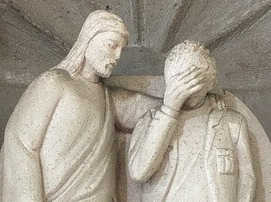
    The power to look within and see the personal and social sin as well as the capacity to show mercy comes as the free gift of our Lord to all who are willing to ask forgiveness of those we have wounded and offer it to those who have wounded us. This is the transformative power of the heart of Christ, as St. John Paul reminded us when he said, “I invite you all to join me in turning to Christ’s heart, the eloquent sign of the divine mercy, the “propitiation for our sins,” “our peace and reconciliation,” that we may draw from it an interior encouragement to hate sin and to be converted to God, and find in it the divine kindness which lovingly responds to human repentance.”

    Sacred Heart of Christ, have mercy on us.

    St. John Paul II, pray for us.

    1http://www.vatican.va/content/john-paul-ii/en/apost_exhortations/documents/hf_jp-ii_exh_02121984_reconciliatio-et-paenitentia.html
  • To Life: Saturday after Ash Wednesday

    To Life: Saturday after Ash Wednesday

    Ezekiel 33:11

    In the gospel acclamation from the book of Ezekiel, the Lord says, I take no pleasure in the death of the wicked man… but rather in his conversion, that he may live (Ezekiel 33:11).

    A popular radio talk show host recently died and the air waves are full of condolences but also, sadly, celebrations. Those who disliked him are publicly rejoicing that he died. Before I get too self-righteous I can honestly say for my part that there have been times I was happy to hear that someone had died. For example, I wasn’t a bit sad to learn that Osama bin Laden had been killed or Saddam Hussein executed. These men were the architects of some truly terrible human disasters; wicked men who met a wicked end, which was exactly what I thought they deserved.

    Yet today we hear that God takes no pleasure in their death. Rather, he wanted their conversion; he wanted them home, eternally in union with him.

    This might upset our idea of justice. How could such tyrants ever merit the eternal bliss of heaven? How could God love them? Then again we must ask: Are we thinking of justice or vengeance? And have we given enough credit to that most wonderful attribute of God – his infinite, merciful love?

    Although our love can never be infinite, Jesus has made it clear that we are still called to love as God loves. Therefore, let us resolve to pray, work, and rejoice in life, not death; to remember that love does not abandon the wicked to their sins but calls them to conversion, that they may find their way out of the darkness and into the healing, forgiving light of Christ.

    Just as we ourselves hope to do.

  • The Choice to Forgive: The 7th Sunday in Ordinary Time

    Leviticus 19:1-2, 17-18; 1 Corinthians 3:16-23; Matthew 5:38-48

    As a young married woman, Edith Eger emigrated to the United States just after World War II and settled in Texas with her husband and first child. If she didn’t carry much material baggage, she carried a lot inside. A Jew, she and her family had been taken by rail along with hundreds of others to Auschwitz. Her parents were immediately put to death. A gymnast and dancer, she got the attention of a camp physician and was forced to dance for him; this was the notorious war criminal Jozef Mengele. Months later she was forced to march to another death camp and was one of the very few who survived. Her way of dealing with the trauma was to dedicate her life to helping others so in the 1970’s, her children grown, she went to college and became a psychologist. Now Dr. Eger, she began treating soldiers suffering from post-traumatic stress syndrome.

    One day Dr. Eger met with two patients, both Viet Nam veterans. They suffered identical injuries; the war left them paraplegics. The first man was angry, bitter, and resentful; all he saw was the world’s evil and his own limitations. His attitude was, “Why me?” The second man was just the opposite. Grateful to have survived, he was determined to focus on the good things in life and on its possibilities. His attitude was, “What next?”

    Both patients deeply affected her. Through the first man she realized two things. First, her wartime experiences had left her like him: Angry, bitter, and resentful inside. More importantly she realized those feelings not only remained unresolved but had taken over, made things worse. Like that patient, she too was defined more by hatred than by love. But the second man showed her that she had a choice. She could choose life over death, to be a victor and not a victim, to celebrate the good and stop mourning the evil; to ask “What next?” and not “Why me?” That is the path she chose and, to coin a phrase, it has made all the difference.

    In her book “The Choice,” Dr. Eger writes, “Maybe to heal isn’t to erase the scar… to heal is to cherish the wound.” May be; we know from the book of Leviticus that we are to cherish no grudge (Leviticus 19:18), for that is the opposite of healing. No wonder the same verse advises us to take no revenge. Although it may seem satisfying for a time, especially when someone has really hurt us, Dr. Eger also said that revenge keeps us revolving, not evolving. Our goal is to get past the pain, not pay it forward, to make a positive change in our lives.

    But when someone has hurt you badly, how do you get past that kind of anger? By acknowledging it and giving it to God. Hiding it or pretending it doesn’t exist aren’t realistic solutions. You must be honest and admit that the anger you feel is the normal response to being badly hurt, but you must also resolve that anger will not win, will not define you, is not who you are. St. Paul told you who you are; you are the temple of God (1 Corinthians 3:16); don’t let anger defile that temple. Then give it to God in prayer. Be completely honest; tell God that the hurt and anger are too big for you, that you cannot do it alone. Ask him to help you forgive those who hurt you.

    Finally, have a realistic understanding of love in the context of forgiveness. When our Lord says love your enemies he isn’t asking us to forget what happened and be friends; rather he is challenging us to see other people, including our enemies, as God sees them. Therefore, forgiveness doesn’t mean complete reconciliation of all differences with all people; it means freeing ourselves to love as God loves. Edith Eger didn’t reconcile with the Nazis but she did forgive them because she came to see them as they were: People who, although created good by God, learned as children to fear and hate what they could not understand. We come to forgiveness the same way; not by total reconciliation of our differences but by accepting first and foremost that all people, even those who have hurt us, are created and loved by God just as we are and in need of the same salvation we need.

    prodigal-son-3388599_640It’s tempting to dismiss all this as foolishness but remember what St. Paul says: If any one among you considers himself wise in this age, let him become a fool so as to become wise (1 Corinthians 3:18). It may be wisdom in the eyes of the world to hate those who have hurt us and foolishness to forgive them but in Christ’s world it’s just the opposite; his is the world where hatred keeps us bound and love frees us, where judgment takes a back seat to mercy, and where God alone sees the heart, knows the pain, calms the fear, heals the wounds, and breaks the chains.

    As Lent approaches I invite you to find that one person in your life most in need of your forgiveness. Make forgiving that person your Lenten project. It may not take you all of Lent or you may not have succeeded come Christmas; regardless, keep working at it. Pray for them; your prayers are the greatest gift you can give and are truly sacrificial. Forgiving others from the heart may be the one thing we do that God loves the most, for it shows how much we want to be like him. After all, God has forgiven us.

  • The Outsiders: Tuesday of the Sixth Week in Ordinary Time

    James 1:12-18; Mark 8:14-21

    We may as well answer the question Jesus asked the disciples at the end of the gospel passage: Do you still not understand (Mark 8:21)? No, they do not understand at all. The question is, why? So far in Mark’s gospel they have heard him teach, seen him heal, witness him expelling demons, raising a girl from the dead, and feeding thousands with a few loaves. Who or what kept them from seeing him as the Christ? And more to the point, who or what does the same thing to us?

    It certainly isn’t God. As the first reading reminds us, God tempts no one (James 1:15). Here, James echoes the ancient truth revealed through the prophet Habakkuk that God cannot even look upon evil (Habakkuk 1:13). Rather, the reading goes on to say, evil comes from within each person who is lured and enticed by his desire (James 1:14). Let us briefly consider three different kinds of enticement.

    First, we entice ourselves to sin by failing to guard against temptation. Just as a person struggling with alcoholism would be foolish to hang around liquor stores so anyone who struggles with a certain sin is foolish to put themselves in situations where they are tempted to it. This is called the near occasion of evil and is what we promise to avoid every time we say the Act of Contrition.

    Second, we entice others to sin by becoming an occasion of evil ourselves. Some do this by dressing immodestly, others by gossiping. We rationalize such behavior in true Adam-and-Eve fashion by blaming the victims – “They shouldn’t look at me that way,” or “I only told the truth” – but deep down we know that we are far from innocent.

    Finally, we are enticed to sin by the dark angels whose master goes by many names: the father of lies (John 8:44), the tempter (Matthew 4:3), the devil (Matthew 4:1). By whatever name he sows confusion, preys on our weakness, encourages selfishness. The wise listen to Christ who urges us to fear the demons for they can destroy us body and soul (Matthew 10:28); the prudent avoid them, and the persevering cling to God with the assurance of St. Paul that no one and nothing can ever separate us from the love of God that is in Christ Jesus (Romans 8:38-39).

    Earlier in Mark, Jesus defined two kinds of people. The “insiders,” or those to whom the mysteries of the Kingdom had been revealed; and the “outsiders,” who did not. Of the outsiders he said, they may look and see but not perceive, and hear and listen but not understand, in order that they may not be converted and be forgiven (Mark 4:12). The irony is that the disciples, who should be the definitive insiders, act more like outsiders than the real outsiders! For example in today’s gospel the disciples, who just witnessed Jesus feeding four thousand people now have the chance to share a quiet boat ride with him. What a shame that this perfect opportunity to unpack all they have seen is wasted on worrying about how little bread they brought along!

    fishing boat and feetStill, Mark’s purpose is not to make us wonder at their behavior but to evaluate our own. Are we insiders or outsiders? Some of us witness Christ feeding a multitude every day, and every day share time with him in the Church, the barque of Peter. Are we focused on our own loaf of bread – be it the next place we have to go, the people we have to see, or things we have to do – or on the Living Bread that is Christ? We see the many wonderful people he gives us – our families, friends, each other; do perceive Christ living within them? We hear his word in the Scriptures; do we understand his voice speaking through all those crying for help? At the Mass he gives us himself Body, Blood, Soul, and Divinity in the Holy Eucharist; are our hearts hardened or are they being converted through the forgiveness of sins in Confession, that we may partake most fully in the infinite grace he offers?

    We conclude where we began, in the letter of James. Consider how the passage begins: Blessed is he who perseveres in temptation, for when he has been proven he will receive the crown of life that he promised to those who love him (James 1:12). Let us pray for perseverance, that gift of the Holy Spirit that empowers us to remain in the state of grace until the end of our lives; may we like the Saints see and perceive, hear and understand, that our hearts be converted, our many sins forgiven, and our focus on the things above.

  • Viva, Cristo Rey: Blessed Miguel Pro

    Daniel 1:1-6, 8-20; Luke 21:1-4

    In biblical studies, as in life, things aren’t always what they seem. For example, some books of the bible seem like history; they mention real historical people and places and the situations they describe seem real enough. However, clues such as language and historical inaccuracies show that the author had another purpose in mind; he is speaking symbolically.

    Thus it is with the book of Daniel. Scholars tell us that the symbolism running through its stories points to two particularly strong themes: The ability of the Jews to thrive in a Gentile world and the importance of remaining true to the traditions of the faith.

    Both themes appear in Daniel and the gospel according to Luke. By successfully bargaining with the Gentile authorities about their diet, four young Hebrew men were able to remain true to their religious identity. Not only that, when the king discovered that their wisdom and understanding far surpassed that of his own people, these men, who it seemed were the conquered, were in fact conquerors.

    These themes also run through the ministry of Blessed Miguel Pro. Born in Mexico, Pro was sent abroad as a seminarian and ordained a Jesuit priest in Belgium in 1925. Finding that he could not thrive abroad due to stomach ailments that nearly killed him, Father was returned to Mexico, despite the great persecution of Catholics currently underway.

    This might seem like the worst thing for an ailing priest, but things aren’t always what they seem. In fact, his ministry to the people of Mexico restored Father’s health. Like Christ and the saints, his food was to do the will of the One who sent him, and he greatly delighted in doing God’s will right under the authorities’ noses. A master of disguise, Father was never what he seemed. He ministered in prisons posing as a policeman; in posh neighborhoods dressed as a rich man; in slums dressed as a beggar. Hiding in plain sight, he taught, gave Communion, said Mass, absolved sins, confirmed the faithful, and prayed over the dead. Father Miguel Pro, like the widow in the gospel, seemed to have almost nothing, but in reality had everything, and freely gave it. He who seemed to be conquered was the conqueror.

    miguel proEventually, Father was caught, imprisoned on a false charge and on the morning of November 23rd 1927 faced a firing squad. Even here, he was a conqueror. Before the cameras and all assembled, he forgave and blessed his persecutors, held out his arms in the shape of the cross and shouted “Viva, Cristo Rey (Long live Christ, the King)!” With that, Father Miguel Pro died.

    The government published a photograph of his execution, believing that it would frighten Catholics into submission. Once again, things were not what they seemed. Father Pro, arms outstretched like a cross, displayed such Christ-like strength, such fearlessness in the face of unjust persecution, that the photograph and Father’s last words became the symbols around which Catholics rallied to resist the repression even more strongly. This was not a photograph of the conquered but of the conqueror. Ironically, the government quickly banned their own photograph.

    Like the young men in the first chapter of Daniel, Blessed Miguel Pro thrived in a hostile environment because he remained faithful to his calling and his religious heritage. While our culture and our authorities are not as openly hostile as was Mexico in the early 20th century, there is constant and perhaps growing pressure to minimize the voice of Christ and his Church in the public arena. While the times may seem bleak, remember: Things are not always what they seem. Let us imitate Blessed Miguel Pro by being in the culture but not of it; by ministering in whatever way we can to preserve and build on the good that has come before. Finally, let us remember that, in the end, we bow to only one authority – that of the Triune God.

    Viva Cristo Rey. Long live Christ the King.

    Blessed Miguel Pro, pray for us.

  • Love Without Measure: Thursday of the 31st Week in Ordinary Time

    Luke 15:1-10

    A man with 99 sheep safe and sound leaves them all to recover a lost one and, finding it, rejoices as if it is all he owns. A woman with ten coins loses one of practically no value but like a miser turns the house upside down until she finds it, then throws a party when she does. If you find this behavior strange, surprising, or even mystifying, know that you’re not alone.

    Also know that our Lord is delighted to hear it.

    That’s because parables aren’t supposed to make sense on the surface. They’re meant to sound strange, to surprise, and even mystify us. Their unexpected behavior or surprising twists should give us pause, make us stop and reflect, prompt us to ask questions, and look beneath the surface for answers. The question for today’s parables is obvious: What is it that would make someone go so far out of their way to recover something it seems they could so easily do without?

    The answer is the infinite, overwhelming, passionate, mysterious, all-consuming love of God.

    This is a love that sees as we do not. We tend to value people not only for who they are but also for what they can do for us. On those terms what is one sheep compared to 99 or one nearly worthless coin compared to the other nine? In contrast, God’s infinite love values people not just for who they are but because they are. Thus, even one lost soul is of infinite importance. This overwhelming love assures us that even if we were the only person ever created God still would have suffered and died for us. Not only that, he wants his standard of love to be ours as well; to make the world a place without hatred, bitterness, resentment, or injustice, where we rejoice not when an enemy dies but when they repent, come to a knowledge and love of God, and live as he intends.

    That brings us to the second point of the parables, which is that God’s love brings the joy of conversion. Again in human terms, we tend to equate joy with an emotional high; a good feeling. But true joy is a fruit of the Holy Spirit, the happiness that comes as we pursue and come to possess our greatest good: Eternal union with God. This is what lies at the heart of the parables – the passionate joy that comes from finding what was lost but so priceless; the joy we too will know as we attain more and more perfect union with Almighty God.

    jesus-3499151_1280Finally, the parables teach us that the love of God works mysteriously through the process of conversion so that no matter how hard we search for Christ, it isn’t we who find him but he who finds us. Our life stories are a testament to the truth of the parables and Isaiah’s words that we have all gone astray like sheep (Isaiah 53:6). It’s who we are in the self-centered weakness of human love; left to ourselves we drift, fall into habits that may be comfortable but lead us further away from God. And it is who Christ is in the glorious strength of his all-consuming love that he comes to us like the shepherd and the woman in the parables, seeking out and saving what was lost (Luke 19:10) no matter the cost. This is the love that literally consumed him, leading him to the cross and beyond.

    It is always there that such infinite, overwhelming, passionate, mysterious, all-consuming love leads. None can possess real love without giving it away, know its deep joy without plumbing the depths of its sacrifice, or attain its life without letting our own life go. It’s very hard to comprehend that kind of love but that’s good because it gives us yet another question to contemplate. Ask yourself, what is the measure of my own love? Consider in your contemplation the answer given by the great saint Francis de Sales centuries ago, who perhaps had in mind these very parables.

    The measure of love is to love without measure.

  • Rich in What Matters to God: St. Isaac Jogues and Companions, Martyrs

    Luke 12:13-21

    In the 17th century, Fr. Isaac Jogues and his companions were among the French Jesuit missionaries who ministered to the Huron, Iroquois, and Mohawk tribes in Canada and New York. To the natives they were “the Black Robes” and were seen at first as curiosities and perhaps nuisances; however, over time their gentle, loving, and helpful demeanor won over many Hurons.

    The Hurons’ enemies, the Iroquois and Mohawks, were not as open-minded. Eventually, Fr. Jogues was taken captive by the Mohawks in upstate New York. Despite mutilating and breaking his body, his captors could not break his spirit. He was the prisoner who acted as though he was free; so implacably kind, so resolutely loving in the face of abuse that he became known as “the Indomitable One.” Slowly, he began to win them over. An elderly Mohawk even adopted him as her nephew.

    When afforded an opportunity to escape, Father regained his freedom but did not enjoy it. In France he seemed to have achieved celebrity status, which he found distasteful. He quickly requested and received permission to return to Canada and New York, where he was soon assigned as ambassador to the Mohawks.

    Although Father was anxious about this assignment, he left his fate in Christ’s hands. For a time the Mohawks were cordial and Father ministered to them. Sadly though, when the crops failed and illnesses set in among the tribe, he was blamed and again made a prisoner. While most of the Mohawks wanted him treated humanely, a small and hostile minority did not. Fr. Jogues suffered martyrdom at their hands at the age of 39 on October 18, 1646.

    antique-233285_640In Luke’s gospel, Jesus said this night your life will be demanded of you; and the things you have prepared, to whom will they belong? Thus will it be for the one who stores up treasure for himself but is not rich in what matters to God.

    Father’s life of missionary service stands as a great testament to these words. In terms of possessions, he died with nothing; in what matters to God, he was the richest of men. Slowly, kindly, patiently, and lovingly he had amassed a fortune by preparing the hearts of these native people, for he knew that they all belonged to God, even the one who would demand and take his life.

    Of this last point we have proof. Sometime after his death, a captured Mohawk warrior was identified by witnesses as Father’s killer. There was not enough hard evidence to convict him, so the missionaries had to set him free. However, the man told them that he had heard Father Jogues preach around the campfire and now wanted to be baptized. When asked what his Christian name would be, he said that he wanted to take the name of the “Indomitable One.” The warrior died not long after being baptized “Isaac Jogues.”

    We will have the mind of St. Isaac Jogues, so totally patterned after the mind of Christ, when we can picture the two men named Isaac Jogues meeting in heaven, and can imagine the joy.

    St. Isaac Jogues, pray for us.

  • The True Beauty of a Pearl: St. Pelagia the Penitent

    John 8:1-11

    Near Antioch in the year 341, a group of bishops met to discuss matters lingering from the Council of Nicaea 16 years earlier. As they spoke, a beautiful woman who was also a known harlot passed by them riding a donkey and wearing little more than jewelry and precious stones. Groaning and sighing, the bishops looked away in disgust in the face of such grave sin. All but one, that is; only bishop Nonnus watched intently as she passed by, and kept watching until she disappeared into the distance. Turning, he then asked his brother bishops if they weren’t delighted with her beauty.

    In the gospel passage we read that the scribes and the Pharisees brought a woman who had been caught in adultery and made her stand in the middle (John 8:3). Although the woman in Antioch had passed them by, Nonnus centered her image in the minds of his brother bishops. Like the scribes and Pharisees, they saw nothing more than a woman caught up in worldliness and sin. They remained silent, for they already passed sentence.

    Jesus also remained silent, but he did have something to say. The evangelist tells us that he bent down and began to write on the ground with his finger (John 8:6). We don’t know what he wrote, but we are reminded of Jeremiah’s prophecy that those who turn away from God shall be written in the earth, for they have forsaken the LORD, the fountain of living water (Jeremiah 17:13, Revised Standard Version). Only after beginning to write did Jesus speak; not to the woman but to her accusers. If they were concerned about worldliness and sin then their proper focus was themselves, for they were the objects of judgment, not the arbiters of it.

    Bishop Nonnus remembered this, for in his brothers’ accusing silence he said, “(W)e have vast promises…stored up with our hidden Lord who cannot be seen. It is he we should please, but we fail to do so; it is for him that we should adorn our bodies and souls, but we totally fail to do so. We should take pains over ourselves in order to scrub away the dirt of sins, to become clean from evil stains; but we have paid no attention to our souls in the attempt to adorn them with good habits so that Christ may desire to dwell in us… (W)e have not taken pains to make ourselves pleasing to God nearly as much as this prostitute… has taken pains to please men – in order to captivate them…” 1

    Mercy begins when we look upon someone else and see our own sinfulness. Compassion is born in the eyes of those who see that as others have fallen, so we have fallen. Their pain is our pain; their healing, our healing; their God, our God.

    shell-3480818In the marvelous healing providence of God, it so happened that this same woman heard bishop Nonnus preach the homily the next day at Mass. Whatever he said moved her to repentance. She asked him to make her a Christian. Not long afterward, the same bishops who once looked away in disgust now watched in wonder as this woman threw herself upon the floor of the church, washed the bishop’s feet with her tears, and dried them with her hair. Once baptized, she traded her jewels for a robe and devoted the rest of her life to penance in the strict regimen of a cloistered monastery. The beautiful, bejeweled harlot once known in Antioch as Margarita (meaning “Pearl”) transformed herself into a beautiful model of penitence known to this day by her birth name, Pelagia.

    We and bishop Nonnus both know that through the grace of Orders, it was Jesus who preached, Jesus who baptized, and Jesus who transformed Pelagia, just as he does to all who ask him with a contrite and humble heart. Like the woman caught in adultery, the only gaze she knew from him was that of merciful love and the only words those of him who said, Neither do I condemn you. Go, and from now on do not sin any more (John 8:11).

    St Pelagia, pray for us.