2 Corinthians 9:6-11; Matthew 6:1-6, 16-18
While every death is in some way a loss to the world, there is something especially tragic about the death of a young person. Our thoughts naturally gravitate around that bright future now lost; we think of the wonderful things they might have accomplished, all the lives they might have touched.
This is no less true for the young man we know by the Latin name Aloysius. Born March 9th 1568, Luigi de Gonzaga had a very bright future. His family enjoyed the kind of power and wealth enjoyed by few. What’s more, as the eldest son, Luigi stood to inherit the wealth of his powerful family.
His father, a landowner and military commander, molded his son to follow in his footsteps. Almost from the time Luigi was able to walk, he was dressed in armor and went along with father to troop inspections. His father also saw to it that the boy traveled and became very familiar with the aristocracy of the time, perhaps believing that this was the kind of cultural enrichment that would help him learn the ways and wiles of the elite social circle into which he was born.
If that was his strategy, it backfired. By the age of 16, Luigi had seen enough to know that this lifestyle was not for him. He didn’t want the armor, wealth and power of his family or political enrichment for his own gain; he preferred the armor of God and the wealth and power of his grace that he might be enriched for all generosity (2 Cor 9:11). Luigi saw at an early age what many do not see until years later, if ever: In God, he already had everything he needed. So he sought his father, not to ask his blessing as future head of the Gonzaga family, but to be released to pursue his desire to serve God as a Jesuit missionary.
It would be understatement to say that Luigi’s father was unhappy to hear this; he was furious. It took him nearly two years but eventually he relented. He may not have become a cheerful giver when it came to his firstborn but he loved his son and respected his resolve. In a letter to the Superior General of the Jesuits he wrote: “I am giving into your Reverence’s hands the most precious thing I possess in all the world.” Once Luigi had signed over the rights of inheritance to his brother, he left home to begin a novitiate with the Jesuits.
Adapting himself to life as a novice was both easy and hard. As a boy, Luigi had adopted such severe penances that those of the novitiate seemed almost trivial by comparison. True to the words of Christ in today’s gospel, he did not try to draw attention to himself, but his asceticism was noticeable. St. Robert Bellarmine, his spiritual advisor, counseled him to eat more, pray less, and become more a part of community life. This was hard for Luigi, for although he was pious he was also stubborn. Nevertheless, he took the advice, saying “I am a piece of twisted iron. I entered religious life to get twisted straight.”
Part of his duties included hospital service and at that time an outbreak of the plague struck Rome. Aloysius confessed to his advisor that serving these patients was extremely difficult for him, yet he let no one else know and gave himself over entirely to the work. Despite precautions, he contracted the disease and after a courageous battle, died at the age of 23.
St. Aloysius would not want us to mourn his early passing; indeed, he would tell us that he hadn’t lost a future, he had gained an eternity! Through him we learn that what matters isn’t the length of time we are given on this earth but how we use it. He would urge us to do as the readings counsel: Sow bountifully, give cheerfully, pray and fast without fanfare or notoriety, and in all things give thanks to God.
 This may sound easy but we know it isn’t, for we too are twisted iron. Perhaps we can’t enter religious life to get twisted straight but we can enter into the silence of our thoughts and the privacy of the confessional to learn how to deal with the sins that are holding us back. Whatever they are, the example of St. Aloysius shows us that while change may be difficult or painful, it is possible.
The keys for us are the same as for him: Humility and docility. Humility is that poverty of spirit by which we come to see that only God has all we need, and docility is the teachable spirit through which we open ourselves to the instruction that fosters change within us. These are the virtues which, through constant practice, the grace of God gradually works to soften and straighten the iron of our self-will.
St. Aloysius, pray for us.
 It took a long time – generations – but the Church in Europe triumphed even over the seemingly invincible Vikings. I say “seemingly” for we who hear the words of Christ in the gospel know that in reality the Vikings never had a chance. All they had were swords, brute strength, and a fierce warrior spirit; what is that against the gentle, persistent, indomitable power of God? Through the ministers of the Church, the Spirit of God flowed over that mighty Norman rock and carved it into a force that would defend and promote the faith they once mocked for yielding so easily.
 Although w
 No one can give what they do not possess. Father Anthony possessed great faith and great charity, but what transformed him from service in an Augustinian monastery to service as one of the greatest preachers and teachers of the faith was his love of Christ, shown in his constant willingness to discern and pursue the call of Christ in his life as well as his desire to keep Christ at the center of his life. As he once so eloquently said, “If you preach Jesus, he will melt hardened hearts; if you invoke him he will soften harsh temptations; if you think of him he will enlighten your mind; if you read of him he will satisfy your intellect.”
 The life of Blessed Diana d’Andalo shows us that to those docile to His promptings the Holy Spirit will show both the greatness and the folly inside ourselves. Diana’s folly lay in the selfishness and will to dominate that has plagued mankind since it first heard the voice that whispers You can be like God (Genesis 3:5). Her greatness lay in her steadfast determination to conquer any enemy, especially herself; to cast aside all fear, remain in God’s love, keep faith in Christ, and abandon herself to the power and working of the Holy Spirit, that her love for God and her neighbor may be made as perfect as possible.
 Norbert did not become a saint because he fell off a horse and heard a Scripture verse; he became a saint because he took a hard look at himself and realized that he had no idea what happiness is. Happiness is beatitude, or eternal union with Christ. As a young man he once aspired to imitate Christ through Holy Orders, but when that life looked difficult and a worldly one much easier, he allowed himself to settle for less. We aren’t so different. In our own spiritual lives, we sometimes try to draw closer to Christ by setting some new and ambitious goal, only to find how hard it is to do in practice. Like Norbert, we end up settling for less and allowing other more worldly things to come between us and a closer union with God.
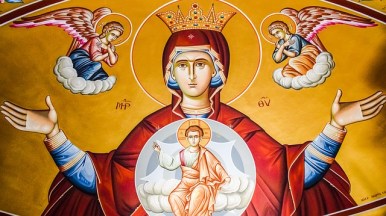 The first reading closes with this exhortation from St. Paul: Rejoice with those who rejoice, weep with those who weep. Have the same regard for one another; do not be haughty but associate with the lowly; do not be wise in your own estimation (Romans 12:15-16). What better or more fitting words are there to describe her whose very soul rejoices in God, her Savior? In the fullness of the grace bestowed on her as a singular gift of God and there visiting Elizabeth and pregnant with the Christ-child, Mary is the very answer to the question Nathanael would ask, “Can anything good come from Nazareth (John 1:46)?” Anything good, indeed! Only she, who by her fiat consented to bring the world Goodness itself; she, not wise in the world’s estimation yet wise enough to leave us with the best advice a mother could tell her children, Do whatever he tells you (John 2:5).
 Leaving Mass, the priest or deacon will say, “Go and announce the gospel of the Lord,” or “Go in peace, glorifying the Lord by your life.” This is our mandate, our call. We have each been given our own unique gifts, not meant only for ourselves. However we do it, our lives are to be a love song to Christ for the world. That our song may be rejected isn’t important. What matters to God is that we sang it for everyone to hear.
 Love is also an act of the will, and to love like Christ requires cooperation with divine grace. This is the love that we are all called to; the love constantly reaches out even to those who push it away; that speaks of healing even to those content only to wound; that speaks of light even to those who love the darkness; that echoes to our neighbor the same words that inspired the artist to paint that famous image of the true Light of the World knocking on the door of our heart: Behold, I stand at the door and knock. If anyone hears my voice and opens the door, then I will enter his house and dine with him, and he with me (Rev 3:20).
 The men and women who we remember today may or may not have had faith in Christ, but in the end what matters is that somehow He spoke to them. In some way known only to Him, Jesus answered their life questions by asking them to be willing to configure themselves to Him; if need be to let go of everything, including their lives, that others may live. Of course, God is never outdone in generosity; we know by the same faith handed on from Peter that each of these fallen soldiers has gone to meet Him face to face and, if so willing, have come to understand the value of the great truth that has confounded mankind throughout the centuries: That only by dying to ourselves do we most truly live; only by letting go of what we want the most do we hold onto what is most truly important: Eternal union with God who is Love itself.
 Mark 10:45