Tag: Church

  • Front and Center

    Front and Center

    Feast of the Dedication of the Lateran Basilica in Rome

    Ezekiel 47:1-2, 8-9, 12; 1 Corinthians 3:9c-11, 16-17; John 2:13-22

    Today, we celebrate the Feast of the Dedication of the Lateran Basilica. My guess is that several of you have been to Rome and seen it firsthand. If so, you know how strikingly beautiful it is, how ancient, how rich in history. The first Catholic basilica and the cathedral of the Holy Father, we call it St. John Lateran, but its dedication 1700 years ago was neither to St. John the Baptist nor St. John the Evangelist; those came centuries later. The first dedication was to Christ the Savior, whose image stands front and center at the top of the basilica.

    That statue is much more than a mere adornment; it is a symbol that Christ is to be front and center of our worship. We see in the gospel that some in the Temple allowed themselves to focus on earthly concerns rather than the spiritual. Jesus knew that with that mindset, both the beauty of the Temple and, most importantly, what it pointed to – the presence of God – was lost to them.

    It’s no different for us. We have lives, and with them earthly concerns, but if we allow ourselves to be distracted by them, then we too have lost our focus.

    Keeping Christ front and center means giving him our total self. At Mass, we do that by placing everything – our prayers, works, joys, and sufferings – on the altar at the Offertory, and making them our sacrifice to the Father, united with the perfect sacrifice of His Son.

    Outside of Mass, keeping Christ central means remembering, as St. Paul said, that we are the Church to the outside world. What matters to them isn’t our buildings, statues, or rituals (important as they are), but whether our actions as Christ’s Body make the world a better place. And that’s why St. Paul next speaks of our call to be holy. We must continually strive to grow in holiness, every day and in every part of our life.

    Of course, that can only be done with God’s grace, symbolized in Ezekiel’s image of water flowing from the temple. While water has never flowed directly from the Temple Mount, the Gihon Spring (Jerusalem’s ancient source of fresh water) did flow near there and emptied into the Dead Sea. Using this imagery, God assures us that, if His grace was a little stream of water, it’s powerful enough to transform even the saltiest lake on Earth into fresh water! How consoling, especially when we feel powerless over our troubles. With God’s grace at work, we can face anything!

    The dedication of the Lateran basilica is a wonderful feast, but must start with the dedication of our own interior temple. Let zeal for the Father’s House move us to purify and re-dedicate ourselves as temples pleasing to the Lord, with Christ Jesus – our one and only foundation – front and center wherever we are and whatever we’re doing.

  • Together

    Together

    Wednesday of the 5th Week of Easter

    Acts 15:1-6; John 15:1-8

    Talking once to a friend about the Church and his willingness to come into it, I remember him replying, “I don’t need a ‘Church.’ All I need is Jesus and a bible.”

    On one level, I understand what he meant. He was looking for a personal relationship with Christ, and we all want that. However, on another level, and especially in light of today’s readings, I have to ask myself, “Is that really what Jesus had in mind?”

    As I look at the bible, I don’t think so.

    While he did call the Apostles individually, Jesus formed them as a group. They were taught together, rebuked together, and sent out together. This wasn’t just Jesus’ method — it reflected a deeper, communal vision embedded in their Jewish heritage. As Jews, God called them to be His people (Genesis 17:7-8). Even their religious leaders worked as a group.

    So, in times of crisis, it shouldn’t be surprising that, as we see in Acts today, the Apostles didn’t go off alone to pray and decide individually. Rather, they met in Jerusalem. They listened. They discerned. They argued. But they did it together.

    The same is true for us. Christ calls each of us individually, but he forms and guides us through his Mystical Body, the Church. The Holy Spirit comes to us individually, too, but as we see in the Apostles at Pentecost, He also works powerfully in and through the community.

    Thus, being a Christian isn’t simply a matter of striking out on our own. We are called to marriage, vocation, and prayer, but each of these is nourished like branches within a community of faith, where Christ is the Vine. And as branches, we do not grow in isolation. Like the Apostles, we are meant to stay connected – to Christ and to one another. That’s how we bear fruit.

    That’s also how we make big decisions. Since the Apostles, there have been hundreds of local councils and twenty-one ecumenical (world-wide) councils — including the Second Vatican Council in our own time. Molded by Christ, we never go it alone; we bring issues before the Body, before the Lord. We listen, discern, and even argue, but we do it together.

    So, yes, a Bible and prayer life are essential. But they aren’t enough. Why? Because Christ didn’t leave us a bible. He left us the Church. And it’s in that Body, guided by the Holy Spirit, that we always have – and will always continue to – find truth, strength, and fruitfulness.

  • Master and Collaborator

    Master and Collaborator

    Friday of the 5th Week of Easter

    Acts 15:22-31; John 15:12-17

    When you train a person for a job, you know – you just know – that it won’t be long until they’re in over their head. New jobs mean many new things to learn, and that’s hard enough, but when you add having to deal with all the unexpected things that get thrown at you, it can be overwhelming.

    That’s pretty much what happened to the early Church not too long after Jesus ascended. As we’ve seen recently in Acts, although the Apostles did have some success at building up the Church, an issue got thrown at them unexpectedly that threatened to bring the whole thing down. Essentially, the question was, “To be a follower of Jesus, do you have to be a Jew?” For many early Jewish Christians, the answer was, “Of course. After all, Jesus was a Jew!” However, others, like Paul and his companions who ministered among the Gentiles, it was, “Of course not! Christ did away with all that!”

    Fortunately, Jesus built his Church on a foundation that, to this day, rests on three pillars. Two of them are his Word, one written (Sacred Scripture), the other unwritten (Sacred Tradition), and the third the Magisterium, or the authority to teach the world about God. In yesterday and today’s readings, we have gotten to see one way the Church uses these pillars.

    When they are confronted with such an explosive and potentially divisive issue as the one facing the Apostles, the Church leaders come together in what is called a Council. To date, there have been 21 “ecumenical”, or world-wide, Councils. This was the first – the Council of Jerusalem. Every Council takes the same form: They gather, debate, listen, pray, and decide. The process goes back and forth; debate can be sharp and deeply felt, and the issues may take days, months, years, even decades to work through. Finally, when decisions are reached, they are written down and published for the world to see.

    The letter from this first Council begins with one of the most monumental phrases in the New Testament, if not the entire Bible: It is the decision of the Holy Spirit and of us… (Acts 15:28). Every Council that has ever been called finds its basis in those words, for only they, gathered and working in unity, have been given by Christ the authority to speak for God, with the Holy Spirit not as their master but their collaborator.

    And, as we hear, it worked; Luke tells us that the people were delighted with the exhortation (Acts 15:31). Some Councils end this way; at Ephesus for example, some of the bishops were hoisted up by the people in a joyful, celebratory parade. Others, such as the First Vatican Council, ended much less ceremoniously. Regardless, each of the Council has done what it set out to do: Wrestle with the problems facing the Church, come to a decision in union with each other and in collaboration with the Holy Spirit, and teach it to the Church and the world.

    The secret to making this work was given by Christ in the gospel. It is love – the love of a Master who humbles himself to be a friend; who holds nothing back; who reveals everything to his friends; who not only chooses but empowers his friends to do as he has done – to hold love as the highest value, even to the point of giving our lives.

    The model given by Christ to the Church leaders is our model, too, for each of us as disciples must wrestle with the challenges, controversies, and questions of our time. But we don’t have to do it alone; as Catholics, we must see the Church as the place we come together to look for answers. It should be normal for us to do this; to talk about the faith, ask questions, perhaps debate, pray the Scriptures, listen, and above all to see God as both Master and collaborator. We may not come up with many solutions, but we will come to a deeper understanding and love of God, ourselves, and each other. The key is unity; to paraphrase Fr. Henri Nouwen, our best solutions are words and actions that do not divide but unite, that do not create conflict but unity, and that do not hurt but heal.

  • Lost and Found in Translation: Tuesday of the 30th Week in Ordinary Time

    Lost and Found in Translation: Tuesday of the 30th Week in Ordinary Time

    Ephesians 5:21-33; Luke 13:18-21

    When people say, “it’s all Greek to me,” they mean that they don’t understand what they’re hearing or reading. We may not realize it but we could often say the same thing about the bible, not so much because it really was written in Greek (and Hebrew) but because things get lost in translation. Sometimes those things don’t matter much; other times they can make a great deal of difference.

    Today’s first reading is a perfect case in point. What may come across as little more than a discourse on marriage is actually a beautiful meditation on various aspects of love that can benefit all people, married or not. The problem is that some of the subtleties lie hidden beneath the surface, lost in translation.

    For example, he begins: Be subordinate to one another out of reverence for Christ. Although the meaning seems obvious, there are nuances. First, the word we translate as “subordinate” also implies obedience, like servant to master. Second, when he says “one another” he means everyone, not a select few. Third, the phrase “reverence for Christ” literally translates “in the fear of Christ.” So, what seems like a simple exhortation to treat each other well is actually a bold challenge to love like Christ: with the humility that seeks to serve and not to be served, and the fear of the Lord by which we reverence God above all things and others out of love for him.

    When it comes to the married, St. Paul begins with what many today see as a put-down of women: Wives should be subordinate to their husbands…. And while he clearly does follow the custom of placing men at the head of the household, an important subtlety is missing from our text. The original Greek reads, wives should be subordinate to their own husbands…. Whatever the reason, St. Paul clearly feels the need to remind the Ephesians of two additional aspects of love: Chastity and faithfulness. Once again, this is a lesson for us; just as we love the Lord and have no false gods before him, so we are to be chaste – faithful to our state in life – whether lay or clergy, married or single.

    Notice too that St. Paul quotes Genesis: a man shall leave his father and his mother and be joined to his wife, and the two shall become one flesh. This is the highest unity we can achieve – a bodily and spiritual communion ordained by God and indivisible by man. When I say “indivisible” I mean exactly that. In the original Hebrew and Greek the word is not joined, but glued. Imagine gluing two sheets of paper together and then, after it has set, trying to separate them. They will tear. We all know of the pain and sadness of the disunity that comes with divorce.

    Not that unity is pain free. In any long-term relationship like marriage, unity requires self-sacrifice. This is especially true as relationships mature over time. Life tends to show us things we didn’t see in the early years; among them, the weaknesses and failings of others. Our natural tendency is to focus on our own pain and suffering, to place blame on others rather than see our own role in them, and to withhold forgiveness rather than make peace with them and ourselves.

    But as St. Paul reminds us, we are to love as Christ loves the Church: Completely, despite and beyond its weaknesses, to the point of dying that she may live. This is the daily discipline of being servant of all, faithful to our state in life whatever it is, and bound to God and each other in a relationship that is life-giving, life-sustaining, and life-affirming, no matter the cost. This is painful but that is the pain of healing, the death that gives way to the new life of resurrection.

    Our Lord points to this in parable form in the gospel, where we see another aspect of love: that it not only unites but multiplies. When the Christian dies to self like leaven, the Church rises like three measures of flour; when husband and wife die to self, their new family flourishes, rising like the branches of the mustard plant toward Heaven, a home for its children.

    This is not possible apart from the grace of God, for God is Love and his grace the glue that binds us one to the other. The power of his grace works within us to form the mind of Christ, to imitate the love of Christ, and to hope more and more in the promise of Christ: that those who love as he loves will one day live as he lives, in the eternal life and infinite love of the Most Holy Trinity.

  • A Mother’s Love: Memorial of the Blessed Virgin Mary, Mother of the Church

    Acts 1:12-14; John 19:25-34

    If my mother said one thing to me consistently from the time I can remember, it was that she loved me. She said it all the time. When she felt the need to go beyond that, she’d say, “You will never know how much I love you until you have children of your own.”

    To me, that’s a way of saying that the deepest love cannot be described, it can only be experienced. That may be true, but perhaps science has begun to come close. I came across a recent study that tried to capture the bond between a mother and her children neurologically. In one part, a group of mothers were shown images of people under stress and asked to imagine themselves in that situation. Various brain responses were recorded. Next, they were asked to imagine their children in those same situations and were again measured. The responses of many of these women were nearly identical in both cases; in other words, mothers tended to feel what their child was going through as if they themselves were going through it. As far as they were concerned, they and their child were one.

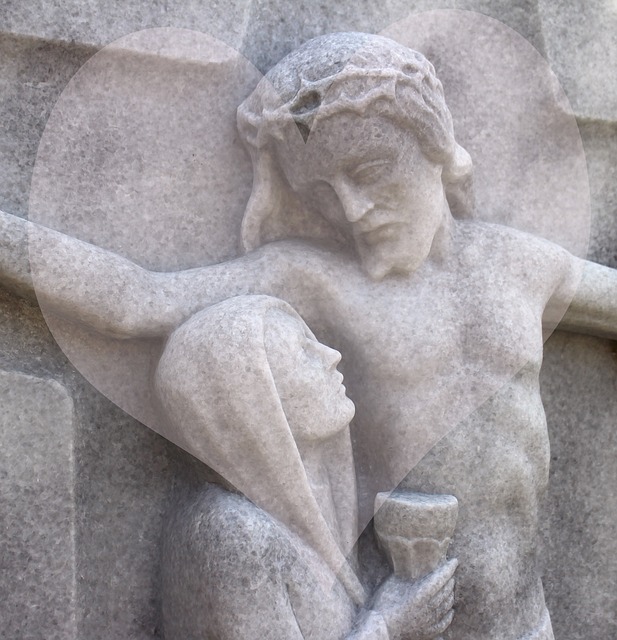
    In light of this, let us pause and reflect on the scene in our gospel reading today. Notice that John, unlike the other evangelists, places Mary right at the cross, not at a distance from it. Our instinctive reaction is to imagine what she felt watching her child suffer so. What mother would not suffer at such a moment, let alone the Blessed Mother? Despite the pain, despite the abandonment of nearly everyone else, Mary remained at his side. Over and above this consider her lifelong, steadfast faithfulness. The gospels make it clear: Mary is the only person to be with Jesus at every pivotal moment of his life from conception to death. She is his mother, but she is his disciple first. Her life is a testament to the advice she herself gave to the wedding stewards at Cana: Do whatever he tells you (John 2:5).

    Knowing that, her Son gives his mother more to do. When Jesus saw his mother and the disciple there whom he loved, he said to his mother, “Woman, behold, your son” Then he said to the disciple, “Behold, your mother.” (John 19:26). Note the high regard Jesus has for Mary. He speaks when he sees her; he speaks first to her; most importantly, he expands her role as mother to now include the ideal or Beloved Disciple. In the words of theologian Fr. Raymond Brown, this is Christ’s last-willed … act of empowerment that both reveals and makes come about a new relationship.”1

    That new relationship is Mary as mother of the Church, for Christ has raised her from being mother of the head to mother also of his Mystical Body. Under the inspiration of the Holy Spirit, the Church proclaims from ancient times that she was born from the wounded side of Christ as he slept the sleep of death upon the cross.2

    jesus-284515_640Mary understood this and, as in all things, obeyed her Lord. That is why in the first reading we find her with the Church – the disciples in the upper room – in prayer. Mary has the most marvelous intercessory role; obedient daughter of the Father, mother of his only Son, and spouse of the Holy Spirit. She is in the perfect position to intercede for the Church.

    Someone once said that the word ‘mother’ isn’t a noun as much as it’s a verb. So today, on the Memorial of the Blessed Virgin Mary, Mother of the Church, consider how Mary’s role from the beginning has been tomother’ people to God by being a model of prayer, discipleship, and unconditional love. And operating on the principle that we will never know how much our Mother loves us until we have children of our own, we must remember that Mary’s model of motherhood is meant to be imitated; we too are called to ‘mother’ people into the Church.

    If we don’t know where to start learning from her, begin with the rosary. From the joyful mysteries alone we learn humility, love of neighbor, poverty of spirit, obedience, and piety. Every major event in her life a mystery, every mystery with its own fruit, every fruit centered on Christ. That is the key; Mary teaches us through the rosary what she teaches through her life; that bringing people to the Church is nothing more or less than bringing them to her Son and allowing him to stir within them the flame of divine love which truly cannot be described but only experienced, and in which we are truly one.

    Mary, Mother of the Church, pray for us.

    Mass, June 1 2020

    1Brown, Fr. R.E., SS (1994). The Death of the Messiah: From Gethsemane to the Grave. New York: Bantam Doubleday Dell Publishing Group, Inc.. p 1021.

  • Truth Beyond the World: The Feast of St. George

    Revelation 21:5-7; Luke 9:23-26

    When I was a boy my favorite comic book was The Amazing Spiderman. Every month I haunted the drugstore waiting for the next issue. When it finally arrived I’d read it over and over again. It was great fun imagining myself as the quirky yet powerful superhero.

    Although comic books date back only to the 1930’s and 40’s, the kids of bygone eras had something every bit as exciting: The Golden Legend, a classic of the faith from the 13th century, which contained in great and often colorful detail the dashing exploits of the heroes of ancient Christianity.

    Among the most dashing was St. George. Like most saints of the early Church, little is known. He appears to have been a young soldier martyred in Palestine around the year 304. What we do know is that there must have been something especially appealing about him, for he quickly became legendary. The Golden Legend includes a few stories about him, the most familiar being the dragon. Passing through a foreign kingdom and coming upon a princess about to be devoured by a dragon, George slayed the dragon and converted the kingdom to Christ. There is also the amazing story of his martyrdom. Arrested during a persecution of Christians, George was handed over to the torturers. Despite their best attempts, which included beating him literally to pieces, crushing him beneath heavy spiked wheels, and submerging him in molten lead, George miraculously reassembled unharmed. Amazed and inspired by this, the governor’s own wife converted to the faith. Infuriated, he had her executed and George finally martyred by beheading.

    But that’s not the end of the story. If he was powerful in life, St. George was even more so in death. The Legend tells of victories won by soldiers carrying his relics into battle, of healings at his tomb by those placing their hand in it, and of healings of those who touched the chains he wore in prison. His tomb became a place of pilgrimage and churches bearing his name were built as far away as Italy. Little wonder that England, whose Crusaders brought home his story, chose him as its national patron, that a kingdom in the Caucasus mountains was named Georgia in his honor, or that to this day Palestinian Muslims, Jews, and Christians would all honor him and ask his intercession for those suffering from various illnesses. Clearly, St. George became a man of mythic proportions.

    Unfortunately many stumble on the word “myth.” As early as the 5th century, the stories of St. George were dismissed as fantasy. Like some ancient, amazing Spiderman, he was too large for life; his adventures unreal and unrealistic; the product of uneducated, unsophisticated people. A fairy tale.

    They completely miss the point, as Chesterton knew when he said, “Fairy tales do not tell children the dragons exist. Children already know that dragons exist. Fairy tales tell children the dragons can be killed.” Or, to paraphrase the French philosopher Jean-Paul Ricœur, the purpose of myths is not to tell the truth about the world but the truth beyond it. The deeper truth about St. George is written between the lines of the stories, not within them. What matters is not that St. George slayed a dragon but that, in committing to follow Christ, he received the grace to slay the dragons in his own life. Similarly, it doesn’t matter whether he was actually beaten to pieces, crushed by wheels, submerged in molten lead, and miraculously reassembled; the truth is that St. George loved Christ and did what he asked in the gospel; he took up his cross daily and followed him (Luke 9:23), saving his life by quite literally losing it.

    statue-1394654_1920Of course these truths are not reserved to St. George, they are for all of us. In Revelation Christ says, Behold, I make all things new (Revelation 21:5); for that to mean anything, we must ask for the grace to find and slay our own dragons. We all have them; they are the sins we allow to linger, the attachments we find hardest to put aside, and the fear, self-doubt, and self-condemnation that keep us from drawing nearer to God. The fear is real because the pain is real; it is the pain of having our pride beaten to pieces, allowing our bodies to be crushed by illness or infirmity, and submerging ourselves in the depths of humility. Nevertheless, the truth is that if we allow the power of God to work within us, we will experience what even the legend of St. George could never imagine: The joy of being reassembled into the person that Christ has called us from all eternity to be.

    St. George, pray for us.

  • Holy Thursday: The Primacy of Service

    John 13:1-15

    Today we read from John’s account of the last evening that Jesus spent with his disciples before his Passion and death. The other evangelists take this opportunity to provide us with the Institution Narrative, or the words spoken by Christ that to this day are repeated by the priest during the Consecration at holy Mass.

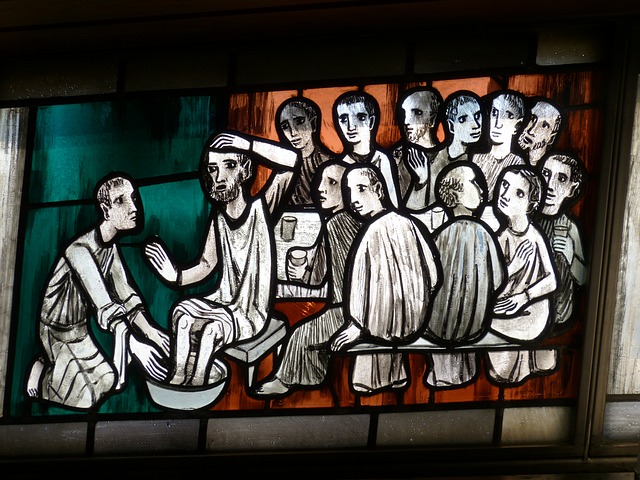
    John does not do this; rather, he uses the occasion of the Last Supper to depict Jesus washing the feet of his disciples and commanding them to do likewise. We don’t know why, but it’s possible that by the time the evangelist composed this gospel account the Breaking of the Bread had become an occasion for people to segregate into groups and eat and drink their fill, rather than to unite and commemorate the Passion, Death, and Resurrection of our Lord as one body.

    passion-3807312_640By showing Jesus washing the feet of his disciples, the evangelist re-emphasizes the primacy of service. Those who would be greatest must become the least. This is the humility and love behind the gift of his life poured out for our sake, by which he becomes one with us and we become one with each other.

    As we approach the Eucharist this evening let us take his words and his actions to heart, for together they show that love leads naturally to service. Christ has shown us the greatest love through the gift of his Body and Blood broken and poured out for our sake and at the same time that this is the love that allows us to see others not as things to be used but as people to be served.

  • A Fragrant Aroma: Monday of Holy Week

    John 12:1-8

    Awhile after my father died, my mother asked if I would help her sort out his things. As I took some clothes out of his dresser it struck me; they still smelled like him. It was as if my father was right there. It took me several minutes to regain my composure.

    Scientists have known for years that the sense of smell is intimately tied to memory and emotion. In fact, smell is the only sense that works directly with the area of the brain that controls emotions. We’ve all experienced it; no matter how far away or far removed we are from a certain time, the aroma of something – perhaps a certain food, a perfume – can bring it all back again. It is if we are there.

    In the gospel we see how one of the sisters of Lazarus gave to their home a sense memory of our Lord: Mary took a liter of costly perfumed oil made from genuine aromatic nard and anointed the feet of Jesus and dried them with her hair; the house was filled with the fragrance of the oil (John 12:3).

    This is significant on many levels. First, it is the perfect counterbalance to the family’s recent experience at the tomb of Lazarus; the foul air of death is literally blown away by the fragrance of new life found in Christ. But second, this perfume is costly; the price of victory is high. As if she senses that his enemies are as near as Judas and plotting his demise, Mary anoints not the head of Christ the King but the feet of Christ the Servant which shall soon be pierced with nails and placed in a tomb. Finally, it may seem odd that Mary wipes away some of the perfume with her hair but I see in it a sign of her devotion; a way to identify herself with Christ and his sacrifice, personifying St. Paul’s meaning in 2 Corinthians when he said, we are a fragrance of Christ to God among those who are being saved and among those who are perishing (2 Corinthians 2:15).

    glass-4108085_640There is an ancient rabbinic saying that “the fragrance of a good perfume spreads from the bedroom to the dining room; so does a good name spread from one end of the world to the other.”1 As Mary filled her house and her hair with the fragrance of Christ, so may we fill the world and ourselves with his holy and glorious Name. And may be as untiring and devoted as she, willing to sacrifice whatever is costly to ourselves to do it. There is no greater identification with Christ than this, as St. Paul knew when he prayed that we may be imitators of God, as beloved children; and walk in love, just as Christ also loved you and gave Himself up for us, an offering and a sacrifice to God as a fragrant aroma (Ephesians 5:1-2).
    1Based on Ecclesiastes 7:1 and cited in Brown, R.E. (1966) The Anchor Bible: The Gospel According to John I-XII. New York: Doubleday & Company, Inc., p. 453.

  • Mother and Baby: The Solemnity of the Annunciation of the Lord

    Isaiah 7:10-14; 8:10; Psalm 40:7-11; Hebrews 10:4-10; Luke 1:26-38

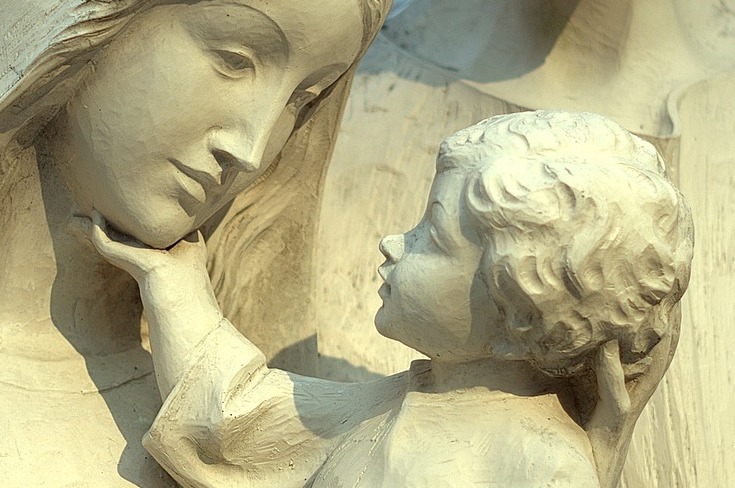
    Everyone knows the bond between a mother and her baby is special and that there is nothing in the world quite like it. But recently I came across some research that taught me things about it I didn’t know and that gave me new perspectives on the Blessed Mother.

    First, there is a physical basis to the phenomenon scientists call the “maternal instinct,” or others know as “Mommy brain.” Others like my older son who as a young child once inspected the back of his mother’s head, searching for the eyes hidden there. He wasn’t far wrong. During pregnancy a woman’s brain actually changes; areas related to the protection and nurturing of her baby develop as never before. This is nature’s way of attuning a mother to the needs and well-being of her children.

    It was no different for the Blessed Mother. From the moment the Holy Spirit came upon her and the power of the Most High overshadowed her (Luke 1:35), Mary began to develop the maternal instinct toward God himself. She alone among all women was to know the singular joy and tremendous responsibility of nurturing the Son of God; of protecting him from and preparing him for the world he came to save; of feeding him who thirsted for souls; and of providing a home for him who sought nowhere to lay his head except upon her breast, first as a helpless babe and then as a lifeless son taken down from the cross.

    It was from the cross that Christ raised Mary’s maternal instinct from the natural to the spiritual. With his words, Woman, behold your son (John 19:26) he gave her motherhood of his disciples, of all those like her who hear the word of God and do it (Luke 11:28). He made the bond complete when he told the Beloved Disciple, Behold, your mother (John 19:27), for in imitation of her Son we too have nowhere else to lay our heads. As her spiritual children we trust her, as he did, to see to our well-being and protection.

    The second thing I learned about the bond between mothers and babies is that children learn to recognize their mother’s voice in the womb and even prefer the language she speaks to any other they hear. By the time he was born, Mary’s voice was already very familiar to Jesus. And of course he prefers her language, for she speaks the language of total and selfless love. This is why we ask the Blessed Mother to speak to Jesus on our behalf; hers is the voice he heard from the time he was old enough to hear anything at all, the voice he could not refuse at Cana. Once again in imitation of him, Mary’s is the voice we too must not refuse, that says to us what it said to the servers at the wedding feast at Cana: Do whatever he tells you (John 2:5).

    Finally, I learned that perhaps the most important aspect of the bond between mother and baby is responsiveness. From the womb, mothers instinctively respond to the needs of their babies, giving from their own bodies whatever they have to give. This continues into childhood. Studies have shown that children thrive when their mothers respond to them in ways that foster growth and security; these especially include support and encouragement in difficult or stressful times. As Scripture makes clear, our Lord was no stranger to difficulty or stress, from his birth in a stable and flight into Egypt to his suffering and death on the cross. But Scripture also makes clear that Mary was with him at each of those times; in fact, she is the only one in all of Scripture to be present from his conception to his ascension. As such, Mary is the epitome of the supporting and encouraging mother.

    mother and baby

    One phrase in the readings perfectly summarizes the bond between Mary and her Son: I come to do your will (Psalm 40:8-9; Hebrews 10:7). For Mary this meant motherhood born of a love for God so deep that she, as Augustine once said, would conceive Christ in her heart before her womb. For Jesus it meant the Incarnation; a love so deep that he would take his own creation’s flesh and offer it back to his Father for the redemption of all who would accept him. Their obedience sets the pattern for us for we too are called to the same kind of obedience; to conceive Christ in our hearts; to offer to the Father the gift of ourselves in total dedication to Him; to love as Jesus and Mary loved. Without grace this is not possible, but this is the great hope of the Solemnity of the Annunciation, when the angel reminds us as he told the Fullness of Grace: nothing will be impossible for God (Luke 1:37).

  • Passing By the Dragon

    Every week I scour the internet and various hard- and soft-bound sources for quotes that I think might make a difference to somebody, somewhere. I know I’m not always successful but I also know for sure that at least once in a while a quote touches someone for the better.

    Well, today’s quote touched me. Some might find it off-putting or unmoving but for whatever reason it’s been running through my head like a mantra. It comes from today’s saint, Cyril of Jerusalem, who knew a little something about the topic and who I think would approve of my selection for the times we now find ourselves in.

    You know what I mean. These are times where people, feeling driven to desperation out of what I can only describe as panic, are depriving each other and themselves of their God-given dignity, fighting over or hoarding such things as bottled water, rolls of toilet paper, canned food, and hand sanitizers.

    St. Cyril once said:

    The dragon sits by the side of the road, watching those who pass. Beware lest he devour you. We go to the Father of Souls, but it is necessary to pass by the dragon.

    The road is life and at every turn the dragon lurks – always hungry, always on the prowl, always ready to devour the unwitting, the arrogant, the unbelieving, the slothful. In one way or another, at one time or another, we are all of these; sometimes of our own free will, sometimes under the compulsion of habit, sometimes the result of forces we cannot name and do not understand, but cannot seem to resist.

    the dragonWhen we think of the dragon we think of the Devil and it is right to do so, for Scripture does refer to him that way (Revelation 12, for example). There is no doubt that the dragon is the Enemy but there is also no doubt that too often the dragon looks back from our own mirror. Worse yet, the victim does too; we allow sinfulness such a hold over us that in effect we devour ourselves, relent to the darker angels of our nature.

    Most recently we have begun to treat the virus as though it were the dragon. That’s easy to understand; insidious, potentially lethal, virtually invisible, it waits not only by the side of the road but perhaps in the air we breathe or the people we touch. That inspires fear, and it should.

    However, it also reminds me of St Teresa of Avila’s words, “I do not fear Satan half so much as I fear those who fear him.” While we are right to fear the virus, we should more rightly fear our own fear of it; fear is the true dragon lurking behind the unloving, self-centered actions we have heard and read about recently.

    How to combat that kind of servile fear? With holy fear. Remember the next part of St. Cyril’s quote. We go to the Father of Souls. It is God whom we most love, God whom we most fear offending. What pleases God is not fear but faith; that we take advantage of the opportunities He has given us to draw closer to Him and each other.

    Where do such opportunities lie in the trial we face today? Right in front of us. First, let us resolve to do the best we can with what we have been given. If the virus prevents us from going out, then we stay in and bring ourselves back to the kind of simpler time that many of us knew as children: Simple, modest home-cooked meals; conversation around the dinner table; recreation time; work time; quiet time. Nothing works to calm those around us like quiet assurance. Second, let us take advantage of the opportunities this sequestered time gives us to get back to the basics of our faith. If the churches are closed to holy Mass they are wide open for Confession. What better time to go than when we feel the dragon near? And what better time to fall on our knees and pray for those who have fallen ill or died and to thank Him that we and so many others have been spared? Finally, we can make this a time to worry less about our own needs and more on those most vulnerable – the elderly, those with small children, those with few resources.

    Fear is not the time to turn away from God but toward Him, for God alone has the power to save. I quoted Cyril of Jerusalem and Teresa of Avila; let me close by quoting our Lord.

    Do not fear: I am with you; do not be anxious: I am your God. I will strengthen you, I will help you, I will uphold you with my victorious right hand. (Isaiah 41:10)

    The LORD is my light and my salvation; whom should I fear? The LORD is my life’s refuge; of whom should I be afraid? (Psalm 27:1)

    It is necessary to pass by the dragon, but no dragon is fearsome in the face of such strength.