Tag: Christ

  • Ripple Effects

    Ripple Effects

    Friday of the 9th Week in Ordinary Time
    Memorial of St. Ephrem the Syrian, Deacon and Doctor of the Church

    Tobit 11:5-17; Mark 12:35-37

    In 1970, a teacher noticed that, if he asked one student to stop an annoying or distracting behavior, other students also stopped it; conversely, if he failed to reprimand a student for that behavior, other students began doing it. He called this the ‘ripple effect,’ a term we still use to describe how the behavior of one person affect others, who then affect others, and so on, like the ever-widening waves produced by a stone dropped in a pond.

    We see examples of this in the readings. Tobiah’s return is one example. His mother, tense for most of the story because his return is so overdue, had turned that tension on her husband; three times so far, she has been very short with him. But upon Tobiah’s return, she rejoices; as a result, she takes a softer tone with Tobit. Then there is how Tobiah’s return affected Tobit. Tobiah has brought healing; once healed, Tobit first joyfully blesses God, then bonds even more closely with his son. Finally, Tobiah’s new wife, Sarah, appears; this causes Tobit and Anna to rejoice, then their joy spreads to all the Jews of Nineveh. In the gospel, our Lord’s preaching is another example. He quotes Psalm 110:1, which first delights his hearers, then went on to delight the early Church. In fact, it delighted her so much that the authors of the New Testament cited that verse more than any other in the Old Testament in support of Jesus as the only begotten Son of God. That’s a ripple effect so large it’s almost beyond measure!

    We also see ripple effects in the life of St. Ephrem, who we remember today. One troublesome stone in the pond was his temper; ultimately, it so adversely affected those around him that he ended up in prison. Once there, though, Ephrem cast a much more productive stone in the pond: contemplation. Taking the time prison gave him to reflect on how his behavior affected himself and others, Ephrem promised God that, if he was released, he would make each day count. The ripples from that stone were impressive; once out of prison, he composed hundreds of hymns, was ordained a deacon, became one of the first to incorporate music into the sacred liturgy, to use women singers in the choir, and was foundational to the doctrine of the Immaculate Conception of Mary.

    Of course, this should prompt us to take a moment to consider the ripple effects in our own lives, both the good and the bad. First, think about how the good we have done has allowed others to do good, which has in turn allowed still others. Imagine the positive impact we have made on all those people! What better reason is there to praise God, as the psalmist sings today? Yet, at the same time, what better reason to ask God’s mercy, for if the good we have done has rippled through the world in a positive way, what have our sins done? While this is a sobering thought, it is key to any good examination of conscience. In the end, only God knows, and may well reveal at our judgment, how the good we have done and the sins we have committed have affected the destinies of other people.

    The book of Tobit makes clear that there is a supernatural element to all of this. Therein lies a warning; we know the torment the demon inflicted on Sarah in the story, and we know the accuser is still among us, whispering in our ear. But on the other hand, therein also lies the best news of all: That, in his infinite love and mercy, God will come to us as Tobiah and Raphael came to Tobit and his family, heal our brokenness, and bring us joy that radiates outward and touches all we come in contact with. All we have to do is ask, for the prayer of a contrite heart yields the greatest ripple effect of all time: the merits of the cross and resurrection of our Lord, Jesus Christ. As St. Ephrem once said,

    “Glory be to Thee, Who laid Thy cross as a bridge over death, that souls might pass over upon it from the dwelling of the dead to the dwelling of life!”

    St. Ephrem, pray for us.


  • Reconsidering Success

    Reconsidering Success

    Thursday of the 6th Week of Easter

    Acts 18:1-8; Psalm 98:2; John 16:16-20

    Perhaps more than any other New Testament author, Luke loves success stories. The first part of the Acts of the Apostles is full of them; chapter after chapter, the Apostles heal, defy the Sanhedrin, preach, baptize thousands, and ordain deacons.

    At the same time, he doesn’t shy away from problems; in fact, in the middle of the book, he runs through a list of them: First, Mark deserts Paul (or so he thinks); then, after an argument, he and Barnabas go their separate ways. Next, Paul is imprisoned in Phillipi, gets chased out of two other towns, and is pretty much ignored in Athens. Meanwhile, in Rome, the Christians have fared so badly that the emperor threw them out, as Aquila and Priscilla know firsthand. In today’s reading, the three of them are in Corinth, but nothing has improved; in fact, Paul is so disgusted by yet more rejection in a synagogue that he says he is abandoning his mission to the Jews entirely.

    Loving success as Luke does, why talk about failure? I think it’s because he’s trying to tell us something. Consider: Because Paul went to Corinth, he founded the Church there; because he did that, and poured himself into it for a year and a half, we have two of his greatest letters, which we read, study, and pray to this day. Because Aquila and Priscilla were kicked out of Rome and went to Corinth, they met Paul and became not only co-workers but friends; they housed him, helped him, even risked their lives for him (Romans 16:3). Finally, because Paul preached Christ to the Jews despite his frustration, the synagogue official became a Christian, which seems to have triggered a series of conversions to Christ. God only knows how many lives were changed for the good in spite of those seemingly bad events. Given that, what is success and what’s failure?

    That is Luke’s first point. We know, because Christ has told us, that our job is to bring him to the world. What we do not know is the plan – how that will be done. When we act as if we do know, we fall into the trap of defining success and failure on our own terms. Paul knew this, which is why he later wrote to this same church in Corinth, I planted, Apollos watered, but God caused the growth (1 Corinthians 3:5-7). In other words, we each have an important part to play, but God has the plan.

    This brings up the second point, which is that even the work that is ours to do cannot be done without others. Paul couldn’t do everything alone. We already know about Aquila and Priscilla, but remember Silas and Timothy; Luke told us that it was their coming to Corinth that allowed Paul to occupy himself totally with preaching the word (Acts 18:5). And, even in the broken or problematic relationships, the Apostles and others were still on the same side. If the man Luke calls “Mark” is the evangelist, then we know what he did! Also, although Paul and Barnabas separated, both continued in ministry (1 Corinthians 9:6). Paul would be the first to admit that if he succeeded, he didn’t do it alone.

    What held true in Luke’s time still holds true for us. While we too we know the joy of seeing people come to faith and the heartbreak of seeing others walk away, we must keep a few things in mind. First, success and failure are not ours to assign; that job belongs to Christ. Our job is to keep bringing him to others by what we say and do, no matter how hard that is. Second, we have no idea what seeds of success lie in each apparent failure; that, too, is for God alone to know. Third, we can’t do it without each other. God has given each of us gifts and intends us to use them together. Like Mark, Paul, and Barnabas, we may not always see eye to eye, but we are on the same side, bound by the love of Christ and pledged to serve him in and with each other. Finally, and above everything else, let us praise God for whatever success we achieve; for, although we speak the words, only God moves the heart; although we teach the truth, only God reveals himself; and although we reach out to others, only God draws them near.


  • Unforgettable

    Unforgettable

    Friday of the 5th Week of Easter

    Acts 15:22-31; John 15:12-17

    “We hold these truths to be self-evident…”
    “Four score and seven years ago…”
    “I have a dream…”

    Every one of us recognizes these phrases, but what is it about them that makes them so unforgettable? Is it their eloquence, or the passion that drove men to speak them? No, it’s what they’re speaking about; powerful truths like liberty, justice, and equality, that resonate in the heart of every person, across time.

    Today, another phrase, just as powerful and resonant, appears. We don’t know who wrote it, or who spoke it for the first time; all we have are the words, It is the decision of the Holy Spirit and of us… (Acts 15:28). Where’s the power or resonance in that? Think for a moment. Before this, when men spoke for God, as in the prophets, we heard things like, “The word of the Lord came to the prophet…” But not here; these are men, gathered together, praying, talking, arguing, trying to resolve a difficult and divisive issue. This phrase dares to say that, as they did so, God didn’t decide for them, he decided with them. Who are they to make such a claim?

    Jesus told us in the gospel exactly who they are: Men, chosen by him, appointed to go and bear fruit. Vested with his authority, given the keys of the Kingdom, and gathered in his name, these men also received his promise, the Holy Spirit, who would lead them into all truth (John 16:13). Note: Lead them, not tell them.

    History bears witness to this. Every time the Church has been confronted with issues that threaten her unity, such as this one, her leaders have met in what is called a Council. To date, there have been 21 of these “ecumenical”, or worldwide, Councils, each taking the same form: Bishops gather, debate, pray, and decide. Emotions can run high, words can get sharp, and the issues can take days or even decades to work through. Still, and every time, decisions are reached, written down, and published for the world to see.

    And, as we hear, the process works. Luke tells us that the people were delighted with the exhortation (Acts 15:31). Some Councils have ended this way. At Ephesus for example, bishops were hoisted up by the people in a joyful parade. At the end of others, like Vatican I, some bishops have run for their lives. Regardless, each Council has done what it set out to do, always in union with the Holy Spirit and collaboration with each other.

    The secret to making it work was given by Christ in the gospel in another unforgettable phrase: Love one another (John 15:17). It is love – the love of a Master who humbles himself to be a friend; who holds nothing back; who reveals everything to his friends; who not only chooses but also empowers them to do as he has done: to hold love for one another as the highest value, even to the giving of their own lives.

    The readings today remind us that we have a lot to be thankful for. First, that God has given us the Church, to which we can turn for answers, confident that God himself leads her into all truth. Second, that God has given us the Holy Spirit in many ways, not least of which is what the Second Vatican Council called the “sense of the faithful” – that inner voice that helps us discern what is truly of God. Finally, that God has given us himself, for God is love, and it is his love that binds us together. Like the bishops, we face problems with the world and sometimes with each other. But, if we keep in mind that we always gather in his name, and pray to be led by the Holy Spirit as he leads the Church, then even though we may not come up with many solutions, we will come to a deeper understanding and love of God, ourselves, and each other. The key is unity; to paraphrase Fr. Henri Nouwen, our best solutions are words and actions that do not divide but unite, that do not create conflict but unity, and that do not hurt but heal.


  • Crowd or Disciple?

    Crowd or Disciple?

    The 4th Sunday in Ordinary Time

    Zephaniah 2:3; 3:12-13; 1 Corinthians 1:26-31; Matthew 5:1-12a

    The day finally arrived. After 21 years in school, I made it; the first day of the last class I’d ever have to take. I was excited, but also nervous. I heard this teacher was tough; my friends advised me to wait another year, hoping he’d retire, but I wanted it over with. What was one more tough teacher?

    It took just one class period to rethink that. The first thing this guy did on the first day was hand out the final exam, a series of questions due back in three months. Looking at them made me even more nervous. They didn’t look hard… they looked impossible.

    As always happens, some people dropped. We who decided to stick it out divided up the questions and worked on them. Although I made progress, it became clear that if I was going to give decent answers, I had to go to class and really engage with this teacher.

    That’s where my world lit up. From our first conversation, I could see that psychology wasn’t just a subject to this man; it was his life, his passion, and he wanted us to share it, to love it like he did. In the end, the real importance of giving us those questions was to draw us into conversations with him, to give the benefit of his experience and insight to us, the next generation of psychologists and teachers, so we could better understand and in turn pass on the most important issues in that field to our own future students.

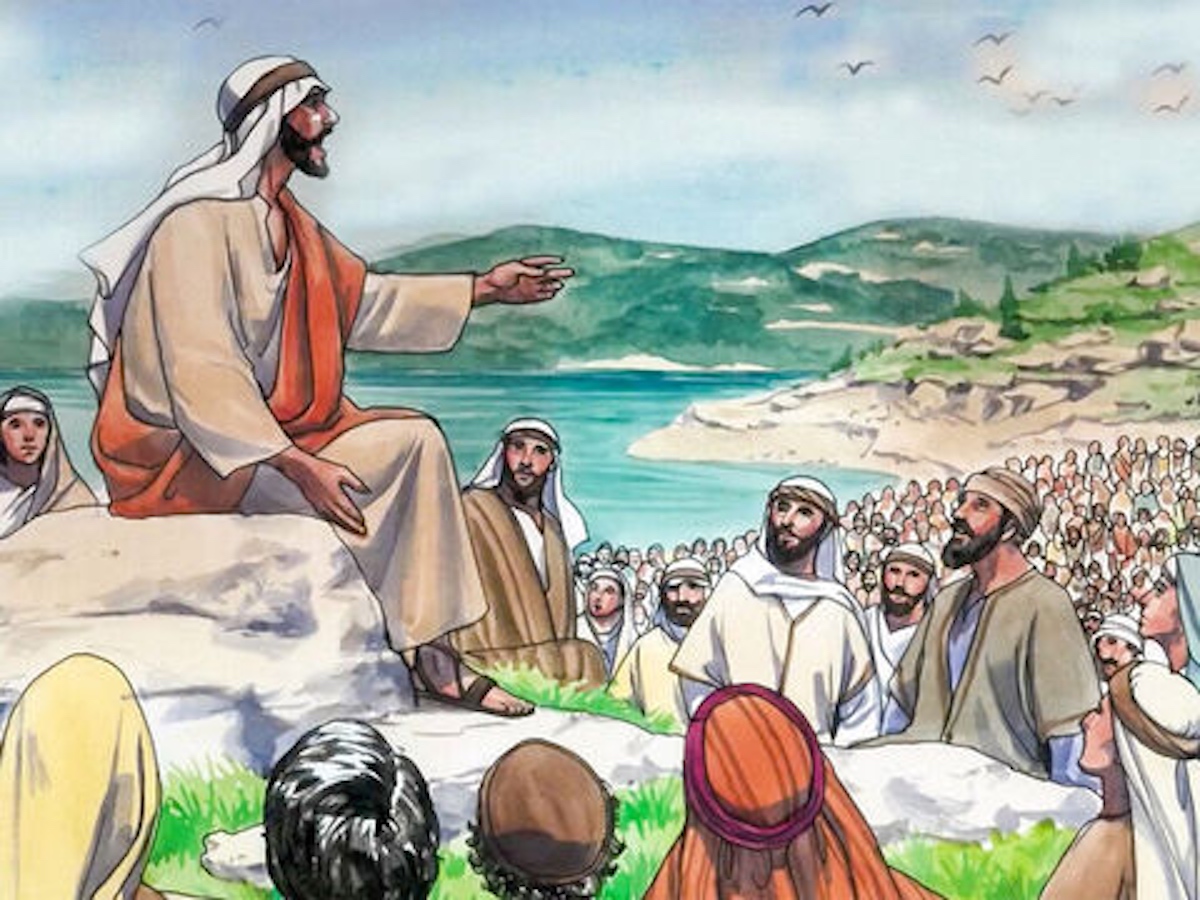
    That is an example of the same purpose our Lord Jesus Christ had when he began his class, the Sermon on the Mount, with his own idea of a final: The beatitudes. Who could blame anyone for finding those hard to understand? We’re blessed to have nothing, to say nothing, and to mourn loved ones? Rejoice when we’re being persecuted? Those don’t seem hard, they seem impossible.

    Of course, they aren’t, but they do require effort. The worst thing we can do is look at them and rule them out as impossible. That’s what St. Paul meant when he mentioned being wise by human standards. No; real wisdom begins with the attitude spoken of by the prophet Zephaniah, the honesty and humility to say, “I don’t understand these,” and the perseverance to say, “But with help, I will.”

    It is virtues like these that set people apart, make them holy. In the first reading we heard about a remnant, a smaller group that emerges from a larger one; people distinguished by their humility and thirst for justice, and rewarded with peace. And we see a shade of it in the gospel, where Matthew begins: When Jesus saw the crowds, he went up the mountain, and… his disciples came to him. So, a large group sees Jesus, a smaller group follows him. The difference? The remnant makes an effort to do it. Each of us has to ask, which am I: Crowd or disciple? Am I satisfied simply hearing about him, or am I committed to following him? We only know that by looking inside ourselves. When and where do I already come to him? Are there circumstances where I will not come to him?

    And what does that mean, to come to him? If I ask God questions, will he answer them? Yes! It is said that when we pray, we talk to God; when we read Scripture, God talks to us. The answers may not be clear, we might have to make an effort to understand, but we have centuries’ worth of resources: Notes on every page of the bible, books by such brilliant thinkers as Benedict XVI. In our own parish, we have priests and deacons who have been trained to help you understand where and how God is moving and speaking in your life.

    This is where your world can light up, too. Studying the beatitudes this way leads us to contemplation, where we learn these aren’t just some nice, pious thoughts to live by; they are a portrait of Christ. Poverty of spirit; who is more humble than he who emptied himself and took the form of a slave? Who has mourned more than he, who wept over Jerusalem? Who is meeker or gentler than the Lamb of God, led to slaughter without a word? Who seeks righteousness more than he who looked upon mankind from the cross and said, “I thirst”? Who was ever more merciful than he who said, “Father, forgive them, they know not what they do,” or more pure of heart than he whose heart was pierced for love of us? These are the kind of meditations that bring us closer to the heart of Jesus, and lead us to see that even on that mount of the beatitudes, our Lord had another mountain in mind; the one he had come to climb for the salvation of the world.

    This is just one example. All of Scripture is open to you; God is there, waiting for you to come to him as the disciples did on that mountain, to be drawn into conversation, gain the insight he has in store, so that you can better understand and in turn pass on all that you have learned, so that others may come to know and love him as you do.

  • The Perfect Plan

    The Perfect Plan

    Saturday of the 5th Week of Lent

    Ezekiel 37:21-28; Jeremiah 31:10, 11-12abcd, 13; John 11:45-56

    When I was 7, I ran away from home. I figured I had to; Mom was forcing me to do all this horrible stuff: school, chores, Confession every other Saturday. So one day, after she said I was being particularly annoying, I decided now was the time: I’d go to St. Louis and live with my uncle. What a great idea; he lived close to where the Cardinals played baseball, was a lot of fun, and he’d love me hanging out with him every day. Best of all, no chores! So, I went upstairs and got some stuff. I packed light. We lived in Denver, Colorado, and on the map it looked like an easy trip; just walk across Kansas and you’re in St. Louis. So I left, pretty pleased with myself. My plan was perfect.

    Or so I thought. When I got to the highway a police car pulled up. They asked me who I was and where I was going, so I told them. I couldn’t believe it; rather than compliment me on a great plan, they made me get in the squad car. Next thing I knew, we pulled up at home. Mom and Dad were standing there and, judging by their faces, it didn’t look like they were going to be calling my plan perfect, either.

    All this is why I think I understand how Caiaphas felt when he prophesied, It is better for you that one man should die instead of the people, so that the whole nation may not perish (John 11:50). He was probably pretty pleased with himself, too. By the death of this one man, Jesus, he could broker peace among the people, placate Rome, keep a firm grasp on his power, and maybe go down in Jewish history as the high priest who saved Israel from destruction. His plan was perfect.

    Or so he thought. Jesus did die as Caiaphas planned, but everything else went exactly opposite of the way he expected: Jesus rose from the dead, the social unrest grew, the people rebelled against Rome, and in response the Roman army burned Jerusalem and the Temple to the ground. It was not a perfect plan at all.

    The truth is that there is only one perfect plan. We call it providence, or God’s loving plan to guide his creation toward perfection (Catechism of the Catholic Church, §302). We heard some of its key elements in the first reading and the psalm: Israel, gathered together in unity under one shepherd; her people cleansed from their sins, given a new heart and a new spirit; God dwelling with them in his sanctuary forever.

    Although the office of high priest did have the gift of prophesy, Caiaphas could not see beyond his own ambition. From the depths of his own desires, he prophesied the death of Christ as an end in itself, not for what it was: the prelude to the resurrection, through which Christ would fulfill the words of Ezekiel – a new Israel, the Church; a divine Shepherd who washed her clean by the blood of his cross and gave her authority to absolve sins in his Name; who with the Father gave her a new heart by sending the Holy Spirit; and who dwells among his people forever in Word and Sacrament. This was, is, and always will be the perfection of God’s plan.

    Given this, it is especially moving to hear those near the Temple asking, What do you think? That he will not come to the feast (John 11:56)? Of course he will. That is the plan; Jesus is the feast!

    So, as we stand on the threshold of Holy Week, let us take a moment now to thank God for his wonderful providence, most truly shown in the gift of his only Son, our Lord, Jesus Christ. He is our hope, our joy, and our confidence. May his steadfast love for us and his Father, so perfectly on display throughout his passion, remind us that God’s plan is the only plan that matters, and that we are the reason for it. And let us pray that the plans we make for our own lives, however imperfect, are always in union with, and built upon, God’s perfect plan. As God himself has told us so beautifully, For I know well the plans I have in mind for you… plans for your welfare and not for woe, so as to give you a future of hope. When you call me, and come and pray to me, I will listen to you (Jeremiah 29:11-12).

  • The Heart of the Law: The 3rd Sunday of Lent, Cycle B

    The Heart of the Law: The 3rd Sunday of Lent, Cycle B

    Exodus 20:1-17; 1 Corinthians 1:22-25; John 2:13-25

    At first, today’s readings might not present themselves as a unified whole: Moses receives the Ten Commandments; St. Paul speaks of the cross; our Lord cleanses the Temple. But if we look a little below the surface, a theme does emerge.

    First, the Ten Commandments. As significant as they are on their own, these are only the first of a series of commands that God used to define the terms of his covenant with the Hebrews. The agreement was this: If the people obeyed God’s law, they would not only be his treasured possession but God would have a sanctuary built and dwell among them. This was truly momentous, for God hadn’t dwelled among people since the Garden of Eden (recall him walking in the Garden in Chapter 3 of Genesis).

    This is why several chapters of Exodus then go into great detail about the sanctuary’s construction. Much of it symbolizes the Garden of Eden, that first sanctuary of God, including the tree in the center of the Garden – the tree of life. And that explains why, down to the time of Jesus and beyond, the Temple held such pride of place among the Jews: The Temple was an icon of the universe, including paradise, and its center, the holy of holies, the place where God Most High dwelled among his people. It was as if God was re-creating Eden and restoring his people to their place near the tree of life.

    The only thing more incredible than all this was how little time it took the Hebrews to break the covenant. Just weeks after agreeing to have no other gods they melted jewelry to make a golden calf. But then we shouldn’t be too hard on them; it’s human nature to want our own way, to determine for ourselves what is good, and then, after we’ve sinned, to rationalize or minimize it.

    We see that in the gospel story. Jewish law did stipulate a census tax and the securing of an animal for sacrifice, but neither of those things had to be done on Temple grounds and there is little doubt that at least some profiteering went on. But come on, what’s the harm? People paid the tax and sacrificed their animal. We see it in our own time as well. For example, the Catechism teaches that it’s a sin against the 2nd Commandment to say God’s name when we’re not praying. God’s name is holy, and we are to speak it only to bless, praise, and glorify him (CCC §2143). Still, we’re tempted to think, “No way. Everybody says, ‘OMG’ when they talk. I can’t believe God really cares about that!”

    But we forget the ancient principle of law that says that the seriousness of an offense is determined not by the person who commits the crime, but by the dignity of the victim. For example, in civil law, if a man assaults someone he might be arrested or fined, but if he assaults the President of the United States he will definitely go to prison for a very long time. Why? Because of the dignity our society bestows on the office of President.

    So with God’s law; when we sin God is offended, and because God’s dignity is infinite, every offense against him is infinite. From that perspective, think how arrogant it is for us to tell God when he should or should not be offended, or demanding that God explain himself to us. That’s exactly backward. Only God gets to say when he is offended and, as Christ implied in the Temple, only God is in a position to demand anything.

    This at last brings us to the cross. For God does demand something – justice – but in his infinite mercy demands that it be satisfied once and for all through the sacrifice of his only Son. As much as the commandments mean, as much as the Temple ever meant, infinitely more was given to us by this gift. For as he implied in today’s gospel, Jesus is the Temple, and only in his cross do we find the true tree of life, the highest expression of what we are called to be, how we are are called to love.

    In these remaining days of Lent, make time to contemplate the cross. If you do not pray the Stations of the Cross, consider doing that. Regardless, pray the words we begin with – the Act of Contrition: “O my God,” (said in prayer!) “I am heartily sorry for having offended Thee, and I detest all my sins because of Thy just punishments, but most of all because they offend Thee, my God, Who art all-good and deserving of all my love. I firmly resolve, with the help of Thy grace, to sin no more and to avoid the near occasions of sin.”

    This prayer helps us remember what God wants most: That his law be written on our hearts; that from our heart we are sorry for offending his infinite dignity; and that we are committed to avoiding the situations or places that have helped lead us into sin. All this strengthens within us the Holy Spirit’s gift of fear of the Lord, through which we come to love God so much, to respect his dignity so deeply that we never want to do anything to offend him; to say as little St. Joan of Arc said at her trial, “I would rather die than do a thing which I know to be a sin or against the will of God.”

    That is the heart of Christ, whose love is the heart of the law.

  • Mercy and Forgiveness: Monday of the 2nd Week of Lent

    Mercy and Forgiveness: Monday of the 2nd Week of Lent

    Daniel 9:4b-10; Luke 6:36-38

    The readings today evoke two images of Pope St. John Paul II in my mind.

    The first is of a trip the pope made on April 13th, 1986. Although very short – less than two miles from the Vatican – its impact was as great as any pastoral visit he would ever make. For on that day the Holy Father bridged a gap that was centuries wide, doing what no pope since St. Peter had ever done: entering a Jewish synagogue. In fact, he entered Rome’s Great Synagogue and, while 1000 Jews watched and wept, warmly embraced the Rabbi, then publicly and sincerely apologized to all Jews on behalf of the Church for whatever part she played in the centuries of discrimination and persecution the Jewish people had suffered.

    We naturally tend to focus guilt on ourselves as individuals but the pope reminded us that, as the reading from Daniel implies, sin is sometimes a matter of “we,” and not just “I.” In his Apostolic Exhortation “Reconciliation and Penance” John Paul II referred to this as social sin – sins committed by groups as small as a few people or as large as many nations. His point was that each member bears some share of responsibility for what the group does or fails to do. As he wrote, social sins are the “very personal sins of those who cause or support evil or who exploit it… who are in a position to avoid, eliminate or at least limit certain social evils but who fail to do so out of laziness, fear or the conspiracy of silence, through secret complicity or indifference… who take refuge in the supposed impossibility of changing the world and… sidestep the effort and sacrifice required….”1

    Therefore, it is our moral duty as Catholics to examine ourselves in light of the behavior of the groups in which we participate in our parish, Church, community, nation, and world, and to speak and act against these behaviors when necessary.

    The second image of St. John Paul is in the prison cell of his would-be assassin, the man who shot him several times on May 13th, 1981. Although the pope publicly forgave him four days later, in 1983 he visited the prison and personally did so again. Later, John Paul appealed to the Italian government to release him, which they did. Eventually the man converted to Catholicism, citing the pope’s influence.

    In the gospel, Luke does not put on our Lord’s lips the words Matthew used: Be perfect, just as your heavenly Father is perfect (Matthew 5:48). Instead, the Jesus of Luke says, Be merciful, just as your Father is merciful (Luke 6:36). Here, “merciful” could also be translated “compassionate,” and there are few examples of mercy or compassion better than the Holy Father’s actions. And look at the effect! The transformation of a man from one who would kill the Vicar of Christ into one who would rather die for love of Christ.

    The power to look within and see the personal and social sin as well as the capacity to show mercy comes as the free gift of our Lord to all who are willing to ask forgiveness of those we have wounded and offer it to those who have wounded us. This is the transformative power of the heart of Christ, as St. John Paul reminded us when he said, “I invite you all to join me in turning to Christ’s heart, the eloquent sign of the divine mercy, the “propitiation for our sins,” “our peace and reconciliation,” that we may draw from it an interior encouragement to hate sin and to be converted to God, and find in it the divine kindness which lovingly responds to human repentance.”

    Sacred Heart of Christ, have mercy on us.

    St. John Paul II, pray for us.

    1http://www.vatican.va/content/john-paul-ii/en/apost_exhortations/documents/hf_jp-ii_exh_02121984_reconciliatio-et-paenitentia.html

  • Today: Thursday After Ash Wednesday

    Today: Thursday After Ash Wednesday

    Deuteronomy 30:15-20; Matthew 4:17; Luke 9:22-25

    Today. We just heard Moses say it twice. Today I have set before you life and prosperity, death and doom. If you obey the commandments of the LORD, your God, which I enjoin on you today… (Deuteronomy 30:15). We can almost feel the immediacy in his words. Don’t put it off! Choose now! The time is now!

    There is a similar sense throughout the gospels. We hear it in the gospel acclamation, the Kingdom of heaven is at hand (Matthew 4:17). It is here, now. We also heard it in Luke’s gospel as our Lord said: if anyone wishes to come after me, he must deny himself and take up his cross daily (Luke 9:23). In fact, this call of Christ differs from the call in Mark’s gospel (Mark 8:34-35) only in that one word – daily.

    Today, the second day of Lent, is that day. God sets before us the choice: On the one hand, death and doom, the inevitable end of all sinfulness; on the other hand, life and prosperity, the inevitable end of bearing our cross and following after our Lord all the way to Calvary, the tomb, and resurrected glory.

    Don’t put it off; tomorrow is not guaranteed. The time is now.

  • The Feast of the Presentation of the Lord

    The Feast of the Presentation of the Lord

    Malachi 3:1-4; Hebrews 2:14-18; Luke 2:22-40

    February 2nd is a day of celebrations. Many know it as Groundhog Day, the day when it seems the whole world watches the behavior of a groundhog in Punxsutawney, Pennsylvania. What many may not know is that this lighthearted little distraction began over a century ago as a Protestant attempt to take attention away from the Catholic celebration of Candlemas. By ancient tradition, February 2nd, the last day of Christmas, is the day on which candles to be used throughout the year are blessed at holy Mass.

    February 2nd is also reserved for a much different kind of celebration. At memorial services around the country, people will gather and candles will be lighted to honor four chaplains who in World War II served on board the USS Dorchester. On this night in 1943 the Dorchester was torpedoed by a German U-boat in the icy waters of the North Atlantic. Out of time, options, and life preservers, these four men – two Protestant ministers, a Jewish rabbi, and a Catholic priest – gave up their life jackets to four soldiers without one, locked their arms together in prayer, and went down with the ship.

    This is exactly the kind of heroic witness that goes to the heart of the greatest celebration on February 2nd – the Feast of the Presentation of the Lord. For, from the moment of their own consecrations, each of these men had, like Christ, committed himself to bringing the love and light of God to those around them. While none knew the fate that awaited him, each spent every day preparing for it; offering themselves to the Father that others may live. When the final moment came, each man came to it exactly as Simeon came to the Temple; in the Spirit, using the gifts only God can give, for the same reason that Christ came in the first place – that others may live.

    But their lives and deaths are more than just a good story; they point the way for us. We too are consecrated to the Lord. At our baptism, each of us received a lighted candle while our parents and Godparents were told, “This light is entrusted to you to be kept burning brightly. This child of yours has been enlightened by Christ. He (she) is to walk always as a child of the light.” The Feast of the Presentation is the perfect time to remember that moment and re-dedicate ourselves to it. As children we depended on others to teach us the faith and to help light its fire in our hearts; as adults we are charged to pass that faith on to others. In both ways, we are called to present ourselves to the Lord and to live out our consecration to Him.

    Begin conformed to Christ in this way will mean that we like him are to be signs of contradiction; teaching life to a culture of death, showing what happiness is to a world so frustrated in its pursuit of pleasure, and living the spiritual life as a model for those who see only the material. That will no doubt bring joy but also rejection and suffering. Jesus experienced this; as we heard in the letter to the Hebrews, he himself was tested through what he suffered. But the author doesn’t leave it there; he concludes by saying that he is able to help those who are being tested (Hebrews 2:18).

    This is the most hopeful note of all, for it means that whether those moments of testing sting like the ice water of the North Atlantic or burn like the refiner’s fire, Christ has not abandoned us; to the contrary, he walks with us, the light for our path and the Light of the world, constantly forming and conforming us in ways more and more like himself – as the prophet Malachi said, a sacrifice pleasing to the Lord.

  • The Heart of the Matter: The 4th Sunday in Ordinary Time, Cycle B

    The Heart of the Matter: The 4th Sunday in Ordinary Time, Cycle B

    Deuteronomy 18:15-20; Psalm 95:8-9; Mark 1:21-28

    When you ask people about their favorite schoolteacher and what it was that made them so great, the answer often has less to do with what they taught than the kind of person they were. They cared about us, were compassionate to us, interested in us, challenged us, and so on. Whatever their qualities, the effect was the same – that teacher inspired us. They taught us much more than how to excel in a subject; through them we learned more about ourselves and how to make a difference in the world.

    Good teachers touch our heart, bad ones make us heartsick; they get reactions. So it was with Christ, the teacher. Last week, Mark told us of our Lord’s first class: He called people to repent, to turn their minds and hearts around. We then witnessed his mysterious, charismatic ability to draw people to himself, namely the first 4 disciples, just by asking them to follow him. It was a week full of dramatic moments and powerful, positive reactions.

    This week the drama continues but as we hear of Christ teaching in the synagogue, we see a totally different reaction. Twice Mark says that the people were astonished. While that might not seem much different, the original Greek word connotes fear; this is not a positive reaction as much as one full of anxiety and foreboding. We can feel the fear in the words of the demoniac: What have you to do with us, Jesus of Nazareth? Have you come to destroy us? I know who you are – the Holy One of God (Mark 1:24)!

    What do they fear? Is it what Moses spoke of in the first reading? Are they struck with fear at the presence of the Lord, like their ancient ancestors? Perhaps; Mark says they sensed his authority, and the demoniac certainly knew that Jesus was no ordinary rabbi. But I think a clue to another reason lies in today’s Psalm response: If today you hear his voice, harden not your hearts (Psalm 95:8f). The term “harden our hearts” essentially means “close our minds.” The person with the hardened heart hears God but does not listen, only wants certain things from God, says the right words but does little or nothing, and may even have stopped feeling the guilt of their own sin.

    Imagine the consternation inside such a person when confronted with Christ, the caring, compassionate teacher who challenges people, moves their hearts, draws them to himself, and inspires in them a longing for more. They can’t help but feel powerfully attracted to his message yet at the same time afraid of what that attraction will cost.

    So then, we come to the heart of the matter. Is the psalm talking about us? Are our hearts hardened? How do we know? Reflect again on a few of the symptoms:

    • Refusal to listen to God. Listening is not hearing; it comes from the Latin word meaning “to obey.” Do I hear but fail to obey what God tells me in Scripture and through the authority he has given his Church? Or, do I rely on my own authority?
    • Only want certain things from God. When I take an honest look at my prayer life, do I tend to talk to God more about what he can do for me than how I can conform my will to his?
    • Say the right words but do little or nothing. Have I said I would change, take full advantage of opportunities given me to do so, but then done little or nothing?
    • No longer bothered by sin. Have I persisted in sin so long now that it no longer bothers me at all?

    Every “yes” to these questions is as if we are saying to Christ, “What have you to do with me, Jesus of Nazareth?” We fear that he has come to destroy us, to condemn us to hell. He has that power; he is the Holy One of God! The longer we live this way, the more ingrained this fear becomes. We know things must change before the great reckoning, but we are so tempted to avoid it; that kind of change is going to hurt.

    We cannot allow fear to deafen us to the call of Christ, the infinitely compassionate teacher. Note his first word to the demoniac: Quiet. He knows that demons love noise and distraction, and we do, too. But he also knows that only in silence can we hear him and only in hearing resolve to obey his voice urging us to face ourselves as we are. It can be a painful moment but in it lies openness; that weakness that pleads for the strength of Christ. First, utter the simplest prayer – one word, the Name above all names: Jesus. As St. John of the Cross said, from all eternity the Father spoke only one word – the Eternal Word – Jesus, and he has no more to say. If that’s enough for God, it’s enough for us. Next, include a request: “Open my heart.” This is the gift of docility, a teachable spirit. No teacher, not even God, can move us if we resolve to keep our minds closed. With docility comes that inner clarity through which we see that Christ has come not to destroy us, but the sinfulness that has hardened our hearts. Finally, ask for mercy. This goes right to Sacred Heart of Christ.

    Do this often. It isn’t an overnight process; change of heart takes time. That’s OK; Jesus is a patient teacher and we have the rest of our lives to work on it. It is true that we know neither the day nor the hour of the “final exam” but we do know that unlike earthly teachers, Christ’s goal is not to touch our heart but to transform it; not to see that we excel in a subject but to see that we are the subject. Above all, he gives us his own Sacred Heart as the model of what a heart should be, one whose faith overcomes all fear, that can behold him and truly say, I know who you are – the Holy One of God!