Malachi 3:13-20b; Luke 11:5-13
Think of the hobby or pastime you love most. Imagine that the world’s leading expert in that area comes to visit you. Honored, you ask him how to improve and he freely offers his advice. Would you take it? Wouldn’t it be foolish not to?
Today God himself visits us in his Word and advises us how to approach him in prayer. If we are wise we will listen to him.
In the first reading he teaches us two foundations of effective prayer: humility and fear of the Lord. Humility helps us realize that we come before God in total dependence. Without him, we have nothing; with him, we have everything. Fear of the Lord is that gift of the Spirit by which we do whatever we can to avoid separating ourselves from him. Through Malachi, God makes clear that those who fear the Lord receive all that they need – his infinite mercy and compassion.
In yesterday’s gospel, Jesus built on that foundation by teaching his disciples the Our Father. In this beautiful prayer he shows us that praying to God is not simply a matter of approaching God but in giving ourselves over to his will and committing ourselves to cooperate in his Divine plan for the world (Catechism of the Catholic Church, §2611).
Today, our Lord continues his catechesis on prayer using both parable and exhortation. In the parable he places prayer in the context of urgency and persistence. First, notice that the man in the parable didn’t wait until a more convenient time to ask for bread; he went out immediately to find what was needed. We know in our own lives how sad we would be to discover that our friend had an urgent need yet refused to ask us for help. So it is with our heavenly Father; he doesn’t want us to bear our burdens alone but to seize the moment, come to him, and tell him our needs. Second, Jesus emphasizes the power of persistence. Unwilling to take no for an answer, the man in the parable showed that he cared enough for his guest to overcome any obstacle to get what he needed. Persistence in prayer helps us to grow in fortitude, the virtue that enables us to conquer our fear and boldly pursue what we need.
Finally, Jesus exhorts us to pray with the assurance that our prayers will be answered. Those who are bold enough to ask will receive; to seek, will find; to knock, the door will be opened. But most importantly, note that he doesn’t say we will get what we want. Rather, we will receive the Holy Spirit.
 We asked for other things; why should we be happy to receive the Holy Spirit instead? Consider everything he brings: Wisdom, the ability to see what is most important; understanding, to get to the heart of the matter; counsel, to submit to the providence of God; fortitude, the strength to pursue the good; knowledge, the ability to judge rightly; piety, reverence for God; and fear of the Lord, a love of God so deep that we would do nothing to hurt him. Poured lavishly upon us, these gifts bring us closer and closer to the mind and heart of Christ, who prayed as he lived – perfectly – that the Father’s will be done, who lived his prayer to the death, and who showed us that death is not the end but the pathway to resurrection and perfect unity with the Father.
Open our hearts O Lord, that we may listen and heed your advice. May we approach you humbly, pray persistently, and rest secure in the knowledge that every prayer is answered by the gift of the Spirit, who goes far beyond everything we want to give us everything we need.
 In the marvelous healing providence of God, it so happened that this same woman heard bishop Nonnus preach the homily the next day at Mass. Whatever he said moved her to repentance. She asked him to make her a Christian. Not long afterward, the same bishops who once looked away in disgust now watched in wonder as this woman threw herself upon the floor of the church, washed the bishop’s feet with her tears, and dried them with her hair. Once baptized, she traded her jewels for a robe and devoted the rest of her life to penance in the strict regimen of a cloistered monastery. The beautiful, bejeweled harlot once known in Antioch as Margarita (meaning “Pearl”) transformed herself into a beautiful model of penitence known to this day by her birth name, Pelagia.
 This is the strength that has inspired the saints throughout the centuries. Every saint knows what it means to wonder as Habakkuk wondered how and when God will fulfill his promises, but they also know what it means to offer themselves as the instruments through which that promise is fulfilled. Every saint knows what it means to face hardship or to be with others as they face them, but like Timothy and Paul they also know what it means to possess the grace to endure and to support others who need to endure. Finally, every saint knows what it means to feel as if their own faith is inadequate to uproot their mulberry tree full of weaknesses. But they also know what it means to surrender themselves totally to the power of the One who nailed those weaknesses to his own tree and cast them once and for all into the ocean of his infinite mercy.
 Of all the things he might have chosen to begin with, Francis wanted to teach that the best and most mystical encounter we can have with Christ comes not from a voice on a sickbed or even a leper on the road but from the encounter with our own sinfulness. Only when we allow the Lord to lead us from the pain of penance through the conquest of our fears can we too rise and leave the world; not to abandon it, but that we may be Christ to it.
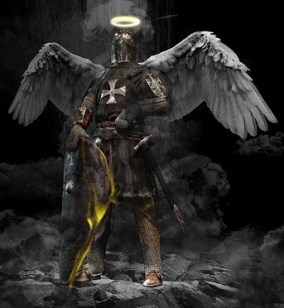 The Archangel Michael, whose name means Who is like unto God?, is the prince of angels. We read in Revelation why Holy Father Leo sought his intercession; it is Michael who leads the heavenly angels in the ultimate battle against Satan and his demons and teaches them why there are none like unto God. Apart from reciting the Pope’s prayer following Mass, let us also ask St. Michael’s intercession for all those who so often find themselves in harm’s way such as soldiers, first responders, and emergency workers. Let us also ask his intercession for ourselves during times of temptation as well as those who have fallen or are in danger of falling away from practice of the faith.
 As Christ commissioned San Lorenzo and his companions, so he commissions us. We are the light of the world; not the light of the rising sun but the light of the risen Son.
 St. Vincent de Paul didn’t begin any better than we, but he ended as well as we can ever hope to. What led him to a healthy, happy life? His relationships to God, his peers, and his flock. How does that help us? At least three ways. First, our relationship with God is at its best when we remember that He dwells not only above but also within each one of us; second, that when we reach out in love to others God is reaching them through us; and third, that we are both sheep and shepherd; the call to holiness is not only a call to take up our cross and follow Christ but to take up our staff and bring others to Him by the example of our lives.
 St. Paul reminds us of this when he says that grace is given to each according to the measure of Christ’s gift (Ephesians 4:11). His measure to Matthew was enough to transform him from a mere money-counter into an artist; indeed the artist who gave us the first portrait of Jesus in our New Testament. His medium wasn’t oil on canvas but words on paper, his subject not simply the man named Jesus but the Son of God and Son of Mary, the prophesied Emmanuel, “God is with us.” His palette held the many colors of Christ: teacher, healer, wonder-worker, Shepherd, Savior. He boldly painted all these images against a dark background for Jesus had come not into a roomful of Roman gamblers but into a land whose people were overshadowed by the darkness of sin and death. Where Caravaggio showed the light coming from behind Christ, Matthew knew that for all times and places Christ is the light – not the light who shines but the light who has arisen (Matthew 4:16). The long night of waiting, hoping, and wondering was over; the bright promise of salvation had dawned in Jesus, the Morning Star who never sets. This is why the great artist put the final brushstroke to his masterpiece in the words of our risen, ascending Master: And behold, I am with you always, until the end of the age (Matthew 28:20).
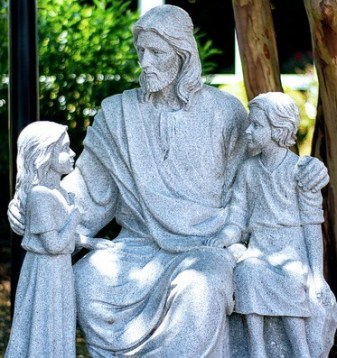 The example of the Korean Church and her martyrs teaches us that every heart open to God and acting on his word becomes a mother, sister, and brother to Christ. Even though we may not have the power of Orders, we do have Christ in the Scriptures and the power of the Holy Spirit through our baptism. We too can evangelize. If you don’t know where to begin, consider: Religious education programs can always use help teaching children the faith; there is a bible study nearby that would teach you more about Christ; there are many ministries that reach out to the hungry, the poor, and the mourning. Be docile to the promptings of the Holy Spirit; He will show you ways to bring Christ to someone in need.
 Finally, the cross is a sign of victory. It is the apparent irony seen throughout salvation history that God works for good by turning evil upon itself. It was Pharaoh who pronounced the curse by which his own people would most suffer: the death of every firstborn. In the desert it was the emblem of the serpent, reminiscent of the one whose envy brought death into the world, that would be lifted up on a tree as a sign of healing and life. It was Caiaphas, plotting to have Jesus executed, who unwittingly prophesied that it was better for one man to die than for the whole nation to perish. It was the Roman governor Pilate who first asked
  Mark 10:45