Wisdom 18:6-9; Hebrews 11:1-2, 8-19; Luke 12:32-48
When the Communist Party under Vladimir Lenin seized power in Russia in 1917, a brutal anti-religious campaign began. Over 100,000 clergy were shot or imprisoned, seminaries closed, religious literature banned, and atheism exalted. By 1939 only 100 churches remained open; the rest – about 60,000 – were confiscated, desecrated, and turned into everything from museums and warehouses to public bathrooms.
Yet by 2011, a survey of religious practice showed that Russia was the most God-fearing nation in Europe, with 82% of her people believing in God. How did religious belief survive despite over 70 years of oppressive persecution? The Russian people and the Church knew the answer: The babushkas.
So who were they? Well, “babushka” in Russian means “grandma.” The babushkas were the elderly women who kept the flame of faith alive during those terrible years. They are a testament to the kind of faith that is spoken of in today’s readings.
What kind of faith is that? The kind that expresses itself in prayer and action; vigilant and resilient, it finds ways to survive even the toughest conditions, like those of the ancient Jews. It was a mean, difficult existence as a Jewish slave; life was hard and only got harder when they asked for freedom. Yet they never gave in; instead, they quietly passed on the faith to their children and prayed in secret. Similarly in Russia. Life for Christians was obviously very hard; still, the babushkas never gave in. Rather, they took action at home and in public. Because Soviet mothers were forced to work, babushka stayed home with the kids and used that time to quietly teach them the faith. In public, where they were dismissed as harmless and irrelevant, the babushkas crept into the deserted, desecrated churches, lit candles, and prayed for deliverance. It didn’t happen overnight, but for both the Jews and the babushkas, the strategy paid off.
We can learn from them for we have challenges, too. We aren’t enslaved by any foreign power, but our society has virtually enslaved itself to the relentless pursuit of pleasure, if not decadence. We aren’t suppressed by an atheistic government but we, especially our young people, do seem to be infected by a kind of spiritual apathy best summarized by a twenty-something who said to me, “I don’t care if God exists or not.”
So these are tough times too but we can rise to the challenge; we can show that resilient and vigilant faith that Christ is looking for. Perhaps you’re a grandma or grandpa; as our congregations age we have more and more of them. Fine. Be babushka. If your own kids aren’t teaching the faith to your grandkids, then you do it. Bring them to Mass if you can. If your kids forbid it, find an indirect way. Watch movies with the grandkids that touch on spiritual themes or read them the classic books that do the same. Challenge them; get them to think about the important issues facing them. However you can, teach them the self-giving love of Christ. When all is said and done, what is more important than that?
Equally important, none of this is going anywhere without prayer. God has the power to deliver us but he wants us to pray, to ask him for help. The Hebrew slaves prayed, the babushkas prayed, Jesus himself prayed before all of the major events of his life. So we are called to pray, to lift up our hearts to the Lord and ask for his intervention.
We know that, but we also know that prayer isn’t easy even in the best of times. We get distracted, feel like God is far away, put off praying, or get discouraged. These only get worse when we’re going through hard times.
 The answer to all of this is given by Jesus in the gospel and can be boiled down to one word – vigilance. If you sense that you are distracted in prayer, then let that become your prayer. Say, “Lord, see how weak I am. I can’t even focus on you now when I need you the most!” In your weakness Christ will be your strength. If you feel like God is far away, remember: God doesn’t move, we do. Weak faith causes us to drift. We strengthen it with exercise, so pray more, not less; attend Mass more often; see him in Adoration. If you find yourself putting off prayer, remember Christ’s words: At an hour you do not expect, the Son of Man will come (Luke 12:40). Also, remember his reaction to finding people not doing what he asked; it did not go well for them. Finally, when you’re discouraged remember Abraham and everything he went through. In faith he left his native land, wandered homeless, and nearly lost his only son. As if that wasn’t enough, he was never allowed to actually live in the land he was promised. Those are pretty good reasons to be discouraged! Still, no matter where he was, he always built an altar and sacrificed to God. He could lose his home, his son, and the land of his inheritance, but he never lost heart; he remained faithful, prayerful, and vigilant to the end. So can we.
The gospel closes ominously: Much will be required of the person entrusted with much, and still more will be demanded of the person entrusted with more (Luke 12:48). The question is, what have we been entrusted with? The answer is faith. What is the demand? That we live it out and pass it on. It seems hard because it is, but when all seems lost remember the babushkas. On the one side, the government and force of the Soviet Union determined to wipe out the faith; on the other a group of elderly women working and praying to preserve it. The Soviets never had a chance.
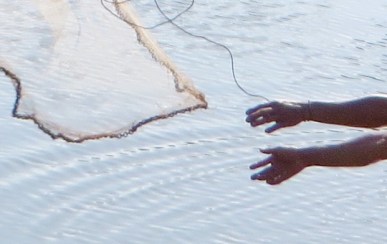 It was Simon’s willingness to put out into deep water and lower his nets despite his reservations that yielded him not only an abundant catch but more importantly the grace to see that the one who sent him was not to be called “Master,” but “Lord.” This is the same Lord before Whom we kneel as we say, “O Lord I am not worthy that you should enter under my roof, Speak but the word and my soul shall be healed.”
 He counsels us to do the same. We may be very busy attending to all the needs of children, family, or work. Whatever dominates your time, resolve to find even a few moments during the day to retreat to your own “deserted place” and listen for that still, small voice which is God.
 Contemplate the humility, the patience, and the genius of this teacher. In our very flesh God himself becomes incarnate; in the Scriptures he consistently speaks to us; in the form of simple bread and wine, blessed and broken, he veils himself and enters into us, all done out of pure, gratuitous love that seeks only to raise us from wherever we are to a place closer to him for all eternity.
 Thus, the encounter with Christ is the key to evangelization. As Cardinal Francis George once said, evangelization consists of introducing people to Christ and allowing him to take over from there. No matter how eloquent, forceful or dramatic we are, the human word pales in comparison with the Eternal Word. Like Nathanael, every person has their own “fig tree” moments; at one time or another, everyone quietly contemplates the eternal, the divine, the transcendent. This is a mystical silence into which we dare not intrude; it is the stillness in which God speaks. The God who sees what we cannot – the heart and soul – speaks to whole person as we cannot. Again like Nathanael, the effect is all-encompassing and all-surpassing.
 What is unique to Luke in the Transfiguration is the dimension of prayer. Only he tells us that Jesus ascended the mountain to pray. Luke properly understands it as a tale of two mountains: On the one, the unnamed mount of Transfiguration, the prayer of Jesus results in a glorious vision, he dazzling white, his face shining, his Father speaking to the apostles awakened. On the other, the mount of Gethsemane, the prayer of Jesus will end in the passion, his face sweating blood, his Father silent, and these same apostles sleeping. Luke is clear: We cannot have the glory of the Transfiguration without the suffering of the cross. In Christ, the two are inextricably bound. What’s more, this is the cost of discipleship; later in Luke Jesus will say, Whoever does not carry his own cross and come after me cannot be my disciple (Luke 14:27)
 Mark 10:45