Zechariah 8:1-8; Luke 9:46-50
The readings from Zechariah and Luke may not be a study in contrasts, but they certainly point in different directions. On the one hand, the reading from the prophet Zechariah paints an ideal picture. Jerusalem is restored and at peace; the elderly sit and watch as children play in her streets; God dwells among his people. The gospel, on the other hand, presents us with a different picture; it hints at pride and mistrust among the Apostles; first they dispute who is the greatest in the kingdom, then they attempt to stop the good work done by an outsider in the name of Christ.
Light can be shed on these contrasting images as we contemplate the life and example of a saint whose memorial we celebrate today. San Lorenzo Ruiz was born around the year 1600 in the Philippines. Raised as a good, practicing Catholic, he married, fathered three children, and worked as a gifted calligrapher. His life was forever altered when, under mysterious and murky circumstances, he was falsely accused of murder. Forced to flee his native country, he learned of a Dominican mission to the Orient and volunteered to serve. During the voyage, Lorenzo learned that the destination was the country of Japan.
Let us reflect for a moment on a verse from the prophet Zechariah: Lo, I will rescue my people from the land of the rising sun (Zechariah 8:7). Speaking through the prophet, God revealed his plan to rescue Israel from the kingdom of Persia, which was known as the land of the rising sun. A thousand years later in the time of San Lorenzo, the missionaries planned to continue evangelizing in the islands of Japan, known then (and now) as the land of the rising sun.
They knew there would be trouble. To the Japanese authorities, the missionaries were unwelcome outsiders who were to be brutally put down. Soon after landing, they were captured, imprisoned, and tortured. It is said that when his captors asked if he would renounce his faith to save his life, San Lorenzo responded, “I am a Christian and I shall die for God, and for him I would give many thousands of lives if I had them.” He was martyred not long after this.
Lo, I will rescue my people from the land of the rising sun. These consoling words spoken by God through Zechariah were also spoken by God through the lives of San Lorenzo Ruiz and his companions who brought the gospel to the land of the rising sun. While there were those who preferred the darkness enough to kill the light-bearers, they could not kill the light, for Christ is the light that the darkness cannot overcome.
We should not speak of the darkness as if it were always outside ourselves; the Apostles’ behavior shows that darkness exists inside as well. Our own sinfulness works against our efforts to live and preach the gospel. Regardless, the example of San Lorenzo Ruiz demonstrates that when we resolve to put our faith in God’s ability to work in us, through us, and despite us, we will be successful.
 As Christ commissioned San Lorenzo and his companions, so he commissions us. We are the light of the world; not the light of the rising sun but the light of the risen Son.
San Lorenzo Ruiz, pray for us.
 St. Vincent de Paul didn’t begin any better than we, but he ended as well as we can ever hope to. What led him to a healthy, happy life? His relationships to God, his peers, and his flock. How does that help us? At least three ways. First, our relationship with God is at its best when we remember that He dwells not only above but also within each one of us; second, that when we reach out in love to others God is reaching them through us; and third, that we are both sheep and shepherd; the call to holiness is not only a call to take up our cross and follow Christ but to take up our staff and bring others to Him by the example of our lives.
 St. Paul reminds us of this when he says that grace is given to each according to the measure of Christ’s gift (Ephesians 4:11). His measure to Matthew was enough to transform him from a mere money-counter into an artist; indeed the artist who gave us the first portrait of Jesus in our New Testament. His medium wasn’t oil on canvas but words on paper, his subject not simply the man named Jesus but the Son of God and Son of Mary, the prophesied Emmanuel, “God is with us.” His palette held the many colors of Christ: teacher, healer, wonder-worker, Shepherd, Savior. He boldly painted all these images against a dark background for Jesus had come not into a roomful of Roman gamblers but into a land whose people were overshadowed by the darkness of sin and death. Where Caravaggio showed the light coming from behind Christ, Matthew knew that for all times and places Christ is the light – not the light who shines but the light who has arisen (Matthew 4:16). The long night of waiting, hoping, and wondering was over; the bright promise of salvation had dawned in Jesus, the Morning Star who never sets. This is why the great artist put the final brushstroke to his masterpiece in the words of our risen, ascending Master: And behold, I am with you always, until the end of the age (Matthew 28:20).
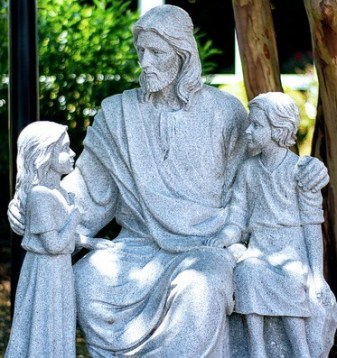 The example of the Korean Church and her martyrs teaches us that every heart open to God and acting on his word becomes a mother, sister, and brother to Christ. Even though we may not have the power of Orders, we do have Christ in the Scriptures and the power of the Holy Spirit through our baptism. We too can evangelize. If you don’t know where to begin, consider: Religious education programs can always use help teaching children the faith; there is a bible study nearby that would teach you more about Christ; there are many ministries that reach out to the hungry, the poor, and the mourning. Be docile to the promptings of the Holy Spirit; He will show you ways to bring Christ to someone in need.
 Finally, the cross is a sign of victory. It is the apparent irony seen throughout salvation history that God works for good by turning evil upon itself. It was Pharaoh who pronounced the curse by which his own people would most suffer: the death of every firstborn. In the desert it was the emblem of the serpent, reminiscent of the one whose envy brought death into the world, that would be lifted up on a tree as a sign of healing and life. It was Caiaphas, plotting to have Jesus executed, who unwittingly prophesied that it was better for one man to die than for the whole nation to perish. It was the Roman governor Pilate who first asked
  Surely his was a life lived in a manner worthy of the call. But the question remains, what about us? Are we to be another St. John Chrysostom? On one level, no; the gifts given to him were his and his alone. God doesn’t want another St. John Chrysostom. But on another level, yes, the gifts given to us are ours and ours alone and God is calling us to sanctity. We are sanctified to the degree that we take advantage of the same grace that was available to John, not to do what he did, but to do as he did. If we do not preach the gospel from a pulpit in a church we still preach it from the pulpit of our lives. Every day, we are the only homily someone will hear. If we do not shepherd a church or diocese we still have a flock; family, friends, everyone we meet. We are to teach, feed, love, and serve them as Christ did. If we do not bear the cross John bore we still take up our own and unite it to the suffering of Christ for the sake of his body, the Church.
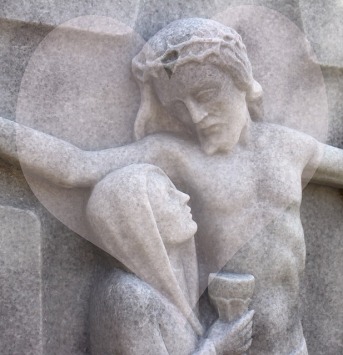 Our gospel closes with this beautiful image:
  It was Simon’s willingness to put out into deep water and lower his nets despite his reservations that yielded him not only an abundant catch but more importantly the grace to see that the one who sent him was not to be called “Master,” but “Lord.” This is the same Lord before Whom we kneel as we say, “O Lord I am not worthy that you should enter under my roof, Speak but the word and my soul shall be healed.”
 He counsels us to do the same. We may be very busy attending to all the needs of children, family, or work. Whatever dominates your time, resolve to find even a few moments during the day to retreat to your own “deserted place” and listen for that still, small voice which is God.
 Contemplate the humility, the patience, and the genius of this teacher. In our very flesh God himself becomes incarnate; in the Scriptures he consistently speaks to us; in the form of simple bread and wine, blessed and broken, he veils himself and enters into us, all done out of pure, gratuitous love that seeks only to raise us from wherever we are to a place closer to him for all eternity.
 Mark 10:45