Category: mercy

  • I Will Make You Great: Friday of the 14th Week in Ordinary Time

    Genesis 46:1-7, 28-30

    An important part of getting to know someone is finding out about their background – their childhood, family, whatever details they’d like to share. It gives us a fuller, richer picture of the person, puts what they say and do in context, and helps us come to a better understanding and appreciation of them.

    Of course, we’re much more limited when it comes to getting to know people in the bible, but that doesn’t mean there is nothing to learn. Sometimes, important details lie hidden between the lines, and knowing them helps us not only to learn more about that person but also more about us and God. This is true for one of the most important, indeed foundational, biblical characters we have heard about this week – Jacob, the son of Isaac and grandson of Abraham.

    As we study the chapters of Genesis that tell us about his life, one thing is clear: Jacob came from a dysfunctional family. It began from the twin brothers’ birth. The name Jacob means “to supplant” or “replace,” and that is what he did, first duping Esau out of his inheritance, then tricking his father into giving him the blessing intended for his slightly older brother. But their parents, Isaac and Rebecca, are the real problem; they play favorites, Rebecca going so far as to help her favorite (Jacob) steal from his brother and get away, while Isaac sat idly by as his favorite (Esau) plotted murder against Jacob. Not what anyone would call a healthy family dynamic.

    Sadly the problem followed Jacob into adulthood, for he too played favorites. We heard this week how his favoritism of Joseph led to such envy in Jacob’s other sons that like their uncle Esau they too plotted to kill their brother – and nearly succeeded.

    Yet we also saw that things don’t always work out the way we think they will. Where in Jacob’s family revenge would be expected, by the grace of God Joseph took a different tack; just yesterday we heard him say to his brothers, It was really for the sake of saving lives that God sent me here ahead of you (Genesis 45:5).

    And therein lies the lesson: With God’s help, the unchangeable can change. Like Jacob, we are born with problems, born into problems, problems plague us all our lives. They may be dysfunctional relationships, addictions, abuse, the list is endless. Whatever they are we feel powerless to change them, and on our own we probably are. But the story of Jacob teaches us that we are not alone, that no matter what the problems are God has ways of dealing with them that we do not, and that as St. Paul once said, all things work for good for those who love God, who are called according to his purpose (Romans 8:28).

    Although Jacob may have taken too much pride in himself and his own schemes over the years, he never forgot God’s purpose and to humble himself before it. In today’s reading we find him doing exactly that at Beersheba. He’s been there before; recall on Monday Scripture told of him fleeing from Esau as a frightened young man. Then, God spoke to him in a dream and, although the words are slightly different, the main points are exactly the same today: I am God… do not be afraid… I will make you great… I will be with you… I will bring you home. Through all that had happened to him from that first moment on – the joys, the sorrows, the love, the loss, the bliss, and the agony – Jacob was never alone. God was right there with him, doing what he said he would do.

    So let us resolve to respond as Jacob did. Scripture tells us that he took everything he owned and everyone in his family with him to Egypt (Genesis 46:6-7). That is, he was totally committed to whatever God wanted him to do. This takes great faith but that is ours for the asking. Jacob asked for it at Beersheba; we have the present moment, here in His presence. And let us remember too that God is never outdone in generosity. For his act of faith, Jacob was rewarded not only with the joy of holding his long-lost son in his arms once again but also, through the great prosperity and growth that Israel, the nation named after him, would come to enjoy, he could rest secure in the knowledge that God’s plan is far above any of human schemes and His merciful love infinitely bigger than any of our problems.

    The best news of all is that to those who commit themselves to Him as Jacob did hear the same words that Jacob heard. Keep them with you today and everyday. Here they are again: I am God… do not be afraid… I will make you great… I will be with you… I will bring you home.
  • All Things to One Man: The Solemnity of the Sacred Heart of Jesus

    All Things to One Man: The Solemnity of the Sacred Heart of Jesus

    Hosea 11:1, 3-4, 8c-9; Ephesians 3:8-12, 14-19; John 19:31-37

    In high school we once did an exercise on self-perception. Sister began by asking us to take out a sheet of paper and write down 3 negative things about ourselves. After a couple of minutes she said, “Alright, now write down 3 positive things about yourself.” I can’t remember what I wrote but I know I didn’t list three; I’m not sure I even wrote two. That was Sister’s point; self-conscious teen-agers aside, people in general tend to be very good when it comes to focusing on their negative qualities but not so good when it comes to the positive.

    The same goes for our relationship with God. If you’re anything like me, it’s probably much easier to come up with reasons why He shouldn’t think very highly of you than reasons why He should. Today, on the Solemnity of the Most Sacred Heart of Jesus, our Lord gives us at least three reasons to focus on the positive.

    First, listen again to his words in the 11th chapter of Hosea: When Israel was a child I loved him… I taught Ephraim to walk… took them in my arms… fostered them like one who raises an infant to his cheeks… stooped to feed my child… I will not let the flames consume you (Hosea 11:1, 3-4, 8-9). This isn’t the imagery of a God who loves from a distance, impersonally, or until we leave or hurt him; no, this is a God who loves intimately, with a deeply personal, boundless, and most of all, healing and merciful love.

    Second, as St. Paul makes clear, this is a love that goes beyond all words except the one, Eternal Word – Jesus. We can hear Paul struggling to express the inexpressible as he prays that we may have the strength to comprehend with all the holy ones what is the breadth and length and height and depth, and to know the love of Christ which surpasses knowledge (Ephesians 3:18-19). This is the key; divine love surpasses human knowledge and can be known only by faith (Ephesians 3:17), the gift of the Father possible only by the strength that comes from the Holy Spirit (CCC §683). To those who have faith, all the riches of grace are available.

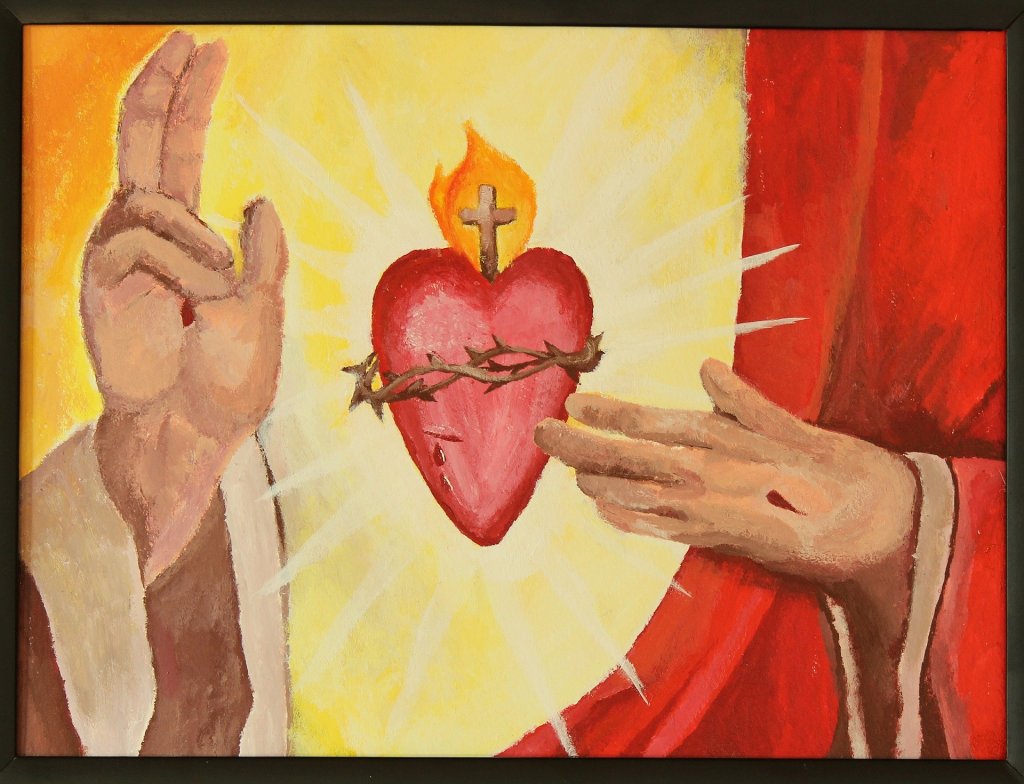
    Finally, every image of the Sacred Heart reminds us with its crown of thorns of the cost of this love. We hear in the gospel of the soldier who thrust his lance into his side, and immediately blood and water flowed out (John 19:34). There is no love worthy of the name that is not asked to endure insult, temptation, and suffering. From the dawn of humankind it is written into our nature; it’s in our blood. But it isn’t in the blood of Christ, either from his Heavenly Father or his holy Mother, the Immaculate Conception. He willingly took it on. This is perhaps the greatest and most positive of all – that God, purely out of his infinite and merciful love for us, gave his only Son that we would be raised to life eternal. As Christ himself said, there is no greater love than this.

    St. Pio of Pietrelcina, Padre Pio, understood that very well. While passing through a crowd of people all clamoring to get near him, someone shouted, “Padre, you are all things to all men!” He replied, “No, I am all things to one Man.”

    May we all come to that kind of understanding! May we all see the Solemnity of the Sacred Heart of Jesus as a day to set aside the negatives and focus on the overwhelming positive – that we too are all things to one Man. We are loved infinitely, personally, and mercifully; we are given the gift of faith which alone can make this love known to us beyond any human understanding; and finally, that as the ultimate expression of this love the Second Person of the Blessed Trinity took human form and allowed his own heart to be pierced that we may not only look upon him in mourning for the sinfulness that put him there but with rejoicing that divine love can take even the passion and death of Christ, the greatest insult of all time, and transform it into the greatest victory the world will ever know – the resurrection to eternal life for all who believe and return to God with their whole heart (Joel 2:12).

    Sacred Heart of Jesus, have mercy on us.

  • The Invitation to Dare: Divine Mercy Sunday

    The Invitation to Dare: Divine Mercy Sunday

    Acts 4:32-35; 1 John 5:1-6; John 20:19-31

    The gospel according to John has been called the gospel of encounters. Each follows the same basic pattern: Jesus encounters someone, they test him, there is an exchange, and the encounter ends with those who tested Jesus finding that in reality they are the ones being tested: Will they believe or not? Of course, Jesus wants them to rise to the challenge but he never forces them; it’s their choice and a test of their faith.

    Between last Sunday and this, John gives us five encounters, each posing its own challenge to faith. First, the Beloved Disciple: Will he believe in the resurrection based only on the testimony of an empty tomb? No; he has to see the tomb himself and the burial cloths neatly arranged, perhaps as proof that the body of Jesus was not stolen. Then Mary Magdalene: Will she recognize the risen Lord if she sees him? No; she must hear his voice. Next, the Apostles: Will they believe if they see and hear? Only when Jesus shows them his hands and side. Then Thomas: Will he believe his brother Apostles, now eyewitnesses? No; he needs to touch the wounds of Christ. The fifth challenge is from the evangelist to us: Will we believe without being able to see, hear, or touch Jesus?

    We might be tempted to say no, for if the Beloved Disciple, Mary Magdalene, and the Apostles struggled with faith, what hope do we have? But that’s not the attitude of Christ; he calls us “blessed.” Why? Because his encounters with us are not about human failure but about the triumph of divine mercy. Jesus didn’t resent the Beloved Disciple going to the tomb; rather, he used it to inspire John to recall the words that made that trip unnecessary: Destroy this temple and in three days I will raise it up (John 2:19). He wasn’t disappointed that Mary Magdalene needed to hear him; he is the Good Shepherd whose sheep follow him because they recognize his voice (John 10:4). He wasn’t angry that the Apostles had to see his wounds; rather, he bid them peace and gave them authority to forgive sins, so that others may know the same peace and all might take to heart his words at the Last Supper: Do not let your hearts be troubled. You have faith in God; have faith also in me (John 14:1). He was perhaps kindest of all to Thomas, that from he who seemed weakest in faith came the greatest affirmation of Christ’s divinity in all the gospel: My Lord and my God (John 20:28). Finally, Jesus spoke encouragingly to us, calling us blessed because we have not seen and have believed (John 20:29).

    This is how God shows mercy: By encouraging rather than cajoling, inspiring rather than depressing, and building up rather than putting down (although justice sometimes demands the whip). For his goal is and always has been to raise us up to himself. God is love and as one spiritual writer has noted, “mercy is love bending over misery to relieve it, to redeem it, to raise it up to itself.”[1] Time and again God has shown that this is what he will do, even to the giving of his only Son, that in his infinite mercy, he might draw us closer and closer to himself.

    Today we have the opportunity to draw very close indeed, for on the Feast of Divine Mercy, Christ offers us a great gift: The renewal of baptismal grace; the complete forgiveness of sins and punishment. This grace is usually received only through baptism itself or a “perfect” sacramental confession – one made purely for the love for God.

    Of course, like all encounters with Christ, there is a challenge. We can only obtain this extraordinary grace if we worthily receive the Eucharist on the Feast of Divine Mercy or its vigil Mass. Since we are at that Mass now we’re off to a good start, but that’s not all; worthily means that we have made a good sacramental confession in the recent past (say, Lent), that we’re still in the state of grace, and that we trust in the infinite mercy of God. Also, our Lord revealed to St. Faustina that if we are to receive mercy, we must show mercy. We don’t have to do what the Christians did in the first reading – sell our homes and give the proceeds to the poor – but we do have to practice the works of mercy listed in the Catechism: Spiritual works such as teaching the faith, advising, consoling or comforting others, forgiving and bearing all wrongs patiently, and the corporal works such as feeding the hungry, sheltering the homeless, clothing the naked, visiting the sick and imprisoned, and respectfully burying the dead.

    Fr. Michael Gaitley, who has dedicated himself to spreading the Divine Mercy devotion, advises us to remember that we do these things out of love and gratitude to God, not to try and earn his mercy. Asked what the biggest misconception is about Divine Mercy, he said that many active Catholics have somehow gotten the idea that “God’s love must be earned by following all the rules, saying all the prayers, and giving money to the right causes… that the more perfect we are, the more worthy we are to draw close to Jesus. The reality is that Jesus invites us spiritually poor, weak, broken, and overburdened people to draw as close as we dare…”[2]

    Every encounter with Christ is an invitation to dare; to “become who we are.” It requires us to face who we are – poor, weak, and broken – but also to see ourselves as God sees us – eternally willed, infinitely precious, and worth any sacrifice. In this lies the wound to our pride, the admission that there is nothing we can do to earn our own salvation but also the healing truth that there is nothing we need to do, for God has already done it. All he asks is that we accept it and, on this feast of Divine Mercy, show our gratitude for it. The only question is, will we?

    1 Fr. Gabriel of St. Mary Magdalene, Divine Intimacy, #236, Section 1.

    2 Catholic Digest, April/May 2020, page 16

  • The Heart of the Law: The 3rd Sunday of Lent, Cycle B

    The Heart of the Law: The 3rd Sunday of Lent, Cycle B

    Exodus 20:1-17; 1 Corinthians 1:22-25; John 2:13-25

    At first, today’s readings might not present themselves as a unified whole: Moses receives the Ten Commandments; St. Paul speaks of the cross; our Lord cleanses the Temple. But if we look a little below the surface, a theme does emerge.

    First, the Ten Commandments. As significant as they are on their own, these are only the first of a series of commands that God used to define the terms of his covenant with the Hebrews. The agreement was this: If the people obeyed God’s law, they would not only be his treasured possession but God would have a sanctuary built and dwell among them. This was truly momentous, for God hadn’t dwelled among people since the Garden of Eden (recall him walking in the Garden in Chapter 3 of Genesis).

    This is why several chapters of Exodus then go into great detail about the sanctuary’s construction. Much of it symbolizes the Garden of Eden, that first sanctuary of God, including the tree in the center of the Garden – the tree of life. And that explains why, down to the time of Jesus and beyond, the Temple held such pride of place among the Jews: The Temple was an icon of the universe, including paradise, and its center, the holy of holies, the place where God Most High dwelled among his people. It was as if God was re-creating Eden and restoring his people to their place near the tree of life.

    The only thing more incredible than all this was how little time it took the Hebrews to break the covenant. Just weeks after agreeing to have no other gods they melted jewelry to make a golden calf. But then we shouldn’t be too hard on them; it’s human nature to want our own way, to determine for ourselves what is good, and then, after we’ve sinned, to rationalize or minimize it.

    We see that in the gospel story. Jewish law did stipulate a census tax and the securing of an animal for sacrifice, but neither of those things had to be done on Temple grounds and there is little doubt that at least some profiteering went on. But come on, what’s the harm? People paid the tax and sacrificed their animal. We see it in our own time as well. For example, the Catechism teaches that it’s a sin against the 2nd Commandment to say God’s name when we’re not praying. God’s name is holy, and we are to speak it only to bless, praise, and glorify him (CCC §2143). Still, we’re tempted to think, “No way. Everybody says, ‘OMG’ when they talk. I can’t believe God really cares about that!”

    But we forget the ancient principle of law that says that the seriousness of an offense is determined not by the person who commits the crime, but by the dignity of the victim. For example, in civil law, if a man assaults someone he might be arrested or fined, but if he assaults the President of the United States he will definitely go to prison for a very long time. Why? Because of the dignity our society bestows on the office of President.

    So with God’s law; when we sin God is offended, and because God’s dignity is infinite, every offense against him is infinite. From that perspective, think how arrogant it is for us to tell God when he should or should not be offended, or demanding that God explain himself to us. That’s exactly backward. Only God gets to say when he is offended and, as Christ implied in the Temple, only God is in a position to demand anything.

    This at last brings us to the cross. For God does demand something – justice – but in his infinite mercy demands that it be satisfied once and for all through the sacrifice of his only Son. As much as the commandments mean, as much as the Temple ever meant, infinitely more was given to us by this gift. For as he implied in today’s gospel, Jesus is the Temple, and only in his cross do we find the true tree of life, the highest expression of what we are called to be, how we are are called to love.

    In these remaining days of Lent, make time to contemplate the cross. If you do not pray the Stations of the Cross, consider doing that. Regardless, pray the words we begin with – the Act of Contrition: “O my God,” (said in prayer!) “I am heartily sorry for having offended Thee, and I detest all my sins because of Thy just punishments, but most of all because they offend Thee, my God, Who art all-good and deserving of all my love. I firmly resolve, with the help of Thy grace, to sin no more and to avoid the near occasions of sin.”

    This prayer helps us remember what God wants most: That his law be written on our hearts; that from our heart we are sorry for offending his infinite dignity; and that we are committed to avoiding the situations or places that have helped lead us into sin. All this strengthens within us the Holy Spirit’s gift of fear of the Lord, through which we come to love God so much, to respect his dignity so deeply that we never want to do anything to offend him; to say as little St. Joan of Arc said at her trial, “I would rather die than do a thing which I know to be a sin or against the will of God.”

    That is the heart of Christ, whose love is the heart of the law.

  • Mercy and Forgiveness: Monday of the 2nd Week of Lent

    Mercy and Forgiveness: Monday of the 2nd Week of Lent

    Daniel 9:4b-10; Luke 6:36-38

    The readings today evoke two images of Pope St. John Paul II in my mind.

    The first is of a trip the pope made on April 13th, 1986. Although very short – less than two miles from the Vatican – its impact was as great as any pastoral visit he would ever make. For on that day the Holy Father bridged a gap that was centuries wide, doing what no pope since St. Peter had ever done: entering a Jewish synagogue. In fact, he entered Rome’s Great Synagogue and, while 1000 Jews watched and wept, warmly embraced the Rabbi, then publicly and sincerely apologized to all Jews on behalf of the Church for whatever part she played in the centuries of discrimination and persecution the Jewish people had suffered.

    We naturally tend to focus guilt on ourselves as individuals but the pope reminded us that, as the reading from Daniel implies, sin is sometimes a matter of “we,” and not just “I.” In his Apostolic Exhortation “Reconciliation and Penance” John Paul II referred to this as social sin – sins committed by groups as small as a few people or as large as many nations. His point was that each member bears some share of responsibility for what the group does or fails to do. As he wrote, social sins are the “very personal sins of those who cause or support evil or who exploit it… who are in a position to avoid, eliminate or at least limit certain social evils but who fail to do so out of laziness, fear or the conspiracy of silence, through secret complicity or indifference… who take refuge in the supposed impossibility of changing the world and… sidestep the effort and sacrifice required….”1

    Therefore, it is our moral duty as Catholics to examine ourselves in light of the behavior of the groups in which we participate in our parish, Church, community, nation, and world, and to speak and act against these behaviors when necessary.

    The second image of St. John Paul is in the prison cell of his would-be assassin, the man who shot him several times on May 13th, 1981. Although the pope publicly forgave him four days later, in 1983 he visited the prison and personally did so again. Later, John Paul appealed to the Italian government to release him, which they did. Eventually the man converted to Catholicism, citing the pope’s influence.

    In the gospel, Luke does not put on our Lord’s lips the words Matthew used: Be perfect, just as your heavenly Father is perfect (Matthew 5:48). Instead, the Jesus of Luke says, Be merciful, just as your Father is merciful (Luke 6:36). Here, “merciful” could also be translated “compassionate,” and there are few examples of mercy or compassion better than the Holy Father’s actions. And look at the effect! The transformation of a man from one who would kill the Vicar of Christ into one who would rather die for love of Christ.

    The power to look within and see the personal and social sin as well as the capacity to show mercy comes as the free gift of our Lord to all who are willing to ask forgiveness of those we have wounded and offer it to those who have wounded us. This is the transformative power of the heart of Christ, as St. John Paul reminded us when he said, “I invite you all to join me in turning to Christ’s heart, the eloquent sign of the divine mercy, the “propitiation for our sins,” “our peace and reconciliation,” that we may draw from it an interior encouragement to hate sin and to be converted to God, and find in it the divine kindness which lovingly responds to human repentance.”

    Sacred Heart of Christ, have mercy on us.

    St. John Paul II, pray for us.

    1http://www.vatican.va/content/john-paul-ii/en/apost_exhortations/documents/hf_jp-ii_exh_02121984_reconciliatio-et-paenitentia.html