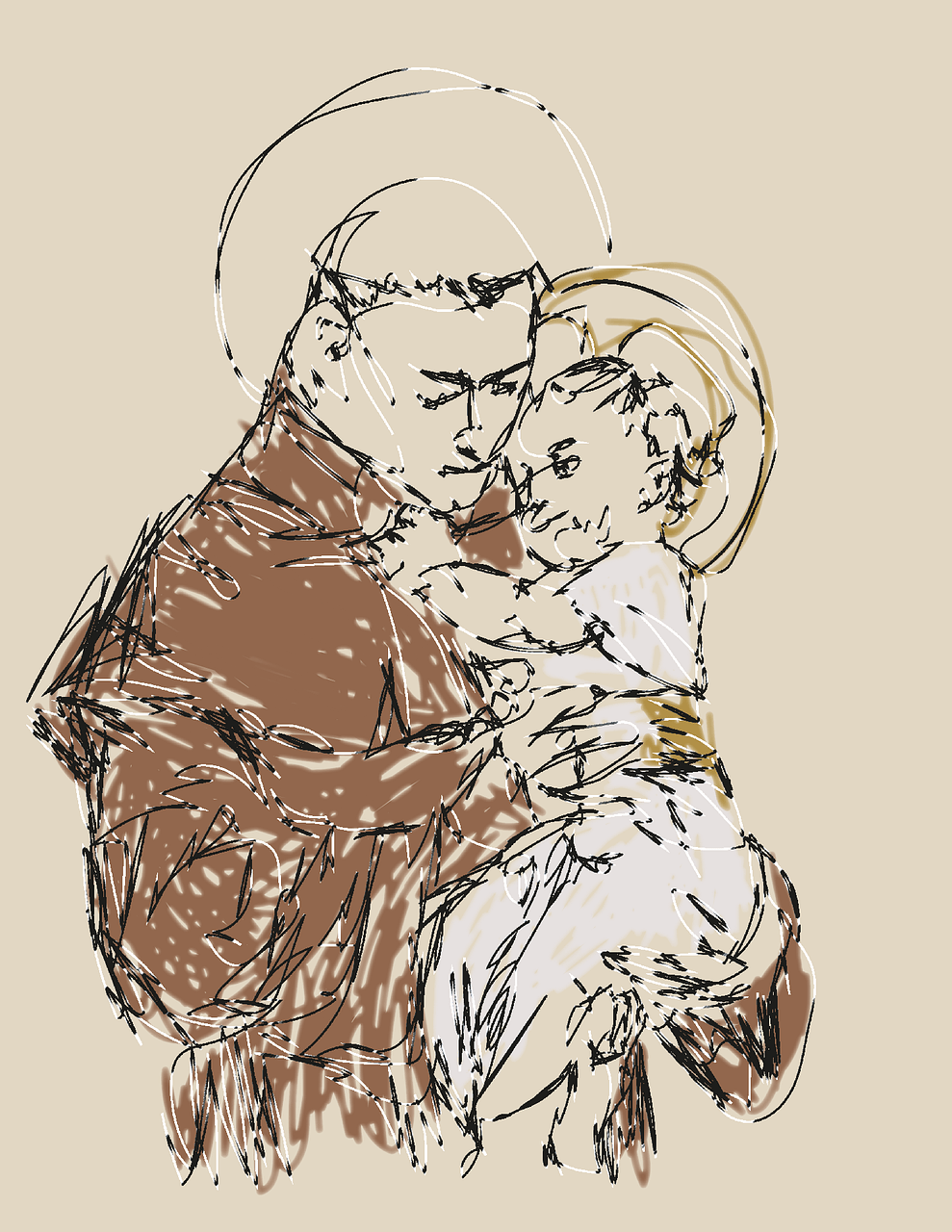
Memorial of St. Anthony of Padua, Priest and Doctor of the Church
1 Kings 18:41-46; Psalm 65:10, 11, 12-13; Matthew 5:20-26
Today is the Memorial of St. Anthony of Padua. Although time doesn’t permit us to look very deeply into his life, this man is such a great saint that even a summary can help us understand something important about God and ourselves.
Born in Lisbon in 1195, Fernando Martins de Bulhões became an Augustinian priest near his home in Portugal, but spent most of his life as a Franciscan named Anthony. He wanted to be a missionary to the Muslims in Africa; he became a theologian. He wanted to be a martyr; he became a teacher. He wanted a quiet life of menial labor; he became a renowned preacher against heresy and the first theology instructor of the new Franciscan order. He wanted to die in Padua; he died on his way there.
In the gospel, Jesus said that unless your righteousness surpasses that of the scribes and Pharisees, you will not enter into the Kingdom of heaven (Matthew 5:20). It isn’t that the scribes and Pharisees have no righteousness, it’s that ours must be surpassing. In life, there is good and there is better; we may be in good health, but we can be healthier. This also applies to the spiritual life; we may have a good understanding of the bible or the Church, but we can always learn more, and, in so doing, grow closer to God.
Everything Anthony wanted was good. Being an Augustinian, a missionary, a martyr, living an ascetic life, serving in the lowest place, are all very good. Nevertheless, God had something better, something surpassing, in mind for him. All people, good and evil alike, are called to conversion. Everyone can grow in holiness.
While growth in holiness sounds great, in practice it means that sometimes we will find ourselves in places we don’t expect, doing things we didn’t plan on doing. If we are ever tempted to see these as mistakes, deviations from the plan, the life of St. Anthony shows the opposite; they may be the plan. We may be exactly where God wants us.
How do we know? By looking at the fruit of our labor. Again, consider St. Anthony. All his desires – to be an Augustinian, a martyr, a servant in a monastery – would have had wonderful effects, touching many lives for the better. For most of us, any of these would be a surpassing gift. But God had given Fernando a brilliant mind, capable not only of understanding deep theological concepts, but of being able to express them simply, clearly, and profoundly. These, along with his passion and humility, would sway the hearts of thousands otherwise lost to the heresy sweeping across western Europe. Thus, Anthony of Padua had gifts that could change the course of the Church herself forever.
He couldn’t know that at the time, any more than we know how our choices will affect others. But therein lies his true greatness; like Elijah’s servant who kept looking for God in the storm, St. Anthony looked for God always and everywhere in the events of his life until he found Him, and then listened to and obeyed Him. We are called to do the same. Like that servant, all we may see at first is the “storm” – the illness, the suffering, the things we’d rather not do. But, if we’re vigilant, if we keep looking with the eyes of faith, God will give us the grace to see ourselves as the psalm does; that through these storms, our Lord prepares us to receive Him. There is pain in breaking into the soil to do that, but how else can the seed grow into a rich harvest? This is how God loves us, and love is His most surpassing gift; He gives it to us every day, at every Mass, in every Eucharist. As St. Anthony and all the saints show us, with the grace of this gift, there is nothing we cannot do.
St. Anthony of Padua, pray for us.
—
 Mark 10:45
Leave a comment