Wednesday of the 3rd Week of Advent
Isaiah 7:10-14; Luke 1:26-38
In its very first paragraph, the Catechism of the Catholic Church says, “At every time and in every place, God draws close to humanity. He calls us to seek him, to know him, to love him with all our strength” (CCC §1).
God calls us. He draws close. The season of Advent has been called a season of hope for that reason. Day after day, its readings show the truth of those words. We see good evidence for that in the readings today, particularly in the promise given through Isaiah that is ultimately realized in the gospel.
As we heard in the reading from Isaiah, the promise was first revealed to Ahaz, the king of Judah. Ahaz was a young man at the time, about 21, who found himself caught up in a power struggle between warring nations, and was in way over his head. God approached him once, just before today’s passage, and was ignored. Now, He has spoken again, this time inviting Ahaz to ask for a sign. Although the king’s response about not wanting to test the Lord seems humble, a deeper look shows this to be less than genuine; Ahaz had already thoroughly tested the Lord (2 Chronicles 28:1-4). The truth is, the king had no faith in God or His promises; he put his faith in the Assyrians and their military might.
Where do we find reason for hope there? Well, consider that, despite the king’s utter faithlessness, God gave him a sign anyway. Even when He is repeatedly ignored or rejected, God never stops trying; He always reaches out, always invites, always gives a sign, is always willing to heal the wounded and welcome home the lost. This is a good time to remember all the people we know who continue to ignore or reject Him, and be consoled that God is merciful, loving, and always ready to forgive. What better reason for hope is there than the depths of such divine love?
Second is that hope is the object of the prophecy itself: the virgin shall conceive and bear a son, and shall name him Emmanuel (Isaiah 7:14). The name “Emmanuel” means “God Is With Us.” As Christians, we see its fulfillment in Jesus, but this prophecy was spoken to, and meant for, the people of Isaiah’s time as well. Ahaz and many in his line were terrible kings, and their people suffered very much. The promise of Emmanuel was a great consolation and hope; not just in some future coming, but in the reality that God was already there and would always be with them. The same is true for us. It was Jesus himself who reassured us of this when he said he would always be with us, until the end of the world (Matthew 28:20).
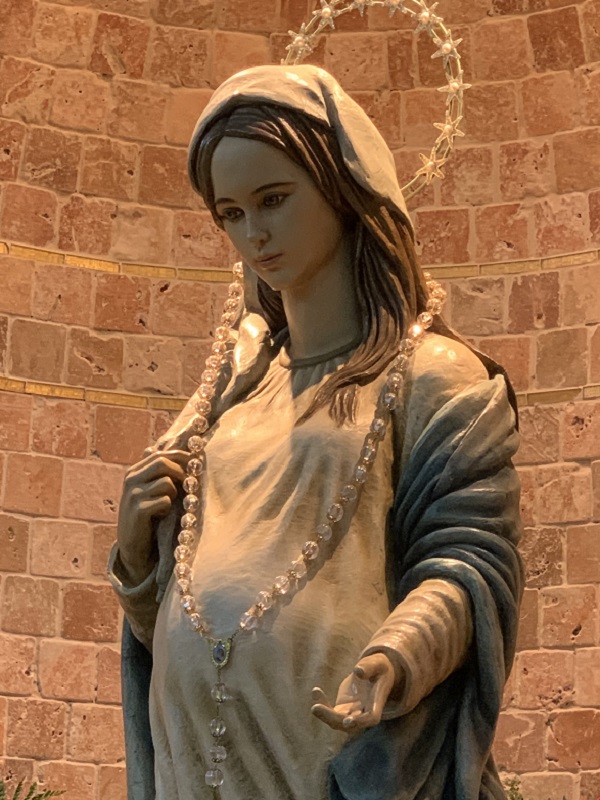
A third reason for hope goes right to the heart of revelation itself. St. Bernard of Clairvaux once hinted at it by writing that when Gabriel told Mary that God had chosen her to be the Mother of His only Son, it was as though the angels in Heaven all held their breath waiting for her reply. No one – neither the angels, the saints, nor anyone on Earth – can know the mind of God. We know only what He wants us to know, when and how He wants us to know it. The rest is a mystery we are asked to submit to in humility and as an act of faith and hope. And not just submit to, but participate in; as the Offertory prayer says today, “Look, O Lord, we pray, upon the one sacrifice of your Son, that, by participating in this mystery, we may possess at last the gifts we have awaited and for which our faith bids us hope.” Who participated in the mystery of the Incarnation more than Mary, the Mother of Hope?
Advent truly is a season of hope – in God’s steadfast love, His constant presence, and His perfect plan for us and our salvation. In that hope, let us devote every moment of our lives as followers of her Son to saying in action what Mary said to the angel: May it be done to me according to your word (Luke 1:38).
 Mark 10:45
Leave a comment