Matthew 8:18-22
The gospel reading begins with an image of people crowding around Jesus. Then and now, people are drawn to Christ. Some he inspires, others he mystifies.
Among those he inspired was the scribe who said, Teacher, I will follow you wherever you go (Matthew 8:19). We may not realize what a bold, shocking statement this was. In those days, scribes didn’t follow; they led. They spent years studying Scripture and were seen as authorities on it. But when this man saw and heard Jesus, he must have sensed a different kind of authority; as Matthew said earlier, Jesus taught as one having authority, and not as their scribes (Matthew 7:29). The scribe had once dedicated his life to studying the written Word of God; now, he could actually see the living Word of God standing right in front of him.
Not everyone is gifted with such vision. Some people are mystified by Jesus. Ironically, these are sometimes the people closest to him, those to whom he has given authority. Somehow, they have gotten lost in the depths of his infinitude. Such a one was Nestorius, a bishop of Constantinople in the 5th century. He looked at Jesus and saw two persons; one human, one divine. When asked if Mary could be called the Mother of God, Nestorius replied no; Mary was the mother only of the human Christ, distinct from the Second Person of the Trinity. She should not be called the Mother of God.
It didn’t take long for this opinion to reverberate around the Middle East and it certainly caught the attention of Cyril, bishop of Alexandria. Although little is known directly about Cyril’s personality, his letters and actions portray him as a deeply a passionate man, determined to protect the faith from heresy. When his sometimes fiery correspondence with Nestorius failed to resolve the issue, Cyril escalated it to Rome. The pope agreed with Cyril, but Nestorius appealed to the Emperor, who supported him. A Church council was called, set for St. Mary’s church in Ephesus, scheduled to begin on Pentecost, June 7, 431.
Cyril and a large contingent of bishops, including Nestorius, arrived to find that many others, mostly supporters of Nestorius, were delayed. After waiting for two weeks, Cyril grew impatient. Over the written protest of many bishops, he decided to begin the Council with those in attendance. When the Emperor’s delegate, who supported Nestorius, fired back that he couldn’t do that, Cyril ordered him to read aloud the Emperor’s opening statement and then had the man thrown out. Cyril assumed presidency of the assembly and began the Council.
Nestorius knew that he had no chance without more support and refused to attend, despite three invitations from Cyril. Once more, Cyril had enough; he ordered his own position and that of Nestorius read aloud to the bishops and into the record. Cyril’s position was accepted, that of Nestorius was condemned. What’s more, the bishops removed him as bishop of Constantinople. All other business was quickly concluded and the Council was closed. The people in the streets met the bishops rejoicing. Thanks to Cyril, Mary could indeed be called the Mother of God.
Shortly thereafter, the supporters of Nestorius arrived. Furious and insulted at being left out, they convoked their own Council, deposed Cyril and condemned his associates. Tempers flared, the Emperor got involved, and both Cyril and Nestorius wound up in prison. Ultimately, they were released and the Council held by Cyril received papal approval. Cyril remained bishop of Alexandria and went on to write eloquently of the Blessed Mother; defeated, Nestorius returned to a monastery in Antioch.
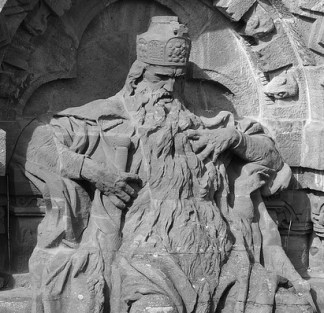 Although he was as willing to follow Jesus as the scribe in the gospel, Cyril did not lose his personality in the process. By all accounts, he was imposing, impetuous, impatient, perhaps even infuriating. He wasn’t always the perfect picture of sanctity or the epitome of virtue. Very few saints are. Sinners and saints fight the same battles, share the same temptations, and struggle with the same demons. They differ only in their response to them. The sinner looks to himself or to the world for strength; the saint looks to Christ alone. This is what Cyril knew and what St. Paul meant when he told the Corinthians: Christ said to me, “My grace is sufficient for you, for power is made perfect in weakness.” I will rather boast most gladly of my weaknesses, in order that the power of Christ may dwell with me. (2 Corinthians 12:9).
St. Cyril of Alexandria, pray for us.

 This may sound easy but we know it isn’t, for we too are twisted iron. Perhaps we can’t enter religious life to get twisted straight but we can enter into the silence of our thoughts and the privacy of the confessional to learn how to deal with the sins that are holding us back. Whatever they are, the example of St. Aloysius shows us that while change may be difficult or painful, it is possible.
 It took a long time – generations – but the Church in Europe triumphed even over the seemingly invincible Vikings. I say “seemingly” for we who hear the words of Christ in the gospel know that in reality the Vikings never had a chance. All they had were swords, brute strength, and a fierce warrior spirit; what is that against the gentle, persistent, indomitable power of God? Through the ministers of the Church, the Spirit of God flowed over that mighty Norman rock and carved it into a force that would defend and promote the faith they once mocked for yielding so easily.
 Although w
 No one can give what they do not possess. Father Anthony possessed great faith and great charity, but what transformed him from service in an Augustinian monastery to service as one of the greatest preachers and teachers of the faith was his love of Christ, shown in his constant willingness to discern and pursue the call of Christ in his life as well as his desire to keep Christ at the center of his life. As he once so eloquently said, “If you preach Jesus, he will melt hardened hearts; if you invoke him he will soften harsh temptations; if you think of him he will enlighten your mind; if you read of him he will satisfy your intellect.”
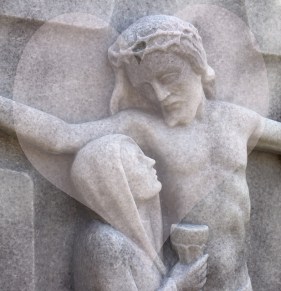 The life of Blessed Diana d’Andalo shows us that to those docile to His promptings the Holy Spirit will show both the greatness and the folly inside ourselves. Diana’s folly lay in the selfishness and will to dominate that has plagued mankind since it first heard the voice that whispers You can be like God (Genesis 3:5). Her greatness lay in her steadfast determination to conquer any enemy, especially herself; to cast aside all fear, remain in God’s love, keep faith in Christ, and abandon herself to the power and working of the Holy Spirit, that her love for God and her neighbor may be made as perfect as possible.
 Norbert did not become a saint because he fell off a horse and heard a Scripture verse; he became a saint because he took a hard look at himself and realized that he had no idea what happiness is. Happiness is beatitude, or eternal union with Christ. As a young man he once aspired to imitate Christ through Holy Orders, but when that life looked difficult and a worldly one much easier, he allowed himself to settle for less. We aren’t so different. In our own spiritual lives, we sometimes try to draw closer to Christ by setting some new and ambitious goal, only to find how hard it is to do in practice. Like Norbert, we end up settling for less and allowing other more worldly things to come between us and a closer union with God.
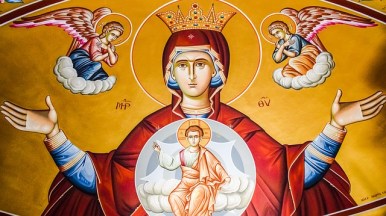 The first reading closes with this exhortation from St. Paul: Rejoice with those who rejoice, weep with those who weep. Have the same regard for one another; do not be haughty but associate with the lowly; do not be wise in your own estimation (Romans 12:15-16). What better or more fitting words are there to describe her whose very soul rejoices in God, her Savior? In the fullness of the grace bestowed on her as a singular gift of God and there visiting Elizabeth and pregnant with the Christ-child, Mary is the very answer to the question Nathanael would ask, “Can anything good come from Nazareth (John 1:46)?” Anything good, indeed! Only she, who by her fiat consented to bring the world Goodness itself; she, not wise in the world’s estimation yet wise enough to leave us with the best advice a mother could tell her children, Do whatever he tells you (John 2:5).
 Leaving Mass, the priest or deacon will say, “Go and announce the gospel of the Lord,” or “Go in peace, glorifying the Lord by your life.” This is our mandate, our call. We have each been given our own unique gifts, not meant only for ourselves. However we do it, our lives are to be a love song to Christ for the world. That our song may be rejected isn’t important. What matters to God is that we sang it for everyone to hear.
 Mark 10:45