
Memorial of Sts. Martha, Mary, and Lazarus (July 29)
1 John 4:7-16; Luke 10:38-42
In this section of the gospel according to Luke, Jesus teaches two important lessons. The first came in the form of the parable we know as “the Good Samaritan,” in which he showed us how God wants us to serve other people. Today we hear the second, where Jesus tells us how God wants us to serve Him.
The setting of course is not a parable, but the home of Martha and Mary. Put yourself in their place: Jesus is coming to your home. How do you prepare for that? I’m sure there are many things you would do, all with the best intention: To make your house the warmest and most welcoming place you can. And as for yourself, what will you do when he is your guest? Without doubt, you intend to serve him as well as possible.
How the two sisters prepared we cannot know, but we do know they served in very different ways. As for Mary, she chose to sit beside the Lord at his feet listening to him speak (Luke 10:39). Of all the disciples, only Mary is consistently found at the feet of Jesus: listening to him, weeping for him (John 11:32), and anointing him (John 12:3). This is why for centuries the Church has pointed to Mary of Bethany as a model of the contemplative life. It certainly nourished her faith; to this day, she is known as an evangelizer. John tells us that many people came to Mary after Jesus raised Lazarus from the dead (John 11:45).
Martha took a more active role, but her faith was certainly no less. To the contrary; John puts on her lips alone the greatest affirmation of faith found in his gospel: I have come to believe that you are the Messiah, the Son of God, the one who is coming into the world (John 11:27). Nevertheless, here in Luke, Martha is distracted, burdened with much serving (Luke 10:40). Should she have chosen not to serve? That’s not what our Lord implied in the parable of the Good Samaritan; there, he commended people who actively serve their neighbor for their faithfulness. Then why did Jesus rebuke her, who was serving him? Not for her actions, but for her state of mind; Martha allowed her focus to shift away from him and onto her sister.
It happens that, as people engage in some activity, they grow accustomed to it, and their minds begin to wander. Think about your prayer life; particularly, the prayers you say most often. Have you ever suddenly realized that your mind is a million miles away from the words your mouth is saying, even at Mass? As I said, it’s only natural, but that doesn’t mean unavoidable; it’s also natural to be vigilant. You know very well that when something is of vital importance to you, you’ll shake off any distraction to stay focused. What made Mary so noteworthy wasn’t where she sat herself, but where she put her mind: Fully on Christ, and everything he had to say. Had her thoughts been drifting somewhere else, she too would have been gently brought back to reality by Christ.
It also happens sometimes that we serve others with mixed motives. Ask yourself if, while working in a parish ministry, you ever found yourself a little too concerned about whether people noticed or praised you, or got a little jealous when someone else was recognized and you weren’t. Again, it’s natural to want to be the center of attention now and then, to be recognized by others for what we’ve done. But, again, the issue is focus; the center of attention is God, not ourselves, and the standard of comparison is not other people, it is Jesus Christ. Who was ever more servant than he, yet when did he ever seek the limelight or care what anyone else thought? The gospels are clear that he had one goal: Doing his Father’s will. The same for Martha, the same for us; regardless what other people think or do, our goal first, last, and always, is to see and serve Christ, and thus show our love for God and our determination to do his will.
So, today, let us take these lessons to heart. In a few moments, the Lord will be our guest in Holy Communion. The whole point of our time here is to prepare ourselves for that, to make our souls His most welcome home. We can only do that to the degree that we keep our eyes fixed on Christ, so to do what John urged us in the first reading when he said: Whoever acknowledges that Jesus is the Son of God, God remains in him and he in God (1 John 4:15).
Sts. Lazarus, Martha, and Mary, pray for us.

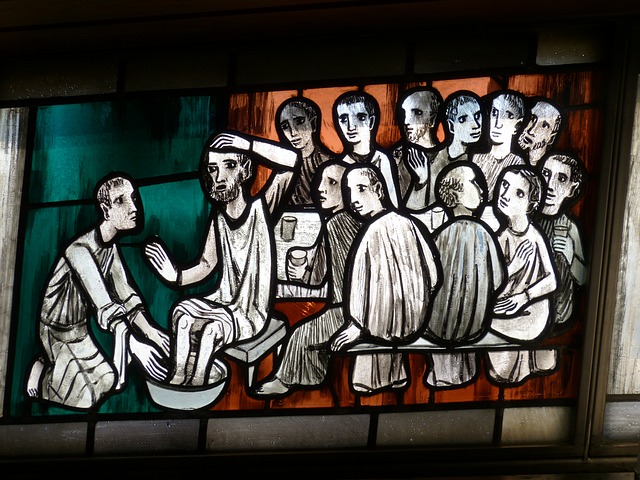 By showing Jesus washing the feet of his disciples, the evangelist re-emphasizes the primacy of service. Those who would be greatest must become the least. This is the humility and love behind the gift of his life poured out for our sake, by which he becomes one with us and we become one with each other.
 Mark 10:45