Tag: sacred heart

  • All Things to One Man: The Solemnity of the Sacred Heart of Jesus

    All Things to One Man: The Solemnity of the Sacred Heart of Jesus

    Hosea 11:1, 3-4, 8c-9; Ephesians 3:8-12, 14-19; John 19:31-37

    In high school we once did an exercise on self-perception. Sister began by asking us to take out a sheet of paper and write down 3 negative things about ourselves. After a couple of minutes she said, “Alright, now write down 3 positive things about yourself.” I can’t remember what I wrote but I know I didn’t list three; I’m not sure I even wrote two. That was Sister’s point; self-conscious teen-agers aside, people in general tend to be very good when it comes to focusing on their negative qualities but not so good when it comes to the positive.

    The same goes for our relationship with God. If you’re anything like me, it’s probably much easier to come up with reasons why He shouldn’t think very highly of you than reasons why He should. Today, on the Solemnity of the Most Sacred Heart of Jesus, our Lord gives us at least three reasons to focus on the positive.

    First, listen again to his words in the 11th chapter of Hosea: When Israel was a child I loved him… I taught Ephraim to walk… took them in my arms… fostered them like one who raises an infant to his cheeks… stooped to feed my child… I will not let the flames consume you (Hosea 11:1, 3-4, 8-9). This isn’t the imagery of a God who loves from a distance, impersonally, or until we leave or hurt him; no, this is a God who loves intimately, with a deeply personal, boundless, and most of all, healing and merciful love.

    Second, as St. Paul makes clear, this is a love that goes beyond all words except the one, Eternal Word – Jesus. We can hear Paul struggling to express the inexpressible as he prays that we may have the strength to comprehend with all the holy ones what is the breadth and length and height and depth, and to know the love of Christ which surpasses knowledge (Ephesians 3:18-19). This is the key; divine love surpasses human knowledge and can be known only by faith (Ephesians 3:17), the gift of the Father possible only by the strength that comes from the Holy Spirit (CCC §683). To those who have faith, all the riches of grace are available.

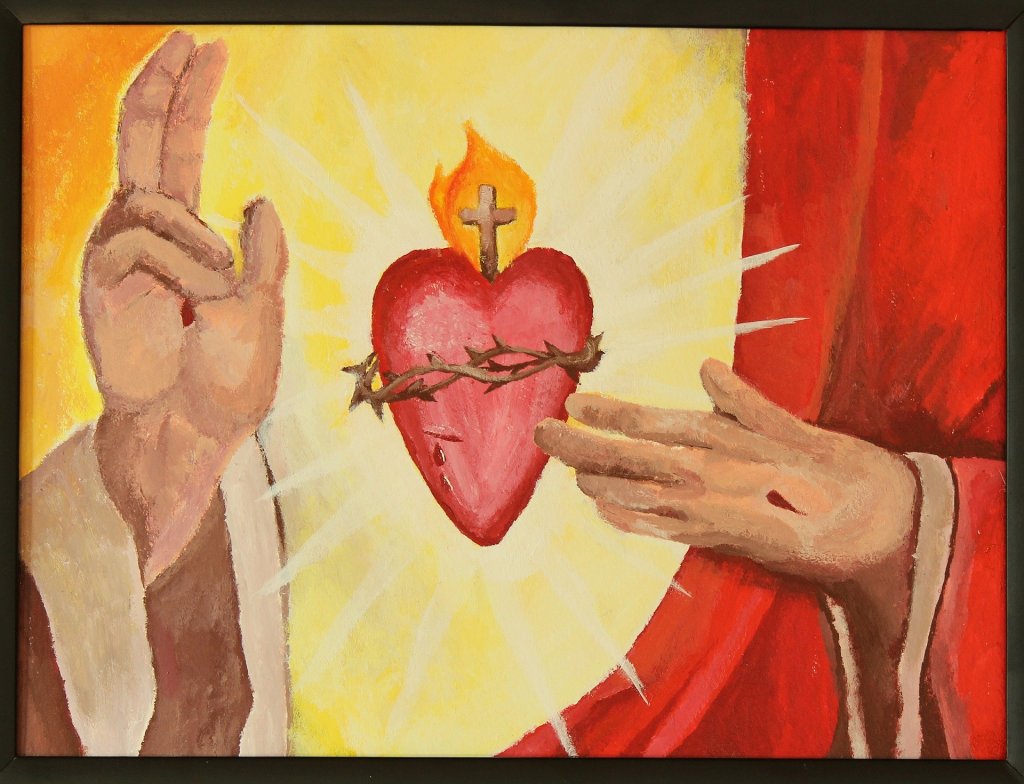
    Finally, every image of the Sacred Heart reminds us with its crown of thorns of the cost of this love. We hear in the gospel of the soldier who thrust his lance into his side, and immediately blood and water flowed out (John 19:34). There is no love worthy of the name that is not asked to endure insult, temptation, and suffering. From the dawn of humankind it is written into our nature; it’s in our blood. But it isn’t in the blood of Christ, either from his Heavenly Father or his holy Mother, the Immaculate Conception. He willingly took it on. This is perhaps the greatest and most positive of all – that God, purely out of his infinite and merciful love for us, gave his only Son that we would be raised to life eternal. As Christ himself said, there is no greater love than this.

    St. Pio of Pietrelcina, Padre Pio, understood that very well. While passing through a crowd of people all clamoring to get near him, someone shouted, “Padre, you are all things to all men!” He replied, “No, I am all things to one Man.”

    May we all come to that kind of understanding! May we all see the Solemnity of the Sacred Heart of Jesus as a day to set aside the negatives and focus on the overwhelming positive – that we too are all things to one Man. We are loved infinitely, personally, and mercifully; we are given the gift of faith which alone can make this love known to us beyond any human understanding; and finally, that as the ultimate expression of this love the Second Person of the Blessed Trinity took human form and allowed his own heart to be pierced that we may not only look upon him in mourning for the sinfulness that put him there but with rejoicing that divine love can take even the passion and death of Christ, the greatest insult of all time, and transform it into the greatest victory the world will ever know – the resurrection to eternal life for all who believe and return to God with their whole heart (Joel 2:12).

    Sacred Heart of Jesus, have mercy on us.

  • Mercy and Forgiveness: Monday of the 2nd Week of Lent

    Mercy and Forgiveness: Monday of the 2nd Week of Lent

    Daniel 9:4b-10; Luke 6:36-38

    The readings today evoke two images of Pope St. John Paul II in my mind.

    The first is of a trip the pope made on April 13th, 1986. Although very short – less than two miles from the Vatican – its impact was as great as any pastoral visit he would ever make. For on that day the Holy Father bridged a gap that was centuries wide, doing what no pope since St. Peter had ever done: entering a Jewish synagogue. In fact, he entered Rome’s Great Synagogue and, while 1000 Jews watched and wept, warmly embraced the Rabbi, then publicly and sincerely apologized to all Jews on behalf of the Church for whatever part she played in the centuries of discrimination and persecution the Jewish people had suffered.

    We naturally tend to focus guilt on ourselves as individuals but the pope reminded us that, as the reading from Daniel implies, sin is sometimes a matter of “we,” and not just “I.” In his Apostolic Exhortation “Reconciliation and Penance” John Paul II referred to this as social sin – sins committed by groups as small as a few people or as large as many nations. His point was that each member bears some share of responsibility for what the group does or fails to do. As he wrote, social sins are the “very personal sins of those who cause or support evil or who exploit it… who are in a position to avoid, eliminate or at least limit certain social evils but who fail to do so out of laziness, fear or the conspiracy of silence, through secret complicity or indifference… who take refuge in the supposed impossibility of changing the world and… sidestep the effort and sacrifice required….”1

    Therefore, it is our moral duty as Catholics to examine ourselves in light of the behavior of the groups in which we participate in our parish, Church, community, nation, and world, and to speak and act against these behaviors when necessary.

    The second image of St. John Paul is in the prison cell of his would-be assassin, the man who shot him several times on May 13th, 1981. Although the pope publicly forgave him four days later, in 1983 he visited the prison and personally did so again. Later, John Paul appealed to the Italian government to release him, which they did. Eventually the man converted to Catholicism, citing the pope’s influence.

    In the gospel, Luke does not put on our Lord’s lips the words Matthew used: Be perfect, just as your heavenly Father is perfect (Matthew 5:48). Instead, the Jesus of Luke says, Be merciful, just as your Father is merciful (Luke 6:36). Here, “merciful” could also be translated “compassionate,” and there are few examples of mercy or compassion better than the Holy Father’s actions. And look at the effect! The transformation of a man from one who would kill the Vicar of Christ into one who would rather die for love of Christ.

    The power to look within and see the personal and social sin as well as the capacity to show mercy comes as the free gift of our Lord to all who are willing to ask forgiveness of those we have wounded and offer it to those who have wounded us. This is the transformative power of the heart of Christ, as St. John Paul reminded us when he said, “I invite you all to join me in turning to Christ’s heart, the eloquent sign of the divine mercy, the “propitiation for our sins,” “our peace and reconciliation,” that we may draw from it an interior encouragement to hate sin and to be converted to God, and find in it the divine kindness which lovingly responds to human repentance.”

    Sacred Heart of Christ, have mercy on us.

    St. John Paul II, pray for us.

    1http://www.vatican.va/content/john-paul-ii/en/apost_exhortations/documents/hf_jp-ii_exh_02121984_reconciliatio-et-paenitentia.html

  • The Heart of the Matter: The 4th Sunday in Ordinary Time, Cycle B

    The Heart of the Matter: The 4th Sunday in Ordinary Time, Cycle B

    Deuteronomy 18:15-20; Psalm 95:8-9; Mark 1:21-28

    When you ask people about their favorite schoolteacher and what it was that made them so great, the answer often has less to do with what they taught than the kind of person they were. They cared about us, were compassionate to us, interested in us, challenged us, and so on. Whatever their qualities, the effect was the same – that teacher inspired us. They taught us much more than how to excel in a subject; through them we learned more about ourselves and how to make a difference in the world.

    Good teachers touch our heart, bad ones make us heartsick; they get reactions. So it was with Christ, the teacher. Last week, Mark told us of our Lord’s first class: He called people to repent, to turn their minds and hearts around. We then witnessed his mysterious, charismatic ability to draw people to himself, namely the first 4 disciples, just by asking them to follow him. It was a week full of dramatic moments and powerful, positive reactions.

    This week the drama continues but as we hear of Christ teaching in the synagogue, we see a totally different reaction. Twice Mark says that the people were astonished. While that might not seem much different, the original Greek word connotes fear; this is not a positive reaction as much as one full of anxiety and foreboding. We can feel the fear in the words of the demoniac: What have you to do with us, Jesus of Nazareth? Have you come to destroy us? I know who you are – the Holy One of God (Mark 1:24)!

    What do they fear? Is it what Moses spoke of in the first reading? Are they struck with fear at the presence of the Lord, like their ancient ancestors? Perhaps; Mark says they sensed his authority, and the demoniac certainly knew that Jesus was no ordinary rabbi. But I think a clue to another reason lies in today’s Psalm response: If today you hear his voice, harden not your hearts (Psalm 95:8f). The term “harden our hearts” essentially means “close our minds.” The person with the hardened heart hears God but does not listen, only wants certain things from God, says the right words but does little or nothing, and may even have stopped feeling the guilt of their own sin.

    Imagine the consternation inside such a person when confronted with Christ, the caring, compassionate teacher who challenges people, moves their hearts, draws them to himself, and inspires in them a longing for more. They can’t help but feel powerfully attracted to his message yet at the same time afraid of what that attraction will cost.

    So then, we come to the heart of the matter. Is the psalm talking about us? Are our hearts hardened? How do we know? Reflect again on a few of the symptoms:

    • Refusal to listen to God. Listening is not hearing; it comes from the Latin word meaning “to obey.” Do I hear but fail to obey what God tells me in Scripture and through the authority he has given his Church? Or, do I rely on my own authority?
    • Only want certain things from God. When I take an honest look at my prayer life, do I tend to talk to God more about what he can do for me than how I can conform my will to his?
    • Say the right words but do little or nothing. Have I said I would change, take full advantage of opportunities given me to do so, but then done little or nothing?
    • No longer bothered by sin. Have I persisted in sin so long now that it no longer bothers me at all?

    Every “yes” to these questions is as if we are saying to Christ, “What have you to do with me, Jesus of Nazareth?” We fear that he has come to destroy us, to condemn us to hell. He has that power; he is the Holy One of God! The longer we live this way, the more ingrained this fear becomes. We know things must change before the great reckoning, but we are so tempted to avoid it; that kind of change is going to hurt.

    We cannot allow fear to deafen us to the call of Christ, the infinitely compassionate teacher. Note his first word to the demoniac: Quiet. He knows that demons love noise and distraction, and we do, too. But he also knows that only in silence can we hear him and only in hearing resolve to obey his voice urging us to face ourselves as we are. It can be a painful moment but in it lies openness; that weakness that pleads for the strength of Christ. First, utter the simplest prayer – one word, the Name above all names: Jesus. As St. John of the Cross said, from all eternity the Father spoke only one word – the Eternal Word – Jesus, and he has no more to say. If that’s enough for God, it’s enough for us. Next, include a request: “Open my heart.” This is the gift of docility, a teachable spirit. No teacher, not even God, can move us if we resolve to keep our minds closed. With docility comes that inner clarity through which we see that Christ has come not to destroy us, but the sinfulness that has hardened our hearts. Finally, ask for mercy. This goes right to Sacred Heart of Christ.

    Do this often. It isn’t an overnight process; change of heart takes time. That’s OK; Jesus is a patient teacher and we have the rest of our lives to work on it. It is true that we know neither the day nor the hour of the “final exam” but we do know that unlike earthly teachers, Christ’s goal is not to touch our heart but to transform it; not to see that we excel in a subject but to see that we are the subject. Above all, he gives us his own Sacred Heart as the model of what a heart should be, one whose faith overcomes all fear, that can behold him and truly say, I know who you are – the Holy One of God!

  • The Things We Bring to Heaven: Friday of the 18th Week of Ordinary Time

    For whoever wishes to save his life will lose it,
    but whoever loses his life for my sake will find it.

    Matthew 16:25

    This saying of Jesus appears to be a paradox. How can we lose our life by saving it or save our life by losing it? Like any paradox, if we take the words at face value we can’t. However, if we look below the surface we find a nuance hidden, lost in translation, from which a deeper meaning emerges.

    As far as we know, the original language of the New Testament is Greek and in Greek, the verb used by Matthew for “save” really means “to keep safe.” Thus, Jesus is counseling us not to keep safe; that is, to risk being hurt, for only when we do that can we enjoy eternal life with God in heaven.

    Although that might help us understand the paradox, it doesn’t make things any easier. It seems as if Jesus is teaching that the way to avoid suffering in the afterlife is to endure suffering in this life. That seems cruel! Does Jesus really want us to suffer?

    Perhaps it’s best to answer that question by remembering that God is Love, that we are made in the image of God, and that no one modeled that image better than Jesus, his only Son. By his Incarnation Jesus taught that true love seeks neither isolation nor safety but entanglement and risk. God could have chosen to save fallen humanity from the safety of pure divinity. He didn’t; he chose to dwell among us, to take on the nature he created and raise it from within; to bind himself to the human condition beyond any untying and restore it to its original capacity for the deepest love possible: Eternal union with him.

    jesus-1844445_640Jesus spent his life and ministry showing us what it means to love as God loves: He made himself vulnerable in the sight of others, exposed his deepest longings, deepest fears, deepest joys, his deepest self. Of course, he risked rejection and it cost him his life, but that is what love does; it was in the nature of his perfect divinity that from the depths of his infinite love and mercy, he glorified what mankind so quickly crucified.

    This tells us that Jesus doesn’t want us to suffer, he wants us to love; by its very nature, love risks suffering and will endure it for the sake of the beloved. Of course we are free to refuse, but refusing to love means that we give nothing, share nothing, resist the promptings of the Holy Spirit, and remain isolated even from God himself. Some may call that safety but Christ calls it loss, for he knows that the only thing we bring to heaven is the love that we have given away.