John 12:1-8
Awhile after my father died, my mother asked if I would help her sort out his things. As I took some clothes out of his dresser it struck me; they still smelled like him. It was as if my father was right there. It took me several minutes to regain my composure.
Scientists have known for years that the sense of smell is intimately tied to memory and emotion. In fact, smell is the only sense that works directly with the area of the brain that controls emotions. We’ve all experienced it; no matter how far away or far removed we are from a certain time, the aroma of something – perhaps a certain food, a perfume – can bring it all back again. It is if we are there.
In the gospel we see how one of the sisters of Lazarus gave to their home a sense memory of our Lord: Mary took a liter of costly perfumed oil made from genuine aromatic nard and anointed the feet of Jesus and dried them with her hair; the house was filled with the fragrance of the oil (John 12:3).
This is significant on many levels. First, it is the perfect counterbalance to the family’s recent experience at the tomb of Lazarus; the foul air of death is literally blown away by the fragrance of new life found in Christ. But second, this perfume is costly; the price of victory is high. As if she senses that his enemies are as near as Judas and plotting his demise, Mary anoints not the head of Christ the King but the feet of Christ the Servant which shall soon be pierced with nails and placed in a tomb. Finally, it may seem odd that Mary wipes away some of the perfume with her hair but I see in it a sign of her devotion; a way to identify herself with Christ and his sacrifice, personifying St. Paul’s meaning in 2 Corinthians when he said, we are a fragrance of Christ to God among those who are being saved and among those who are perishing (2 Corinthians 2:15).
 There is an ancient rabbinic saying that “the fragrance of a good perfume spreads from the bedroom to the dining room; so does a good name spread from one end of the world to the other.”1 As Mary filled her house and her hair with the fragrance of Christ, so may we fill the world and ourselves with his holy and glorious Name. And may be as untiring and devoted as she, willing to sacrifice whatever is costly to ourselves to do it. There is no greater identification with Christ than this, as St. Paul knew when he prayed that we may be imitators of God, as beloved children; and walk in love, just as Christ also loved you and gave Himself up for us, an offering and a sacrifice to God as a fragrant aroma (Ephesians 5:1-2).
1Based on Ecclesiastes 7:1 and cited in Brown, R.E. (1966) The Anchor Bible: The Gospel According to John I-XII. New York: Doubleday & Company, Inc., p. 453.
 When we think of the dragon we think of the Devil and it is right to do so, for Scripture does refer to him that way (Revelation 12, for example). There is no doubt that the dragon is the Enemy but there is also no doubt that too often the dragon looks back from our own mirror. Worse yet, the victim does too; we allow sinfulness such a hold over us that in effect we devour ourselves, relent to the darker angels of our nature.
 It’s tempting to dismiss all this as foolishness but remember what St. Paul says: If any one among you considers himself wise in this age, let him become a fool so as to become wise (1 Corinthians 3:18). It may be wisdom in the eyes of the world to hate those who have hurt us and foolishness to forgive them but in Christ’s world it’s just the opposite; his is the world where hatred keeps us bound and love frees us, where judgment takes a back seat to mercy, and where God alone sees the heart, knows the pain, calms the fear, heals the wounds, and breaks the chains.
 The great gift of fertility given to Samson’s mother and to Elizabeth are confirmation that perseverance is rewarded. God sees all of us who endure desolation and, in his own time and manner, provides from the storehouse of his infinite mercy the life-giving consolation of his Spirit. When we find ourselves in times of desolation remember to ask the intercession of St. Elizabeth; she understands very well not only the pain of endless waiting but also the indescribable joy of the Holy Spirit’s three priceless consolations: The new life of St. John within her womb; the love and help of Mary, the Mother of Hope; and most of all the fulfillment of Hope itself: Our Lord and Savior, Jesus Christ.
 Eventually, Father was caught, imprisoned on a false charge and on the morning of November 23
 The two themes of fidelity and love are interwoven in the feast of the Presentation of the Blessed Virgin Mary. The presentation of oneself to God is an act of great faith and deep love. Whether Mary demonstrated her faith and love in a formal consecration to God in the Temple as described in the ancient non-biblical documents is irrelevant. Every day of Mary’s life was a presentation, a self-offering, an abandonment to the divine will made possible by the movement of grace within her. Long before he dwelled within her womb, indeed from the moment of her immaculate conception, our Lord dwelled within her soul and bestowed upon it the fullness of grace, his very life. By her response to that grace, Mary most truly defines what it means to be a Temple of the Holy Spirit.
 Persistence in prayer does not test God’s patience or change his mind; rather, it tests our faith and changes our attitude. Through his life and the Scriptures he has given the world, Jesus has told us that God loves each of us with a love beyond our understanding and knows our needs before we ask. That being so, God wants our prayer to consistently express the trust we have in him and his providence; that is the faith that Christ wants to find upon his return.
 No wonder. Internet scans, scrolls, and searches cannot bring the wisdom we need. As the first reading tells us, Wisdom is a spirit… Firm, secure, tranquil, all-powerful, all-seeing… the spotless mirror of the power of God, the image of his goodness (Wisdom 7:22, 23, 26). Wisdom is Christ, and his gift to us is wisdom as the fruit of the Spirit. A fruit born of the love of God, wisdom desires not only to be one with God but to see things as God sees them. Like any fruit, wisdom takes time to mature; its development a function of our life experience as seen through the lens of long-suffering that strengthens us to finish what we start, docility to listen as God speaks, and humility to remember that we are servants of God and each other.
 We who have inherited this faith must never forget these two lessons from the readings: First, the worth of the human body was not, is not, and never will be ours to decide. God has given us freedom, so we can define and re-define who is and who is not worthy to live, but in the end these are just words; our laws
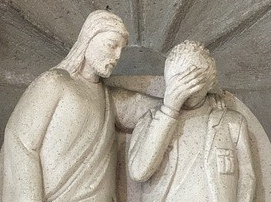 The psalmist today sings Save me O Lord in your mercy (Psalm 109:26). The readings are God’s answer to that prayer. In his infinite love and mercy he assures us that no matter how hypocritical we are, how much a Pharisee, or how much we deserve it, we are never alone. God is always true to his word and today his word is that there is nothing – neither death, nor life, nor angels, nor principalities, nor present things, nor future things, nor powers, nor height, nor depth, nor any other creature – that can separate us from the love of Jesus Christ our Lord (Romans 8:38-39).
 Mark 10:45