Tag: pope

  • How Lows Become Highs: Memorial of Pope St. Martin I, Martyr

    How Lows Become Highs: Memorial of Pope St. Martin I, Martyr

    2 Timothy 2:8-13; 3:10-12

    In C.S. Lewis’s brilliant work The Screwtape Letters, the senior devil (Screwtape) teaches his apprentice what he calls the “Law of Undulation.” In a nutshell, this is the idea that people experience highs and lows in their relationship with God. The “highs” are those peak times when we feel especially close to God, while the “lows,” are the times when we feel dry, uninspired, and God seems far away. The “wise” demon waits out the highs and strikes during the lows.

    Of course, the genius of this is that we can all relate to it. Think back on times, perhaps a Mass or contemplative moment, when you felt a spiritual high. It felt as if God was all around you; a time of almost indescribable joy. Then think of those other times, the lows; you felt alone, your prayers dry, your faith stagnant.

    In a sense, this is part of what it means to be human. In friendship, marriage, and work, there are times we feel close to people or the job and times we don’t. It’s only natural that in our relationship with God we would experience the same thing. But as Lewis notes, sometimes those with evil intent manipulate this law to drive us away from God.

    Such was the case with Pope Martin I. His reign came at a tumultuous time; it was the 7th century, and for over 600 years people had struggled to understand the persons and natures of Christ. Was he only human? Only divine? A mixture? Did he have a human will, a divine will, or both? There were as many opinions as there were people.

    Then as now, some opinions mattered more than others, especially when it was the opinion of the highest civil power – the Emperor. Unfortunately, his opinion was heretical. Like many inside the Church, he believed that Jesus did not have a human will, or that if he did it was completely absorbed into his divine will like a drop of water in the ocean. Pope Martin disagreed, publicly and in council, holding the Church to the truth we profess to this day, that Christ had both a human and a divine will.

    Angered, the Emperor had the pope hauled to Constantinople and ordered to endorse the “official” position or face a charge of treason. When Martin refused to obey, he was imprisoned and starved for several weeks. Again he was ordered to obey, and again he refused. When it became clear that the pope would never agree, he was sentenced to death for treason. Stripped of most of his clothing, he was mercilessly whipped, then dragged in chains through the streets. The abuse he suffered was so horrific that even the residents of Constantinople, accustomed to violence, were disgusted. Eventually the sentence was commuted and Martin was exiled, where he was neglected and starved.

    When we think of the Holy Father’s situation, it seems ripe for the kind of spiritual low that demons would relish: Cut off from his flock; in prison; in chains; beaten; humiliated; vilified; starved; exiled; neglected. Who would blame him for turning inward, giving up, and spiraling down? Yet his letters written from prison and exile read like someone moving toward a spiritual high. The pope prayed not for himself but for his flock, especially the heretics, that they would repent and return to the one true faith. When he did write of himself, it wasn’t to bemoan his own suffering but to glorify God in it; he spoke of his abandonment to the will and mercy of God, and his hope that Christ would come soon to bring him home. Finally, after two years, Martin was delivered from the starvation and neglect of exile. He is the last pope (to date) to die a martyr.

    In the first reading St. Paul wrote to Timothy, If we have died with him we shall also live with him; if we persevere we shall also reign with him (2 Timothy 11-12). This reminds us not only of the glorious destiny of Pope St. Martin I, but of the need for us to pray for and practice the virtues of fortitude and perseverance. Both the spiritual highs and lows are gifts from God that are meant to be used. Although we want to hold onto the highs and treasure them, they provide the grace we need to look beyond ourselves and see how we might strengthen others, and to look within ourselves to see where we need strength, where God is working in our lives, and where he may be calling us. And if God feeds our virtues in the highs, he tests them in our lows. But again, as St. Martin shows, we don’t run from those times; rather, we persevere through them by focusing not on ourselves but on others and not by complaining about our suffering but by uniting it to the suffering of Christ for the sake of his body, the Church. To paraphrase St. Martin, throughout the highs and lows, remember that Christ is at hand, and hope in His mercy.

    Pope St. Martin I, pray for us.

  • The Leader as Servant: Feast of Pope St. Gregory the Great

    The Leader as Servant: Feast of Pope St. Gregory the Great

    2 Corinthians 4:1-2, 5-7; Luke 22:24-30

    In the gospel we hear Jesus say to the Apostles, let the greatest among you be as the youngest, and the leader as the servant. Few people epitomize those words better than the successor of the Apostles we remember today, Pope St. Gregory I.

    Born around the year 540 into a wealthy, aristocratic Roman family, Gregory received the best education of the day, designed to form him as an effective political and social leader. He was also deeply grounded in the faith; indeed, his family tree boasted two popes, several consecrated religious, and at least one saint: his mother, Sylvia. If not born great, Gregory was certainly bred for greatness.

    Greatness was certainly needed, for Rome was in dire straits. No longer the capital of the empire, it was barely guarded; vandals regularly overran it. Plague, war, and famine decimated the population from a high of one million to about fifty thousand. Although Gregory wanted nothing more than to pursue his dream of life as a Benedictine monk, his sense of public service prevailed; at the age of 30 he became mayor and served for two years. When his father died Gregory resigned, turned the family palace into a monastery, and became a monk. He called these the happiest years of his life.

    They didn’t last long. Knowing of Gregory’s talent, Pope Pelagius summoned him, ordained him a deacon, briefly put him in charge of social assistance to Rome and then sent him to Constantinople, where for 6 years he served as ambassador, learning the workings of the imperial court. When he returned to Rome he was delighted to learn that he had been made abbot; however, that too didn’t last long; when Pope Pelagius died, Gregory was unanimously elected pope. He appealed to the emperor to reject the election but he refused. Against his will, Gregory served as pope for 14 years.

    It is difficult to summarize briefly everything Gregory did to merit the title “Great,” but let me focus on two particular areas.

    First was his great love of the missions. Gregory was the first pope to send missionaries to a distant land, dispatching 40 monks to England led by the man who would become St. Augustine of Canterbury. No less important was his acumen and sense of balance; Gregory advised Augustine to bring Christ in His fullness to the Anglo-Saxons but at the same time to adapt the faith where he could to the customs and ways of the people. This bore great fruit; the subsequent centuries saw England and Ireland send out missionaries of their own whose evangelization forever changed the face of Europe. But Gregory’s care and concern for the missions didn’t stop there. Hundreds of his letters still remain, and reveal the pope’s involvement in and knowledge of the missions in places as far away as Africa, Spain and Greece.

    Second, Gregory was a great shepherd to his local flock. For bishops he wrote a book called Pastoral Care, really a treatise on preaching that became popular for centuries, as well as a book on St. Benedict. His own homilies are read to this day; in fact, it is for them that he was made Doctor of the Church. He also transformed Rome into a real diocese, organized under a bishop and seven regional deacons assisted by seven sub-deacons. Using this structure, Gregory systematized outreach to the poor, orphans, and widows. Charity burned so greatly within this man that for years he fed Rome’s poor with money out of his own pocket.

    That’s not to say that the pope never used Church money. To the contrary, he used it whenever he could but did so to protect Rome from invaders. He was a good diplomat and a brilliant negotiator, doing whatever he could to keep the people safe, whether that meant paying imperial troops or bribing vandals to keep away. He was so effective that eventually the city put him in complete charge of the military.

    We could say much more but let us close with St. Paul’s words: God who said, ‘Let light shine out of darkness,’ has shone in our hearts to bring to light the knowledge of the glory of God on the face of Jesus Christ (2 Corinthians 4:6). Pope St. Gregory was the lamp God set on Vatican Hill to shine in a very dark time and that light still shines today. In summary and in essence, Gregory’s greatness is the man himself. From him we learn these life lessons: First, we must be aware not only of our power and ability but also our weakness and fragility; this teaches us humility. Second, no matter how much we know or plan, not all decisions or circumstances will work out in our favor; this teaches us patience, perseverance, and fortitude. Finally, although we may want a certain life for ourselves, the love of Christ impels us to put that aside for the greater good of service to God and the world in which we find ourselves. From this we learn the greatest gift of all: Charity. In the end Gregory teaches us that those who are most truly leader most truly serve.

    Pope St. Gregory the Great, pray for us.

  • What’s In A Name? Feast of Saints Michael, Gabriel, and Raphael, Archangels

    Revelation 12:7-12ab; John 1:47-51

    It is said that one morning, perhaps in the year 1884, once Pope Leo XIII had finished saying Mass and was leaving the altar, he suddenly stopped. According to witnesses, it was as if he was in a trance; he stood motionless for several minutes and his face turned ashen in color. When he regained his composure the Pope went to his office, asked to be left alone, and began writing. It took him only a short while to produce what became a new prayer to St. Michael the Archangel, which he ordered to be recited after all Low Masses everywhere.

    Only the Holy Father knows what he experienced during the vision; all we have is conjecture. Some say he heard Satan confronting Christ with threats to destroy the Church; others that he saw a terrible vision of dark angels attacking the Church. Whatever it was, Pope Leo left the chapel convinced that demonic forces were gathering and the next 100 years would be a great trial for the Church and the world. From our vantage point of history we see how right he was. The fingerprints of Satan are all over the 20th century: World wars, civil wars, weapons of mass destruction, bloodthirsty tyrants; millions upon millions of lost lives and, as if that isn’t enough, millions more killed in the wombs of their mothers.

    Thanks be to God who has not left us to battle such grave evil alone but has given us good and holy angels like the three whose feast we now celebrate.

    knight-3003641_640The Archangel Michael, whose name means Who is like unto God?, is the prince of angels. We read in Revelation why Holy Father Leo sought his intercession; it is Michael who leads the heavenly angels in the ultimate battle against Satan and his demons and teaches them why there are none like unto God. Apart from reciting the Pope’s prayer following Mass, let us also ask St. Michael’s intercession for all those who so often find themselves in harm’s way such as soldiers, first responders, and emergency workers. Let us also ask his intercession for ourselves during times of temptation as well as those who have fallen or are in danger of falling away from practice of the faith.

    The Archangel Gabriel, whose name means God is my strength, is the great messenger of Christ. In the book of Daniel he speaks of the coming Messiah; to Zechariah he announces the birth of John the Baptist, forerunner to the Messiah; above all, he is chosen to greet and announce to the Blessed Virgin Mary the great mystery of the Incarnation. Let us ask the intercession of Gabriel on behalf of all those who are charged to carry the message of salvation to others, and ask him to intercede for us, that we may more and more be effective messengers of the Messiah ourselves.

    Finally, there is the Archangel Raphael, whose name means God has healed. He appears in Scripture in only one place: the Old Testament book of Tobit. Full of Messianic undertones, the book tells of a loving father who sends his only son accompanied by a holy spirit (Raphael) to rescue a bride tormented by a demon. During their travels Raphael heals Tobit’s blindness; for this reason many who suffer with diseases of the eye ask his intercession. Let us also ask St. Raphael’s intercession for all those who are in any way blind, morally or spiritually, examining our own inner vision first.

    I am no Pope Leo XIII, but I suggest that we make a habit of praying to these powerful archangels. Something like this:

    St. Michael, Prince of Angels, protect me as I face the many dangers of this world;

    St. Gabriel, strengthen me that I may worthily proclaim Christ to others;

    St. Raphael, ask Our Lord to heal the blindness that keeps me from seeing His Face in everyone I meet.

    Heavenly Father, grant me the grace of the Apostles, that I too may see heaven opened and all the holy angels ascending and descending on the Son of Man: Your only Son, our Lord, Jesus Christ who reigns with You and the Holy Spirit, one God forever and ever. Amen.

    Sts. Michael, Gabriel, and Raphael, pray for us.

  • Conquer by Yielding: Monday of the 11th Week in Ordinary Time

    2 Corinthians 6:1-10; Matthew 5:38-42

    Centuries ago, the Vikings sailed their warships down from the north, onto the coasts and into the rivers of Europe. Although they didn’t discriminate much, one of their favorite targets was the Church. They quickly learned that her monasteries and buildings not only held great riches but were the homes of religious men and women who offered virtually no resistance at all.

    Eventually the Vikings tired of their pilgrimages south to plunder and decided to settle in Europe. The French bought them off by giving them a large tract of land known still as Normandy, named after the Norsemen. The first Normans were pagans and scoffed at the religious ways of the Europeans but over time their children and their children’s children, raised in those ways, became not only fierce warriors but also devout Catholics. In fact, at least one historian has referred to the Norman armies as the “Pope’s marines.”1 Not only that, but Normandy became a place of great monastic reform within the Church.

    It’s paradoxical but also one of the great strategies for ultimate victory in battle. It is ancient, known even to Ovid, the Roman poet of Christ’s time who wrote, “Yield to him who opposes you; by yielding you conquer.

    That is what Christ commands in today’s gospel. Conquer by yielding. Measure his words: offer no resistance to one who is evil. He does not advocate losing, giving in, or even passive resistance. He advocates no resistance at all. Offer the other cheek; give your cloak and your tunic; go two miles when asked for one; give when asked. An adversary is powerless in the face of this. What difference does it make how hard a river wave strikes a reed if the reed bends at a mere ripple? One slender reed that bends renders the entire power of the river useless.

    There is pain in the bending. Jesus doesn’t say that yielding is easy or pain-free. In the first reading, St. Paul recounts the many ways it hurt him: afflictions, hardships, constraints, beatings, imprisonments, riots, labors, vigils, fasts (2 Corinthians 6:4-5). Not a path for the faint of heart. Yet consider the alternative; when fighting a vastly superior force, is resistance easier and a guarantee of victory? Indeed, just as we all know how trees that cannot bend in the wind will break, we’ve all felt the pain and futility of trying to conquer the worst enemy of all: our own will. Think how often our own resistance has been so easily overcome.

    Now consider what it means to yield to the superior forces of temptation and evil around us. It doesn’t mean to give in, for that would be losing. No, to yield is to have the humility to acknowledge that these forces are more powerful than I, so I must rely on the greatest power, the Holy Spirit. St. Paul also lists the benefits of that: purity, knowledge, patience, kindness, unfeigned love, truthful speech (2 Corinthians 6:6-7). These are the gentle, God-given strengths available to us; although they take time to cultivate and develop, even the largest boulder is smoothed and worn down over time by a gentle stream.

    viking-1114632_640It took a long time – generations – but the Church in Europe triumphed even over the seemingly invincible Vikings. I say “seemingly” for we who hear the words of Christ in the gospel know that in reality the Vikings never had a chance. All they had were swords, brute strength, and a fierce warrior spirit; what is that against the gentle, persistent, indomitable power of God? Through the ministers of the Church, the Spirit of God flowed over that mighty Norman rock and carved it into a force that would defend and promote the faith they once mocked for yielding so easily.
    The key to victory then and now is patient endurance. We may know it as the virtue of ‘long-suffering,’ and for this virtue we must constantly pray. Long-suffering requires tremendous strength but it is the strength born of hope, hope in that one great victory promised by Christ who, envisioning his own redemptive passion, death, and resurrection said through the evangelist John, In the world you will have trouble, but take courage, I have conquered the world (John 16:33).

    1 Crocker III, H.W. (2000). Triumph: The Power and the Glory of the Catholic Church. New York: Three Rivers Press, p. 160.

  • The Primacy of Service: Holy Thursday

    Today we read from John’s account of the last evening that Jesus spent with his disciples before his Passion and death. The other evangelists take this opportunity to provide us with the Institution Narrative, or the words spoken by Christ that to this day are repeated by the priest during the Consecration at holy Mass.

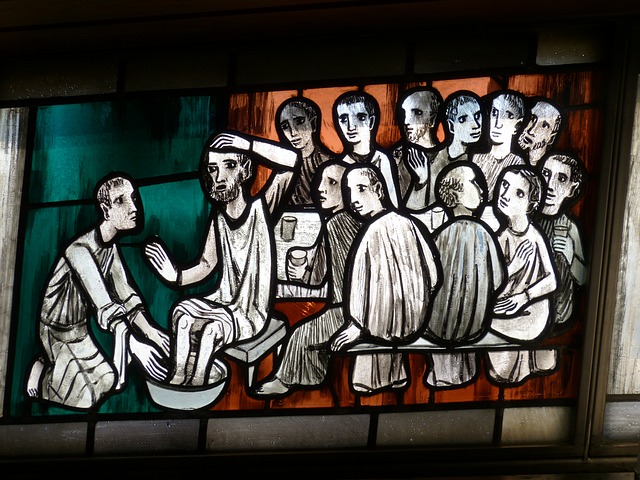
    John does not do this; rather, he uses the occasion of the Last Supper to depict Jesus washing the feet of his disciples and commanding them to do likewise. We don’t know why, but it’s possible that by the time the evangelist composed this gospel account the Breaking of the Bread had become an occasion for people to segregate into groups and eat and drink their fill, rather than to unite and commemorate the Passion, Death, and Resurrection of our Lord as one body.

    passion-3807312_640
    By showing Jesus washing the feet of his disciples, the evangelist re-emphasizes the primacy of service. Those who would be greatest must become the least. This is the humility and love behind the gift of his life poured out for our sake, by which he becomes one with us and we become one with each other.

    As we approach the Eucharist this evening let us take his words and his actions to heart, for together they show that love leads naturally to service. Christ has shown us the greatest love through the gift of his Body and Blood broken and poured out for our sake and at the same time that this is the love that allows us to see others not as things to be used but as people to be served.

  • Fragile Man

    Fragile Man

    Feast of the Chair of Saint Peter, Apostle

    1 Peter 5:1-4; Matthew 16:13-19

    • Pope St. Leo I, who singlehandedly faced down Attila the Hun, preventing him from sacking Rome, and who later spoke so eloquently about the person and nature of Christ that the bishops exclaimed, “Peter has spoken through Leo”;
    • Pope Nicholas II, who turned clerics into kingmakers;
    • Pope St. Gregory VII, who drove the German King Henry IV to his knees begging forgiveness after making him stand four days in the snow waiting for it;
    • Pope Julius II, the warrior pope known for his fierce temper or “terribilita,” yet whose great aesthetic sense drove him to commission Michelangelo, Raphael, and Bramante to create some of their greatest works; and
    • Pope Paul III, who excommunicated the King of England, Henry VIII, organized the Council of Trent against the Protestant Revolt, instituted seminaries to train priests, and founded the Roman Inquisition to enforce purity of doctrine.

    As we celebrate the Feast of the Chair of St. Peter, the Church gives us a selection from the first letter of Peter which tell us that those who tend the flock of Christ are to do so “willingly,” “eagerly,” and to “be examples.” As we look across the centuries, history shows that different popes have interpreted these words in very different ways. There have been forceful shepherds such as

    There have been more pastoral shepherds such as

    • Pope St. Gregory I, the first monk to be pope, such a deeply pastoral man that he saw himself as “the servant of the servants of God,” who took the care of his flock so seriously that he sold papal property to feed them;
    • Pope Innocent III, who approved the Franciscan and Dominican orders, greatly deepening the spiritual lives of the faithful for generations to come;
    • Pope Leo XIII, known as “the worker’s pope,” who laid the groundwork for Catholic social thought in the 20th and into the 21st century; and
    • Pope St. John XXIII, perhaps the most ecumenical pope in history, who called the Second Vatican Council, wrote an encyclical on world peace, and went out of his way to change the relationship of the Church to the world and to other religions.

    Of course, for every one of these shepherds we can name at least one whose pontificates were marred by scandals and abuses of every sort. And for every one of these, we can name perhaps a dozen more who passed through history almost completely unnoticed and who seem to have done nothing at all during their reign.

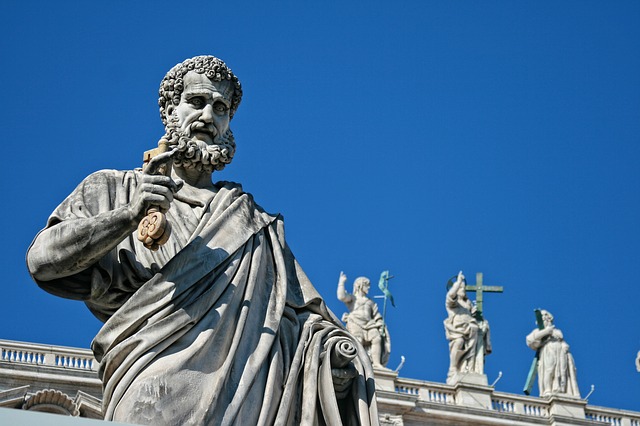
    Yet how like St. Peter they all are! Peter, who grudgingly re-cast his nets after catching nothing on his own, only to have Jesus fill them to the breaking point; who in one breath proclaimed Jesus as the Christ and in the next tried to talk him out of his destiny; who tested the reality of Christ’s presence on the water by walking on it himself and sank as the truth sank into him; who insisted that he would never deny Our Lord but did so three times; and who ran from the cross only to end his life on a cross of his own.

    And how well we know that St. Peter lies within each one of us. We let the Holy Spirit work within us, proclaiming Jesus as the Christ of God, yet at the same time allow the enemy to tempt us to lay down the cross Christ bids us carry. We challenge Christ to prove himself to us yet sink as he does so. We say that we would never deny him yet in fact deny him with every sin we commit.

    So as we look at every man who has ever sat on the Chair of Peter from the greatest to the least, we should see ourselves. Within each of us lies the strength and poetry of Leo I, the “terribilita” of Julius, the compassion of Gregory I, the resolve of Gregory VII, and the openness of John XXIII. The celebration of the Chair of St. Peter is at its heart a call to look within; to be as 1 Peter reminded us, shepherds in our own way, tending those around us with the care of the Shepherd who commissioned Peter himself, giving to fragile man the keys to the Kingdom of Heaven and best of all, who loved, forgave, and strengthened Peter as he loves, forgives, and strengthens us.